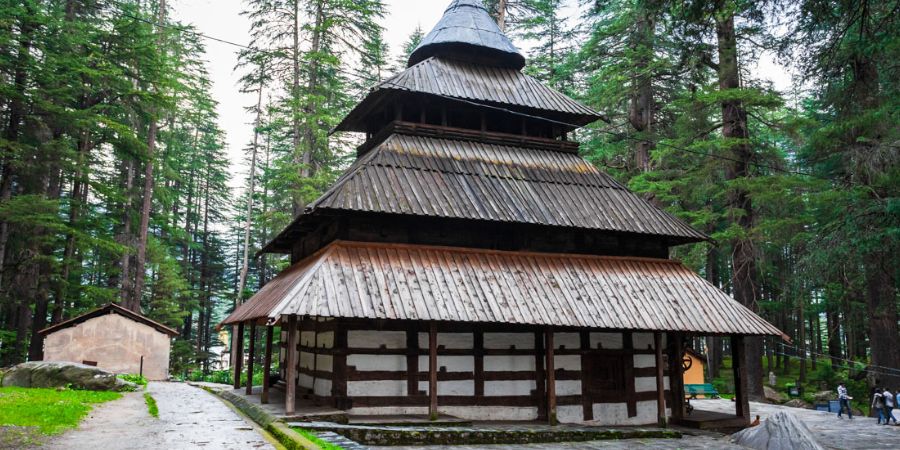


The Hadimba Devi Temple sits in the middle of a cedar forest on the outskirts of Manali, and reaching it requires walking past vendors selling roasted corn and woolen shawls, past rabbits in cages posed for tourist photographs, past the noise and hustle of a Himalayan hill station in full commercial bloom. Then the trees thicken, the crowd thins slightly, and a four-tiered wooden pagoda appears between the trunks like something that wandered out of the wrong century.
Built in 1553, the temple predates most of what passes for history in this part of Himachal Pradesh. It honors Hadimba, a demoness from the Mahabharata who married the Pandava prince Bhima — an unusual object of worship by any standard. The structure itself is stranger still: no idol inside, just a large rock formation on the cave floor, blackened by centuries of offerings. This is not a polished heritage site. It's a living shrine where the mythic and the mundane coexist with a casualness that can unsettle visitors expecting either reverence or ruin.
A Raja's Obsession and a Builder's Severed Hand
Raja Bahadur Singh of the Kullu kingdom commissioned the Hadimba Devi Temple in 1553, during a period when local rulers cemented their authority through acts of devotion as much as through military force. The site wasn't chosen arbitrarily. The cave beneath the temple had already served as a place of worship for centuries before any structure rose above it, and the rock inside — uncarved, formless — was treated as a manifestation of Hadimba herself. Bahadur Singh simply gave the devotion a roof.
The construction took a full year, an ambitious timeline given the complexity of the woodwork and the altitude of the site. The builder, according to local accounts passed down through generations in the Kullu Valley, was a craftsman of extraordinary skill whose name has not survived in any verifiable record. What has survived is a grim legend: upon completing the temple, Raja Bahadur Singh ordered the builder's right hand cut off to ensure he could never replicate the structure elsewhere. Whether this actually happened is impossible to confirm, but the story persists with remarkable consistency among locals, and it tells you something about how the temple was regarded from the moment it was finished — as singular, unrepeatable.
The temple's historical significance extends beyond its construction. It became the tutelary shrine of the Kullu royal family, and Hadimba was considered the presiding deity of the entire valley. Decisions of state, including declarations of war and the settling of disputes, were made with her blessings sought first. The Kullu Dussehra festival, which draws deities from across the valley to Kullu town each October, begins only after Hadimba's rath — her ceremonial palanquin — arrives.
This political weight is easy to miss if you visit the temple as a casual day-tripper. The building looks quaint, almost fairytale-like, surrounded by its forest. But for centuries it functioned as the spiritual and administrative nerve center of Kullu governance. The blackened cave floor, stained with centuries of sacrificial offerings, carries that weight in a way no informational plaque ever could.
The Demoness Who Chose Love Over Her Own Kind
Hadimba's story, as told in the Adi Parva of the Mahabharata, doesn't fit the sanitized mold of most temple origin myths. She was a rakshasi — a demoness — living in a forest with her brother Hidimba, who survived by killing and eating travelers. When the five Pandava brothers and their mother Kunti entered the forest during their exile, Hidimba sent his sister to lure them. She found Bhima, the second Pandava, sleeping under a tree. Instead of killing him, she fell in love. She shape-shifted into a beautiful woman and confessed her feelings. Bhima, characteristically, wasn't interested until his mother intervened.
What makes Hadimba's mythology compelling is its moral ambiguity. She betrayed her brother, who Bhima subsequently killed in combat. She married outside her species, gave birth to a son named Ghatotkacha — himself a fearsome warrior who would die in the Kurukshetra war — and was then abandoned when the Pandavas moved on. The Mahabharata gives her no triumphant conclusion. She simply returns to the forest.
Yet in the Kullu Valley, she's not pitied. She's revered as a goddess of immense power and benevolence. Local belief holds that Hadimba chose to remain in these forests permanently, protecting the valley and its people. The transformation from demoness to deity happened gradually through centuries of folk worship, layering the Sanskrit epic with Himalayan animist traditions that already venerated forest spirits and mountain energies. Her worship predates Hinduism's more codified temple culture in this region.
The counterintuitive dimension here is worth sitting with: a flesh-eating demoness who abandoned her own kin became the most beloved deity in an entire valley. Her shrine doesn't celebrate purity or transcendence. It celebrates a messy, violent, deeply human act of choosing love over loyalty. That the Kullu royals built their legitimacy around this figure says something about the valley's tolerance for complexity in its spiritual life — a tolerance you won't find acknowledged in most travel brochures.
A Pagoda Built from the Forest It Stands In
The Hadimba Devi Temple looks nothing like the stone shikhara temples that dominate North Indian religious architecture. Its four-tiered pagoda roof, covered in timber shingles, rises to a brass cone finial topped with a small trident. The style owes more to Himalayan vernacular building than to any canonical temple design, and the resemblance to Nepali and Tibetan pagoda structures is unmistakable. Deodar cedar — the dominant tree species in the surrounding forest — provides the primary construction material, and the building seems less placed in the forest than grown from it.
The most arresting feature is the carved wooden doorway. Its panels depict animals, deities, dancers, and scenes of devotion in a dense, interlocking arrangement that rewards slow examination. The carvings show folk artistic traditions rather than courtly refinement — the figures are animated, slightly rough, and packed with narrative energy. Some panels include images of animal sacrifice, a practice that continued at the temple for centuries and hasn't been entirely discontinued.
Inside, the temple is surprisingly small and dark. There is no sculpted idol. The object of worship is a natural rock formation on the cave floor, covered in offerings of flowers, vermillion, and ghee. The cave predates the wooden structure above it, and the contrast between the elaborate exterior and the raw, unadorned interior creates a strange dissonance — as if the building exists to honor something that refuses ornamentation.
The pagoda roof's layered construction serves a practical function beyond aesthetics. The steep angle sheds heavy winter snowfall efficiently, and the timber structure flexes under seismic stress better than stone would. This is architecture shaped by altitude and weather, not by religious prescription. A footprint measuring roughly twenty by fifteen feet makes the temple one of the smallest significant shrines in Himachal Pradesh, yet its vertical profile — the four ascending tiers pulling the eye upward through the deodar canopy — gives it a presence that defies its modest dimensions. The Archeological Survey of India now maintains the site, though the temple's active religious use sometimes sits uneasily with preservation protocols.
Blood, Butter, and the Persistence of Sacrifice
Worship at Hadimba Devi Temple follows patterns that would unsettle visitors accustomed to the vegetarian piety of mainstream Hindu shrines. Animal sacrifice — primarily goats — remains part of the ritual calendar, particularly during festivals and on specific auspicious days determined by the temple's hereditary priests. The practice has been curtailed by legal restrictions and shifting social attitudes, but it hasn't been erased. Blood offerings to Hadimba are ancient, consistent with her identity as a powerful being whose favor requires something more visceral than flowers and fruit.
Daily worship is modest by comparison. The temple's pujari performs morning and evening aarti, offering incense, ghee lamps, and prasad to the rock formation inside the cave. Devotees tie red and yellow threads to the wooden railings outside — each thread representing a prayer or vow. The accumulation of thousands of these faded threads gives the temple's exterior a textile quality, as if the building were slowly being wrapped in human need.
Local families visit regularly, not just for formal prayer but for practical counsel. The temple functions as an oracle site. During certain rituals, a medium — known locally as a gur — enters a trance state and channels Hadimba's voice, answering questions about illness, disputes, marriages, and agricultural decisions. This oracular tradition is common across Kullu Valley temples but surprises visitors who associate Hindu worship exclusively with darshan and recitation.
The temple's worship also incorporates elements that sit outside standard Hindu liturgy. Offerings of locally distilled liquor, for instance, appear during certain ceremonies — a practice rooted in the region's pre-Vedic spiritual traditions. Hadimba's worship blends Sanskritic Hinduism with animist mountain religion so seamlessly that distinguishing where one ends and the other begins is impossible. The pujari doesn't seem troubled by this ambiguity. He lights the lamp, feeds the rock, and lets the theology sort itself out. Visitors expecting a doctrinal experience should prepare instead for something older and less tidy.
When Hadimba Leaves Her Forest and the Valley Stops
The Kullu Dussehra festival, which begins on Vijayadashami — the day Dussehra ends everywhere else in India — is the most significant event connected to Hadimba Devi Temple. While the rest of the country packs away its Ramlila stages, Kullu's festival runs for seven full days. The entire affair cannot begin until Hadimba's rath arrives in Kullu town from Manali, a journey of roughly forty kilometers that the ceremonial palanquin makes accompanied by devotees, musicians, and other village deities carried on wooden palanquins of their own.
The procession is loud, chaotic, and intensely local. Brass instruments and drums create a wall of sound that bounces off the valley walls. Over two hundred deities from villages across the Kullu Valley converge on the Dhalpur Maidan in Kullu town, each carried by groups of men who sway and dance with the palanquins. Hadimba's arrival triggers the formal start of celebrations — a sequence that underscores her supremacy in the valley's divine hierarchy. Lord Raghunath, technically the presiding deity of Kullu since the seventeenth century, receives all visiting deities. But the festival's rhythm answers to Hadimba.
At the temple itself, smaller festivals mark seasonal transitions. The Dussehra preparations begin days in advance with special pujas and ritual cleaning. Spring brings a separate set of ceremonies tied to agricultural cycles — planting and harvest rhythms that predate organized religion in these mountains. During winter, when Manali empties of most tourists and snow buries the forest floor around the temple, worship continues with a stripped-down intensity. The pujari still lights the lamps. The incense still burns.
The festival calendar reveals something that casual visitors miss entirely: Hadimba Devi Temple isn't a monument or a photo stop. It's a node in a living network of valley deities who visit each other, compete for precedence, and negotiate their relationships through annual ritual gatherings. The temple's significance multiplies the moment you understand it as part of this system rather than as an isolated structure in a pretty forest.
The Yaks Don't Care About Your Instagram
The approach to Hadimba Devi Temple passes through what amounts to a small carnival. Yaks draped in colorful saddlecloths stand tethered to posts, their handlers offering rides or photo opportunities for negotiable fees — typically starting at a hundred rupees and settling at whatever patience allows. The yaks themselves are docile to the point of boredom, chewing quietly while tourists pose beside them in rented Himachali caps and shawls. Rabbits, often dyed improbable colors, sit in small cages nearby. The animal welfare dimension of this scene is uncomfortable and worth acknowledging.
Beyond the yaks, the path is lined with stalls selling everything from prayer beads to Maggi noodles. The commercial density increases during peak season — May through June and October — when Manali absorbs a daily influx of domestic tourists that strains the town's infrastructure to its edges. The forest around the temple absorbs some of this pressure; the deodar cedars create a buffer of relative calm even when the path below is packed.
Local experiences worth seeking out include the smaller, far less visited temple of Ghatotkacha — Hadimba's son — located a short walk uphill through the forest. It sees a fraction of the foot traffic and offers a quieter encounter with the same mythological lineage. The Van Vihar park, adjacent to the temple forest, provides flat walking paths along the Beas River and draws families who've had enough of uphill trudging.
The most honest local experience, though, might simply be sitting on the stone steps near the temple entrance during late afternoon, after the tour groups have departed for their hotels. The forest turns quiet. The deodar branches filter the remaining daylight into something greenish and dim. You can hear the temple bell when the pujari strikes it for the evening aarti — a single clear tone that travels through cold air with startling precision. That sound, more than any yak photo, is what the place actually offers.
What the Guidebooks Skip About Getting There and Staying Sane
The Hadimba Devi Temple sits roughly two kilometers from Manali's Mall Road, reachable on foot in about twenty minutes or by auto-rickshaw for around fifty to eighty rupees. The walk is uphill but manageable, and it passes through Old Manali's fringes before entering the deodar forest. Driving directly to the temple is possible, though parking during peak season transforms a spiritual visit into a logistical ordeal. Go on foot if your legs allow it.
Timing matters more than most visitors realize. The temple opens at 8:00 AM and closes by 6:00 PM in summer, with shorter winter hours. Arriving before 9:00 AM or after 4:00 PM avoids the densest crowds, which peak between 11:00 AM and 2:00 PM when tour buses disgorge their passengers in coordinated waves. The difference between a 9:00 AM visit and a noon visit isn't marginal — it's the difference between hearing birds in the forest canopy and hearing only other people.
Practical details worth noting:
- There is no entry fee for the temple, though donations are welcomed and a small box sits inside the shrine.
- Photography is permitted outside the temple but restricted inside the cave shrine — respect the pujari's guidance on this.
- Shoes must be removed before entering; the stone floor is cold year-round, so socks help.
- The nearest ATM is on Mall Road; vendors near the temple deal in cash only.
- Manali's altitude sits around 2,050 meters — not high enough for serious altitude sickness but sufficient to leave lowland visitors winded on the uphill approach.
Winter visitors between December and February should expect snow on the temple grounds and icy paths. The forest looks extraordinary under snow — the dark pagoda roof against white deodar branches creates a severe, almost monochrome beauty — but footing is treacherous. Bring proper shoes, not the sandals that somehow persist among tourists even in January. The cold inside the cave shrine during winter months is penetrating and real.
The Forest Doesn't End at the Temple Gate
Manali's gravity pulls visitors toward Rohtang Pass and Solang Valley, both of which deliver the snow-and-adventure experience that domestic tourism has come to expect from the region. But the area immediately surrounding the Hadimba Devi Temple rewards anyone willing to resist that gravitational pull for a day. The Club House, a short walk from the temple, offers unremarkable food but sits on a ridge with clear views of the Beas Valley and the Pir Panjal range beyond — useful for orienting yourself geographically before heading further afield.
Old Manali, accessible via a walk across the Manalsu stream, operates on a different frequency from the main town. Its narrow lanes host guesthouses, cafes serving Israeli and Italian food with varying fidelity, and a pace that owes more to the backpacker trail of the 1990s than to the package-tour economy below. The old village core, where timber-and-stone houses cluster around tight paths, gives a sense of what Manali looked like before the hotels arrived.
For a deeper encounter with the region's temple culture, the Bijli Mahadev Temple stands about twenty kilometers from Manali atop a ridge at approximately 2,460 meters. The temple's Shiva lingam, according to local priests, is periodically shattered by lightning and reassembled using butter and sattoo — a claim that sounds mythological but which the priests describe as a recurring physical event. The hike to reach it passes through grasslands and offers a physical challenge that the flat stroll to Hadimba's shrine does not.
Naggar, the former capital of the Kullu kingdom before the seat shifted to Kullu town, lies about twenty kilometers south. Its castle, now a heritage hotel, and the Nicholas Roerich Art Gallery — housed in the Russian painter's former home — provide a historical and artistic counterweight to Manali's commercial atmosphere. Roerich spent his final years here, painting the Himalayan peaks he could see from his studio window. His canvases still hang in those rooms, the mountains visible through the glass matching the ones fixed in oil on the walls. That doubling — the painted and the actual — is the kind of experience this valley delivers when you step past the yaks and the Maggi stalls.
The Hadimba Devi Temple exists at the intersection of epic mythology, mountain animism, royal politics, and twenty-first-century tourism — and somehow none of these forces has managed to flatten the others. It remains a place where a demoness is worshipped without apology, where oracular trances coexist with selfie sticks, where a cave floor blackened by five centuries of offerings still receives fresh ones each morning. Most sacred sites in India have been either museumified or commercialized beyond recognition. This one has absorbed both pressures and stayed, stubbornly, itself. The next time you hear a single bell tone cutting through deodar-scented air at dusk in a Himalayan forest, you'll understand that some places survive not despite their contradictions but because of them.