

The paint on the Alappuzha Lighthouse has faded to a shade that isn't quite white, isn't quite cream — the color of salt air working on concrete for a century and a half. Stand at its base on any afternoon in March and you'll hear three things simultaneously: the Arabian Sea dragging itself across the beach fifty meters west, the horn of a KSRTC bus grinding through the town junction to the east, and the particular silence of a structure that has outlasted every building around it.
The lighthouse sits on Alappuzha Beach not as a monument but as a fact — solid, slightly worn, still functioning. It was built when this stretch of Kerala coast was one of the most commercially significant shorelines in South Asia, when coir and copra and pepper moved through the canal systems behind you in quantities that made European trading companies rearrange their shipping routes. That commercial past is mostly gone now, replaced by tourism and the slower economy of a district headquarters. But the lighthouse remains, and climbing its spiral staircase still delivers you to a vantage point that explains, in a single panoramic sweep, why this particular town exists where it does. What follows traces the lighthouse's origins, the city it watches over, its architecture, and what it means to stand at its summit.
Built Before the Town Had Electricity: How the Alappuzha Light Came to Be
The first Alappuzha Lighthouse was erected in 1862, during a period when the princely state of Travancore was aggressively modernizing its western coastline. Raja Kesavadas, the Dewan of Travancore in the late 18th century, had already laid the groundwork for Alappuzha as a port town, and by the mid-19th century the volume of maritime traffic along the Malabar Coast demanded navigational infrastructure. Ships carrying coir, spices, and timber needed a fixed reference point. The sea here offers no natural harbor, no protective headland — just a long, flat stretch of sand. A lighthouse was not decorative. It was survival equipment.
The original structure was modest, built to the engineering standards available to a regional Indian administration working without British imperial funding for this particular project. Travancore financed and oversaw the construction independently, which makes the Alappuzha Lighthouse an unusual artifact: a piece of colonial-era maritime infrastructure that wasn't colonial. It belonged to a princely state asserting control over its own trade routes and coastal identity.
The current structure, which replaced the original, dates to the early 20th century and reflects the shift toward more durable construction — reinforced masonry, a taller profile, and a light mechanism designed to be visible further out at sea. The Directorate General of Lighthouses and Lightships, under the Government of India, took over its maintenance after independence in 1947. That transfer moved the lighthouse from a symbol of Travancore sovereignty to a node in the national maritime safety network.
What's counterintuitive about the Alappuzha Lighthouse is its persistence. Dozens of lighthouses along India's western coast have been decommissioned or demolished. This one kept working, partly because the stretch of sea it illuminates remains treacherous — shallow, current-ridden, and without the GPS-era certainty that newer ports enjoy. The old technology still has a job to do.
Canals First, Roads Later: Why Alappuzha Exists Because of Water
Alappuzha didn't grow along a river or around a temple. It grew along a canal — a man-made one, dug at the orders of Raja Kesavadas in 1786 to connect the backwaters to the coast. That canal turned a fishing settlement into a trading hub within a single generation. By the early 1800s, foreign merchants referred to Alappuzha as the "Venice of the East," a comparison that was more economically accurate than it sounds. Like Venice, the town's wealth depended on water routes, not land ones. The roads came later, almost as an afterthought.
The canal system linked Alappuzha to Kottayam, Changanassery, and the pepper-growing highlands of the Western Ghats. Goods moved on kettuvallams — the heavy-hulled cargo boats now repurposed as houseboats for tourists. A single kettuvallam could carry several tons of rice or coir, traveling at the pace of the tide through a network that functioned as Kerala's interior highway. The lighthouse marked the point where this inland system met the open sea, where canal commerce became ocean commerce.
The coir industry cemented the town's identity. By the late 19th century, Alappuzha was the world's largest exporter of coir fiber and coir products. The factories — most of them small, family-run operations — lined the canals, and their output went straight to the port. The smell of soaking coconut husk, sharp and vegetal, still drifts through neighborhoods near the old coir warehouses.
The town's grid layout, unusual for Kerala, reflects this commercial planning. Streets run parallel and perpendicular to the coast, designed for the movement of goods rather than the organic sprawl typical of agrarian settlements. Alappuzha was engineered as a port town, and the lighthouse was its most visible signal to the world that goods were ready to move.
Red Stripes and a Spiral Staircase: What 150 Years of Engineering Looks Like
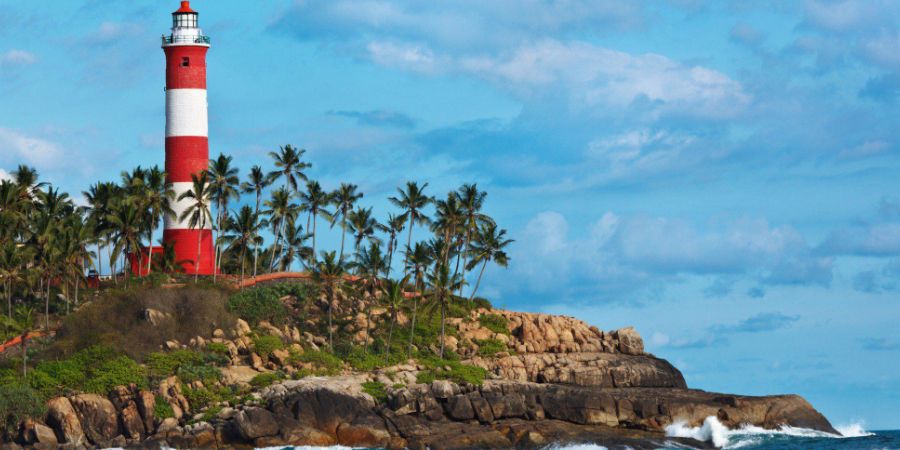
The Alappuzha Lighthouse stands roughly 30 meters tall — not imposing by the standards of European coastal lights, but tall enough to command any sightline in a town where nothing exceeds three stories. Its shape is a tapered circular tower, painted in alternating red and white horizontal bands that serve a functional purpose: daytime identification for vessels approaching from sea. At night, the light itself does the work. During the day, those stripes are the lighthouse's signature.
The construction is solid masonry, reinforced during the 20th-century rebuild with techniques that prioritized wind and moisture resistance over elegance. The walls are thick, the windows narrow — not for aesthetics but because the Arabian Sea pushes salt-laden air against the structure year-round. Corrosion is the enemy here, not ornamentation. Every design choice reflects the single requirement of durability in a marine environment.
Inside, a tight spiral staircase — iron-railed, stone-stepped — winds upward through the tower's core. The climb takes about five minutes if you don't stop, but most visitors do, catching their breath in the narrow landings where small windows offer framed slices of the town below. The staircase has no central column; instead, the steps are cantilevered from the outer wall, a detail that feels precarious until you notice how little the structure moves even in high wind.
The lantern room at the summit houses the light mechanism, a rotating lens assembly that produces a white flash visible at sea. The Directorate General of Lighthouses and Lightships maintains the equipment, and unlike many heritage lighthouses in India, this one remains operational. The lens catches sunlight during the day in a way that turns the entire lantern room into a prism — an accidental beauty in a building designed for pure utility.
Where the Backwaters End and the Arabian Sea Begins
The panorama from the top of the Alappuzha Lighthouse doesn't reward you with drama. It rewards you with legibility. From thirty meters up, you can finally read the geography that makes this town coherent. To the west, the Arabian Sea extends flat and grey-green to the horizon, its surface broken only by the occasional fishing trawler returning to shore. To the east, the backwater network becomes visible as a system — not the picturesque postcard version, but the engineered reality of canals, lagoons, and reclaimed land stretching inland toward the paddy fields of Kuttanad.
Look south and the beach curves away in a long, uninterrupted arc, lined with coconut palms that have been there long enough to lean permanently toward the land, bent by decades of onshore wind. North, the old pier — or what remains of it — juts into the sea, a skeletal reminder of the port infrastructure that once made this view commercially vital. The pier's concrete pilings have been claimed by barnacles and rust, but they still trace the line of a working dock.
The most revealing detail from the top is how narrow the town is. Alappuzha sits on a strip of land between the sea and the backwaters that's barely a few kilometers wide in places. You can see both bodies of water simultaneously, which explains why the town's history has always been defined by the tension between them — freshwater behind, saltwater ahead, and the human effort to profit from the junction.
On a clear day, the light is hard and equatorial, flattening shadows and bleaching colors. It's not the soft golden hour that travel photography demands. It's noon light, honest and unforgiving, and it shows you Alappuzha exactly as it is: a working town on a thin coast, still oriented toward the sea even when the sea's commercial relevance has diminished.
Pepper, Coir, and the Ships That Stopped Coming
Alappuzha's maritime history is a story of volume, not glamour. By the 1860s, the port handled more coir exports than any other in Asia. Pepper, cardamom, timber, and dried fish moved through the same channels, loaded onto sailing vessels and later steamships bound for Colombo, Aden, and London. The lighthouse guided these ships along a coast where monsoon currents could push a vessel off course by several nautical miles in a matter of hours.
The port's peak came in the late 19th and early 20th centuries, when the Travancore government invested heavily in wharf construction and warehouse infrastructure along the beach. British commercial firms established offices in the town, and Alappuzha developed the trappings of a proper colonial-era port — customs houses, shipping agents, bonded warehouses — all without being formally under British administration. Travancore ran its own show, and the lighthouse was part of that independent infrastructure.
Decline arrived through geography, not politics. The absence of a natural harbor meant that Alappuzha could never accommodate the larger ships that 20th-century trade demanded. Cochin, fifty kilometers north, had a deep-water port and a protected harbor. When the Cochin Port Trust expanded in the mid-20th century, Alappuzha's commercial shipping traffic migrated northward almost entirely. The coir trade continued, but in diminished form, increasingly moving by road rather than sea.
The lighthouse outlasted the commerce it was built to serve. Fishing boats still use it as a bearing — trawlers leaving before dawn line up against its beam to set their course — but the cargo vessels are long gone. What remains is a navigational tool that has quietly transitioned from commercial necessity to safety infrastructure for a fishing fleet that still works this coast by hand and net.
Sand, Sea Walls, and the Nehru Trophy Starting Line
Alappuzha Beach is not a resort beach. There are no loungers, no thatched umbrellas, no vendors selling cocktails in coconut shells. The sand is coarse and dark, stained by mineral deposits, and the surf breaks close to shore with a force that discourages casual swimming. The beach functions as a public space — families walk it in the evenings, fishermen sort their catch on it in the mornings, and on weekends, vendors sell sliced mango dusted with chili powder from small carts near the lighthouse.
A concrete sea wall runs along part of the beach, built to combat the erosion that has been eating the Alappuzha coastline for decades. The wall is functional and ugly, the kind of infrastructure that signals a town fighting to hold its ground against the Arabian Sea's slow advance. Behind the wall, a narrow park stretches between the beach and the town, with paths, benches, and the peculiar stillness of a public green space that locals use primarily as a shortcut.
The old Alappuzha pier, now partially ruined, extends from the beach into the sea and remains one of the town's most photographed structures — largely because ruin is more photogenic than function. Beyond the beach, the backwater canals begin, and the boat jetty for the Nehru Trophy Snake Boat Race sits about a kilometer inland. The race, held every August on Punnamada Lake, draws thousands of spectators and remains the single event that pulls Alappuzha into national attention each year.
The lighthouse anchors the beach's northern end, visible from almost every point along the shore. Its presence gives the otherwise flat, unstructured coastline a center of gravity — a fixed point around which the rest of the beach organizes itself, even if nobody consciously notices.
Getting There, Getting In, and Knowing What to Expect
The Alappuzha Lighthouse opens to visitors on most days, though the hours can shift without much warning. Generally, you can climb the tower between 10:00 AM and 5:00 PM, with a break around midday. A small entry fee applies — nominal by any standard — and tickets are sold at the base. There's no advance booking system, no app, no QR code. You pay in cash, you climb.
Getting to Alappuzha is straightforward from most points in Kerala:
- Cochin International Airport sits about 85 kilometers north; a taxi takes roughly two and a half hours depending on traffic through Ernakulam.
- Alappuzha Railway Station connects to Ernakulam, Trivandrum, and Kayamkulam, with frequent daily service on all three routes.
- KSRTC and private buses run from Ernakulam, Kottayam, and Kollam; the Kottayam route takes under two hours through rubber plantation country.
- The lighthouse sits on Alappuzha Beach, within walking distance of the bus stand and about two kilometers from the railway station — a flat, manageable walk or a short auto-rickshaw ride.
Carry water. The climb is enclosed and warm, especially from late morning onward. The staircase is narrow enough that you'll need to press against the wall when someone descends past you. Footwear with grip matters — the steps can be slick from humidity. Photography is permitted inside the tower and from the top, though tripods aren't practical in the confined lantern room.
The best time to visit is between October and February, when the monsoon has passed and the air is clear enough to see the full coastal arc from the summit. During monsoon months — June through September — the lighthouse may close intermittently, and the beach becomes rough enough that the approach feels more like an expedition than a stroll. Plan for a visit that lasts about an hour, including the climb, the view, and the time spent at the beach afterward.
The Alappuzha Lighthouse doesn't compete with India's grand monuments for attention, and it shouldn't. Its significance is quieter and more specific — a single structure that records the ambitions of a princely state, the rise and fall of a port economy, and the stubborn persistence of a navigational technology that GPS hasn't fully replaced. Lighthouses everywhere carry a certain romance, but this one earns its interest through context rather than spectacle. It stands where it does because a particular coast needed it, and it remains because the coast hasn't finished needing it. Most travelers pass through Alappuzha for the houseboats. The lighthouse asks you to consider what came before the tourism — and what will still be standing after the last kettuvallam is dry-docked.