


The morning smog had just thinned enough to let a pale sun through when I first walked past the iron gates on Lodhi Road. A peacock screamed from somewhere behind a neem tree. Two elderly men in white kurtas sat on a stone bench, not talking, just breathing the damp December air — the kind of silence that only exists in Delhi before eight o'clock. Beyond them, through a canopy of jamun and siris trees, rose the dark silhouette of a fifteenth-century tomb, its dome blackened by centuries of monsoon and exhaust. This is Lodhi Garden, ninety acres of imperial burial ground turned public park, dropped improbably between the institutional sprawl of South Delhi.
The tombs here predate the Taj Mahal by two hundred years, yet most foreign visitors skip them entirely, racing instead toward the Red Fort or Humayun's Tomb. That's a mistake. What Lodhi Garden offers isn't spectacle but proximity — you can press your palm against masonry laid in the 1440s, stand inside octagonal chambers where sultans were once washed and wrapped, and do it all while joggers in Nikes circle the perimeter path. This article moves through the garden's origins, the dynasties that built these structures, each monument in turn, the architectural language they share and dispute, the garden's designed and accidental ecology, its role as an urban refuge, and the conservation pressures threatening to erode what five centuries of weather have not.
Before the Garden Was a Garden: Lodhi Village and the Forgotten Burial Fields
The land now occupied by Lodhi Garden was not designed as a park. For most of its history, it was an open burial ground and scrubland on the outskirts of the medieval city of Delhi — part of the patchwork of ruins, agricultural plots, and scattered villages that stretched south from Purana Qila. The British colonial administration knew the area as Lady Willingdon Park, named after the wife of Viceroy Lord Willingdon, who in 1936 ordered the relocation of an entire village — Lodhi Village — to clear the land around the tombs.
That forced displacement gets glossed over in most guidebooks, which tend to credit the British with "rescuing" the monuments. The reality is more complicated. The villagers who lived among these tombs had occupied the area for generations. Their removal wasn't preservation so much as imperial landscaping — the creation of a green zone for colonial recreation. The tombs were cleaned up, pathways laid, and ornamental trees planted. A burial ground became a pleasure garden.
After Indian independence in 1947, the park was renamed Lodhi Garden in 1968, reclaiming its association with the Lodhi dynasty whose rulers had commissioned some of the structures inside. The Archaeological Survey of India (ASI) took over stewardship of the monuments, while the New Delhi Municipal Council (NDMC) assumed responsibility for the horticultural upkeep. This dual authority — one managing stone, the other managing soil — would later create friction, but in the early decades it worked well enough.
What's strange is how recently the garden assumed its current form. The bougainvillea-draped pergolas, the circular rose garden, the palm-lined central avenue — these were all added in the 1960s and 1970s by landscape architect Joseph Stein, who reimagined the space not as a heritage site but as a public commons. Stein's design layered recreation over ruin, and the tension between those two purposes has defined Lodhi Garden ever since. You walk through a fifteenth-century necropolis on paths built for morning exercise.
Sayyids and Lodhis: The Short-Lived Sultanates That Left Permanent Stone
Two dynasties share credit for the monuments inside these garden walls, and neither ruled for long. The Sayyid dynasty controlled Delhi from roughly 1414 to 1451 — barely four decades. The Lodhis followed them and held power from 1451 until 1526, when Babur's forces dismantled their army at the Battle of Panipat. Between them, these two lineages governed for just over a century, a sliver of time compared to the Mughals who succeeded them. Yet the tombs they left behind are among the oldest surviving Sultanate-era structures in Delhi.
The Sayyid rulers claimed descent from the Prophet Muhammad, a lineage that gave them religious legitimacy but little military muscle. Their territory rarely extended far beyond Delhi and its immediate surroundings. Muhammad Shah, the third Sayyid sultan, ruled from 1434 to 1445, and his tomb in the garden is the oldest datable structure on the grounds. It was likely built shortly after his death, though the exact date remains debated among historians.
The Lodhis, by contrast, were Afghan in origin — Pashtun chiefs from the Ghilzai tribe who consolidated power through force rather than genealogy. Sikandar Lodi moved the capital to Agra for a time but maintained Delhi as a center of religious and funerary architecture. His son Ibrahim Lodi, the last of the line, is buried not here but on the battlefield at Panipat where he fell. The garden's Lodhi-era tomb, known as the Bara Gumbad, and its adjoining mosque date to around 1490, though they've never been conclusively linked to a specific individual.
This anonymity matters. Unlike the Mughal tombs that followed — where every inch of marble proclaimed the identity and glory of the deceased — several Lodhi Garden monuments remain unattributed. They were built to honour powerful people whose names the centuries simply swallowed. The stones survived; the stories didn't.
Walking the Dead: A Monument-by-Monument Circuit Through Lodhi Garden
Start at the southern end, near the Prithviraj Road entrance, and the first structure you'll encounter is the Tomb of Muhammad Shah. An octagonal plan, three arched openings on each face, a bulbous dome — it sits on a raised platform surrounded by a low wall and a few scraggly hedges. Step inside and the acoustics shift immediately; your footsteps ring off the stone floor. The central cenotaph is plain, stripped of whatever textile coverings or inscriptions it once carried. Pigeons own the upper galleries now.
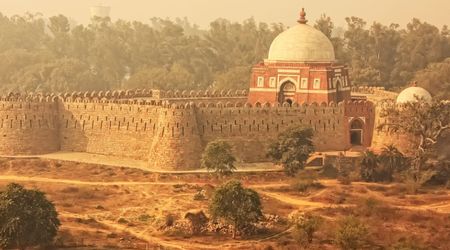
Walk north along the main path and you'll hit the Bara Gumbad, the "Big Dome," a squat, imposing structure with sloping buttressed walls and a heavy dome that looks like it was pressed down by a giant thumb. Directly adjacent stands the Bara Gumbad Mosque, whose interior stucco work is the single most elaborate decorative surface in the entire garden — carved Quranic inscriptions, geometric interlacing, and floral arabesques in shallow relief, still sharp after five centuries. If you visit only one interior in the garden, this is the one.
Opposite the mosque sits the Sheesh Gumbad, the "Glass Dome," so named for the glazed tiles that once covered its exterior. Almost all of those tiles are gone now, but patches of blue glaze remain visible on the drum of the dome if you look carefully in raking afternoon light. The interior houses several unidentified graves.
The Tomb of Sikandar Lodi, at the garden's northern edge, is the most formally composed of the group — an octagonal tomb within a walled enclosure, clearly influenced by the earlier Muhammad Shah tomb but larger, with a more pronounced double dome. A garden of its own once surrounded it, an early precursor to the char-bagh funerary gardens the Mughals would later perfect at Humayun's Tomb and the Taj. That evolutionary line, from Lodhi octagon to Mughal paradise garden, is one of the most direct architectural genealogies in Indian history.
The Grammar of Sultanate Stone: How These Tombs Speak a Language Before Mughal
Most visitors to Delhi arrive with the Mughal aesthetic already imprinted — white marble, symmetrical gardens, inlaid pietra dura. The architecture of Lodhi Garden works in a different register entirely. These are structures built from grey Delhi quartzite and rubble masonry, plastered over with lime, their decoration carved into stucco rather than inlaid into stone. The palette is earth, not gemstone. The overall impression is of weight, not lightness.
The octagonal tomb plan, used at both the Muhammad Shah and Sikandar Lodi tombs, didn't originate here. It arrived in Delhi from earlier Sultanate-era precedents, possibly influenced by Central Asian funerary traditions carried along trade and conquest routes. But the Lodhi-era builders refined the octagon into a formula: eight sides, three arched bays per side, a verandah circling the central chamber, and a dome rising from an octagonal drum. That formula worked so efficiently that it was essentially copied — and then surpassed — by the Mughals within decades.
The Bara Gumbad introduces a different typology: the square tomb with battered walls, meaning walls that slope inward as they rise. This gives the structure a pyramidal solidity, an almost defensive posture. Scholars have noted similarities to Afghan architectural traditions, which makes sense given the Lodhis' Pashtun origins. The building looks like it's bracing against something.
Decoratively, the Bara Gumbad Mosque's stucco panels represent a high point of pre-Mughal ornament in Delhi. The carving mixes calligraphic bands with dense vegetal scrollwork in a style that borrows from Timurid Central Asia but adapts it to local materials and sensibilities. What strikes you standing inside isn't the intricacy but the restraint — the carvers knew exactly where to leave blank space, and the blankness makes the decorated panels sing louder. The Mughals would later fill every surface. The Lodhis understood subtraction.
Ninety Acres of Designed Accident: The Ecology and Layout of the Park
Joseph Stein's 1968 redesign layered a modernist park over a medieval necropolis, and the result is a space that feels both intentional and improvised. The central lake, now home to a small population of migratory birds each winter, was excavated to create a focal point that the original burial ground never had. Palm-lined avenues radiate outward from the lake, connecting the major monuments in a circuit that takes roughly forty-five minutes on foot if you don't stop — though stopping is the entire point.
The planting is generous and somewhat undisciplined compared to the manicured Mughal gardens elsewhere in Delhi. Jamun, neem, silk cotton, and mango trees form a dense upper canopy. Bougainvillea riots across pergolas near the northern entrance. A dedicated section of the park maintains indigenous species as part of a biodiversity initiative, though most visitors walk past it without noticing. Bird counts have recorded over fifty species within the garden's boundaries, including spotted owlets that roost in the older trees and parakeets that scream through the canopy at dusk.
The paths themselves tell a story about competing priorities. Some follow the formal axes Stein laid down, connecting monuments in clean sightlines. Others are informal — dirt tracks beaten into the grass by joggers, yoga groups, and couples seeking privacy behind the Sheesh Gumbad. On any given morning, you'll find synchronized walking groups, solo readers on benches, and clusters of photographers angling for the perfect frame of a dome against the tree line.
The garden's most counterintuitive feature is its sound profile. Despite sitting between two of South Delhi's busiest roads, the dense tree cover creates pockets of genuine quiet near the lake and around the Sikandar Lodi enclosure. Traffic noise doesn't vanish, but it drops to a hum — the kind of background drone that your brain filters out after five minutes. The tombs themselves, with their thick walls and domed chambers, dampen sound further. Step inside and the city disappears, replaced by the echo of your own breathing.
The Jogger and the Tomb: Why Delhi Needs Its Dead Sultans
Delhi has 20 million people and roughly 20 square feet of green space per capita — a figure that puts it below the World Health Organization's recommended minimum. Lodhi Garden's ninety acres absorb somewhere between five thousand and ten thousand visitors daily, depending on the season and whom you ask. On winter mornings, the paths are thick with runners, dog walkers, embassy staff from the nearby diplomatic enclave, and elderly residents who've been coming since the garden was still called Lady Willingdon Park.
The park's democratic character is its most distinctive quality. You don't pay to enter. There are no tickets, no queues, no audio guides. The fifteenth-century tombs share space with yoga mats and picnic blankets without any apparent friction. A woman practices tai chi in the shadow of the Bara Gumbad. A government bureaucrat eats aloo paratha from a foil wrapper while sitting on a bench opposite the Sheesh Gumbad. The dead sultans, whoever they were, don't seem to mind.
This casual coexistence between heritage and daily life is something Delhi does better than almost any city I've encountered. In Europe, a monument of this age would be cordoned off, interpreted, and managed within an inch of its life. Here, the tombs are simply part of the furniture — the backdrop against which ordinary mornings unfold. That informality comes with risks, of course. Walls get leaned on, platforms get sat on, stucco gets touched by a thousand hands. But it also means the monuments remain integrated into lived experience rather than sealed behind glass.
There's something unsentimental about the way Delhiites use Lodhi Garden. They don't come for the history. They come because the trees are tall, the air is marginally cleaner than the surrounding roads, and the paths are smooth enough to walk on without twisting an ankle. The tombs are a bonus, not the draw. That accidental relationship between citizens and centuries-old structures may be the most honest form of preservation there is — not reverence, but use.
Crumbling Stucco and Rising Groundwater: What Threatens the Tombs Now
The ASI's conservation efforts at Lodhi Garden have followed a pattern familiar across Delhi's medieval sites: periodic restoration campaigns separated by long stretches of benign neglect. The most visible recent work involved repointing the masonry at the Bara Gumbad and Sheesh Gumbad, where water infiltration had loosened stones in the dome drums. But the underlying threats are structural and environmental, not cosmetic.
Rising groundwater levels — a consequence of Delhi's increasingly erratic monsoons and poor drainage infrastructure — have saturated the foundations of several monuments. Damp wicks upward through the rubble masonry, carrying dissolved salts that crystallize on interior surfaces and slowly destroy the stucco decoration. The Bara Gumbad Mosque's carved panels, the garden's finest ornamental work, show visible salt damage on their lower registers. Conservators have attempted to control moisture migration using chemical barriers, but results have been mixed.
Air pollution presents a different kind of erosion. Delhi's particulate matter levels routinely exceed WHO guidelines by a factor of ten or more during winter. Sulfur dioxide and nitrogen oxides in the air react with limestone and lime plaster to form gypsum crusts — the black staining visible on almost every exposed surface in the garden. Cleaning these crusts without damaging the underlying stone requires specialized laser techniques that the ASI has employed at higher-profile sites like Humayun's Tomb but has not yet applied comprehensively at Lodhi Garden.
The dual management structure adds a bureaucratic layer to every conservation decision. The ASI controls the monuments; the NDMC controls the grounds. A leaking water main near the Sikandar Lodi enclosure, reported by conservation groups in recent years, required coordination between both agencies — a process that moved slowly. The tombs don't care about jurisdictional boundaries. Water finds its way in regardless of which office is responsible for stopping it.
Getting There, Getting In, and Getting the Timing Right
Lodhi Garden sits on Lodhi Road in South Delhi, flanked by the India International Centre to the west and the India Habitat Centre to the southeast. The nearest metro station is Jor Bagh on the Yellow Line, roughly a ten-minute walk from the southern entrance. Auto-rickshaws and ride-hailing apps will drop you at any of three gates: Lodhi Road (east), Prithviraj Road (south), or Max Mueller Marg (north).
The garden opens daily at six in the morning and closes at eight in the evening, with no entry fee. The best months to visit are November through February, when Delhi's temperatures drop to a manageable 10-20 degrees Celsius and the winter light falls at low angles that make the stone glow amber in late afternoon. Avoid midday between April and September — the heat is genuinely punishing, and the monsoon months (July-August) turn paths muddy and attract mosquitoes in force.
A few practical notes worth heeding:
- There are no official guides inside the garden; bring a good map or download one in advance, as the ASI signage at each monument is minimal and weathered.
- Shoes with some grip help on the stone steps of the tombs, which get slippery after rain or morning dew.
- No food vendors operate inside the garden, but the India Habitat Centre's cafeteria and several restaurants on Lodhi Colony's market lane are within walking distance.
- Photography is unrestricted for personal use; tripods occasionally attract attention from security guards, though enforcement is inconsistent.
Arrive before seven on a weekday morning for the closest thing to solitude. By eight, the joggers arrive en masse. By ten on a weekend, school groups and photography clubs fill the paths. The golden hour before closing, around five-thirty in winter, offers the softest light and the thinnest crowds — a window of perhaps forty minutes when you can stand inside the Bara Gumbad Mosque and watch the last sun catch the carved stucco with no one else in the chamber.
Budget ninety minutes for a thorough visit. Two hours if you're serious about the architecture. Half a day if you bring a book and a willingness to sit still among the dead.
Lodhi Garden is not the most famous site in Delhi, and it probably shouldn't be. Its power lies precisely in its ordinariness — the way a fifteenth-century burial ground has become a place where a city of twenty million comes to stretch, breathe, and ignore the traffic for an hour. The tombs here predate the Mughal monuments that dominate every Delhi itinerary, and they did so with rougher stone, smaller budgets, and patrons whose names have been largely forgotten. What survives is the architecture itself, solid and unadorned enough to outlast its own history. Cities that keep their ruins accessible — not curated, not ticketed, just open — tend to understand something about time that tidier places don't. The stone outlives the story. The park absorbs the city. And at seven in the morning, a peacock screams behind a tomb that nobody can name, and that is enough.