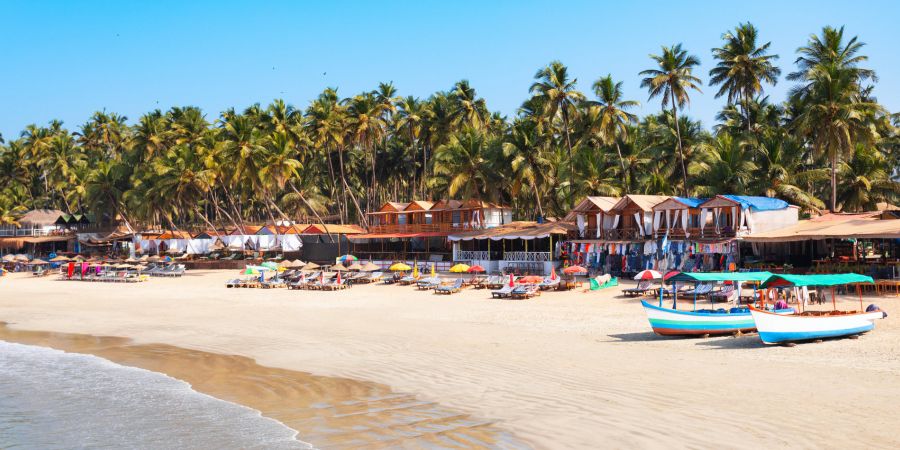


The fish curry arrived in a steel bowl, swimming in a sauce the color of burnt sunset, and the woman who served it — barefoot, sari hitched above her ankles — pointed toward the water with a spoon. "That's where my husband is," she said, meaning the Arabian Sea, meaning the trawler somewhere past the horizon line, meaning everything that Goa is before the bass drops and the cocktail menus come out. I was sitting at a shack in Betalbatim, South Goa, where the sand is the shade of unbleached flour and the only sound competition comes from crows arguing over prawn shells. Forty kilometers north, Baga Beach was pulsing with EDM and sunburned tourists negotiating jet ski prices. Both of these are Goa. Neither is the whole story.
This stretch of India's western coastline — barely 100 kilometers from tip to tip — holds more contradictions per square mile than most countries manage across entire provinces. Fishing villages share borders with trance parties. Portuguese-era chapels overlook beaches where Russian package tourists tan beside Mumbaikar weekenders. The ten beaches laid out here aren't ranked by beauty alone, because beauty is the cheapest currency on this coast. They're ranked by what they deliver: solitude, chaos, food, surf, or that particular Goan quality of making you forget what day it is.
The Sand Isn't the Point — What You Want From It Is
Most people arrive in Goa with a single image burned into their expectations: palm trees, a shack, a Kingfisher beer. That image isn't wrong, but it's dangerously incomplete. Goa's beaches differ not just in appearance but in temperament. Calangute feels like a carnival midway — loud, commercial, and unapologetically populist. Palolem, three hours south, operates on a completely different clock, where hammocks outnumber hawkers and the crescent bay creates a natural amphitheater of stillness.
Your choice depends less on aesthetics than on your tolerance for company. If you want to dance until 4 a.m. with sand between your toes, North Goa's strip from Anjuna to Vagator will oblige. If your ideal afternoon involves a paperback and the sound of waves without a Bluetooth speaker in earshot, South Goa's coast between Agonda and Galgibaga rewards that patience. The geography makes this division almost tidy: the Zuari River acts as an informal border between the state's two personalities.
Budget matters, but not the way you'd expect. South Goa's reputation as the "expensive" half is partly earned by its five-star properties around Cavelossim, yet the beach shacks in Palolem charge roughly the same for a fish thali as their cousins in Candolim. The real cost difference is in what surrounds you — North Goa's density means cheaper accommodation and more dining options within walking distance, while South Goa's sparser development sometimes means a scooter ride to your next meal.
Water conditions split the coast further. Morjim and Ashwem in the north offer calmer stretches suitable for wading, while Arambol's northern end catches swells that attract longboarders. In the south, Palolem's sheltered bay stays gentle year-round, but Agonda's open exposure to the Arabian Sea produces a rougher shore break. If you're traveling with children or weak swimmers, this distinction matters more than any Instagram ranking.
One thing nobody tells you: the most popular beaches are often the least interesting to eat at. The shacks at Baga and Calangute serve a homogenized tourist menu — pasta, fried rice, Goan fish curry diluted for unfamiliar palates. Walk ten minutes inland from almost any South Goa beach and you'll find family-run spots where the recheado masala hasn't been softened and the sol kadhi comes sharp enough to make your eyes water.
November's First Week Smells Different Than January's Last
The standard advice — visit between November and February — is correct but crude. Within that four-month window, Goa's beaches undergo a transformation that most guidebooks flatten into a single "peak season" label. Early November carries the residue of monsoon: the sand is still compact and dark from months of rain, vegetation behind the dunes is almost aggressively green, and the tourist infrastructure is shaking off rust. Shack owners are still hammering bamboo poles into place. Prices are lower. The air holds moisture.
By mid-December, the machinery is fully operational. Sunbeds multiply overnight. Trance parties at Hilltop in Vagator and Curlies in Anjuna hit their stride during Christmas week, when domestic tourists from Mumbai, Delhi, and Bangalore descend in numbers that turn Calangute's beach road into a parking lot. New Year's Eve inflates every price — hotel rooms that cost 2,000 rupees in November command 8,000. If your goal is party culture, this is the window. If your goal is the beach itself, you're paying a premium to see less of it.
February brings a peculiar clarity. The crowds thin after Republic Day, the humidity drops to its annual low, and the sea flattens into something almost glassy by late afternoon. This is arguably the best month for South Goa, when Agonda and Butterfly Beach operate at half capacity and the water visibility improves enough to make snorkeling worthwhile off Grande Island.
The monsoon months — June through September — deserve a separate conversation. Goa's beaches are officially off-limits for swimming during this period, and most shacks close entirely. But the coastline becomes something else: dramatic, empty, and genuinely wild. Vagator's red laterite cliffs look their most striking against charcoal skies, and Arambol's sweet water lake swells to its full size. You can't swim, but you can witness a coast without performance.
October is the gamble month. The rains recede in fits, and some years the first two weeks are washed out while other years deliver premature sunshine. Flights and hotels are cheap. The reward, if the weather cooperates, is a Goa that belongs almost entirely to its residents — and to you.
Ten Beaches, Ten Arguments for Staying Another Week
- Palolem earns the top position not because it's the most beautiful — though its symmetrical crescent lined with coconut palms makes a strong case — but because it functions. The beach offers kayak rentals to nearby Butterfly Beach, silent disco headphone parties that satisfy the urge to dance without destroying the peace, and a row of beach huts where you fall asleep to the sound of the tide dragging across coarse sand.
- Agonda, just north, takes the second spot for being Palolem's quieter, longer-limbed sibling, where the shore stretches wide enough that even in peak season you can claim fifty meters of solitude.
- Anjuna, ranked third, is Goa's most historically charged beach — the flea market that started here in the 1960s when hippies sold their belongings to fund extended stays has evolved into a Wednesday institution. The beach itself is rocky in parts, punctuated by tidal pools and the remnants of laterite formations.
- Fourth is Morjim, sometimes called "Little Russia" for reasons that become obvious when you read the restaurant signs, where Olive Ridley turtles nest between November and March along the quieter northern stretch.
- Vagator takes fifth place for its split personality: the upper beach (Ozran) hides below a cliff and attracts a crowd that skews younger and more countercultural, while the main beach opens onto a wide bay overlooked by the crumbling red walls of Chapora Fort.
- Sixth is Arambol, the northernmost tourist beach, where the drum circles at sunset are either transcendent or insufferable depending on your relationship with bongo solos.
- Mandrem, seventh, feels like a deliberate secret — a narrow river crossing separates it from the main road, and the beach itself is a long, clean strip that appeals to yoga practitioners and couples.
- Eighth, Cavelossim offers the manicured calm that South Goa's luxury hotels cultivate, though the public beach access points deliver the same sand without the room rate.
- Ninth, Betalbatim — my fish curry beach — rarely appears on any list, which is precisely its value: a working fishing village where tourism exists as a whisper, not a shout.
- Tenth is Butterfly Beach, technically accessible only by boat from Palolem or via a steep jungle trail from the south. It's small, rocky at the edges, and sometimes occupied by nothing but hermit crabs and the occasional dolphin surfacing offshore. It ranks last only because reaching it requires effort — and effort, in Goa, is a currency most visitors prefer not to spend.
The Real Division Isn't Geography — It's What You're Running From
Party hubs and hidden coves attract fundamentally different species of traveler, and the honest version of that distinction has nothing to do with age or budget. The twenty-two-year-old sitting alone in Agonda reading Murakami and the fifty-year-old dancing at Curlies until dawn have both made deliberate choices about what they need from a coastline. Goa accommodates both without asking either to explain.
The party beaches — Baga, Calangute, Anjuna, and Vagator — operate on a rhythm that begins sluggishly around noon and accelerates through sunset into a nightlife that can carry you from a beachside cocktail at Club Tito's to an afterparty in a cashew plantation near Assagao. The infrastructure supports this: ATMs, pharmacies, late-night food stalls serving greasy chow mein at 3 a.m. You're never more than a stumble from the next experience. The energy is external, borrowed from the crowd.
The cove beaches demand something different from you. Butterfly Beach has no shack, no vendor, no phone signal in parts. Betalbatim's entertainment is watching fishermen sort their catch at dawn. Agonda's nightlife consists of a candle on your dinner table and the sound of waves. These places don't offer less — they offer subtraction, and subtraction turns out to be the harder sell but the longer-lasting effect.
The interesting travelers are the ones who do both within a single trip. Three nights in Anjuna to feel the pulse, then a scooter ride south to Palolem where the tempo drops and the silence becomes a physical presence. Goa's compact size — you can cross the state in under three hours — makes this kind of tonal shift not just possible but almost irresistible. The mistake is committing to only one version of the coast.
What nobody warns you about is how quickly the coves rearrange your internal clock. After two days in Agonda, the idea of a nightclub feels absurd — not because you've aged out of it, but because your nervous system has recalibrated to something slower. The party beaches offer escape from routine. The quiet beaches offer escape from the need to escape. That's not a philosophical distinction. You feel it in your shoulders.
Where the Sand Ends and Something Else Begins
Goa's beaches aren't interchangeable backdrops for the same vacation. Each one carries its own argument about how time should be spent, how much noise a human needs, and what a coastline owes the people who visit it. The rankings here are a starting point, not a verdict — your Palolem might be someone else's overcrowded disappointment, and the Betalbatim that moved me might leave you restless for a louder shore.
What makes this coast exceptional isn't any single beach but the compression of so many contradictions into such a small space. Fishing nets dry in the same wind that carries bass from a beach club. A church bell sounds above the crash of surf. The curry is always better than you expected, and the sunset — every single evening, without fail — stops conversation dead for exactly ninety seconds before the shack speakers come back up. Goa doesn't ask you to choose between its versions. It just asks you to show up with enough days to discover which version was yours all along.