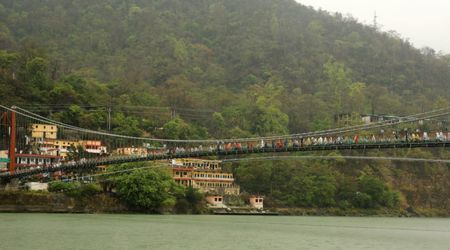
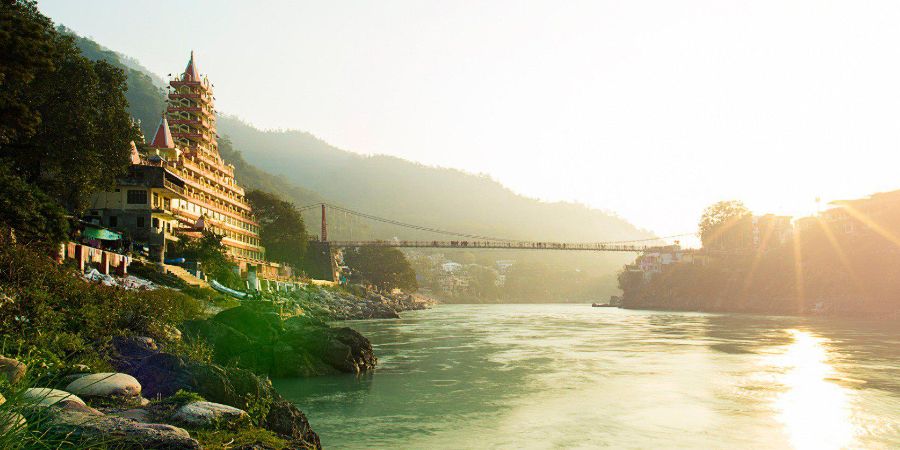


Lakshman Jhula hangs 70 feet above the Ganges in Rishikesh, Uttarakhand, and the river beneath it runs a shade of green you don't quite trust, too vivid, too deliberate, as if the water decided to dress up for the pilgrims. Motorbikes once squeezed across this bridge alongside barefoot sadhus and bewildered tourists, though vehicular traffic was eventually banned. The bridge was closed entirely to pedestrians in 2020 due to structural concerns, and a parallel bridge now carries the foot traffic that once defined the original crossing. Yet Lakshman Jhula endures — not as infrastructure, but as mythology made physical.
It connects the villages of Tapovan on the west bank and Jonk on the east, but those are just the geographic coordinates. The real connection runs between the ancient and the immediate, between a story told in the Ramayana and the concrete reality of river, rope, and iron. What follows traces that arc: from divine legend to colonial engineering, from pilgrimage site to the peculiar ecosystem of yoga studios, temple kitsch, and genuine spiritual searching that clusters on both sides of the Ganges at this exact point.
Seventy Feet Above the Ganges — The Numbers Behind the Icon
Lakshman Jhula spans approximately 450 feet across the Ganges, linking Tapovan on the western bank to Jonk on the eastern side, in the Tehri Garhwal district of Uttarakhand. The bridge sits at an elevation of roughly 1,100 feet above sea level, placing it in the foothills of the Himalayas rather than the mountains proper. Rishikesh itself lies about 25 kilometers from Haridwar and 240 kilometers northeast of Delhi, making this stretch of the Ganges one of the most accessible points where the river still moves fast and cold from its mountain source.
The iron suspension bridge was completed in 1929, replacing an earlier rope bridge that had served pilgrims and locals for centuries. It stands roughly 70 feet above the water's surface — enough height that looking down through the iron lattice induces a specific, queasy vertigo, especially when the bridge sways under collective footfall. The bridge's deck is narrow, roughly eight feet wide, which created the peculiar intimacy of strangers pressing past each other with the river roaring below.
Authorities closed the bridge to vehicular traffic in 2014 after an engineering assessment flagged structural fatigue. In 2020, Lakshman Jhula was closed entirely to all foot traffic. A new cable-stayed bridge, completed nearby, now carries pedestrians between the same two banks. The original structure remains standing, visible and photographed constantly, but no longer walked upon. This gives it a strange double identity: it's simultaneously the most recognizable landmark in Rishikesh and an object you can no longer physically experience.
The surrounding area sits at the point where the Ganges exits the Shivalik Hills and begins its long, flattening journey across the Indo-Gangetic Plain. The water temperature here, even in summer, stays bracing — cold enough to make you gasp if you wade in above the knee. The current moves deceptively fast. What looks gentle from 70 feet up can knock you sideways at river level, a discrepancy that catches more than a few visitors off guard every year.
A Younger Brother's River Crossing and a Story That Outlasted Empires
The name attaches to Lakshmana, the younger brother of Lord Rama, whose story runs through the Ramayana like a second spine. According to the legend specific to this site, Lakshmana crossed the Ganges at this exact point using a jute rope bridge — or, in some versions, by simply walking across two ropes strung between the banks. The story places the crossing during the exile period of the Ramayana, when Rama, Lakshmana, and Sita wandered the forests of northern India for fourteen years. This stretch of the Ganges, where the river narrows between rocky banks and the current concentrates into a single powerful channel, would have been a logical and dangerous crossing point.
What's striking is how the legend has resisted standardization. Ask three pandits along the ghats and you'll get three versions — one insists Lakshmana meditated on the eastern bank before crossing, another claims the crossing happened during the return from Lanka, a third says the rope bridge was divine, materialized by prayer. The inconsistency doesn't weaken the story. It strengthens it. A living myth doesn't need a single authorized edition; it needs local ownership, and every temple and ashram on both banks has claimed a piece of the narrative.
The name "Jhula" itself comes from the Hindi word for swing, referring to the way the original rope bridge swayed in the wind above the river. That physical sensation — the lateral movement, the sense of suspension between solid ground — became part of the mythology. Crossing wasn't just transit; it was an act of faith, a moment where the ground disappeared and you trusted rope, or prayer, or both.
Upstream, about five kilometers, sits Ram Jhula, named for the elder brother. The two bridges bracket a stretch of the Ganges that locals treat as sacred geography, a corridor rather than a single point. The legend didn't just name a bridge. It organized an entire riverbank into a story that people could walk through, and millions still do, even if the original bridge no longer lets them across.
Jute Ropes, Colonial Iron, and the Slow Collapse of 2020
The original crossing at this site was a rope bridge — jute fibers braided thick enough to support a single person at a time, anchored to boulders on both banks. No one knows precisely when this first bridge appeared. Oral accounts from pilgrims and sadhus place some version of a rope crossing here for centuries, possibly predating the Mughal period. The ropes needed constant replacement; the monsoon humidity and the Ganges spray rotted jute within a few seasons. Maintaining the bridge was a community act, part logistics and part devotion.
The British colonial administration in India, which had a particular fondness for replacing local infrastructure with engineered permanence, commissioned the iron suspension bridge in the late 1920s. Construction finished in 1929. The design used wrought iron cables anchored to concrete pylons on each bank, with a latticed iron deck suspended between them. The colonial engineers chose suspension not for aesthetics but for the gorge's geometry — the gap was too wide for a simple beam bridge, and the rocky banks provided natural anchor points for cable tension.
For nearly ninety years, the bridge carried an evolving mix of traffic: pilgrims, motorcycles, cattle, tourists with backpacks, sadhus with nothing. The weight limits were theoretical. No one enforced them. By the early 2000s, engineers began noting corrosion in the main cables and metal fatigue in the deck plates. The 2014 vehicle ban was a half-measure. The complete closure in 2020 followed a report that declared the bridge structurally unsound for any load.
The replacement bridge, completed nearby, is a modern cable-stayed design — wider, stronger, and entirely without character. It works. No one writes poems about it. The original Lakshman Jhula still stands, rusting slowly, closed but intact, occupying the peculiar category of structures too famous to demolish and too fragile to use. Its preservation remains an open bureaucratic question, debated by the Uttarakhand Public Works Department with no resolution in sight.
Cables Under Tension — What Holds a Bridge Above a Sacred River
Suspension bridges work on a principle that feels counterintuitive: the deck doesn't hold itself up. The weight transfers through vertical hangers to main cables, which curve in a parabolic arc between two anchor points on opposite banks. The cables carry the load in tension, pulling against the anchors rather than pushing down on supports. Lakshman Jhula's design follows this logic with colonial-era directness — two main wrought iron cables, concrete anchor blocks sunk into the rock on each bank, and a series of vertical iron rods suspending the flat deck below.
The bridge's 450-foot span required cables thick enough to support not just the dead weight of the iron deck but the live load of hundreds of people crossing simultaneously, plus wind forces channeled through the river gorge. The gorge acts as a funnel; wind speeds at the bridge can exceed those on open ground by a significant margin. The original engineers accounted for this with cable diameter, but the design didn't anticipate the vibration frequencies generated by motorized vehicles, which were introduced decades after construction.
That vibrational stress, compounded by ninety years of monsoon humidity and the corrosive spray rising off the Ganges, ultimately degraded the cables beyond safe tolerance. Iron corrodes differently than steel; it doesn't fail suddenly but develops a rough, pitted surface that reduces cross-sectional strength gradually. The bridge's closure wasn't the result of a single dramatic failure. It was the accumulation of thousands of monsoons, millions of footsteps, and the slow chemistry of water meeting iron in an environment that never fully dries out.
One detail the casual visitor wouldn't notice: the anchor blocks on each bank are not symmetric. The western bank's geology — harder metamorphic rock — allowed a shallower anchor. The eastern bank, with softer sedimentary layers, required deeper foundations. The bridge's two sides were engineered for two different kinds of earth, a quiet asymmetry hidden beneath identical-looking pylons.
What Gathers on Both Banks After You Cross the River
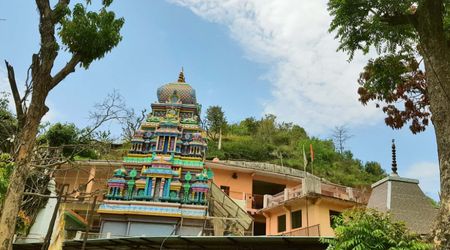
The thirteen-story Trimbakeshwar Temple dominates the eastern bank with a stacked, tiered architecture that looks less like a single structure and more like several temples standing on each other's shoulders. Each floor is dedicated to a different deity, and the interior corridors smell of sandalwood incense and warm ghee from the oil lamps. The temple's aesthetic falls somewhere between devotional and maximalist — painted in bright blues and oranges, with statues peering from every alcove. It's not subtle. It's not trying to be.
The western bank tilts toward yoga and international tourism. Ashrams along Tapovan offer multi-week residential programs, and the smell of chai competes with nag champa incense in the narrow lanes. The Beatles Ashram — officially the Maharishi Mahesh Yogi Ashram — sits a short walk south along the river, abandoned and partially reclaimed by forest, its meditation halls now open-air galleries of graffiti art. The contrast between the structured devotion of the temples and the crumbling counterculture of the ashram is jarring and honest.
River rafting launches from Shivpuri, about 16 kilometers upstream, and covers rapids rated Class III and IV before finishing near the bridges. The water temperature makes a wetsuit advisable even in April. For something quieter, the evening Ganga Aarti ceremony at Parmarth Niketan Ashram draws hundreds of people to the western bank at dusk, where priests swing fire in synchronized arcs while the river turns the color of hammered copper in the fading light.
Small cafes on both sides serve thalis for under 200 rupees and surprisingly decent espresso — a concession to the European backpacker economy that took root here in the 1970s and never fully left. The German Bakery, a Rishikesh institution despite having no German staff, makes banana pancakes that have been sustaining budget travelers for decades. The food scene here is entirely vegetarian; Rishikesh falls within a dry, meat-free zone enforced by municipal and religious authority. You won't find a beer or a chicken leg within city limits, a fact that surprises visitors who didn't read ahead.
The Months the River Cooperates — and the Months It Doesn't
October through March offers the most reliable weather for visiting Lakshman Jhula and the broader Rishikesh area. Daytime temperatures in this window range from the low teens to the mid-twenties Celsius, and the sky tends toward a pale, clean blue that makes the Shivalik foothills sharp against the horizon. The Ganges runs lower and clearer in winter, its green turning almost translucent over the rocky riverbed. Morning fog sometimes fills the gorge until nine or ten o'clock, which gives the bridge and temples a quality of half-presence, as though they haven't fully committed to existing yet.
The monsoon, which typically arrives in late June and lingers through September, transforms the river into something unrecognizable. The Ganges swells dramatically, turning brown with Himalayan silt, and the water level can rise high enough to submerge the lower ghats entirely. Rainfall in Rishikesh during peak monsoon can exceed 300 millimeters in a single month. Landslides close the mountain roads with regularity, and the approach from Haridwar sometimes floods at low-lying points. Rafting companies shut down. Some ashrams close for the season.
April and May bring a dry, heavy heat that doesn't suit long walks along the riverbank. Temperatures push past 35 degrees Celsius, and the stone steps of the ghats absorb enough solar radiation to burn bare feet. The Ganges drops to its lowest annual level, exposing sandbars and rocky shelves not visible at other times — interesting geologically, less pleasant atmospherically.
The single best month, if you're forced to choose, is probably early November. The monsoon has just retreated, the vegetation on both banks remains intensely green from recent rain, the river has calmed but hasn't yet shrunk to its winter minimum, and the tourist crowds haven't hit their December peak. The light in November has a particular warmth to it — low-angled and golden by four in the afternoon, painting the bridge's iron lattice in tones that make even a closed structure look briefly alive.
Iron and Faith Suspended Over Moving Water
Lakshman Jhula hasn't carried a footstep since 2020, yet it continues to function — not as a bridge, but as a kind of lens through which everything around it organizes. The temples, ashrams, cafes, and ghats on both banks orient themselves toward it. Photographs of Rishikesh almost always center on it. The replacement bridge, functional and forgettable, exists in its shadow. A closed bridge shouldn't have this kind of gravitational pull, but Lakshman Jhula does, because it occupies a category that defies engineering assessments: it's a story you can see.
The Ramayana placed Lakshmana at this crossing. The British replaced jute with iron. Corrosion and time closed it. Each phase added a layer without erasing the ones beneath. The bridge holds all of them simultaneously — mythological, colonial, structural, spiritual — and that accumulation is what gives it weight beyond its tonnage. You can stand on either bank and see an iron suspension bridge from 1929, or a rope crossing from an ancient epic, or a symbol of a city that has spent centuries negotiating between pilgrimage and tourism, between faith and commerce.
Bridges are supposed to be transitional spaces, things you pass through on your way to somewhere else. Lakshman Jhula refused that role. It became the destination itself. And even now, closed and corroding, it remains the one structure in Rishikesh that makes people stop walking and simply look — at the river, at the mountains, at the strange persistence of a story that outlasted the iron built to honor it.