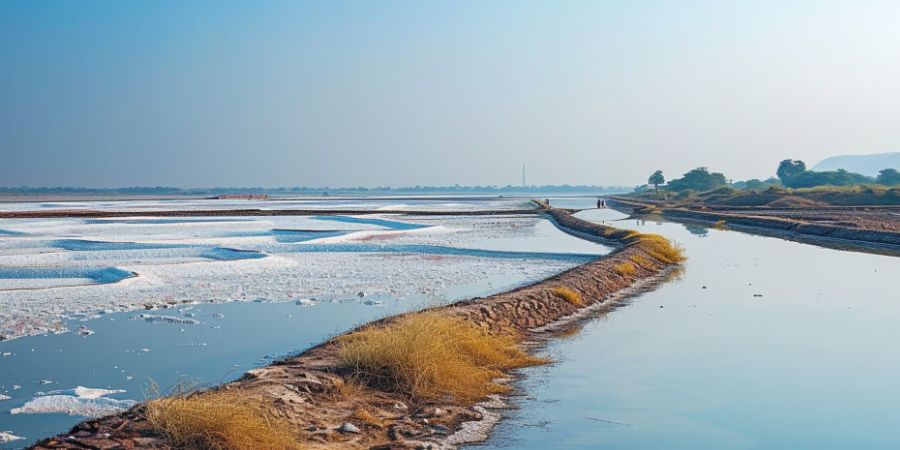


The wind carries a faint mineral tang, the kind that settles on your lips and stays. At Pachpadra, thirty kilometers north of Barmer in western Rajasthan, the ground doesn't behave the way ground should. It shimmers. Depending on the season, the lakebed is either a vast crust of crystallized salt stretching toward a horizon that wobbles in the heat, or a shallow sheet of water so still it duplicates the sky with unsettling precision. This is not a lake in any conventional sense. It's a salt pan — one that has supplied the Thar Desert's salt trade for centuries, long before the region became a district on anyone's administrative map.
Agarias, the salt-mining community, still work here, raking white ridges from the earth the way their ancestors did under Marwar's feudal lords. The place resists tourism in its current form: no ticket counters, no guardrails, no curated experience. That rawness is exactly what makes it worth the long drive from Jodhpur or Jaisalmer. What follows is a practical, unvarnished guide — what Pachpadra feels like when you're actually standing there, when to go, how to photograph it, what else lies nearby, and where to sleep and eat in a stretch of Rajasthan that doesn't cater to visitors with much ceremony.
Standing at the Edge of Pachpadra — What It Actually Feels Like
The first thing you notice is the silence. Not the manufactured quiet of a meditation retreat, but the kind of silence that comes from flat, open land with nothing tall enough to break the wind or bounce a sound. Pachpadra's salt flats extend in a pale crust that crunches underfoot like frozen snow, except the air is forty degrees Celsius and there's not a cloud for two hundred kilometers. Your boots leave shallow impressions that fill with brine almost instantly, a slow seep of mineral water reclaiming its territory.
The color palette is disorienting. You expect the Thar to be amber and ochre, but here the ground is white, tinged with grey and pale violet where the salt concentration shifts. In the monsoon aftermath, when a thin layer of water covers the pan, the surface turns into a mirror so convincing that photographs look inverted — you genuinely can't tell which half is sky. The effect is geological, not magical: the lakebed's extreme flatness and the high salinity of the water suppress ripples, creating near-perfect reflections.
What catches most visitors off guard is the presence of the Agarias. These aren't performers or heritage exhibits. They're working. Men and women in bright turbans and dupattas scrape salt into geometric mounds, their tools rudimentary, their labor visible. The salt pans are divided into shallow rectangular plots, almost like rice paddies, each one evaporating at its own rate. You walk among them and nobody stops you, but nobody performs for you either. This is their livelihood, not your backdrop.
The heat is the second honest thing about Pachpadra. It bounces off the white surface and hits you from below, a reflected furnace that sunscreen alone won't address. Bring a cotton scarf, cover your neck, and drink water before you feel thirsty. The lake doesn't reward the unprepared, but it doesn't punish the respectful either. It simply exists, indifferent to your camera and your expectations, which is precisely what makes standing there feel so genuinely rare.
The Calendar Trick: Why October Through February Changes Everything
Pachpadra is technically accessible year-round, but visiting in May or June is an exercise in masochism. Daytime temperatures push past forty-five degrees, the salt crust becomes blinding white under direct sun, and the reflected heat creates a thermal envelope that makes even short walks exhausting. The lake is bone dry, its surface fractured into polygonal tiles that look dramatic in photographs but feel punishing in person. The Agarias themselves reduce their working hours to early morning shifts during peak summer.
The window between late October and February is the one that matters. Post-monsoon, the shallow water that collects over the pan hasn't fully evaporated, and temperatures drop to a manageable twenty-five to thirty degrees during the day. Mornings can be genuinely cool — fifteen degrees in December and January — which transforms the experience from endurance test to contemplative walk. The low-angle winter light does something specific to the salt crust: it turns the surface a warm gold at sunrise and a pale lavender at dusk, colors that the harsh overhead sun of April obliterates entirely.
The counterintuitive detail is this: the lake is most photogenic not when it's full of water, but in the weeks just after the monsoon recedes, roughly late September through November. During this period, the water level sits at perhaps two or three centimeters — too shallow to wade, too deep to be dry. That razor-thin layer creates the mirror effect that draws photographers from across India. By January, much of the water has evaporated, and the texture shifts to cracked salt flats, beautiful in a different, more austere register.
Avoid the monsoon itself — July and August — when unpaved access tracks turn to mud and the surrounding scrubland becomes unexpectedly marshy. The road from Balotara can be unreliable after heavy rain, and local infrastructure doesn't account for stranded travelers.
Two Centimeters of Water and the Light That Bends Time
The mirror effect at Pachpadra isn't guaranteed — it depends on water level, wind speed, and timing. Arrive at golden hour, roughly thirty to forty-five minutes before sunset, and you'll have the best chance. The low sun angle eliminates the harsh overhead glare that washes out the salt's subtle tones, and the warm light saturates the shallow water with amber and copper hues. A telephoto lens compresses the foreground salt patterns against a reflected sky, creating an almost painterly abstraction. A wide-angle lens at ankle height captures the full sweep of the mirror, but you'll need to kneel or lie flat, which means getting salt brine on your clothes and gear.
Bring a polarizing filter, but don't use it the way you normally would. Fully polarized, the filter kills the reflection entirely, turning the water opaque. Dial it to about a quarter rotation instead. This preserves the mirror while cutting just enough glare to reveal the texture of the salt beneath the surface — a layered effect that straight-off-the-sensor shots can't replicate. Shoot in RAW. The dynamic range between the bright salt crust and the darker sky will exceed what JPEG compression can handle.
The Agaria salt workers, if present, add a human scale that transforms a landscape shot into a story. Silhouettes of figures raking salt against a reflected sunset are the images that tend to circulate on social media, and for good reason — they work compositionally because the geometry of the salt plots provides natural leading lines. Approach the workers with courtesy. Ask before pointing a lens at someone's face. Most will nod and continue working; a few will wave you off. Respect both responses equally.
Dawn shoots offer cleaner air and fewer dust particles, but the golden hour at sunset tends to produce warmer tones because of accumulated atmospheric haze. The difference is subtle on a clear day and dramatic on a dusty one. Bring lens wipes — salt crystallizes on glass faster than you'd expect, and a single fingerprint on a filter becomes a permanent soft-focus effect you didn't ask for.
What Lies Within Striking Distance of the Salt Flats
Barmer, the district headquarters, sits about thirty kilometers south and functions as Pachpadra's nearest proper town. It's not a tourist destination in any polished sense, but the Thursday market is worth the detour — a sprawling ground-level affair where Rabari herders sell embroidered textiles alongside stalls of dried red chilies heaped in pyramids taller than the vendors. The Barmer woodcarving tradition, recognizable by its deep relief patterns and dark teak, is still practiced in workshops along the old town's narrow lanes. You can watch artisans work if you buy something; window-shopping alone doesn't open those doors.
Balotara, about twenty-five kilometers east of Pachpadra, is the more practical base. It's a textile-printing hub where fabric is block-printed and sun-dried along the banks of the Luni River. During production months, the riverbanks transform into vast grids of drying cloth — reds, indigos, and saffrons pinned against the sand, a visual spectacle that rivals the salt flats themselves. The Nakoda Jain Temple, twelve kilometers from Balotara, draws pilgrims from across western Rajasthan; its marble architecture and hilltop position make it a worthwhile stop even for non-devotional visitors.
If you have a full day to spare, the road northwest toward Jaisalmer passes through Kiradu, an archaeological site with tenth-century temples in varying states of ruin. The carvings on the Someshvara Temple are extraordinary — erotic figures, celestial musicians, and battle scenes rendered with a detail that rivals Khajuraho, though Kiradu receives a fraction of those visitors. The site is effectively unguarded, which means you can explore freely but also means there's no interpretation panel, no guide, no restroom. Pack your own water and context.
The desert between these points isn't empty either. The drive itself passes through scrubland dotted with wind turbines and the occasional cluster of thatched bhungas, round mud huts that belong to pastoral communities still practicing transhumant herding across the Thar.
Getting to a Place That Doesn't Exactly Advertise Itself
Pachpadra has no railway station, no airport, and no bus service that terminates at the lake itself. The nearest railhead is Balotara Junction, connected to Jodhpur by several daily trains including the Ranakpur Express, with a journey time of roughly three hours. From Balotara, you'll need a hired car or auto-rickshaw for the twenty-five-kilometer stretch to the salt flats. Auto-rickshaws will negotiate hard — expect to pay between three hundred and five hundred rupees for the one-way trip, depending on your bargaining stamina and the driver's read of your desperation.
By road, Pachpadra sits on National Highway 15, which connects Jodhpur to Barmer. The drive from Jodhpur takes approximately four hours in a private vehicle, passing through Pali and then Balotara. The highway is well-surfaced for most of the route, though the final approach to the lake involves a turn onto a narrower road that degrades significantly during and immediately after monsoon. A sedan handles it fine in dry months; post-rain, a vehicle with higher clearance earns its keep.
Jodhpur's airport, the closest one with regular commercial flights, receives daily connections from Delhi, Mumbai, and Jaipur via carriers including IndiGo and Air India. From Jodhpur airport, the drive to Pachpadra is a straight shot south on NH-15. If you're coming from Jaisalmer, the distance is roughly two hundred and fifty kilometers — a five-hour drive that crosses some of the Thar's most open and sparsely populated terrain. Fuel up before leaving either city. Petrol stations thin out considerably between Balotara and Barmer, and the stretches between them can feel long when the gauge drops below a quarter tank.
No organized tour currently includes Pachpadra on a standard Rajasthan circuit. You arrive here because you chose to, not because an itinerary delivered you. That self-selection keeps the crowds thin and the experience honest.
Sleeping and Eating Where the Thar Doesn't Try to Impress You
Accommodation near Pachpadra ranges from modest to very modest. Balotara offers the most options: a handful of guesthouses and budget hotels along the main road, none of which you'd describe as luxurious, most of which provide clean sheets, functioning air conditioning, and hot water — the three things that matter after a day on the salt flats. Hotel Nakoda Palace in Balotara is a reliable mid-range choice, with rooms that run between fifteen hundred and twenty-five hundred rupees per night. Don't expect a swimming pool or a concierge. Expect a firm mattress and a television that gets Hindi news channels.
Barmer has slightly more variety, including a few heritage-style properties that attempt to evoke the haveli aesthetic with varying degrees of success. The RTDC Hotel in Barmer, government-run, offers functional rooms at lower rates but books up during the annual Barmer Desert Festival in January. If your visit coincides with the festival, reserve weeks ahead or resign yourself to Balotara.
Food in this part of Rajasthan leans heavily toward Marwari cuisine — dal baati churma is the signature meal, and you'll find it at nearly every dhaba and small restaurant between Balotara and Barmer. The baati here is baked harder than what you'll encounter in Jodhpur or Udaipur, with a denser crust that holds up to the generous ladle of ghee poured over it. Ker sangri, a preparation of desert beans and berries cooked with dried red chilies, tastes nothing like anything you've eaten elsewhere in India — tangy, slightly bitter, and deeply specific to this arid geography. Mirchi vada, a deep-fried chili fritter, appears at every roadside stall and pairs improbably well with sweet chai.
Carry water and dry snacks to the lake itself. There's no vendor, no chai stall, no convenience store at the salt flats. The nearest refreshment is back in Balotara, and the drive feels longer when you're dehydrated.
Pachpadra doesn't fit neatly into Rajasthan's tourism narrative of forts, palaces, and curated desert camps. It belongs to a different register — the register of working land, where salt miners still earn their living from the same mineral crust their families have scraped for generations. The absence of infrastructure isn't a flaw; it's the reason the place retains its character. You don't visit Pachpadra for comfort or convenience. You visit because the Thar Desert, at this exact coordinate, does something with light, water, and salt that it does nowhere else. That's enough. In a country where every lakefront is being developed, every viewpoint is acquiring a railing and a ticket booth, a place that simply exists — unmanaged, unbranded, unaware of its own beauty — is becoming the rarest thing in Indian travel.