

The heat in Jodhpur doesn't negotiate. It arrives at six in the morning and stays until well past dark, pressing against your skin like something solid. But step through the iron gates of Mandore Garden, eight kilometers north of the old city, and the temperature drops — not metaphorically, but by several perceptible degrees. The canopy of ancient banyan and pipal trees creates a green compression chamber where the air tastes different, damp and vegetal. Parakeets shriek from somewhere above the cenotaphs. Langur monkeys sit on carved sandstone ledges like bored sentinels.
The place is technically a public park, managed by the Jodhpur Municipal Corporation, with concrete pathways and the odd rusted bench. But underneath that civic veneer lies a necropolis — the original seat of the Rathore dynasty and the burial ground of Marwar's rulers long before Mehrangarh Fort existed. Most tourists rush past Mandore on the way to Mehrangarh or the blue lanes of the old city, which means the garden holds something increasingly rare in Rajasthan: the quiet to actually hear what the stones are saying. What follows is an account of those stones, the people who carved them, and the slow erosion threatening to silence them.
Before Jodhpur Existed, Mandore Was the Capital That Shaped Marwar
Mandore's history predates the Rathore clan by centuries. The site appears in inscriptions linked to the Pratihara dynasty, which controlled the region from roughly the sixth century onward. The name itself likely derives from "Mandavyapura," an ancient settlement referenced in regional texts as a significant node on trade routes running between Gujarat's coast and the northern plains. By the time the Pratiharas ceded influence, Mandore had already accumulated layers of habitation — temples, fortifications, water systems — that would attract every subsequent power in the region.
The Rathores didn't arrive until 1381, when Rao Chunda seized Mandore from the ruling Parihar Rajputs. For nearly a century after that, Mandore served as the political and ceremonial center of what would become the Marwar kingdom. The city already possessed defensive geography — a ridge of rocky hills to the north, scrubland to the south — that suited a ruling seat. Rao Chunda and his successors built upon the existing infrastructure rather than erasing it, a pattern visible in the archaeological jumble still present at the garden.
The capital shifted to Jodhpur in 1459, when Rao Jodha founded his new citadel on the imposing Bhaurcheeria hill. But Mandore didn't vanish into irrelevance. It retained its sacred and ceremonial significance, becoming the preferred cremation and memorial ground for the Rathore rulers. This dual status — former capital and ongoing funerary site — gives Mandore a density of historical material that most visitors don't fully register.
The irony of Mandore's historical position is that its very age works against it in the popular imagination. Tourists gravitate toward Mehrangarh's imposing silhouette, its museum rooms filled with labeled artifacts. Mandore offers no audio guide, no curated narrative. The history here demands that you bring your own knowledge, or you'll walk past nine centuries of layered occupation and see only a pleasant garden with some old buildings. The site rewards preparation in a way that more famous monuments don't require.
The Rathore Clan: How Funeral Rites Built an Architectural Record
The Rathores are one of Rajasthan's most consequential Rajput clans, and their relationship with Mandore is essentially genealogical. Every major cenotaph in the garden marks a specific ruler, and the progression of structures — from the relatively austere early memorials to the elaborate later ones — traces the dynasty's rising ambition and wealth. Rao Chunda's original claim on Mandore established the site as Rathore territory, but it was his successors who transformed it into a monumental chronicle.
Maharaja Ajit Singh, who ruled from 1707 to 1724, oversaw some of the most significant construction at Mandore. His own cenotaph, and those he commissioned for ancestors, reflect the Mughal-inflected architectural vocabulary that had seeped into Rajput court culture by the eighteenth century. The Rathores were pragmatists in their politics — alternately fighting and allying with Mughal emperors — and their architecture at Mandore mirrors that flexibility. You'll see pointed arches alongside Hindu temple shikhara forms, sometimes on the same structure.
What makes the Rathore legacy here distinct from, say, the Sisodia memorials at Ahar near Udaipur is the sheer concentration within a garden setting. The cenotaphs at Mandore aren't scattered across a barren plain. They rise from manicured lawns and wild undergrowth, framed by trees that in some cases predate the monuments. This creates an atmosphere that feels less like a historical site and more like a family estate where the departed never quite left.
The Rathore investment in Mandore also tells a subtler story about legitimacy. By continuing to build memorial structures at the original seat of power, even after relocating the capital to Jodhpur, the rulers reinforced their ancestral claim to the land. Each new cenotaph was a political statement carved in red sandstone — a reminder that the family's roots ran deeper than any single fortress.
A Walk Among the Cenotaphs: From the Hall of Heroes to the Temple of 330 Million
The most visited structure in Mandore Garden is the "Hall of Heroes," a rock-cut shrine containing large painted figures carved directly into the cliff face. These aren't heroes in any military sense — they're folk deities and legendary figures from Rajasthani tradition, including Pabuji, a folk god revered by the Rebari camel-herding community. The figures are rendered in bright, somewhat garish paint that gets refreshed periodically, giving them an oddly contemporary feel against the ancient rock. The effect is startling: medieval sculpture repainted to look like theme park installations.
Nearby, the "Shrine of the 330 Million Gods" — named for the traditional count of deities in the Hindu pantheon — holds a similar arrangement of carved and painted figures. These two rock-cut galleries attract the most visitors, partly because they photograph well and partly because they require the least contextual knowledge to appreciate. A painted god is accessible in a way that an unmarked cenotaph isn't.
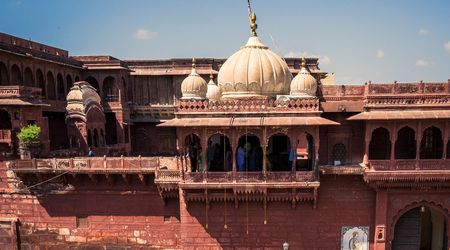
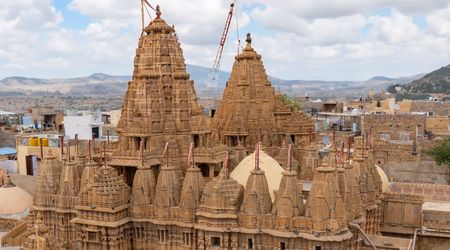
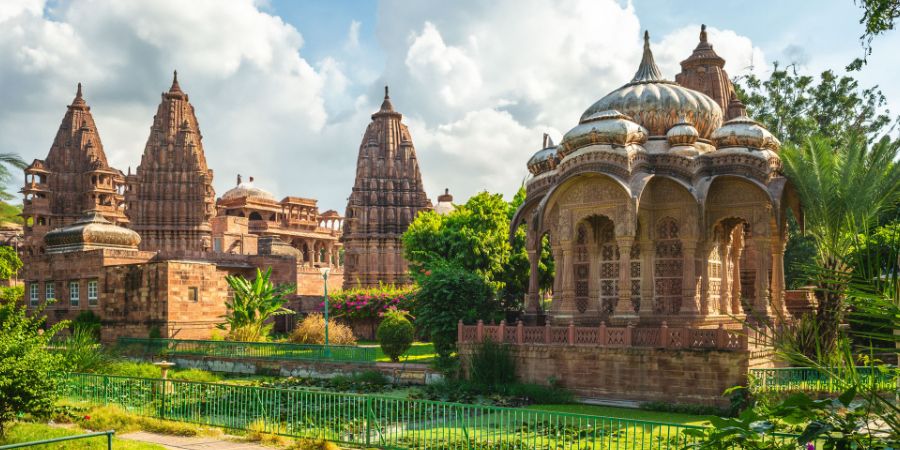
The cenotaphs themselves vary dramatically. The most elaborate ones feature multi-tiered spires, intricate jali screens, and elevated platforms that recall the chattris found at royal cremation sites across Rajasthan. The cenotaph attributed to Maharaja Ajit Singh is the largest and most ornate, a towering red sandstone structure with balconies and carved pillars that could hold its own against many standalone temples. Others are modest, almost domestic in scale — a single platform with a carved canopy, overgrown with lichen.
The monument that most visitors overlook is the small step-well tucked behind the main cluster of cenotaphs. Partially filled with silt and obscured by vegetation, it hints at Mandore's role as a functional settlement, not merely a ceremonial site. Water infrastructure doesn't photograph as well as painted gods, but it tells you more about how people actually lived in this place before it became a garden of the dead.
Where Hindu Spires Met Mughal Arches and Neither Apologized
The architectural language at Mandore Garden is deliberately hybrid. The cenotaphs don't follow a single stylistic template; instead, they reflect the Rathore court's evolving relationships with neighboring powers. The earlier structures lean toward Rajput temple forms — heavy plinths, corbelled arches, curvilinear towers. The later ones incorporate Mughal elements with increasing confidence: cusped arches, chhatri domes, geometric surface patterns derived from Islamic geometric traditions. This isn't cultural submission. It's architectural fluency.
The building material throughout is Jodhpur's signature red sandstone, quarried from the Chittar Hill area. Sandstone is forgiving for carvers — it holds detail well and weathers to a warm ochre over decades — but it also erodes faster than granite. The surface carving at Mandore, particularly on the older cenotaphs, has softened considerably. Edges that were once crisp have rounded into suggestions. This erosion gives the garden a romantic quality but represents genuine information loss: inscriptions becoming illegible, decorative motifs dissolving into smooth stone.
One design feature worth pausing at is the use of elevated platforms, or jagatis, beneath the cenotaphs. These aren't merely structural; they serve a ritual function, providing a raised surface for ceremonial activity and visually asserting the importance of the person memorialized. The height of the jagati correlates roughly with the ruler's significance — a subtle hierarchy encoded in the architecture that most visitors walk past without registering.
The carved jali screens on several cenotaphs deserve close inspection. These perforated stone panels filter light into the interior chambers, creating shifting geometric patterns on the floors. The technique is shared with Mughal and Sultanate architecture across northern India, but the specific motifs at Mandore — lotus chains, elephant processions, mounted warriors — are unmistakably Rajput in their narrative content. The form is borrowed; the stories carved into it are entirely local.
The Widow Who Built the Tallest Cenotaph and the Rebel Who Defied an Emperor
Mandore's stones carry biographical weight that no interpretive sign currently communicates. The cenotaph of Maharaja Ajit Singh, the garden's most imposing structure, memorializes a ruler whose life reads like a thriller. Born during a period of Mughal aggression against Marwar, Ajit Singh was smuggled out of Delhi as an infant in 1679 to prevent Mughal emperor Aurangzeb from converting him to Islam. The escape involved loyal retainers substituting another child — a detail that historians debate but that lives vividly in Rajasthani oral tradition. Ajit Singh spent his youth in hiding, reclaimed the throne, and was eventually murdered by his own sons in a succession dispute in 1724.
The cenotaphs also encode the lives of women who held no formal political power but shaped the built environment through patronage. Several of the smaller, more refined structures at Mandore were commissioned by queens and dowager queens as memorial acts for deceased husbands or sons. The precision of the carving on some of these smaller cenotaphs exceeds that of the larger royal memorials — a pattern that suggests these women engaged directly with the craftsmen rather than delegating through court bureaucrats.
One narrative thread that connects the garden's various eras is the role of conflict in generating construction. Nearly every major cenotaph corresponds to a ruler who died in battle, was assassinated, or navigated existential threats to the kingdom. The garden's tranquility is built, quite literally, on violence. Walk from cenotaph to cenotaph and you're tracing a sequence of deaths — some heroic, some brutal, some ambiguous — that collectively produced the Marwar state.
These stories don't announce themselves. The painted gods in the rock-cut shrines attract the selfie sticks; the cenotaphs get a passing glance. But the cenotaphs are where the human drama lives, preserved in proportions and inscriptions and placement relative to one another — a family tree expressed in stone, complete with its betrayals and loyalties.
Red Sandstone Doesn't Last Forever: The Race to Preserve Mandore
Mandore Garden faces a paradox common to Indian heritage sites: it's popular enough to sustain foot traffic but not prestigious enough to attract the conservation funding that flows to places like Mehrangarh or Amber Fort. The Archaeological Survey of India classifies some structures within the garden as protected monuments, but enforcement is inconsistent. Graffiti marks several cenotaphs. Moss and root systems from nearby trees infiltrate the stonework. The painted figures in the rock-cut shrines have been repainted multiple times with materials that likely differ from the originals, raising questions about authenticity.
Water damage presents a chronic challenge. Rajasthan's monsoon season, though brief, delivers intense rainfall. The cenotaphs lack effective drainage systems, and standing water accelerates the sandstone's decay. Some platforms show visible cracking where water has penetrated joints and expanded during temperature fluctuations. The garden's irrigation system, intended for the lawns and flower beds, adds moisture to an environment where the monuments need dryness.
Local conservation groups have pushed for a comprehensive management plan that balances the garden's recreational function with its heritage obligations. The challenge is jurisdictional: the garden falls under municipal management while the monuments fall under archaeological authority, creating bureaucratic gaps where maintenance tasks belong to nobody. A broken railing around a cenotaph can remain unrepaired for months while two agencies determine whose budget should cover it.
Tourism itself exerts pressure. Visitors climb on cenotaph platforms for photographs, lean against carved pillars, and leave food waste that attracts the monkey population whose activities further damage the stonework. The counterintuitive reality is that Mandore's relative obscurity has been a form of protection — the crowds that could fund proper conservation through ticket revenue don't arrive, and neither does the damage those crowds would bring. It's preservation through neglect, a strategy with an expiration date.
Getting to Mandore Without Getting Lost in Jodhpur's Traffic
Mandore Garden sits roughly eight kilometers north of Jodhpur's railway station, reachable by auto-rickshaw in about twenty minutes if traffic cooperates — a significant "if" on the congested Mandore Road. Agree on a fare before departing; seventy to ninety rupees is reasonable from the old city area. Local buses also run the route, departing from Jodhpur's Paota bus stand, though they're slow and crowded. If you're staying near Mehrangarh Fort, a shared jeep heading north on the Mandore road is the cheapest option.
The garden is open daily from roughly 8 AM to 8 PM, though the most comfortable visiting hours fall between early morning and 10 AM, before the heat asserts itself. Entry is free. There's a small government museum on the grounds housing sculptures and inscriptions collected from the site, worth thirty minutes if you want contextual grounding before wandering the cenotaphs. The museum charges a nominal fee of around ten rupees.
Practical considerations worth noting:
- Carry water — there are a few vendors near the entrance but nothing reliable inside the garden itself.
- Wear closed shoes if you plan to explore beyond the paved pathways, as the rocky terrain around the periphery is uneven and thorny scrub encroaches.
- The langur monkeys are not aggressive but will investigate unattended bags, especially those containing food.
- Photography is unrestricted at the monuments, though the museum may charge a small camera fee.
- Allow at least ninety minutes for a thorough visit; most tour groups spend thirty minutes and leave having seen only the painted rock-cut shrines.
Combine Mandore with a visit to the Balsamand Lake area, a few kilometers south on the return route, to fill a half-day itinerary that avoids the old city's midday intensity. The garden pairs especially well with an early-morning visit — the light through the banyans at eight o'clock turns the red sandstone almost amber, and you'll share the paths with joggers and devotees rather than tour buses.
Mandore Garden doesn't compete with Jodhpur's marquee attractions for visual spectacle, and it shouldn't try. Its value lies in something less immediately photogenic: the accumulation of centuries in a single, walkable space where political ambition, religious devotion, and family grief produced structures that outlasted the people who commissioned them. Most visitors will remember Mehrangarh's ramparts or the blue city's labyrinthine lanes. But Mandore, quiet and unmarketed, offers something those celebrated sites have been polished out of providing — the sense that you've arrived somewhere the past hasn't been cleaned up for your benefit. The cenotaphs stand exactly as their neglect and their dignity have left them, and that honesty is worth the rickshaw ride.