

The wind at Tughlaqabad carries grit. It scrapes across crumbling ramparts that rise from the dry, rocky ridge of south Delhi like broken teeth, and it deposits a fine layer of dust on everything — your hands, your camera lens, the inside of your mouth. On a Tuesday afternoon in February, I counted exactly four other visitors across a fortified area that once enclosed an entire city. A stray dog slept in what was probably a royal chamber. A kite circled overhead, riding thermals off stone walls that still stand fifteen metres high in places, seven centuries after masons laid them.
Tughlaqabad Fort is the kind of monument that forces you to recalibrate your sense of Delhi. Most visitors orbit between the Red Fort and Qutub Minar, ticking off the Mughal and Sultanate highlights that appear in every guidebook. They skip this colossal ruin sprawling across a ridge near Mehrauli-Badarpur Road, even though it predates the Red Fort by more than three hundred years and covers an area several times larger. The fort's obscurity isn't accidental. There's a curse involved, a dynasty's spectacular implosion, and a slow abandonment that turned a fortified capital into scrubland within a single generation. What remains is one of Delhi's most physically imposing and least understood monuments — a place where the scale of ambition and the speed of failure exist in the same frame.
A Sultan's Three-Year Empire Built on a Lifetime's Obsession
Ghiyasuddin Tughlaq was a soldier long before he was a sultan. He served the Khilji dynasty as a frontier commander and governor, defending the borderlands against Mongol incursions for decades. The idea of a massive fortified city on Delhi's southern ridge wasn't born from sudden imperial ambition — it grew from years of watching what happened when cities lacked proper defences. He'd seen the Mongols press against Delhi's existing walls. He understood siege warfare from the defender's side.
When Ghiyasuddin overthrew Khusrau Khan, the last of the Khilji line, in 1320 and established the Tughlaq dynasty, he moved immediately to build a new fortified capital. The site he chose — a rocky plateau south of the existing settlements — offered natural elevation and defensibility. Construction began in 1321, just a year after he took the throne. He pressed tens of thousands of labourers into service, diverting workers from other construction projects across Delhi, including the shrine being built by the Sufi saint Nizamuddin Auliya. This decision would prove consequential in ways Ghiyasuddin couldn't have predicted.
The fort and its surrounding city were completed in roughly four years, a staggering pace for a fortification of this size. Ghiyasuddin ruled from Tughlaqabad, but his reign lasted only until 1325 — just five years on the throne. He died when a hastily erected wooden pavilion collapsed on him at Afghanpur, near Delhi, while his son Muhammad bin Tughlaq welcomed him back from a Bengal campaign. Whether it was an accident or assassination remains one of medieval Indian history's persistent questions.
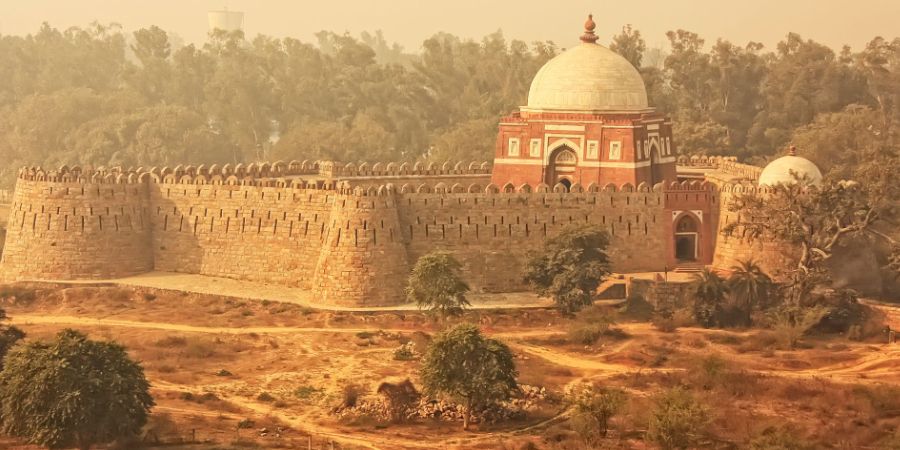
His tomb, a striking red sandstone structure with a marble dome, stands in the artificial lake bed south of the main fort, connected by an elevated causeway. It's the only part of the complex that still looks deliberate rather than ruined. The irony cuts: the tomb outlasted everything the living sultan built for the living.
Fifty-Two Gates in a Wall That Swallowed a Hill
Tughlaqabad's fortifications run for over six kilometres, enclosing an irregular polygon that follows the contours of the ridge. The walls are built from massive blocks of locally quarried stone, their surfaces left deliberately rough — no ornamental cladding, no calligraphic inscriptions, no decorative arches. This is military architecture stripped to its function. The stone is a grey-brown granite that absorbs sunlight and radiates heat well into the evening, which makes afternoon visits feel like walking through a kiln.
The fort complex divides into three distinct sections. The citadel, or inner fortress, sits at the highest point of the ridge and once contained the palace, audience halls, and administrative chambers. Below it, the main walled city spread across the slope, housing the general population, markets, and reservoirs. A third section, sometimes called the palace area of Ghiyasuddin's son Juna Khan (later Muhammad bin Tughlaq), occupies the southern portion. Contemporary accounts mention fifty-two gates, though far fewer survive in identifiable form today.
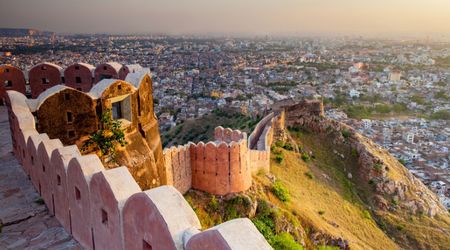
The walls themselves slope inward as they rise — a technique called battered construction that makes them resistant to undermining and battering rams. Some bastions still stand at nearly their original height, and you can climb portions of the wall where the rubble has created rough staircases. From the top, the scale becomes legible in a way it never is from ground level. You see the grid pattern of vanished streets, the depressions where reservoirs collected monsoon runoff, the stumps of towers at regular intervals.
What's absent is as telling as what remains. There's almost no decorative stonework anywhere. No jali screens, no carved brackets, no floral motifs. Ghiyasuddin built to withstand armies, not to impress courtiers. The aesthetic is pure siege mentality — a fortress that communicates power through mass and height rather than ornamentation. It makes the Mughal forts that followed it centuries later look almost theatrical by comparison.
The Saint Who Told a City to Go Thirsty
The story most visitors hear — if they hear anything at all about Tughlaqabad — involves the Sufi mystic Hazrat Nizamuddin Auliya, whose dargah in central Delhi still draws thousands daily. The conflict between Ghiyasuddin and Nizamuddin was rooted in labour, not theology. When the sultan conscripted workers for his massive construction project, he forbade them from working on any other building site, including Nizamuddin's baoli (stepwell) and shrine complex in what is now the Nizamuddin neighbourhood.
The workers, many of whom were devoted followers of the saint, reportedly continued working at the shrine by night, after their daylight shifts at Tughlaqabad. When Ghiyasuddin discovered this, he ordered the oil merchants to stop selling lamp oil to the saint's followers, cutting off their ability to work after dark. Nizamuddin, according to the tradition, blessed the water of his baoli and told his followers to use it as fuel. The lamps, the story goes, burned with water.
The curse itself is remembered in a single Urdu phrase attributed to Nizamuddin: "Ya rahe gujar, ya base Gujar" — roughly, "Either it will remain uninhabited, or the Gujjars will live here." The Gujjar pastoralists, a nomadic herding community, did eventually graze their livestock among the ruins for centuries. The prophecy, whether genuine or retroactively applied, mapped perfectly onto what happened. Tughlaqabad emptied within a generation. The Gujjars moved in with their cattle.
What's striking about this story isn't its supernatural element but its political texture. Sultanate-era Delhi was a city where Sufi orders held enormous popular influence, often exceeding that of the court itself. Ghiyasuddin's confrontation with Nizamuddin wasn't a side drama — it was a fundamental miscalculation about where real authority rested. The saint's dargah thrives seven hundred years later. The sultan's fort is rubble and silence. That asymmetry tells you everything about power in medieval Delhi that no textbook quite captures.
An Entire Capital Abandoned Before Its Mortar Fully Cured
Ghiyasuddin's death in 1325 didn't immediately doom Tughlaqabad. His son Muhammad bin Tughlaq inherited both the throne and the fortress. But Muhammad was a restless, erratic ruler whose ambitions ricocheted across the subcontinent. He shifted his capital to Daulatabad in the Deccan — roughly 1,100 kilometres south — in 1327, forcibly relocating much of Delhi's population. The move was catastrophic. Thousands died on the march. The Deccan venture collapsed. Muhammad eventually returned to Delhi, but he didn't return to Tughlaqabad. He built a new fortified area, Jahanpanah, closer to the older settlements.
The physical reasons for Tughlaqabad's abandonment compound the political ones. The fort's location on a dry ridge made water supply a persistent problem. The reservoirs that Ghiyasuddin had engineered relied on seasonal rainfall, and the rocky terrain limited well-digging. Without a reliable river or canal connection, sustaining a large urban population was always precarious. The fort was built for defence, not habitability, and the distinction mattered once the immediate military justification faded.
By the mid-fourteenth century, Tughlaqabad was effectively deserted. The stone was too massive and too roughly hewn to be easily repurposed, so unlike many Delhi monuments, it wasn't extensively plundered for building material. Firoz Shah Tughlaq, who ruled from 1351 to 1388, built his own new city — Firuzabad — along the Yamuna, and Tughlaqabad slipped further into irrelevance. The Mughal period barely acknowledged its existence.
What you see today is less a ruin than a fossil. The walls stand because no one found it worthwhile to knock them down. The interior structures collapsed from neglect, monsoon erosion, and the slow creep of thorny scrub. The fort's abandonment wasn't dramatic — no sacking, no fire, no siege. It was simply surplus to requirements, a stone city that outlived its single patron by centuries but never found another purpose. Delhi moved on. Tughlaqabad stayed.
Where Monkeys Outnumber Tourists and the ASI Sign Is Barely Legible
The Archaeological Survey of India maintains Tughlaqabad Fort, though "maintains" is doing heavy lifting in that sentence. The entry gate on Mehrauli-Badarpur Road has a ticket window (Rs 25 for Indian nationals, Rs 300 for foreign visitors as of early 2024), and a faded information board offers a site map that bears only approximate resemblance to what you'll actually encounter inside. There are no designated walking paths through the interior. No guided tours. No café, no gift shop, no audio guide. You walk in and figure it out.
This absence of infrastructure is, paradoxically, the fort's greatest asset. You scramble over rubble that hasn't been roped off or sanitised with viewing platforms. You can climb the walls in several places, though the footing is uncertain and there are no railings — a fact that would induce cardiac arrest in any European heritage site manager. The views from the ramparts take in the Qutub Minar to the west, the Bahai Lotus Temple to the north, and the Faridabad sprawl to the south. You see Delhi's geological layers laid bare: medieval fortification, post-independence housing blocks, twenty-first-century metro infrastructure, all compressed into a single vista.
The fort is best visited between October and March, when the heat is manageable and the monsoon-greened scrub makes the grey stone more photogenic. Summer temperatures on the exposed ridge routinely exceed 45 degrees Celsius, and there is no shade anywhere inside the walls. Carry water — at least two litres per person. Wear shoes with ankle support; the terrain is uneven rock and broken masonry throughout.
Monkeys are a consistent presence, particularly near the entrance. They're bold and experienced with bags. Keep food sealed and zippers closed. The real wildlife surprise is the birdlife — blue rock thrushes, spotted owlets, and Indian robins use the fort's crevices for nesting. Early morning visits, just after the gates open, offer both cooler temperatures and better birding than anywhere else in south Delhi.
The Metro Line That Drops You Seven Centuries Back
Tughlaqabad Fort sits along the Mehrauli-Badarpur Road in south Delhi, and the most efficient way to reach it is the Violet Line of the Delhi Metro. Tughlakabad station — note the slightly different transliteration — is the nearest stop. From the station exit, the fort's walls are visible to the west, roughly a ten-minute walk or a five-minute auto-rickshaw ride. Negotiate the auto fare before sitting down; Rs 30 to Rs 50 is reasonable, though drivers will initially quote double.
From central Delhi — Connaught Place or New Delhi Railway Station — the metro journey takes approximately forty-five minutes with one interchange at Central Secretariat, switching from the Yellow Line to the Violet Line heading toward Faridabad. The interchange is well-signposted and manageable even with luggage.
Reaching the fort by road from other parts of Delhi involves the following practical considerations:
- From the Qutub Minar complex, it's a twelve-kilometre drive east along Mehrauli-Badarpur Road — roughly thirty minutes in moderate traffic, closer to an hour during peak hours.
- From Humayun's Tomb, the distance is about fifteen kilometres south; auto-rickshaws and app-based cabs (Ola, Uber) serve the route reliably.
- From the airport (IGI Terminal 3), budget fifty minutes to an hour via the Outer Ring Road and MB Road. Pre-booked cabs are the least stressful option.
The fort opens at sunrise and closes at sunset — there's no artificial lighting inside, so late afternoon visits mean truncated exploration time. Parking is available in a small lot near the entrance, sufficient for about twenty cars, rarely full. The adjacent Ghiyasuddin Tughlaq tomb enclosure, across the road and connected by the remnants of the old causeway, requires a separate short walk and has its own entry point.
Pair the visit with the nearby Adilabad Fort ruins, built by Muhammad bin Tughlaq just southeast of the main fortification. It's a five-minute walk and rarely has anyone inside. Between the two sites and Ghiyasuddin's tomb, you can spend a full morning exploring a single dynasty's ambitions laid out across three adjacent hillocks — a concentration of Tughlaq-era architecture that exists nowhere else in Delhi.
Delhi has seven historically recognised cities layered beneath and beside the modern capital, and Tughlaqabad is the one that feels most honestly abandoned. The Red Fort has sound-and-light shows. Purana Qila has boating. Qutub Minar has busloads of school groups and ice cream vendors. Tughlaqabad has wind, rock, silence, and the particular melancholy of a place built to last forever that was abandoned almost immediately. It doesn't ask you to admire it. It simply refuses to disappear. Among the dozens of medieval fortifications scattered across the Indian subcontinent, few deliver a more visceral lesson in the distance between ambition and permanence than these six kilometres of wall on a dry ridge that no one bothered to defend twice.