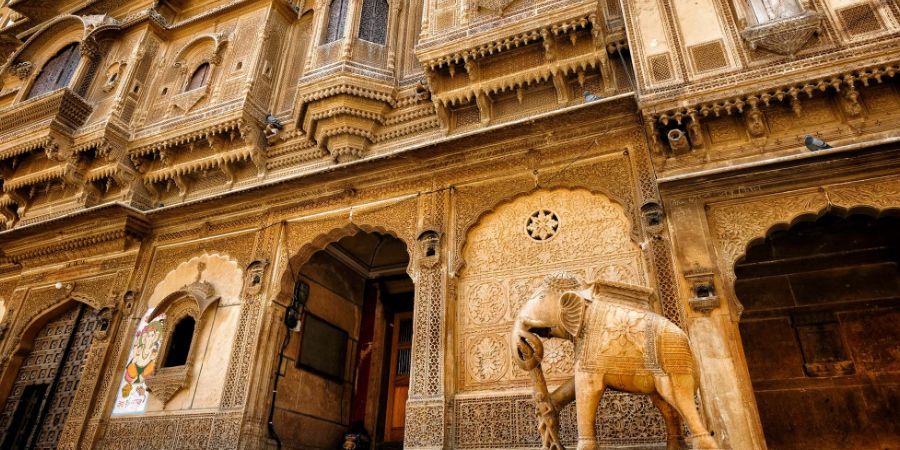


The sandstone elephants flanking the entrance have been worn smooth by a century of hands reaching out to touch them — a compulsive gesture, like rubbing a lucky coin. Stand in front of Nathmal Ki Haveli on a late afternoon in Jaisalmer, and the entire facade turns the color of burnt honey as the sun drops toward the Thar Desert. The carvings seem to shift, almost breathe: flowers you'd swear were alive, soldiers frozen mid-march, bicycles and trains that have no business appearing on a 19th-century building. This is not a palace, not a temple, not a fort. It was someone's house. That fact alone makes it extraordinary.
Jaisalmer's Golden City tag gets applied lazily to everything within the fort walls, but Nathmal Ki Haveli earns the description through sheer material honesty — it's built from the same yellow sandstone as the desert floor beneath it. What distinguishes it from the city's other grand havelis is a construction story so peculiar it sounds apocryphal, an architectural detail list that reads like a catalogue of obsession, and a political backstory that connects it to the inner workings of a Rajput princely state. The haveli sits not inside Jaisalmer Fort but in the town below, on a narrow lane where motorcycles barely squeeze past and stray cows claim the right of way. What follows is the full account of who built it, why, and what you'll actually find when you arrive.
The Prime Minister Who Built Like a King: Nathmal's Unlikely Rise
Nathmal was not royalty. He served as the Diwan — the prime minister — of Jaisalmer state during the late 19th century, under Maharawal Berisal Singh. The title carried enormous administrative weight in Rajputana's princely hierarchy: a Diwan managed revenue, settled disputes, maintained diplomatic relations with neighboring states, and essentially ran the government while the Maharawal presided. Nathmal held that position in the 1880s, and the haveli was commissioned around 1885 as his official residence.
The distinction matters. Havelis in Rajasthan were typically built by wealthy Marwari merchants — the Patwon Ki Haveli in Jaisalmer, for example, belonged to a brocade and opium trading family. Nathmal's haveli breaks that pattern. Its construction was an act of political patronage, ordered by the Maharawal himself as a reward for his minister's service. The building was meant to signal something specific: that Jaisalmer's administrative class held real power and real prestige, separate from the mercantile elite.
This political origin shaped the haveli's design. Where merchant havelis tended toward maximalist display — every surface carved, every window screened — Nathmal Ki Haveli balances ornamentation with structural boldness. The facade is imposing before it's decorative. Five stories of sandstone rise from the narrow street with a verticality unusual for domestic Rajasthani architecture. Nathmal apparently had strong opinions about how the building should present itself, and the Maharawal gave him latitude.
Little documentary evidence survives about Nathmal's personal life beyond his administrative role. His descendants still occupy portions of the haveli, which complicates its status as a heritage site. You can visit the exterior and parts of the ground floor, but the upper stories remain private — a living house wearing the disguise of a monument. That tension between habitation and preservation defines the experience of standing in its shadow.
Two Master Craftsmen, One Facade, and the Seam You Can't Unsee
The haveli's most repeated story — two brothers, Hathi and Lulu, each assigned one half of the facade — sounds like the kind of tale guides invent to justify a tip. It happens to be true, and the proof is visible. Stand directly in front of the entrance and look at the two halves of the building's face. They don't match. Not in the way that suggests sloppy work, but in the way that reveals two distinct artistic temperaments operating independently, side by side, with deliberate autonomy.
The left half favors floral motifs — vines curling into themselves, lotus blooms at various stages of opening, leaves with individually rendered veins. The right half leans toward figurative and narrative carving: soldiers, horses, elephants, and — here's the detail that stops people cold — representations of a bicycle and a steam train, objects that were just arriving in India during the 1880s. The brothers were documenting modernity in real time, translating industrial-age machines into the vocabulary of sandstone filigree.
The construction technique itself was standard for the era: chisel and mallet on Jaisalmer's native yellow limestone, a stone soft enough when freshly quarried to permit extraordinary precision but which hardens with exposure to air. What wasn't standard was the competitive dynamic between the two craftsmen. Neither brother could see the other's work-in-progress, according to local accounts. They carved simultaneously, separated by the central axis of the building.
The result is a facade that rhymes without repeating. Proportions align — window heights, cornice lines, the rhythm of jharokha balconies — but the surface language diverges. It's the architectural equivalent of two jazz musicians soloing over the same chord changes. The asymmetry isn't a flaw. It's the entire point, and once you notice it, the building becomes impossible to look at casually again.
From Seat of Power to Stone Relic: How 140 Years Reshaped the Haveli's Purpose
When the haveli was completed around 1885, it functioned as the working residence of a sitting prime minister. Petitioners would have climbed its steps, messengers arrived with dispatches, and the building's ground-floor chambers likely served as both audience halls and administrative offices. Jaisalmer in the 1880s was a remote desert principality, largely bypassed by the railways that were transforming the rest of Rajasthan. The haveli was, by local standards, a seat of government.
That function ended with Indian independence in 1947, when Jaisalmer's princely state merged into the new Republic. The Diwan's position dissolved along with the political structure that created it. Nathmal's descendants retained ownership of the building, but its civic purpose vanished overnight. For decades, the haveli existed in a kind of administrative limbo — privately owned, increasingly famous, and largely unprotected.
Tourism changed the equation slowly. Through the 1970s and 1980s, Jaisalmer began attracting backpackers drawn to the desert and the fort. The haveli appeared in guidebooks, first as a footnote, then as a highlighted stop. The Archaeological Survey of India has not taken direct control of the property, which distinguishes it from sites like the Patwon Ki Haveli, where the top floors are government-managed. Nathmal Ki Haveli remains a family property with visitor access to limited areas.
This dual identity creates friction. Restoration work competes with domestic needs. Portions of the upper facade show weathering damage that would prompt immediate intervention on a government-protected monument. The family collects a modest entry fee. You're visiting someone's home, even if the carvings on the walls belong to a craftsmanship tradition that has largely disappeared from the region. The timeline isn't just historical — it's ongoing, and unresolved.
Sandstone Lace at Five Stories: The Obsessive Detail of Nathmal's Facade
The building's exterior does nearly all the talking. Five stories of carved yellow sandstone rise from a street so narrow that you can't step back far enough to photograph the full facade without a wide-angle lens. The ground level features two large stone elephants that project from the wall on either side of the entrance — not placed in front of it, but emerging from the stone as though the wall itself grew them. They're life-sized, or close to it, and their surfaces carry the polish of thousands of palms.
Above the entrance, rows of jharokha balconies project outward on carved brackets. These are enclosed balconies with perforated stone screens — jali work — that allowed women of the household to observe street life without being seen. The jali patterns vary from window to window, each screen cut from a single slab of stone with geometric or floral perforations thin enough to filter desert light into lacework shadows inside.
The interior spaces open to visitors include chambers with painted walls and ceiling murals in mineral pigments — ochre, indigo, and a green derived from copper compounds. Some paintings depict courtly scenes; others show floral arabesques influenced by Mughal decorative traditions that filtered into Rajput architecture over centuries. The miniature painting tradition of Jaisalmer's royal court is visible in these interiors, scaled up to wall size.
Key architectural features worth examining closely include:
- Carved sandstone brackets supporting the balconies, each depicting a different animal or deity figure
- The bicycle and steam engine carvings on the right half, documenting late-19th-century technological arrivals
- Jali screens with patterns so fine that they function like stone curtains, each unique to its window
- Interior ceiling work combining Rajput painting styles with Mughal-derived geometric frameworks
The craftsmanship operates at a scale that rewards patience. Spend twenty minutes on a single window bay and you'll notice details — a bird tucked into a vine, a face half-hidden in a leaf pattern — that a quick walkthrough misses entirely.
Why a Minister's House Tells More Than a King's Fort
Jaisalmer Fort dominates every postcard, every tourism poster, every Instagram feed tagged with the city's name. The fort is a military structure first and a living space second; its walls communicate defense, sovereignty, and the strategic anxiety of a desert kingdom sitting on trade routes between India and Central Asia. Nathmal Ki Haveli communicates something different: the texture of civilian life among Jaisalmer's administrative elite during the last full century of princely rule.
Domestic architecture preserves what political architecture deliberately obscures — taste, comfort, daily habit, the negotiation between public display and private living. The haveli's ground-floor chambers were built to receive visitors, which explains their ceiling height and painted walls. The upper floors, still occupied, were designed for family life: smaller rooms, more intimate proportions, ventilation systems suited to desert heat. The building's form maps directly onto a social hierarchy that placed governance on the ground and domesticity above it.
The carvings of a bicycle and a steam train carry a specific cultural weight. Jaisalmer in the 1880s was deeply isolated — the railway wouldn't reach the city until 1968. These images represent not technology the builders had used, but technology they had heard about, possibly seen in illustrations or during travels to larger cities. The craftsmen were carving aspiration and curiosity into stone, embedding modernity into a medieval vocabulary. That impulse — to absorb the unfamiliar and translate it into local artistic language — is arguably more revealing than any fort wall.
The haveli also sits within the broader tradition of Rajasthani merchant and administrative havelis that functioned as status declarations. In Shekhawati, painted havelis served the same purpose for trading families. In Jaisalmer, sandstone carving replaced painting as the primary medium of display, a choice dictated by material availability and craft tradition stretching back centuries.
What to Know Before You Walk Through the Elephant Gate
The haveli operates on an informal schedule. Expect the exterior courtyard and ground-floor rooms to be accessible roughly between 8:00 AM and 6:00 PM, though these hours shift with season and the family's discretion. There is no fixed closure day. Entry fees are modest — typically around 50 to 100 Indian rupees for foreigners, less for Indian visitors — collected by family members or an attendant at the door. No online booking system exists. You show up, you pay, you enter.
Photography is generally permitted on the exterior and in the open ground-floor areas, but ask before pointing a camera at the interior rooms. Some family members are protective of painted chambers that remain in domestic use. Tripods and professional equipment may draw restrictions. The narrow street outside makes exterior photography difficult during midday when foot traffic and parked vehicles crowd the approach. Early morning light — around 7:30 to 8:30 AM — hits the facade at the right angle and avoids the worst of the crowds.
Practical considerations worth noting:
- Wear shoes you can slip off quickly, as you'll be asked to remove them in certain interior spaces
- The street approach is uneven sandstone with no ramp access — wheelchair users will face significant difficulty
- No food or drink vendors operate immediately at the haveli; carry water in the summer months
- Guides loiter near the entrance and offer explanations for negotiable fees — some are well-informed, others recite a memorized script
A visit takes 30 to 45 minutes if you examine the carvings carefully. Most tourists pass through in 15. The difference between a rushed visit and a slow one is the difference between seeing a building and reading it. Budget the extra time.
Finding Your Way to a Narrow Lane Below the Fort
Nathmal Ki Haveli sits in the old town area of Jaisalmer, below the fort, on a lane called Goverdhan Chowk. It's roughly 500 meters from the fort's main gate — a walk of about ten minutes through lanes that grow progressively narrower as you move deeper into the residential quarter. No bus stops directly at the haveli. Auto-rickshaws from Jaisalmer's main market or Hanuman Circle will drop you at the nearest intersection for 30 to 50 rupees, but the final approach is pedestrian only.
If you're arriving from outside the city, Jaisalmer's railway station lies about 2 kilometers southeast of the old town. The 1968 rail connection links to Jodhpur, which in turn connects to Delhi, Mumbai, and Jaipur via major junction routes. The Jodhpur-Jaisalmer route takes roughly five to six hours on an express train, and the overnight Delhi-Jaisalmer service covers the distance in approximately 18 hours. Jaisalmer's airport handles limited domestic flights, primarily seasonal connections to Delhi and Jaipur — check current schedules, as these routes appear and disappear depending on demand.
From the railway station, an auto-rickshaw to Goverdhan Chowk costs around 100 to 150 rupees. Taxis are available but not always metered. Most hotels in the old town sit within walking distance of the haveli — if you're staying near the fort or in one of the heritage guesthouses along the lower lanes, you won't need any transport at all. Google Maps marks the location accurately, which is more than can be said for some Jaisalmer landmarks.
The approach through the old town is part of the experience. Sandstone walls close in on both sides, overhead cables form a loose net, and the sound shifts from traffic to conversation as you move away from the main road. You'll know you're close when the elephants appear.
The Desert Calendar: When Sandstone Looks Best and Heat Won't Flatten You
October through March defines the comfortable window. Jaisalmer sits in the Thar Desert, and from April through June, daytime temperatures climb past 45 degrees Celsius with regularity. Standing in an unshaded lane staring at a stone facade in that heat isn't tourism — it's endurance training. The monsoon months of July through September bring sporadic rain that clears the dust and softens the light, but also humidity that Jaisalmer's dry-adapted infrastructure handles poorly. Drainage in the old town lanes is improvised at best.
November and December deliver the clearest skies and the best photographic conditions. Morning temperatures hover around 8 to 12 degrees, which feels genuinely cold if you've just arrived from tropical India. The low-angle winter sun makes the sandstone glow in a way that justifies every golden-city cliche. February marks the Jaisalmer Desert Festival, a government-organized event that fills the city with tourists, camel races, and folk performances — if you want the haveli to yourself, avoid the festival dates.
The sweet spot for visiting the haveli specifically is a weekday morning in late November or early December. Tour groups tend to arrive between 10:00 AM and 1:00 PM; by arriving at 8:00 AM, you'll have the facade largely to yourself for the first hour. The light at that time rakes across the carvings at a sharp angle, throwing every chisel mark into relief and making the asymmetry between the two halves unmistakable.
Late afternoons work well too, especially around 4:00 PM when the western sun turns the upper stories a deep amber. The temperature has dropped but the light hasn't gone flat. This is when the elephants at the entrance cast their longest shadows — a detail worth planning around if you're carrying a camera.
What Else Waits Within a Fifteen-Minute Walk
Patwon Ki Haveli sits roughly 300 meters away, the largest and most elaborately carved haveli complex in Jaisalmer. Five separate havelis built by the five sons of Guman Chand Patwa, a wealthy brocade trader, the complex offers a useful contrast to Nathmal Ki Haveli: merchant wealth versus administrative prestige, maximalist carving versus selective ornamentation. The top floors are government-managed and house a small museum of carved artifacts and period furnishings.
Salim Singh Ki Haveli, also within the old town, stands about 400 meters south. Its distinctive arched roof — shaped like an inverted boat — marks it on the skyline before you reach it. The upper stories overhang the street on carved brackets, and the building's narrow, vertical proportions feel more aggressive than Nathmal Ki Haveli's balanced facade. Together, the three havelis form an unofficial circuit that most visitors complete in a half day.
Jaisalmer Fort looms above everything. A living fort — roughly a quarter of Jaisalmer's population still resides within its walls — it contains Jain temples from the 12th and 15th centuries whose marble carvings rank among the finest in western India. The fort's Raj Mahal palace museum offers painted rooms and illustrated manuscripts. The walk from Nathmal Ki Haveli to the fort's main gate takes ten minutes uphill.
Other sites worth considering include:
- Gadisar Lake, a medieval rainwater reservoir about a kilometer south, ringed by temples and ghats
- The Thar Heritage Museum, a private collection assembled by a local historian, covering desert life and Jaisalmer's princely-era material culture
- Bada Bagh, a cluster of royal cenotaphs six kilometers north of town, best visited at sunset
The havelis of Jaisalmer reward slow accumulation. See one and you've seen a beautiful building. See three and you begin to understand a civilization's relationship with stone, space, and the display of power through domestic architecture.
Most heritage sites in Rajasthan belong to kings, generals, or gods. Nathmal Ki Haveli belongs to a bureaucrat — a man who governed, not conquered — and that distinction shapes everything about the building's character. It is less theatrical than a palace, more personal than a fort, and more architecturally honest than a temple. The fact that descendants still live behind those carved walls keeps the haveli suspended between monument and home, between the deep past and the difficult present of preservation in a city where tourism and daily life grind against each other in every narrow lane. Jaisalmer has no shortage of sandstone to admire. But only here will you find two brothers' competing visions still arguing silently across a single facade, their disagreement preserved in stone long after everything else about them has been forgotten.