

Birla Mandir isn't Delhi's oldest sacred site, nor its grandest. What it is, and what keeps drawing people who aren't particularly devout, is something harder to quantify — a place where industrial-age philanthropy, inter-war architecture, and a genuine democratic impulse converge in a city that rarely lets those things coexist. This piece covers the history, architecture, practical logistics, and the unwritten rules that will determine whether your visit feels like a pilgrimage or a frustrating miscalculation.
The Temple That Doesn't Need a Guidebook — But You'll Want One Anyway
Most visitors to Delhi build itineraries around the obvious monuments: Red Fort, Humayun's Tomb, Qutub Minar. These are Mughal-era sites, and they dominate because guidebooks favor age and imperial grandeur. Birla Mandir, completed in the twentieth century, often gets relegated to an afterthought — something to see if you have a spare afternoon. That's a miscalculation worth correcting.
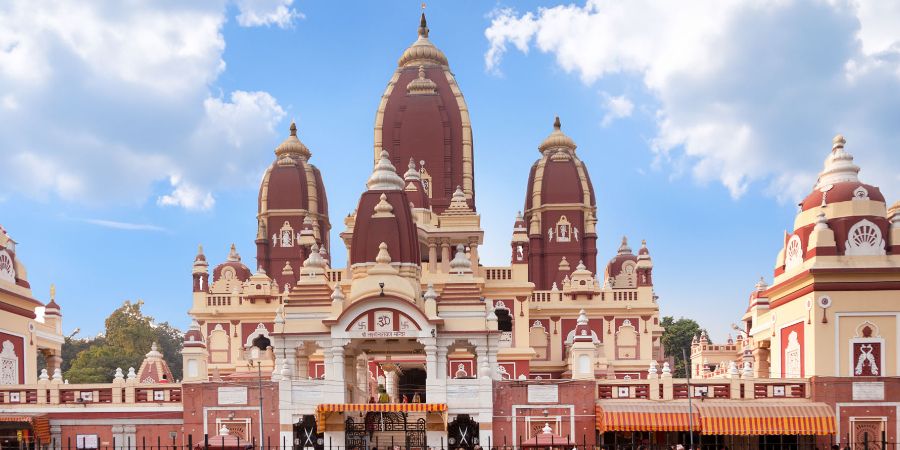
The temple occupies a 7.5-acre site on a slight rise along Mandir Marg, near Connaught Place. Unlike the fortified enclosures of older Delhi monuments, the grounds here function as a public garden, open and unguarded in atmosphere. Families spread out on the grass. Elderly men read newspapers on benches shaded by neem trees. The temple itself rises from this greenery with three spires visible from blocks away, painted in a shade of saffron that deepens to ochre under the late afternoon sun.
What makes Birla Mandir worth your time isn't spectacle — it's texture. The carvings on the exterior walls depict scenes from the Bhagavad Gita, the Ramayana, and episodes from the life of the Buddha, all rendered in a style that owes as much to Art Deco sensibility as to classical Hindu iconography. You'll find inscriptions in Hindi and English running along the interior walls, quoting scriptures from multiple traditions. The temple was designed, deliberately, to be legible to visitors who don't share its faith.
For travelers exhausted by the relentless density of Old Delhi, or underwhelmed by the antiseptic grandeur of Lutyens' Delhi, Birla Mandir offers a different register entirely. It's neither ancient nor modern, neither ostentatious nor humble. It sits in a peculiar middle ground that tells you more about twentieth-century India's aspirations than a dozen Mughal tombs ever could.
Sandstone, Visiting Hours, and the One Thing Nobody Mentions About Shoes
Birla Mandir opens daily from 4:30 a.m. to 1:30 p.m., then reopens at 2:30 p.m. and stays open until 9:00 p.m. That midday closure catches first-time visitors off guard, especially those who arrive around noon expecting a quick look. Plan accordingly. The temple sits on Mandir Marg, directly west of Connaught Place, and the nearest metro station is RK Ashram Marg on the Blue Line, roughly a ten-minute walk.
Entry is free. No tickets, no queues, no timed slots. Photography is not permitted inside the temple building itself, though you can photograph the exterior and the gardens without restriction. The temple's construction used red sandstone and white Makrana marble — the same marble that clads the Taj Mahal — which gives the structure an unexpected luminosity at dusk when the floodlights hit the spires.
The shoe situation deserves specific mention. You must remove footwear before entering, and while there is a counter near the entrance where attendants will hold your shoes, the process can take several minutes during peak hours, particularly on Tuesday and Saturday evenings when devotional crowds swell. Carry socks. The marble floors inside stay cool even in May, but the stone courtyard outside, baked by hours of summer sun, can burn bare feet badly enough to make you hop.
There are no food vendors inside the complex, and you won't find a cafeteria. Water fountains exist near the entrance, but bringing a sealed bottle is wise, especially between March and October. The gardens close at the same time as the main temple. A visit — including a slow circuit of the exterior carvings — takes roughly forty-five minutes to an hour.
A Jute Baron's Vision and Gandhi's One Non-Negotiable Demand
Jugal Kishore Birla, a member of the Birla industrial family whose fortune came from jute, textiles, and cement, commissioned the temple in the early 1930s. The architect was Sris Chandra Chatterjee, a Bengali designer who had spent years studying the mathematical proportions of medieval Hindu temples and believed that modern India needed sacred architecture that spoke in contemporary idioms without abandoning classical grammar. Construction began in 1933 and took six years.
The Birla family invited Gandhi to inaugurate the temple on its completion in 1939. He agreed, but attached a condition that turned a routine ribbon-cutting into a political act. Gandhi insisted the temple remain open to Dalits and people of all castes — a radical demand at a time when many Hindu temples in India enforced strict caste-based entry restrictions. The Birlas accepted. On the inauguration day, Gandhi walked through the doors alongside Dalit community members, a gesture the press covered extensively.
This history matters because it shaped the temple's identity permanently. Birla Mandir never became a site of orthodox Hindu practice in the exclusionary sense. The inscriptions on its walls quote the Quran and the Bible alongside the Vedas. A small section near the rear of the complex features carvings of the Buddha. The temple functions, in practice, as a multi-faith space built on Hindu architectural foundations — an unusual combination in 1939 and still an unusual one now.
The Birla family went on to build similar temples in other Indian cities — Hyderabad, Jaipur, Kolkata — but the Delhi temple remains the original, and the one most tightly bound to the independence movement's idealism. You can feel that idealism in the architecture's openness: no barriers, no gatekeepers, no hierarchy of access.
Where Konark Meets Nagara — And Neither Wins
Sris Chandra Chatterjee didn't copy a single precedent. He pulled from the Nagara temple tradition of northern India — characterized by a curvilinear shikhara tower that tapers to a point — and grafted onto it elements borrowed from the Orissan temple style of eastern India, particularly the tiered, ribbed tower form seen at Konark and Bhubaneswar. The result is a structure that feels familiar to anyone who's visited Hindu temples across the subcontinent but doesn't quite match any of them.
The main shikhara rises approximately 160 feet, flanked by two smaller towers. The proportional relationship between these three spires follows ratios Chatterjee derived from the Shilpa Shastras, ancient treatises on Hindu temple construction. But look closely at the decorative panels and you'll spot deviations that no medieval text would sanction: geometric patterns that echo Art Deco motifs, floral borders with a distinctly Edwardian sensibility, and figural carvings rendered with a naturalism that owes more to the Bengal School of Art than to any temple-carving guild.
The interior is organized around a central shrine dedicated to Lord Narayan (Vishnu) and Goddess Lakshmi, with side shrines for Lord Shiva, Lord Krishna, and the Buddha. The walls carry painted and carved panels depicting scenes from Hindu epics, but the palette — muted greens, dusty reds, and cream — feels restrained compared to the riot of color inside South Indian temples. The effect is contemplative rather than overwhelming.
Chatterjee's most counterintuitive decision was the use of Makrana marble for the exterior cladding alongside Kota sandstone. White marble signals Mughal architecture in the Delhi imagination, not Hindu temples. By combining it with the red sandstone associated with Rajput and Hindu building traditions, Chatterjee created a structure that visually refuses to belong to a single architectural lineage — an appropriate choice for a temple built to reject exclusion.
No Leather, No Phones, and the Unspoken Rule About Lingering
Birla Mandir enforces a dress code, though not in the way that, say, the Vatican does. There are no signs specifying hemline lengths. The expectations are implicit and culturally enforced rather than officially policed. Wear clothing that covers your knees and shoulders. Sleeveless tops and short skirts will attract disapproving stares from regular worshippers, and temple attendants may quietly ask you to cover up. Carrying a scarf or shawl in your daypack solves this problem entirely.
Leather items — belts, bags, wallets — are officially prohibited inside the sanctum. In practice, enforcement is inconsistent: you might walk through with a leather watchband and nobody blinks, or you might be stopped at the inner entrance and asked to leave your bag at the shoe counter. The safest strategy is to carry a cloth or canvas bag and leave leather goods in your hotel. Phones and cameras must remain off and stowed inside the temple; this rule is enforced strictly, and attendants will approach you if they see a screen glowing.
The unspoken rule concerns time. Birla Mandir is an active place of worship, not a museum. During aarti ceremonies — the evening one, around 7:30 p.m., is particularly attended — the atmosphere shifts from touristic to devotional. Standing at the back with a respectful posture is welcome. Wandering through the shrine area during prayers, examining carvings while devotees are mid-prostration, is not. Read the room. If the hall is thick with incense smoke and the sound of bells, stand still or step outside.
One detail that surprises Western visitors: there is no collection box pressure, no suggested donation sign, no guilt mechanism. The Birla family endowed the temple's maintenance. You're a guest here, not a customer, and the absence of commercial apparatus gives the visit a quality that many religious sites in heavily touristed cities have lost.
Three Metro Lines, Two Auto-Rickshaw Scams, and One Pleasant Walk
RK Ashram Marg station on the Blue Line drops you closest to Birla Mandir — about 800 meters on foot, heading south along Panchkuian Road before turning onto Mandir Marg. The walk takes ten to twelve minutes, passes a row of printing shops and tea stalls, and deposits you at the temple's eastern gate. If you're coming from the Yellow Line, Patel Chowk station works, though the walk is longer and less direct, threading through the edge of Connaught Place's inner circle.
Auto-rickshaws from Connaught Place will take you there for forty to sixty rupees if you negotiate before sitting down. The two common scams to watch for: drivers who claim the temple is closed (it isn't; they want to reroute you to a souvenir shop) and drivers who "don't know" Birla Mandir but recognize "Laxminarayan Mandir" — the temple's official name — and charge a premium for the confusion. Use the name Laxminarayan Mandir and agree on the fare before departure.
Ride-hailing apps like Uber and Ola function reliably in this part of Delhi and eliminate the negotiation entirely. Drop-off happens on Mandir Marg itself; there's no dedicated parking lot, but vehicles can idle briefly along the road. If you're driving, paid street parking exists along the north side of Mandir Marg, though spaces fill fast on weekends and festival days.
The most enjoyable approach, if the weather allows it, is walking from Connaught Place. The route takes about twenty minutes, passes the Hanuman Mandir at the intersection of Baba Kharak Singh Marg and Ashoka Road, and gives you a sense of how Delhi's sacred and commercial geographies overlap without any planning commission ever intending them to. You arrive at Birla Mandir having already understood something about the city that a taxi ride would have hidden from you.
Birla Mandir won't rearrange your understanding of Indian architecture or leave you staggering with spiritual revelation. It does something subtler and, for the right visitor, more lasting: it shows you a moment in India's history when a wealthy family, a freedom fighter, and an architect agreed that a building could embody an argument — that sacred space belongs to everyone. In a city saturated with monuments to power, this one was built around an idea of access. Every open gate, every multilingual inscription, every absent velvet rope carries that argument forward. The next time someone tells you Delhi's temples are interchangeable stops on a package tour, you'll know they never stood in the evening light on Mandir Marg and watched the marble turn gold.