

Neelkanth Mahadev Temple sits at the confluence of the Pankaja and Madhumati rivers in the Garhwal hills of Uttarakhand, roughly 32 kilometers from Rishikesh by road.Pilgrims and trekkers arrive here in roughly equal numbers, though their motivations diverge sharply at the gate. For devotees of Shiva, this is the place where the universe was saved — where the god swallowed poison and his throat turned blue. For trekkers, it's an excuse to spend four hours walking uphill through sal forest and across river crossings that can turn treacherous during monsoon. Both groups converge at the same courtyard, remove their shoes on the same cold stone, and stand before the same lingam inside a sanctum that smells of ghee and damp centuries.
Before the Temple Stood: What Occupied This Ridge in the Garhwal Hills
Pinning down the historical origins of Neelkanth Mahadev requires accepting a certain amount of fog. The Garhwal region has been a center of Shaivite worship for centuries, and the site itself — perched between two small rivers in dense forest — carries the geological and spiritual markers that have drawn Hindu ascetics since at least the early medieval period. Hot and cold springs emerge from the ground near the temple, a feature that across the Indian subcontinent has almost always attracted religious significance.
References to the Neelkanth site appear in various Puranic texts, though scholars debate the specificity of these mentions. The name "Neelkanth" — literally "blue throat" — ties the location directly to the Samudra Manthan episode described in the Vishnu Purana, the Bhagavata Purana, and the Mahabharata. Whether a formal structure existed here during the period these texts were compiled remains an open question. What's more certain is that the surrounding hills have served as retreat grounds for sadhus and wandering ascetics for a long time, and the natural springs gave the site a functional purpose beyond the symbolic.
The Garhwal Kingdom, which controlled this territory for several centuries before British annexation in 1815, maintained numerous temples across the region. Many were destroyed by natural disasters — earthquakes and landslides are routine in this part of the Himalayas — and rebuilt multiple times. Neelkanth Mahadev almost certainly went through similar cycles of destruction and reconstruction, which makes any single founding date misleading.
The temple's survival owes as much to geography as to devotion. Its position inside what is now a protected forest meant it was never swallowed by urban expansion or commercial development, which preserved both its isolation and its atmosphere. That remoteness, paradoxically, is what kept it intact while more accessible shrines were modified, expanded, or absorbed into larger religious complexes. The forest acted as a kind of accidental conservator.
The Builders Nobody Can Quite Name: Tracing Neelkanth's Earliest Construction
No single ruler or dynasty has been definitively credited with building the original Neelkanth Mahadev Temple, and anyone who tells you otherwise is simplifying a complicated record. The Garhwal kings — the Panwar dynasty that ruled from Srinagar (the Garhwal capital, not the Kashmiri city) — are the most likely patrons, given their well-documented tradition of temple construction across the region. Several temples in the Garhwal hills bear inscriptions linking them to Panwar rulers, but Neelkanth's inscriptional evidence, if it ever existed, has not survived in a form that modern historians can work with.
The current structure is relatively modern. Much of what you see today dates from renovation work carried out in the twentieth century, including the colorful exterior panels and the entrance gateway. The Archaeological Survey of India has not classified Neelkanth Mahadev as a protected monument, which tells you something about the age of its visible fabric. The sanctum — the innermost chamber housing the Shiva lingam — is the oldest surviving element, though even this has been repaired and resurfaced over the years.
What complicates the question further is the temple's location inside a forest reserve. Systematic archaeological surveys of the kind conducted at more accessible sites have not been carried out here with the same rigor. Local oral histories attribute the shrine's founding to various periods, sometimes stretching back thousands of years, but oral tradition and verifiable chronology are different things. The honest answer is that the site is old, the worship is old, and the building has been replaced or rebuilt often enough that "who built it" is really a question about which version you're asking about.
The temple's lack of a tidy origin story doesn't diminish it. If anything, the ambiguity makes the place feel less curated and more genuinely lived-in — a shrine that exists because people kept coming back to it, not because a king needed a monument.
Poison, a Blue Throat, and the Story That Gives This Place Its Name
The legend of Neelkanth is one of Hinduism's most dramatic episodes, and the temple exists as a geographic anchor for it. The story centers on the Samudra Manthan — the churning of the cosmic ocean — in which the devas and asuras cooperated to extract amrita, the nectar of immortality. Before the nectar emerged, the churning released Halahala, a poison so virulent it threatened to destroy all creation. No being, divine or mortal, could contain it. Shiva stepped forward and drank the poison. Parvati, his consort, pressed her hand against his throat to prevent the poison from descending into his body. The Halahala remained lodged in his throat, turning it blue. Hence: Neelkanth, the blue-throated one.
The temple marks the spot where, according to tradition, this act took place. The geographical claim is significant. Several sites across India assert a connection to the Samudra Manthan, but Neelkanth Mahadev's position in the upper Garhwal — close to the sources of the Ganges, deep in a region already dense with Shaivite mythology — gives it a particular gravity. The presence of the natural springs at the site reinforces the association; the mingling of hot and cold water is interpreted by devotees as a physical remnant of the cosmic event.
The legend shapes every ritual performed at the temple. Devotees pour water and milk over the lingam in direct reference to the cooling of Shiva's throat. The abhishek isn't decorative — it's narrative. You're watching people re-enact a cosmological rescue mission, one ladle of milk at a time. The myth also explains why the temple draws its largest crowds during Maha Shivaratri, the night dedicated to Shiva, when the poison-swallowing episode is recounted in prayers and bhajans that echo through the forest well past midnight.
Strip away the theology, and the story is about sacrifice — about one being absorbing collective poison so others don't have to. That resonance isn't lost on the pilgrims who climb here.
Twelve Kilometers of Forest Between You and the Shrine
Neelkanth Mahadev sits inside the Rajaji National Forest, approximately 32 kilometers from the center of Rishikesh by the motorable road that winds up through the hills. The temple occupies a ridge between the Pankaja and Madhumati rivers — two modest streams that converge just below the temple complex. The elevation is roughly 1,330 meters, which places it about 900 meters above Rishikesh's riverside ghats. The climb is real. You feel it in your ears and your lungs.
The surrounding forest is predominantly sal, mixed with teak and scattered bamboo groves. During the monsoon months, from July through September, the canopy thickens into a near-continuous green ceiling, and the trail — for those who walk — becomes slick with red mud and fallen leaves. Wildlife in the Rajaji reserve includes elephants, leopards, and several species of deer, though sightings near the temple are uncommon due to foot traffic. Langurs are the exception; they sit on the temple walls with proprietary confidence.
The location creates a paradox that defines the experience. You're visiting a temple that feels remote — surrounded by dense forest, accessible only by a narrow hill road or a four-hour trek — yet it sits barely an hour's drive from one of India's most visited spiritual tourism hubs. The forest acts as a buffer, filtering out the commercial noise of Rishikesh's Laxman Jhula area. By the time you reach the temple clearing, the yoga studios and German bakeries feel like they belong to a different country.
The twin rivers below the temple provide the water for the kund — the bathing pool where pilgrims immerse themselves before entering the sanctum. The water is cold enough in winter to make you gasp. In summer, it's merely bracing. The setting is the temple's first argument: you've earned this place by traveling to it.
Dravidian Bones Under Garhwal Paint: How the Temple Looks and Why
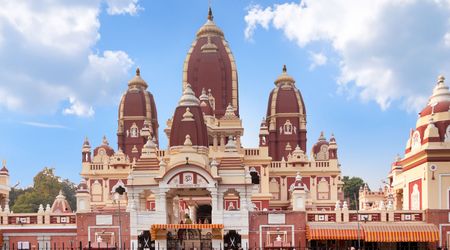
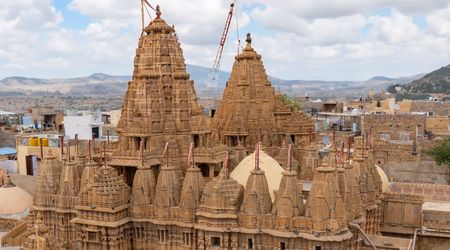
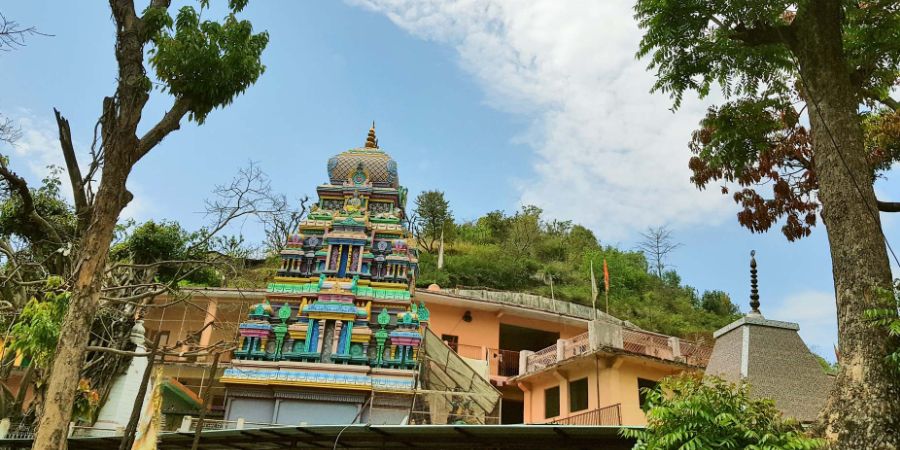
The architecture of Neelkanth Mahadev blends South Indian temple elements with the decorative impulses of the modern Garhwal hills, and the combination is more jarring than harmonious — which is part of its character. The shikhara, or tower, above the sanctum follows a broadly Dravidian form: tiered, tapering, with horizontal divisions rather than the curvilinear profile typical of Nagara-style North Indian temples. This is unusual for Uttarakhand, where most Shiva temples follow northern architectural conventions, and no one has offered a fully satisfying explanation for why Neelkanth diverges.
The exterior walls are covered in brightly painted panels depicting scenes from the Samudra Manthan, the life of Shiva, and various Puranic episodes. These panels are clearly modern — the paint colors are synthetic, the figures outlined in bold black — and they give the temple the appearance of a devotional comic strip rendered in three dimensions. Purists may wince, but the panels serve a functional purpose: they narrate the legend to pilgrims who may not read Sanskrit or Hindi texts. The temple is a teaching tool as much as a worship space.
Inside the sanctum, the scale contracts sharply. The lingam sits in a small, low-ceilinged chamber that forces you to bow simply to enter. The stone is dark, perpetually wet from continuous abhishek, and the air is thick with the smell of ghee, sandalwood paste, and bilva leaves. There's no ornamentation inside — the contrast with the vivid exterior is deliberate, or at least effective. You move from spectacle into silence within the space of a few steps.
The courtyard surrounding the main shrine includes smaller sub-shrines and the natural spring that feeds into the bathing kund. The architectural modesty of the complex — no towering gopurams, no marble courtyards — reinforces the sense that this temple grew organically around its site rather than being imposed upon it.
What Happens to You Between the Kund and the Sanctum Door
The spiritual experience at Neelkanth Mahadev is structured by the physical sequence of arrival: trek or drive, descend to the kund, bathe, climb the steps, enter the courtyard, remove your shoes, wait in line, and then enter the sanctum. Each stage peels away a layer of whatever you brought with you. The bathing kund, fed by the natural spring, is the first real threshold. The water is cold enough to make thought difficult. Your body takes over. By the time you step out and dry off, the mental chatter that accompanied you up the hill has gone quiet.
The line to enter the sanctum moves slowly, especially during peak pilgrimage seasons and on Mondays — Shiva's day in the Hindu calendar. The wait isn't wasted time. You stand barefoot on stone that has been worn smooth by decades of feet. Around you, people chant "Om Namah Shivaya" at different tempos and volumes, creating an uncoordinated drone that works better than any organized chorus could. The sound fills the courtyard and bounces off the painted walls.
Inside, the darshan is brief. A priest guides your offering — milk, water, bilva leaves — onto the lingam, and you're moved along. The brevity is the point. You don't linger in the presence of the divine; you pass through it. The moment is compressed, almost pressurized, and whatever you feel — peace, awe, confusion, nothing at all — arrives without preamble. There's no guided meditation, no explanatory placard. The temple assumes you know why you're here, or that you'll figure it out after you leave.
The counterintuitive thing about Neelkanth's spiritual atmosphere is that it intensifies after you exit the sanctum. Sitting in the courtyard afterward, watching the next group of pilgrims shuffle forward, you process the experience retroactively. The temple gives you the raw material. The meaning, you assemble on your own time.
Four Hours Uphill or Forty Minutes Clinging to a Jeep Seat
Two routes lead to Neelkanth Mahadev from Rishikesh, and neither is casual. The motorable road runs approximately 32 kilometers from the city center, climbing through switchbacks that tighten as the forest thickens. Shared jeeps and taxis operate from near Ram Jhula, and the ride takes roughly 40 to 50 minutes depending on traffic, weather, and your driver's relationship with the concept of lane discipline. The road is paved but narrow, and during monsoon it's occasionally blocked by landslides or fallen trees. There are no guardrails on the exposed sections. You either make peace with that or you walk.
The trekking route begins near the Swarg Ashram area of Rishikesh and covers roughly 12 to 14 kilometers, depending on which trail variant you follow. The path crosses the Nar Singh and Neelkanth ranges through sal forest, with elevation gain distributed unevenly — the steepest sections come in the final third. Small chai stalls appear at intervals along the route, selling tea and biscuits at altitude-adjusted prices. The trek takes between three and a half and five hours, depending on fitness, season, and how many times you stop to let your heart rate normalize.
- Carry at least two liters of water per person; refill points are unreliable beyond the first few kilometers.
- Wear shoes with actual tread — the trail is loose rock and packed earth, slippery when wet.
- Start before 7 a.m. if trekking, especially in summer, to avoid the midday heat on exposed sections.
- The return trek is harder on the knees than the ascent is on the lungs; trekking poles help.
Most pilgrims take the jeep up and walk down, which is a reasonable compromise. The descent offers forest views the jeep road doesn't, and your knees will remind you of the trip for about two days afterward.
Getting There, Getting In, and Getting the Timing Right
The nearest major transit hub is Dehradun, about 45 kilometers from Rishikesh. Jolly Grant Airport in Dehradun handles daily flights from Delhi, and the Dehradun railway station connects to most major Indian cities. From Dehradun, taxis and buses reach Rishikesh in roughly an hour. Once in Rishikesh, shared jeeps to Neelkanth Mahadev depart from near Ram Jhula and Swarg Ashram; expect to pay between 50 and 150 rupees per seat for the shared ride, or considerably more for a private hire.
The temple opens daily, typically from early morning — around 4 or 5 a.m. — until 8 or 9 p.m., though these hours shift seasonally and during festivals. Maha Shivaratri, usually in February or March, draws the largest crowds; the temple stays open through the night, and the road becomes a slow-moving procession of vehicles and foot traffic. If you want a contemplative experience, avoid Shivaratri and visit on a weekday morning outside of holiday periods.
The best months for visiting are October through March, when the weather is cool and the skies are clear enough to see the surrounding ridgelines. April and May are hot at lower elevations but tolerable at the temple's altitude. The monsoon — July through September — makes the trek genuinely risky and occasionally closes the road. The forest is most beautiful during and just after the rains, but that beauty comes with practical hazards including leeches, flash flooding of river crossings, and reduced visibility.
- Carry cash; there are no ATMs near the temple and most vendors don't accept digital payments.
- Dress modestly — covered shoulders and knees — as the temple enforces a conservative dress standard.
- There's no overnight accommodation at the temple; plan to return to Rishikesh the same day.
- Mobile network coverage is patchy above the tree line; don't rely on GPS for the trek.
Food options at the temple are limited to a few stalls selling prasad, chai, and simple snacks. Eat a proper meal before you leave Rishikesh.
Neelkanth Mahadev doesn't exist to make your visit convenient. It exists in the forest because that's where the story happened — or where people decided the story happened, which amounts to the same thing over enough centuries. The temple asks you to adjust to it: to climb, to bathe in cold water, to stand in line on bare stone, to accept a three-second darshan after a four-hour effort. Rishikesh has become a place where spirituality is increasingly packaged for consumption — curated, timed, monetized. Neelkanth resists that. The forest road is too narrow for tour buses. The trek is too long for an afternoon excursion between yoga classes. The temple itself offers no Wi-Fi, no gift shop, no interpretive center. What it offers instead is a direct transaction: you bring your body and your attention, and the place does the rest. Every temple in India claims to be sacred; this one makes you work hard enough to arrive that you might actually believe it.