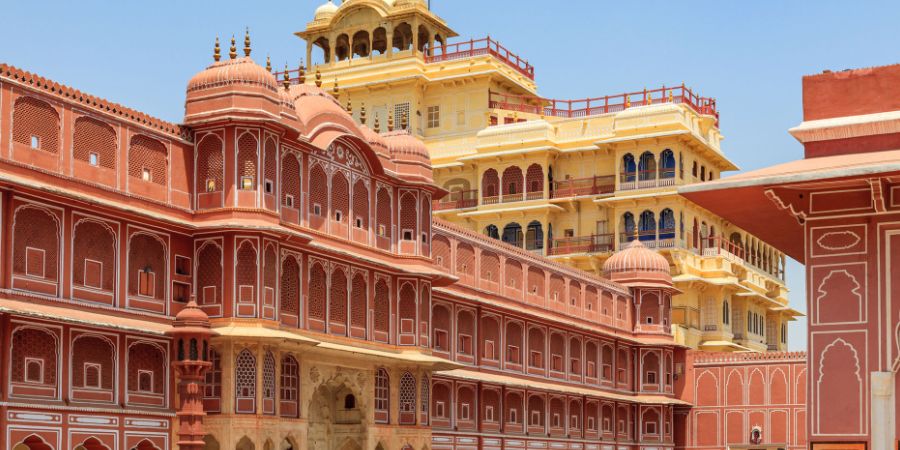


The courtyard smells of dry sandstone baked by forty-degree heat, and somewhere behind a scalloped archway, a peacock screams. You're standing inside a walled compound that has served as the seat of Jaipur's royal family for nearly three centuries, and the scale of it — seven courtyards, multiple palaces within palaces, a private observatory — still manages to disorient. City Palace isn't a museum you walk through in a linear fashion. It's a layered, living place where the current royal family occupies one wing while tourists shuffle through another, separated by nothing more than a velvet rope and a stern-faced guard. The fusion of Rajput and Mughal design here doesn't announce itself with plaques and explanations; it reveals itself slowly, in the geometry of a lattice screen, in the curve of a gateway that borrows from three traditions at once. What follows is a walk through the palace's past, its architecture, what you'll actually encounter inside, and the practical details — timing, routes, temperatures — that determine whether your visit feels transcendent or merely sweaty.
Three Centuries of Power, Compressed into Pink Walls
Maharaja Sawai Jai Singh II founded Jaipur in 1727, and City Palace was the first major structure he ordered built. Jai Singh wasn't just a king with expansionist ambitions — he was an astronomer and mathematician who consulted the Bengali scholar Vidyadhar Bhattacharya to plan the city's grid layout. The palace anchored everything. Its walls went up alongside the city's own, and for decades, no building in Jaipur stood taller.
Successive rulers expanded what Jai Singh started. Maharaja Sawai Pratap Singh, who ruled in the late 18th century, added the Chandra Mahal, which remains the royal residence. Sawai Man Singh II, the last ruling maharaja before Indian independence in 1947, converted portions of the palace into a museum and opened the doors to the public. That transition — from private fortress to tourist destination — happened without demolishing or gutting the original spaces, which is why City Palace feels less like a curated exhibit and more like someone's very grand, very old house.
The royal family's decision to remain in residence sets City Palace apart from comparable sites like Amber Fort or Mehrangarh. You're not visiting ruins. You're visiting a home that happens to be 296 years old. The Kachwaha Rajput dynasty that built it still occupies the upper floors of Chandra Mahal, and their staff still walks the same corridors that 18th-century courtiers used.
Here's what catches most visitors off guard: the palace wasn't built as a single ambitious project. It accumulated. Each maharaja added a wing, a garden, a gate — almost like geological layers. That accretion gives the complex its disorienting, labyrinthine quality. You'll turn a corner expecting an exit and find another courtyard instead. The history isn't behind glass. It's the floor under your feet.
Where Mughal Arches Meet Rajput Swagger
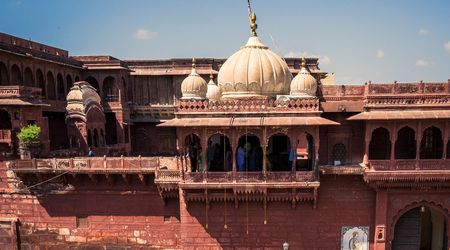
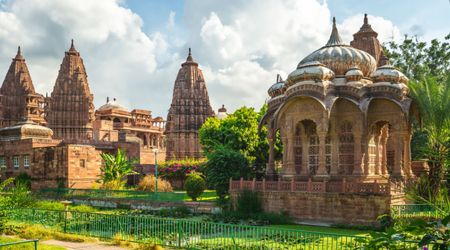
City Palace's architecture refuses to sit in one category. The entrance gate, Virendra Pol, uses pointed Mughal arches, but the interior courtyards follow Rajput spatial logic — open to the sky, ringed by colonnaded walkways designed for a desert climate where shade matters more than enclosure. The fusion isn't accidental. Jai Singh II maintained diplomatic ties with the Mughal court in Delhi and deliberately borrowed their architectural vocabulary while keeping Rajput structural priorities intact.
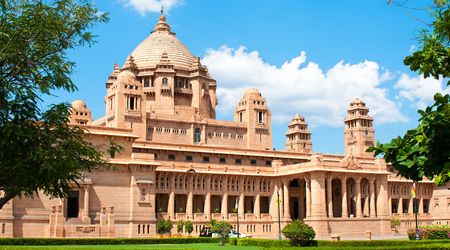
Chandra Mahal, the seven-story tower that dominates the complex, illustrates this blend floor by floor. The ground level features heavy sandstone columns and relatively austere surfaces. Climb higher — visitors can access the first floor with a special ticket — and the decoration intensifies: mirror work, floral frescoes, blue-and-white tiles that suggest Portuguese or Dutch influence traded through Gujarati ports. Each floor carries a different name, from Sukh Niwas (Hall of Rest) to Rang Mandir (Temple of Color), and each uses distinct materials.
The Mubarak Mahal, built in the late 19th century by Maharaja Madho Singh II, sits in the first courtyard and looks like it belongs in a different country entirely. Its architect, Samuel Swinton Jacob, was a British colonial engineer who combined Islamic pointed arches, Hindu bracket capitals, and European symmetry into one structure. The result should feel confused. Instead, it feels strangely coherent, the way a dish with too many ingredients sometimes works because of the cook's confidence.
What most photographs miss is the scale. The Diwan-i-Khas (Hall of Private Audience) contains two sterling silver urns, each standing over five feet tall and weighing roughly 345 kilograms. Maharaja Madho Singh II commissioned them to carry Ganges water on his trip to London in 1902. They hold the Guinness record for the largest silver objects in the world. You don't read about them and feel impressed. You stand next to them and feel small.
What's Actually Behind the Ticket Counter
You enter through the Virendra Pol gate and immediately face Mubarak Mahal, now housing the textile and costume gallery. The royal garments on display include the oversized robes of Maharaja Sawai Madho Singh I, who reportedly stood nearly seven feet tall and weighed over 250 kilograms. The fabrics — Benarasi brocade, Sanganeri block print, fine pashmina — tell you more about trade networks than any map could.
From there, you pass through the Rajendra Pol, flanked by two carved marble elephants, into the Sarvato Bhadra courtyard. This is where the Diwan-i-Khas sits, along with those massive silver urns. The space feels intimate despite its ceremonial purpose; the proportions keep everything at a human scale even when the objects inside it are not.
The Diwan-i-Am (Hall of Public Audience) contains a collection of miniature paintings, manuscripts, and Persian-translated Hindu texts from the royal library. The paintings are the standout — detailed Rajasthani and Mughal miniatures showing hunting scenes, court rituals, and surprisingly tender domestic moments. Spend time here. Most visitors rush through to reach the courtyards, but the manuscript collection rivals what you'd find in the National Museum in Delhi.
The Pritam Niwas Chowk, the innermost courtyard, delivers the palace's most photographed feature: four ornate doorways representing the four seasons. The Peacock Gate (autumn) gets the most attention for its mosaic density, but the Lotus Gate (summer) is the more accomplished piece of craft — layered plaster relief work that creates depth without any actual sculptural projection. It's a flat surface that tricks your eye into seeing three dimensions. The counterintuitive lesson here: the most visually rich part of the palace is also its quietest courtyard.
Heat, Crowds, and the Right Kind of Light
Jaipur's climate dictates everything. From April through June, temperatures regularly hit 45 degrees Celsius, and the palace's stone surfaces absorb and radiate that heat mercilessly. You'll last about ninety minutes before the dehydration headache sets in. The monsoon months of July and August bring relief from the temperature but introduce unpredictable downpours that flood the lower courtyards and sometimes close sections of the complex.
October through March is the window most travelers target, and for good reason. December and January mornings drop to a pleasant 8-10 degrees, and the low winter sun hits the palace's sandstone at an angle that turns it genuinely pink — a color that looks artificial in summer's overhead glare. The catch is that everyone else knows this too. December weekends bring dense domestic tourist crowds, and the courtyards lose their contemplative quality entirely.
The sharpest move is a weekday visit in early November or late February, arriving when the gates open at 9:30 AM. You'll get roughly an hour of relative quiet before the tour bus groups arrive around 11. Afternoon visits work surprisingly well in winter — the crowds thin after 3 PM, and the sunset light on Chandra Mahal's upper floors is worth the wait.
Ticket pricing operates on two tiers: a standard entry around 500 rupees for foreign nationals, which covers the courtyards and museums, and a composite ticket that includes Chandra Mahal's first-floor guided tour for an additional fee. That upper-floor tour is worth the cost. The guides are palace-employed and know the rooms personally, not from a script. They'll point out details — a hidden balcony, a ventilation shaft disguised as decoration — that you'd walk past a dozen times without noticing.
Getting There Without Losing Your Mind
Jaipur's Sanganer Airport sits about 13 kilometers south of City Palace and handles direct flights from Delhi, Mumbai, Kolkata, Bengaluru, and Hyderabad. The taxi ride from the airport takes 30 to 45 minutes depending on traffic and costs between 400 and 600 rupees by prepaid booth. App-based cabs work reliably here, though surge pricing during peak tourist season can double the fare.
If you're arriving by train, Jaipur Junction is the main station, positioned roughly 4.5 kilometers from City Palace. The Shatabdi Express from Delhi takes about four and a half hours and delivers you into the center of the city without airport hassle. Auto-rickshaws from the station to the palace should cost 100-150 rupees — settle on a price before you sit down, because meters are decorative objects in Jaipur rickshaws, not functional instruments.
By road, the Delhi-Jaipur stretch on NH48 runs about 280 kilometers and takes five to six hours by car. The highway is well-maintained, and the dhaba stops along the way — particularly around Behror and Neemrana — serve dal-baati-churma that justifies the drive all by itself. From Agra, the distance is roughly 240 kilometers, making a Delhi-Agra-Jaipur Golden Triangle loop entirely practical within a week.
Once you're in the old city, City Palace sits on Jaleb Chowk, directly south of Jantar Mantar and a short walk from Hawa Mahal. The neighborhood is dense, loud, and navigable only on foot or by rickshaw during peak hours. Don't attempt to park a car anywhere near the palace entrance between 10 AM and 4 PM — the lanes constrict to a width that makes two rickshaws passing each other feel like an engineering problem.
Jaipur sits at the intersection of enough transport routes that reaching it is never the challenge. The challenge is leaving enough time once you arrive. City Palace alone demands a minimum of three hours. With Jantar Mantar and Hawa Mahal within walking distance, a full day in this quarter of the old city barely scratches the surface.
City Palace doesn't reward the visitor who checks it off a list and moves on. It rewards the one who slows down, who notices the asymmetry of a doorway that two different centuries shaped, who stands in Pritam Niwas Chowk long enough for the tour groups to pass and the silence to settle back in. Jaipur's royal complex asks for your attention the way its builders intended — not as spectacle, but as accumulated craft. Go in the right season, arrive early, stay late, and let the place unfold on its own schedule. It has been doing this for nearly three hundred years. It doesn't need to rush, and neither do you.