

The ticket counter sits inside a converted colonial mansion on the Alappuzha waterfront, and the woman behind the glass barely looks up as she slides your receipt through the slot. Twelve rooms await. Twelve rooms that contain — among other things — a Tanjore painting darkened by two centuries of lamp soot, a crystal throne that weighs more than some motorcycles, and a carved ivory replica of a Hindu temple so detailed you can count the individual devotees. This is the Revi Karunakaran Memorial Museum, and it exists because one man from a small Kerala port town spent sixty years buying objects that other people might have dismissed as impractical, excessive, or simply strange.
Alappuzha — still called Alleppey on half the signboards — draws visitors for its backwaters, its snake boat races, its coir mats drying on the roadside. The museum gets fewer footfalls than the houseboats do. That's a shame, because walking through this collection tells you more about Kerala's relationship with global trade, religious syncretism, and inherited taste than any guided canal tour ever will. The objects here don't just sit in vitrines; they argue with each other across centuries and continents.
What follows is a close look at the man, the collection, the building that holds it, and the town that surrounds it — along with what you need to know before showing up at that ticket counter yourself.
A Coir Magnate Who Preferred Crystal: The Life of Revi Karunakaran
Revi Karunakaran was born in 1922 into a family whose wealth came from the fibrous husk of coconuts. His father, Kochouseph Chittilapilly, ran a coir empire in Alappuzha at a time when the town functioned as Kerala's primary commercial port, exporting rope, matting, and bristle fibre to Europe and Southeast Asia. The business was thoroughly pragmatic — coconut husks soaked in backwater lagoons, beaten by hand, spun into export-grade cord. Nothing glamorous about it.
Karunakaran grew up in a household where money was earned from dirt and salt water but spent on beautiful things. His family's ancestral home already contained a handful of antiques acquired through the networks that trade creates: a brass lamp from a Dutch merchant, a rosewood chest from a British officer rotating out of Travancore. The boy noticed these objects. He learned their histories before he learned the coir business.
After inheriting and expanding the family's industrial interests — which eventually stretched into cashew processing and real estate — Karunakaran directed much of his personal income toward acquisition. He never trained as an art historian. He never published a catalogue. He bought what compelled him, which turned out to be an extraordinarily wide range: Mughal miniatures, Chinese porcelain, Travancore-era gold ornaments, European oil paintings, and an almost obsessive quantity of crystal objects.
He died in 2003. His family established the museum two years later, converting the colonial-era building he'd used as a residence into a public space. The conversion was deliberate — they wanted the collection displayed inside the domestic environment where Karunakaran had actually lived with it. You don't walk through white-walled gallery spaces here. You walk through someone's home, and the objects feel less like exhibits than like furniture that simply never left.
Sixty Years of Saying Yes: How One Man Built a Private Hoard
Most serious collectors specialize. They pursue Meissen porcelain, or Chola bronzes, or Ottoman textiles, and they build networks of dealers and auction contacts within that narrow world. Karunakaran did none of this. His collecting was omnivorous, which makes the museum either thrilling or baffling depending on your temperament. A Swarovski crystal piano sits two rooms from a wooden mask used in theyyam ritual performance. A pair of oil paintings depicting European pastoral scenes hangs across from a jewel-encrusted model of a snake boat.
His primary acquisition channels were three. First, the antique dealers who passed through Alappuzha and Kochi during the mid-twentieth century, many of them trading in objects pulled from the dissolution of princely states after Indian independence. Second, auction houses in Bombay and Madras where estate sales regularly surfaced pieces from the Travancore and Cochin royal collections. Third, overseas purchases made during business trips — crystal from Austria and Czechoslovakia, porcelain from Canton, oil paintings from London galleries that were clearing colonial-era stock.
The pattern that emerges isn't randomness. It's a particular kind of aesthetic greed: Karunakaran wanted objects that demonstrated extraordinary human labor. The Tanjore paintings are thick with gold leaf applied in dozens of layers. The ivory carvings represent thousands of hours of micro-scale work. The crystal pieces refract light in ways that required industrial precision. He wasn't drawn to the conceptual or the minimal. He wanted proof of effort — objects you could look at and immediately understand that someone had spent a significant portion of their life making them.
That instinct, whether he articulated it or not, gives the collection a coherence that isn't obvious from the inventory list alone.
A Colonial Mansion That Refuses to Be a Gallery
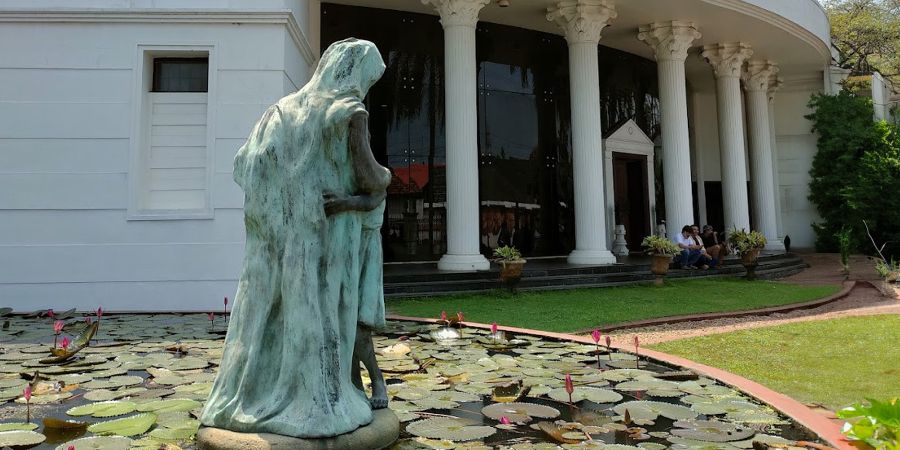
The building itself — a whitewashed structure with wooden shutters, a red-tile roof, and a verandah that faces the Alappuzha canal — dates to the early twentieth century. It was built in the Kerala-colonial hybrid style that you still find scattered along the Malabar coast: high ceilings for heat dispersal, jackfruit wood beams, rooms arranged around a central courtyard that admits rain and light in equal measure. The floor plan follows the residential logic of a prosperous Alappuzha household, not the circulation plan of a museum.
This matters. You move through the collection the way you'd move through someone's house during a visit — entering a sitting room, passing into a dining area, climbing a staircase to upper chambers where the more personal items live. The curators made a deliberate choice to retain much of the domestic furniture alongside the collection pieces. You'll see a wooden writing desk that Karunakaran actually used positioned next to a display case of Mughal-era coins. The boundary between "exhibit" and "possession" stays blurred throughout.
The rooms are organized loosely by material or origin — one for paintings, one for crystal, one for ivory and bone carving, one for mixed decorative arts — but the transitions between them feel spatial rather than thematic. You turn a corner and the light changes because you've moved from a north-facing room to a south-facing one, and suddenly the objects glow differently. Air-conditioning keeps the climate controlled in most rooms, though a few of the upper chambers rely on ceiling fans and open windows, which means you occasionally hear the canal traffic — a motor launch chugging past, someone shouting a price for fish — while examining an eighteenth-century miniature.
That collision of sound and silence, of street life and preserved stillness, is part of the experience the building provides.
Gold Leaf, Carved Bone, and a Crystal Throne You Shouldn't Sit On
The Tanjore paintings occupy the first room most visitors enter, and they set the tone. These are not the mass-produced Tanjore reproductions you'll find in craft shops along MG Road in Kochi. The originals here date from the eighteenth and nineteenth centuries, and the gold-leaf work retains its uneven, handmade texture — you can see where the artisan's brush skipped slightly, leaving a tiny gap in the gilding over Lord Krishna's crown. That imperfection is how you know it's real.
The ivory collection draws the most prolonged stares. A model of a Hindu temple, carved from a single tusk, stands under glass with a magnifying lens provided nearby. Through the lens, you can distinguish individual figures in a procession scene no larger than a fingernail. Kerala banned ivory trade decades ago, and these pieces carry documentation establishing their pre-ban provenance. The ethical discomfort they provoke is part of what makes them worth seeing — they represent a craft tradition that was extraordinary and unsustainable in equal measure.
The crystal room houses the collection's most photographed object: a throne made entirely of Swarovski crystal, weighing approximately 150 kilograms. It sits on a raised platform, lit from below. The effect is garish and mesmerizing at once. Nearby, a crystal grand piano catches whatever ambient light enters the room and scatters it across the ceiling in prismatic fragments.
Other notable pieces include:
- A set of Mughal miniature paintings depicting court scenes, their pigments still vivid despite visible foxing on the surrounding paper.
- Chinese Canton-ware porcelain bowls with famille rose enamel work, acquired through the trade routes that connected Alappuzha to Southeast Asian ports.
- A collection of antique oil lamps from across South India, several with inscriptions identifying the temples they originally served.
Each room rewards slow looking more than quick scanning.
Why a Port Town's Private Museum Tells Kerala's Whole Story
Kerala's cultural identity was never insular. The Malabar coast traded with Rome before Christ, with Arab merchants by the seventh century, with the Portuguese by the sixteenth, and with the Dutch and British thereafter. Spices went out. Objects, religions, languages, and architectural styles came in. The result is a cultural palimpsest where a synagogue stands beside a mosque beside a Hindu temple, and nobody finds this remarkable because it's been that way for a thousand years.
Karunakaran's collection embodies this layered history without trying to. His Mughal miniatures arrived in Kerala through the same trade networks that brought Islam. His Canton porcelain followed the same sea routes that carried black pepper to China. His European oil paintings entered India with the same colonial apparatus that built the house they now hang in. The museum doesn't make these connections explicit — there are no wall texts explaining Kerala's maritime trade history — but the objects make the argument silently, by their mere coexistence in a single building in a single port town.
The theyyam masks and kathakali ornaments in the collection add a domestic layer. These aren't imports; they're homegrown. Seeing them alongside Swarovski crystal and Mughal gold forces a question that Kerala itself constantly negotiates: what's indigenous and what's absorbed, and does the distinction still mean anything after five centuries of continuous exchange? A brass nilavilakku oil lamp lit in a Christian household, a Muslim trader's rosewood chest carved by a Hindu artisan — Kerala's culture has always been a shared production, authored by everyone and owned by no one.
The museum doesn't teach this. But you feel it in the accumulation.
A Dead Man's Possessions and the Grief That Preserved Them
The word "memorial" in the museum's name is easy to skip past, but it carries weight. This is not a neutral institutional collection assembled by committee and funded by government grants. It's a family's attempt to make a private man's private passion publicly legible. The decision to open the house — their house — to strangers, to put velvet ropes around furniture they once sat on, required a kind of generosity that has nothing to do with money.
Photographs of Karunakaran appear throughout the museum, and they show a quiet, heavy-set man who does not appear to enjoy being photographed. He poses stiffly beside his crystal throne. He stands in a garden with a half-smile that suggests the photographer had to ask for it. These images don't mythologize him. They make him specific — a person with a body and a posture and a reluctance to perform for the camera.
The memorial dimension complicates the visitor's role. You're not just looking at objects in a museum; you're looking at a dead man's things in his dead man's house, arranged by people who loved him. This awareness makes you move more carefully, look more closely. The wooden desk where he sat becomes more than a desk. The arrangement of paintings on a wall suggests a choice someone made for reasons that are now irrecoverable.
Grief, properly channeled, can produce remarkable preservation. The family didn't sell the collection, didn't donate it to a state museum, didn't let it scatter at auction. They froze it in place. The result is a time capsule where the collector's personality remains legible decades after his death, embedded in every selection, every juxtaposition, every impractical purchase that made perfect emotional sense to the man who made it.
Fish Markets, Backwater Canals, and the Alappuzha That Tourists Miss
Most visitors treat Alappuzha as a houseboat embarkation point. They arrive from Kochi or Kottayam, board a kettuvallam on Punnamada Lake, cruise the backwater canals for a night, and leave without walking the town's streets. This is like visiting Venice only from a gondola — you get the water but miss the city.
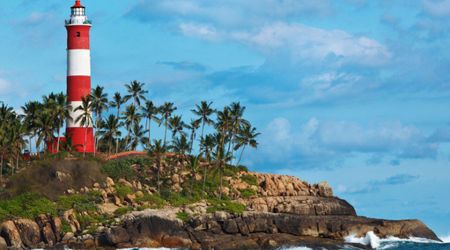
The Alappuzha beach road runs south from the old lighthouse, and the morning fish market at the western canal junction operates with a volume and velocity that no houseboat experience replicates. Fishermen offload karimeen, prawns, and seer fish onto concrete slabs where women with curved knives break them down in seconds. The smell is iron and brine. The sound is competitive pricing conducted at full shout.
The town's commercial district, centered on Mullakkal Road, retains the architecture of a late-colonial port: godowns with corrugated roofs, textile shops with wooden facades, a municipal market building with cast-iron columns that could pass for a minor Victorian railway station. The Mullakkal Rajarajeswari Temple, dedicated to Parvati, sits in the middle of this commercial zone, and its annual festival in December fills the surrounding streets with elephant processions and percussion ensembles that make conversation impossible for hours.
Eating in Alappuzha means karimeen pollichathu — pearl spot fish marinated in a red masala paste, wrapped in banana leaf, and cooked over coals. The Harbour Restaurant, a short walk from the museum, serves a version that's been consistent for years: the fish skin blackened and blistered, the flesh underneath still moist, the banana leaf imparting a faint vegetal sweetness. Order it with kappa, boiled tapioca mashed with coconut and shallots. The combination is Alappuzha on a plate.
Getting There, Getting In, and Getting the Most from Two Hours
The museum sits on CCSB Road (also called Beach Road), roughly 500 meters from the Alappuzha boat jetty. If you're arriving by train, the railway station is about two kilometers east — an auto-rickshaw ride that should cost between 50 and 80 rupees if you decline the first quoted price. From Kochi, the drive takes roughly ninety minutes on NH66, though Kerala traffic is not something you schedule around with confidence.
Opening hours run from 9:00 AM to 5:00 PM, Tuesday through Sunday. The museum closes on Mondays. Entry fees are modest by international standards — Indian nationals pay considerably less than foreign visitors, which is standard for Kerala's heritage sites. A small printed guide is available at the entrance, though the labeling inside the rooms varies in quality; some objects carry detailed provenance cards, others sit in cases with nothing more than a material description.
For the best experience, consider these practical points:
- Arrive before 10:30 AM, when the rooms are cooler and emptier, and the morning light through the east-facing windows hits the crystal collection at its most dramatic angle.
- Bring a magnifying glass or use your phone's zoom function for the ivory carvings — the naked eye misses at least half the detail.
- Allow ninety minutes minimum; two hours if you're the type who reads every placard and doubles back.
- Photography policies have varied over the years — confirm at the ticket counter whether interior photography requires an additional fee.
Combine the museum visit with a walk along the canal to the beach, then lunch. The full Alappuzha morning, done properly, takes about four hours and requires nothing more than your feet and an appetite.
The Revi Karunakaran Memorial Museum is not the kind of institution that appears on bucket lists or generates Instagram pilgrimages. It doesn't try to. What it offers is rarer than spectacle — it offers intimacy with a single person's accumulated obsession, housed in the rooms where that obsession was lived. You walk through twelve chambers and emerge knowing something about Kerala's place in the world, about the relationship between commerce and beauty, and about what happens when a family decides that one man's private joy deserves to outlast him. Most museums ask you to admire their collections; this one asks you to understand the collector, and the difference between those two requests is the distance between tourism and actual encounter.