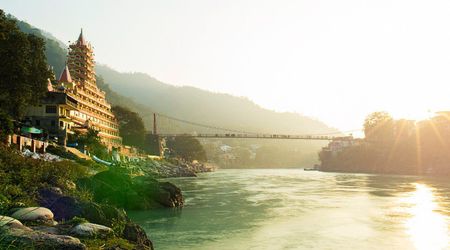
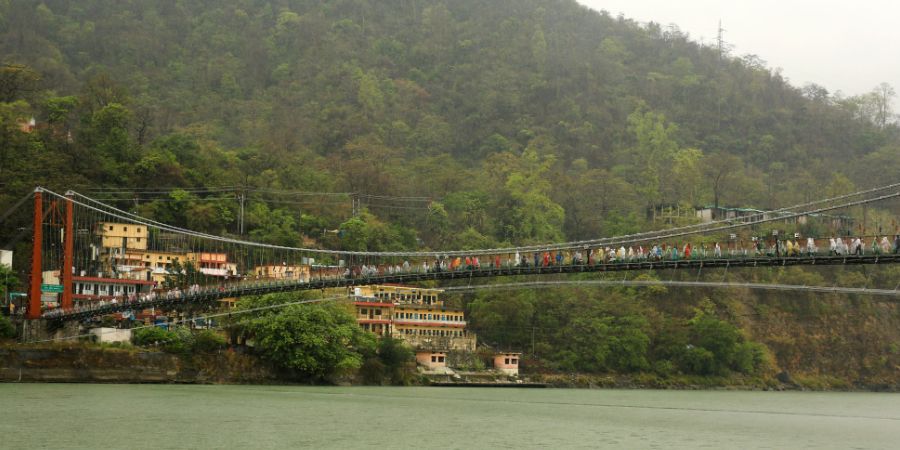


The first thing you notice on Ram Jhula isn't the view of the Ganges below or the temples stacked along its banks like mismatched crockery. It's the vibration. The iron suspension bridge hums under the weight of motorbikes, pedestrians, cows, and the occasional langur monkey swinging from its cables, and the whole structure trembles with a frequency that enters through your feet and stays in your teeth. I crossed it for the first time in 2009, gripping the railing while a sadhu in orange robes brushed past me without breaking stride, his bare feet apparently unbothered by the metal grating that showed the Ganges churning sixty feet below.
Ram Jhula is not a monument you observe from a respectful distance. It's a bridge you survive, and in the surviving, you understand something about Rishikesh that no ashram brochure will tell you: this city's spirituality isn't serene. It's kinetic, crowded, occasionally terrifying, and deeply alive. Spanning the Ganges in the Tehri Garhwal district of Uttarakhand, Ram Jhula has functioned since 1986 as both an infrastructure link and a pilgrimage threshold. What follows traces its origins, its architecture, its spiritual surroundings, and the practical realities of visiting a bridge that refuses to sit still.
Built on Rope and Legend: How Ram Jhula Got Its Start
The bridge you walk across today is not the one that existed for centuries before it. The original crossing at this point on the Ganges was a jute rope bridge — a swaying, precarious affair that connected the ashrams on the east bank to the markets and roads on the west. Local tradition holds that some form of rope crossing has existed here for generations, used by sadhus, pilgrims, and villagers navigating between the two halves of what was then a much smaller settlement upstream from Haridwar.
The modern iron suspension bridge was completed in 1986, funded and constructed under the oversight of the local administration in what was then the undivided state of Uttar Pradesh. It replaced the rope bridge not out of aesthetic ambition but practical necessity — foot traffic between the ashrams of Swarg Ashram and Sivananda Ashram on either bank had grown beyond what braided jute could safely accommodate. The decision to build a permanent structure reflected Rishikesh's gradual transformation from a quiet retreat for renunciants into a destination that attracted both Indian pilgrims and international seekers.
Ram Jhula sits roughly three kilometers upstream from its older sibling, Lakshman Jhula, which was completed in 1929 and carried its own mythological associations. The two bridges bookend the spiritual core of Rishikesh, and understanding their relationship matters. Lakshman Jhula drew the early yoga tourists, the Beatles-era seekers. Ram Jhula inherited the overflow and, over time, developed its own distinct character — more devotional, less countercultural, closer to the rhythms of Hindu pilgrimage than Western spiritual tourism.
The bridge's construction also coincided with the expansion of road networks linking Rishikesh to Delhi and Dehradun, which accelerated the town's growth in the late 1980s and 1990s. Ram Jhula became a functional artery as much as a symbolic one. Pilgrims arriving by bus from the plains could cross the Ganges on foot and reach a dense cluster of temples and ashrams within minutes. The rope bridge had served seekers. The iron one served a small economy.
Why a Bridge Bears the Name of a God
Ram Jhula translates directly as "Ram's Swing" — jhula being the Hindi word for a swing or, by extension, a suspended bridge. The name ties the structure to Lord Rama, the seventh avatar of Vishnu and the central figure of the Ramayana. According to local belief, Rama crossed the Ganges at or near this spot during his period of exile, and the bridge commemorates that crossing. There is no archaeological evidence for this claim, but the absence of evidence has never slowed a good pilgrimage tradition.
The naming convention matters because it signals how the bridge functions in the devotional imagination. It's not named after a builder, a politician, or a fund. It carries a divine name, which means that crossing it becomes, for many pilgrims, a minor devotional act — a reenactment, however compressed, of a mythic journey. You'll see families pause at either end to touch the bridge's ironwork or offer a quick prayer before stepping on. The structure becomes a threshold between the mundane world of the west bank, with its traffic and shops, and the sacred zone of the east bank, dense with ashrams and temple bells.
The word jhula also carries a connotation of playfulness, of movement. It's the same word used for the decorated swings set up during the festival of Janmashtami to celebrate Krishna's birth. Applying it to a bridge captures something true about the experience — the gentle lateral sway, the slight bounce underfoot. You don't march across Ram Jhula. You ride it. The name encodes the physical sensation of the crossing itself, which is more honest than most architectural nomenclature manages to be.
Locals sometimes distinguish between Ram Jhula and Lakshman Jhula by associating each with a different chapter of the Ramayana — Lakshman Jhula named for Rama's devoted brother Lakshmana, who is said to have crossed the river nearby on a jute rope. The paired naming creates a mythological geography layered onto the actual one, two bridges framing a stretch of river that becomes, in the telling, a sacred corridor.
Sixty Feet of Iron, Cable, and Controlled Sway
Ram Jhula stretches approximately 450 feet across the Ganges, suspended from steel cables anchored into concrete pylons on each bank. The deck is a metal grating — perforated, which means you can see the river directly below your feet. This is not a design choice aimed at aesthetics. The perforations reduce wind resistance, a critical factor for a suspension bridge in a valley that channels strong gusts during the monsoon months between June and September. The grating also allows rainwater to drain instantly rather than pooling on the surface.
The bridge's width accommodates roughly two lanes of foot traffic, though the actual distribution of that space is governed more by negotiation than engineering. Motorbikes were permitted for years — a practice that added to the bridge's constant vibration and compressed pedestrians against the railings — before being restricted in recent years due to safety concerns. The cable railing rises to about waist height, wrapped in places with cloth or garlands left by pilgrims, and the entire structure sways perceptibly under heavy foot traffic.
Unlike the arched silhouette of Lakshman Jhula, Ram Jhula presents a flatter profile. Its cables describe a shallower catenary curve, giving it a more utilitarian appearance from the riverbanks. The pylons are unadorned concrete, functional rather than decorative. There's no architectural pretension here, no ornamentation beyond what visitors have added — the prayer flags, the faded marigolds caught in the grating, the occasional padlock attached to the railing by couples borrowing a European tradition.
The controlled sway deserves attention. A suspension bridge that doesn't move is either overbuilt or broken. Ram Jhula's lateral movement is slight but continuous, and it intensifies when large groups cross in step. Engineers designed the deck joints to absorb this oscillation, but the sensation remains unnerving for first-time visitors. Experienced locals walk the bridge without altering their gait, which is its own form of devotion — trust in a structure that never stops trembling.
Temple Towers and Chanting Frequencies on the East Bank
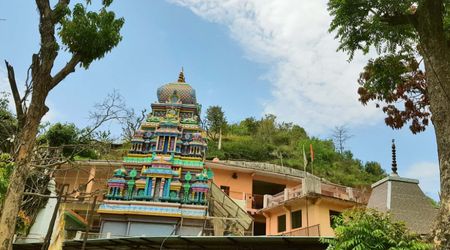
Step off Ram Jhula's east end and the spiritual density hits you before you've taken ten steps. The 13-story Swarg Ashram complex rises directly ahead, its tiered structure painted in the saturated pinks and whites common to North Indian temple architecture. Each floor houses a different deity — Shiva, Lakshmi, Hanuman — and the effect of entering is less like visiting a temple and more like ascending through a vertical cosmology. The stairwells smell of sandalwood incense and damp concrete in roughly equal measure.
The east bank concentrates an extraordinary number of ashrams, meditation centers, and temples within a few hundred meters of the bridge. The Parmarth Niketan Ashram, one of the largest in Rishikesh, conducts a daily Ganga Aarti at sunset that draws hundreds of participants to the ghats. The ceremony involves oil lamps, synchronized chanting, and the release of leaf boats carrying small flames onto the river's surface. The sound carries across the water and reaches the bridge itself, which means that crossing Ram Jhula at dusk means walking through a corridor of amplified devotional music.
What surprises most visitors is how commercial and sacred space intertwine here without apparent friction. A shop selling rudraksha beads sits adjacent to a yoga hall. A chai stall operates from a niche in a temple wall. The spiritual and the transactional don't occupy separate zones — they share walls, doorways, and customers. This isn't hypocrisy. It's an old Indian logic in which pilgrimage has always included marketplace, in which the sacred journey requires fuel, souvenirs, and a place to sleep.
The Geeta Bhawan, located near the bridge's east approach, houses one of the larger free dharamshalas in the area, offering basic accommodation to pilgrims. Its library contains thousands of texts in Hindi, Sanskrit, and English. Monkeys patrol its rooftops. The building's faded murals depict scenes from the Bhagavad Gita, and on any given morning you'll find elderly pilgrims reading scripture on its balconies while the bridge hums with traffic a hundred meters away. Proximity and contrast define this bank of the river.
What Happens Between the Two Concrete Pylons
Crossing Ram Jhula takes roughly four minutes if nobody blocks your path, which nobody won't. The bridge is a compression chamber for every species and social class that passes through Rishikesh. You'll share the grating with barefoot sadhus carrying tridents, families herding small children, backpackers with rolled yoga mats strapped to their packs, and at least one cow that has decided to stand precisely in the center and regard you with total indifference. The cow always wins. You walk around it.
The view from midspan offers something that photographs consistently fail to capture: the speed of the Ganges. From the banks, the river looks wide and relatively calm. From sixty feet above, you see the current's true force — the way it carves around boulders, the whitecaps that form and dissolve in seconds, the sheer volume of water moving south toward Haridwar. During monsoon months, the river rises visibly and turns from blue-green to a silty brown, and the bridge's sway increases enough that crossing becomes a deliberate act of nerve.
Sound layers in unexpected ways over the water. Temple bells from both banks arrive at the bridge slightly out of sync, creating an accidental polyrhythm. Motorbike horns, where bikes still operate, add a sharp punctuation. The wind, channeled by the valley, creates a low whistle through the cable stays. And beneath everything, the constant white noise of the Ganges itself — a sound that residents describe as the river's own mantra, though it sounds more honestly like pressure, like force, like a reminder that the bridge is temporary and the river is not.
The most counterintuitive thing about the crossing is its intimacy. On a bridge packed with strangers, personal space collapses. You smell the jasmine in a woman's hair, the camphor on a priest's hands, the diesel from a motorbike that shouldn't be there. Physical proximity breaks social barriers that would hold firm on solid ground. People smile more on bridges, perhaps because shared precariousness is its own form of community.
The City That Grew Around the Ganges and Never Stopped
Rishikesh extends well beyond its two famous bridges, and the version of the city you encounter depends entirely on which bank you stay on and how far you walk from the river. The west bank, particularly around Tapovan and the road toward Neelkanth Mahadev Temple, has absorbed most of the adventure tourism infrastructure — rafting outfitters, bungee jumping operators, and cafes serving banana pancakes to a clientele that arrived seeking moksha and settled for Wi-Fi.
The Beatles Ashram, officially the Maharishi Mahesh Yogi Ashram in the Rajaji National Park area, sits south of Ram Jhula and draws a steady stream of visitors to its graffiti-covered meditation domes. The ashram was abandoned in the 1990s and reopened in 2015 as a ticketed attraction. Its appeal is partly nostalgic, partly photographic — the jungle is reclaiming the structures with visible enthusiasm, and the decay creates a useful metaphor for the impermanence that the ashram's original residents were trying to transcend.
Upstream from the bridges, the Ganges narrows and the town thins into forest. Neer Garh Waterfall, a roughly two-kilometer hike from the main road, offers cold freshwater pools surrounded by sal trees. The trail is steep and poorly marked, which keeps the crowds manageable. Downstream, toward Haridwar, the river widens and the temples multiply. The contrast is instructive: upstream is where Rishikesh remembers it was once wilderness; downstream is where it practices being a city.
The food scene splits along similar lines. East bank eateries near the ashrams serve strictly vegetarian thalis and fresh lime sodas. West bank cafes cater to the international crowd with Israeli shakshuka, Italian pasta, and Korean bibimbap of varying authenticity. The best chai in the area comes not from any cafe but from the unmarked stalls near the bus stand on the Haridwar road, where a glass costs ten rupees and the tea has been simmering since before dawn.
Getting There, Staying Sane, and Knowing When to Leave
Rishikesh sits 240 kilometers north of Delhi, reachable by road in five to seven hours depending on traffic through the Muzaffarnagar and Roorkee corridor. The Jolly Grant Airport in Dehradun, 35 kilometers away, receives daily flights from Delhi, Mumbai, and Bangalore. The train station in Rishikesh handles a limited number of services; most rail travelers arrive at Haridwar Junction, 25 kilometers south, and complete the journey by shared auto or bus. The key details for planning a visit around Ram Jhula break down as follows:
- The bridge is open to pedestrian traffic year-round, though monsoon months (July through September) bring heavy rain and increased river levels that can make the crossing feel considerably less stable.
- October through March offers the most comfortable temperatures — daytime highs between 15 and 25 degrees Celsius — and the clearest views of the Himalayan foothills to the north.
- Accommodation ranges from free dharamshalas on the east bank (basic rooms, shared facilities, vegetarian meals) to boutique hotels in Tapovan on the west bank charging upward of 5,000 rupees per night.
- Footwear matters more than most travel guides acknowledge — the metal grating on the bridge heats significantly in afternoon sun during April and May, and the stone steps on the east bank are perpetually slick from river spray and spilled offerings.
- The bridge sees its heaviest traffic between 8 and 10 in the morning and again between 4 and 6 in the evening, coinciding with ashram schedules and the daily aarti ceremony.
Arriving early — before seven — gives you the rarest version of the crossing: near-empty, the cables still cool, the Ganges catching the first angled light. The bridge at that hour belongs to the resident monkeys and the occasional fisherman on the bank below. It's the one time you can stand at midspan without being jostled, look upstream toward the foothills, and hear the river without competition. Leave Rishikesh when the crowds start to feel like the point rather than the obstacle. That moment arrives differently for everyone, but you'll recognize it when it does.
There's a temptation to treat Ram Jhula as a photo opportunity — a picturesque crossing to be captured and catalogued between yoga class and dinner. But bridges are never just bridges, especially in a country where rivers carry the ashes of the dead and the prayers of the living in the same current. Ram Jhula exists because people needed to cross a river that their faith told them was sacred, and the tension between practical necessity and spiritual meaning is the truest thing about it. Thousands of feet cross it daily without ceremony, and each crossing is still, in its small way, an act of trust — in iron, in engineering, in the idea that the other side holds something worth reaching. The bridge trembles because it's alive with the weight of everyone who believes that.