

The sand shifts underfoot in a way that makes you conscious of every step, a gritty golden dust that coats your shoes and fills the creases of your clothes before you've even reached the entrance. Pokhran Fort sits in western Rajasthan's Jaisalmer district, roughly 110 kilometers from Jaisalmer city, and the first thing that strikes you isn't the fort itself but the silence around it — a dry, mineral quiet broken only by the occasional cry of a desert bird circling overhead. This is not Rajasthan's glamorous circuit. There are no queues of tourists here, no selfie sticks cluttering the ramparts.
The fort rises from the flat, scrubby terrain of the Thar Desert like something the earth simply pushed upward and forgot to erode. It carries the weight of centuries of Rajput rule, the strange footnote of India's nuclear ambitions, and the slow, patient decay that comes from standing in one of the hottest, driest corners of the subcontinent. What follows traces the fort's origins, its sandstone architecture, the dynasty that built and held it, and the peculiar twist of modern history that gave the name Pokhran a meaning no medieval warrior could have anticipated.
Before the Walls Rose: How a Desert Outpost Became a Fortress
Pokhran Fort's origins date to the 14th century, when the Champawat clan of Rathore Rajputs established their hold over this stretch of the Thar. The fort didn't emerge as a grand ambition — it started as a strategic necessity. Controlling Pokhran meant controlling a key route between Jaisalmer and Jodhpur, two major centers of trade and power. Caravans carrying spices, textiles, and opium passed through this corridor, and whoever held the fort collected tolls and intelligence in equal measure.
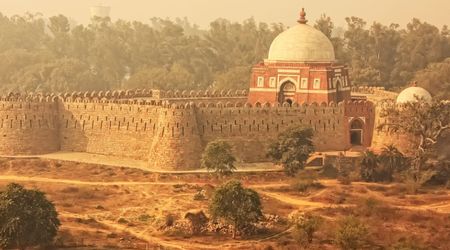
The Champawats built their initial fortifications from locally quarried sandstone and desert rubble, materials that blended with the surrounding terrain so thoroughly that, from a distance, the fort appeared to be a natural outcrop. This wasn't merely aesthetic — it served a defensive purpose. Raiders approaching from the west would have struggled to distinguish the fort's walls from the rocky ground until they were well within arrow range.
Over subsequent centuries, successive rulers expanded the structure. New bastions were added during the Mughal period, when the fort's strategic position drew attention from Delhi's imperial apparatus. The Rathores maintained a complicated relationship with the Mughals — sometimes allies, sometimes adversaries, always negotiating from behind their desert walls. Unlike the more celebrated forts of Jodhpur and Jaisalmer, Pokhran never became a seat of supreme power. It remained a secondary holding, a place where younger sons and loyal chieftains governed on behalf of more prominent rulers.
That secondary status may explain its survival. Pokhran never attracted the kind of sustained siege warfare that destroyed other Rajasthani fortifications. It was valuable enough to maintain, but not so valuable that anyone felt compelled to tear it down. The fort endured through a combination of geographic isolation and political modesty — virtues that rarely make it into the heroic narratives Rajasthan prefers to tell about itself.
Where the Road Ends and the Desert Begins in Earnest
Pokhran sits at the edge of what most travelers consider habitable Rajasthan. East of here, the Thar is still punctuated by scrubby villages, the occasional neem tree, and wells that produce brackish but drinkable water. West, the land flattens into a pale, cracked expanse that stretches toward the Pakistan border with almost nothing to interrupt it. The fort occupies a low rise in the center of Pokhran town, surrounded by narrow lanes of yellow-brown houses built from the same sandstone.
The town itself has a population of around 50,000, though it feels smaller. Most commercial activity clusters along a single main road that connects the National Highway to the fort. The air here carries a particular dryness — not the pleasant warmth of Udaipur or Jaipur, but a parching heat that pulls moisture from your skin within minutes during summer months, when temperatures routinely crack 45 degrees Celsius.
What makes the setting remarkable isn't scenic beauty in any conventional sense. The land around Pokhran is austere and repetitive, a palette of tan, ochre, and bleached white. The sky dominates everything. On clear days — which is most days — it stretches in an unbroken blue dome from horizon to horizon, making the fort appear smaller than its actual dimensions. At dusk, the sandstone walls absorb the last orange light and hold it for a few minutes after the sun drops below the flat western line, giving the structure a brief, involuntary glow.
The nearest railway station is in Pokhran itself, on the Jaisalmer-Jodhpur line, which makes the fort more accessible than its remote feel suggests. Trains arrive sporadically, and the station is a ten-minute auto-rickshaw ride from the fort's main gate. The contrast between the mechanical clatter of the railway and the fort's ancient stillness is the kind of juxtaposition India specializes in, the centuries stacked on top of each other without apology.
Sandstone Walls That Remember What Concrete Forgets
The fort's construction uses the yellow sandstone native to the Jaisalmer district, the same stone that gives Jaisalmer's more famous citadel its "Golden City" reputation. But Pokhran's stonework is rougher, less refined — the blocks are larger, less precisely cut, and fitted together with a pragmatism that prioritizes strength over ornamentation. You can run your fingers along the exterior walls and feel the chisel marks, evidence of manual quarrying that relied on iron tools and controlled fractures along the stone's natural grain.
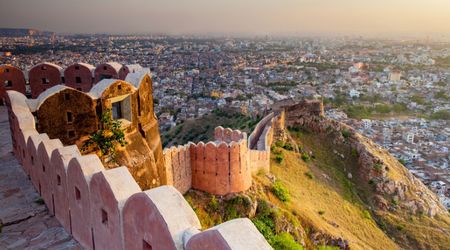
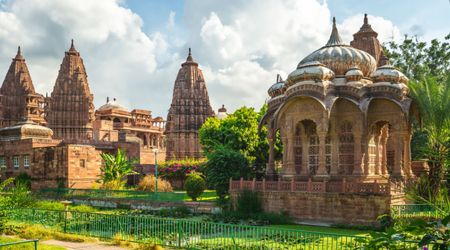
The fort's layout follows a concentric plan. An outer wall, punctuated by semicircular bastions at irregular intervals, encircles an inner courtyard complex that includes a small palace, a temple, and what remains of the garrison quarters. The bastions were designed not for symmetry but for sightlines — each one covers a different angle of approach, and standing atop any one of them gives you a clear view of at least two others.
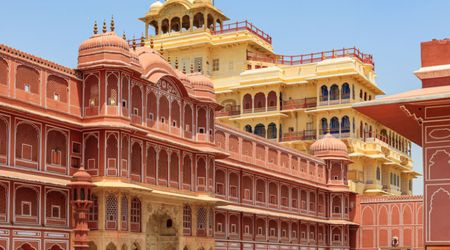
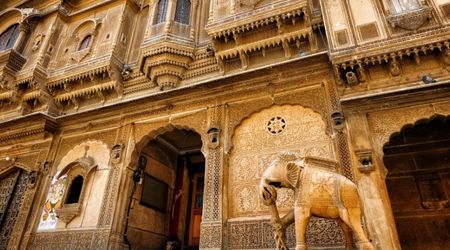
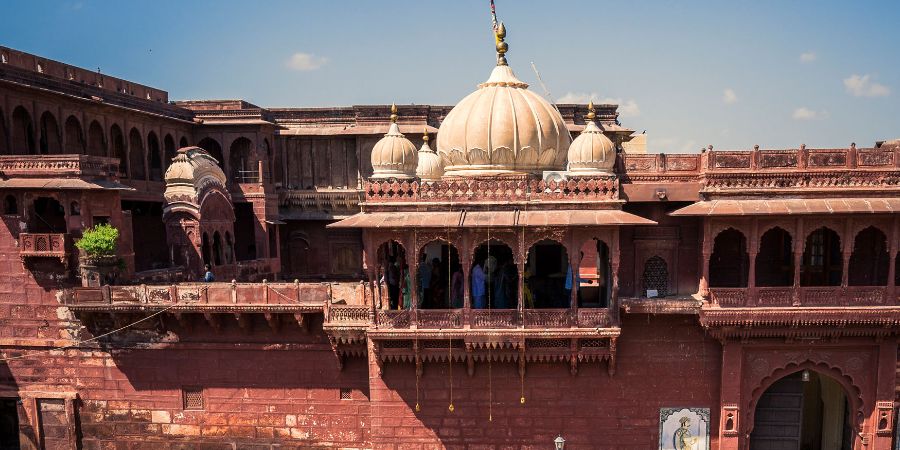
Inside, the palace section features carved jharokha windows — projecting enclosed balconies that allowed the fort's residents to observe the town below without being seen. The carvings on these balconies are intricate, featuring geometric patterns and floral motifs executed in surprisingly fine detail given the remoteness of the site. Skilled stone carvers from the Jaisalmer region likely traveled to Pokhran during construction phases, bringing techniques that were standard in the larger courts but rare in secondary outposts.
The fort also contains a series of underground rooms, partially excavated and accessible through narrow staircases. These rooms served as storage for grain and water during sieges, and their cool temperatures — noticeably lower than the surface rooms even in peak summer — demonstrate a practical understanding of thermal mass that modern architects have only recently begun to rediscover. The walls down there sweat slightly, the stone retaining moisture from infrequent rains in a way that feels almost biological.
The Champawats Held This Sand for Six Hundred Years
The Champawat Rathores, a branch of the larger Rathore clan that ruled Jodhpur, controlled Pokhran from roughly the 14th century onward. Their tenure wasn't a straightforward line of succession — it was interrupted by Mughal incursions, internal clan disputes, and the slow erosion of Rajput autonomy under British colonial rule. But the Champawats held on, adapting to each new political reality with a stubbornness that the desert itself seemed to encourage.
Rajput identity in this region was defined less by martial glory than by endurance. The Champawats weren't fighting grand pitched battles or constructing the kind of elaborate court culture that flourished in Udaipur or Jaipur. They were managing a harsh territory, collecting revenue from trade routes, maintaining water infrastructure — wells, tanks, and baoris (stepwells) — that made desert life possible. Their legacy at Pokhran is written in these practical achievements as much as in the fort's walls.
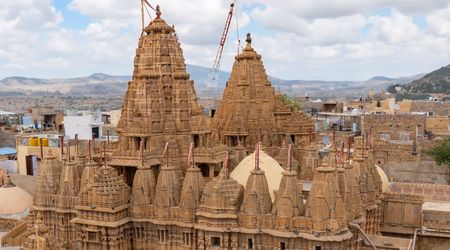
The fort's small temple, dedicated to the goddess Karni Mata, reflects the distinctive religious practices of this region's Rajputs. Karni Mata worship is best known from the famous rat temple in Deshnoke, but the cult's influence extended across western Rajasthan, and Pokhran's temple likely served as a local center of devotion. The integration of religious space within the fort's military architecture tells you something about how the Champawats understood power — it wasn't purely coercive but wrapped in the language of divine sanction and community obligation.
British colonial records from the 19th century document Pokhran as a thikana — a feudal estate — under the larger princely state of Jodhpur. The Champawat rulers retained their titles and some local authority but ceded military and foreign policy decisions to the British crown. This arrangement persisted until Indian independence in 1947, when the princely states were absorbed into the new republic, and the Champawats became private citizens who happened to own a very old, very large building.
The Day the Desert Shook Twice and the Name Changed Forever
On May 18, 1974, India detonated a nuclear device at the Pokhran Test Range, roughly 25 kilometers from the town. The test, codenamed "Smiling Buddha," was officially described as a "peaceful nuclear explosion" — a euphemism that satisfied no one. The device yielded approximately 12 kilotons, comparable to the bomb dropped on Hiroshima. Locals reported feeling the ground tremble, and a cloud of dust rose from the test site that was visible from the fort's ramparts.
Twenty-four years later, on May 11 and 13, 1998, India conducted five more nuclear tests at the same site — collectively known as Pokhran-II, codenamed "Operation Shakti." These tests were different in both scale and intent. They included thermonuclear and fission devices, and the Indian government made no attempt to disguise them as anything other than weapons tests. The geopolitical consequences were immediate: economic sanctions from the United States and Japan, a nuclear arms race with Pakistan, and Pokhran's permanent association with atomic weaponry.
For the fort and the town, the nuclear connection is a strange inheritance. Walk through Pokhran's market and you'll find shops selling postcards of the fort alongside images of mushroom clouds and portraits of A.P.J. Abdul Kalam, the scientist who led the 1998 tests and later became India's president. The juxtaposition is jarring — medieval Rajput architecture marketed alongside nuclear nationalism — but the locals treat it as simply another layer of their town's identity. The test range remains active and off-limits to civilians, a restricted zone that creates an odd geographic boundary: ancient fort on one side, nuclear proving ground on the other, separated by a few kilometers of flat desert.
The nuclear tests brought brief national attention to Pokhran but didn't translate into sustained investment or tourism. The town returned to its pre-1998 quietude within months, leaving the fort to continue its slow conversation with wind and sand.
A Fortress Running on a Skeleton Crew of Curiosity
Pokhran Fort today operates as a minor tourist attraction and a heritage property with uneven maintenance. Parts of the structure have been restored — the main gate, portions of the palace, and the temple receive periodic attention. Other sections remain in various states of disrepair, with crumbling walls and rooms that are off-limits due to structural instability. The fort charges a modest entry fee, and you're largely free to wander without guides or ropes, a freedom that feels both refreshing and slightly negligent.
A small museum inside the fort displays weapons, coins, and textiles associated with the Champawat rulers. The collection is modest and inconsistently labeled, but it includes a few pieces of genuine interest: a set of curved Rajput swords with hilts wrapped in deteriorating leather, and a collection of miniature paintings that show the fort as it appeared in the 18th century, with a bustling courtyard scene that contrasts sharply with the emptiness you'll find there now.
Visitor numbers remain low compared to Rajasthan's major heritage sites. On a typical weekday, you might share the fort with a handful of domestic tourists and the occasional European backpacker who wandered off the Jaisalmer trail. This scarcity of visitors creates an atmosphere that larger forts can't replicate — you can stand alone on the ramparts for twenty minutes without hearing another voice, listening to nothing but wind moving across stone.
The fort's custodians include descendants of the Champawat family, who retain ownership of portions of the property. Their involvement adds a personal dimension to the site that government-administered forts lack. You're walking through someone's ancestral home, not a museum exhibit, and that distinction flavors every room you enter. The wear on the stone steps isn't heritage decay — it's the record of a family's daily life accumulated over six centuries.
The Desert Doesn't Stop at the Fort's Gate
Pokhran's cultural texture extends beyond the fort into a landscape shaped by Rajasthani folk traditions that have remained largely intact precisely because tourism hasn't industrialized them here. The town hosts a small annual fair that draws traders, livestock sellers, and musicians from surrounding villages. The music you'll hear at these gatherings — a mix of rawanhatta (bowed fiddle) and algoza (double flute) — carries a tonal quality distinct from the folk music performed for tourists in Jaisalmer or Jodhpur, less polished and more rhythmically unpredictable.
The food in Pokhran reflects the constraints of desert living. Ker sangri, a dish made from dried desert beans and berries cooked with spices and oil, appears at nearly every meal. Bajra (pearl millet) rotis replace wheat bread, and dal-bati-churma — baked dough balls served with lentil curry and a crumbled sweet — is the region's staple celebration food. Water scarcity historically limited the variety of available ingredients, and the resulting cuisine is austere but deeply flavored, built on dried and preserved elements rather than fresh produce.
The surrounding Thar Desert offers its own sparse attractions. The village of Ramdevra, roughly 12 kilometers north of Pokhran, contains a temple dedicated to Baba Ramdevji, a folk deity worshipped across western Rajasthan and parts of Gujarat. The temple draws large crowds during the annual Ramdevra Fair in August-September, transforming the area from quiet desert to a temporary city of pilgrims, tent camps, and open-air kitchens.
Local craft traditions include block printing on cotton fabric and lacquerware production, both of which you can observe in small workshops in and around the town. The artisans working here supply regional markets rather than export chains, which means the work retains a functional roughness — imperfect registrations in the block prints, visible tool marks on the lacquer — that mass production would have sanded away. These imperfections are the point, evidence of a hand doing the work rather than a machine.
Getting There, Getting In, and Getting the Most Out of Pokhran
Reaching Pokhran requires passing through either Jaisalmer (110 km to the west) or Jodhpur (312 km to the east), both of which have airports with domestic connections. From Jaisalmer, the drive takes roughly two hours on National Highway 15, a well-maintained road that cuts through increasingly sparse terrain. Buses run between the two towns regularly, though schedules are approximate rather than precise. The Pokhran railway station, on the Jodhpur-Jaisalmer line, receives a few trains daily — check Indian Railways' IRCTC website for current timings.
The fort's opening hours generally span from morning to evening, though exact times can shift seasonally. Entry fees are nominal, typically under 100 rupees for Indian nationals and slightly more for foreign visitors. Photography is usually permitted without additional charges, though the museum section may have separate rules.
Practical considerations for planning your visit:
- The best months are October through February, when daytime temperatures drop to a manageable 20-30 degrees Celsius and the light turns the sandstone a deeper gold.
- Accommodation in Pokhran is limited — a couple of basic hotels and guesthouses serve the town, but none approach the heritage hotel standards found in Jaisalmer or Jodhpur.
- Carry water and sun protection regardless of season; the desert air dehydrates faster than you expect.
- Combine Pokhran with a broader western Rajasthan itinerary — a day trip from Jaisalmer works well, or a stop between Jaisalmer and Jodhpur breaks that long drive into manageable segments.
- Hiring a local guide at the fort entrance, if one is available, adds historical context that the limited signage doesn't provide.
Pokhran rewards the traveler who arrives without grand expectations. There are no sound-and-light shows here, no curated gift shops, no Instagram-ready viewing platforms. What you get instead is a fort that still feels like a fort — a structure built for survival in a landscape that tests everything left standing on it.
The fort is best experienced slowly. Spend an hour on the ramparts, watching the desert light change. Visit the temple, examine the museum, then walk through the town's main market for chai and ker sangri. Two to three hours covers the fort itself; a full day gives you Pokhran town and a side trip to Ramdevra. Don't rush it. The desert has its own pace, and Pokhran makes more sense when you match it.
Rajasthan's famous forts — Mehrangarh, Amber, Chittorgarh — have been polished into tourist monuments, their rough edges smoothed by renovation budgets and visitor management plans. Pokhran Fort operates outside that economy. It exists in a space between preservation and neglect, maintained enough to stand but not enough to perform. That liminal state gives it something the celebrated forts have traded away: the feeling that you've arrived at a place the present hasn't fully decided what to do with.
The nuclear tests added an absurd second identity to a town that had spent six centuries accumulating its first one. Pokhran now carries both — the Rajput fortress and the atomic proving ground, the medieval and the modern, coexisting without resolution. Every fort in India tells you something about the past. Pokhran is the rare one that tells you something about the distance between what a place was built for and what history decided to make of it.