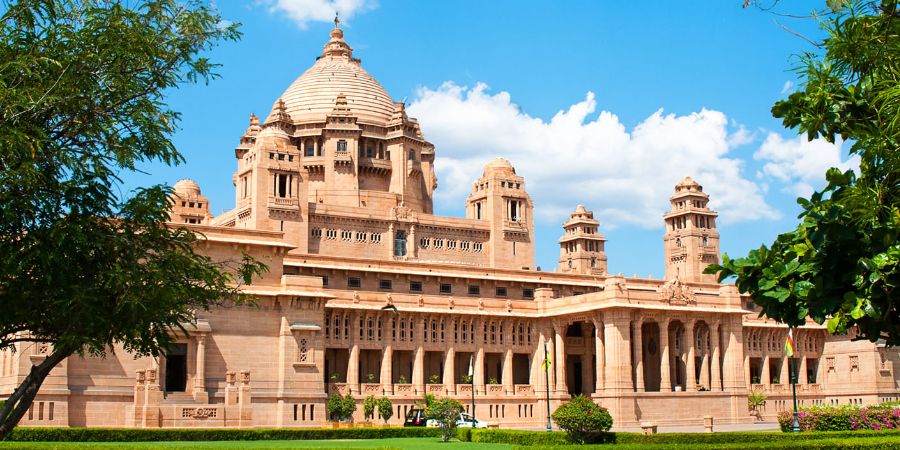


The sandstone glows amber at six in the morning, when the palace catches the first light before anything else on the Chittar Hill. From the city below — where Jodhpur's blue-washed houses press against one another like stacked tiles — Umaid Bhawan Palace appears almost implausible, a 347-room Art Deco apparition floating above the Thar Desert. The air smells of dry earth and marigold garlands left at temple thresholds, and the palace sits there in the haze like something dreamed up by a maharaja who'd spent too long in London and not long enough being told no.
That maharaja existed. His name was Umaid Singh, and the palace he commissioned during the 1930s and 1940s wasn't simply an act of vanity — though vanity certainly played a part. It was a public works project, a famine relief measure, an architectural experiment, and a dynasty's final grand gesture before Indian independence redrew the rules. Today, Umaid Bhawan functions simultaneously as a royal residence, a luxury hotel, and a public museum, each segment revealing a different face of the same extraordinary structure. To visit is to confront a building that refuses to belong to any single category: not fully British, not entirely Indian, not merely a relic, and not quite modern. The palace exists in the seams between those identities, and that's precisely what makes it worth the climb up the hill.
A Famine, a Hill, and Three Thousand Workers Who Built a Dynasty's Last Dream
Jodhpur in the late 1920s was in crisis. Successive years of drought had starved the region, and the local population — farmers, artisans, laborers — faced destitution. Maharaja Umaid Singh, who had ascended the throne of the Jodhpur princely state in 1918, needed a solution that was practical, visible, and large enough to employ thousands. What he conceived was not a dam or a road but a palace, one that would take roughly 3,000 workers nearly 15 years to complete, from 1929 to 1943.
The project served as a massive employment scheme during the famine, putting wages into the hands of laborers who might otherwise have migrated or perished. This origin story complicates the easy reading of Umaid Bhawan as mere royal excess. The palace was built on Chittar Hill, the highest point in Jodhpur, using locally quarried sandstone and marble hauled from Makrana — the same quarry that supplied stone for the Taj Mahal centuries earlier.
Henry Lanchester, a prominent British architect, drew the initial plans before the project was handed to the firm of Lanchester and Lodge. The construction didn't use steel framing, relying instead on interlocking stones — a technique that made the building earthquake-resistant but demanded extraordinary precision from masons working without modern power tools. Sand and stone, hand-cut and hand-fitted, block by block, year after year.
The palace cost an estimated 11 million rupees at the time, a staggering sum paid from the royal treasury. Some historians have questioned whether the famine-relief justification was genuine or retroactive public relations. Either way, the result stands: a colossal building born from drought, designed by a British firm, and built by Indian hands during the last gasp of princely India. The timing alone — a palace completed four years before independence — gives the structure an elegiac quality no architect intended.
Umaid Singh: The Ruler Whose Name Outlasted His Reign
The palace bears Umaid Singh's name, but his actual tenure as its resident was tragically brief. He moved in during 1943, when the building was finally finished, and died just four years later in 1947 — the same year India gained independence and the princely states began dissolving into the new republic. The symmetry is almost too neat: a king's palace completed just in time to become an anachronism.
Umaid Singh was the 37th Rathore ruler of Jodhpur, a lineage that traced itself back to the 13th century. He was educated partly in England, which shaped both his aesthetics and his political instincts. He was a modernizer in some respects — he established schools and supported infrastructure — yet the palace itself was an unambiguous statement of monarchical authority, constructed at a scale that rivaled European estates.
Before the building was named Umaid Bhawan, locals called it Chittar Palace, after the hill on which it stands. The name Umaid Bhawan — "Umaid's Mansion" — was adopted posthumously to honor the maharaja who conceived it. His son, Hanwant Singh, inherited both the palace and a vanishing political order. The Jodhpur royal family eventually negotiated terms with the Indian government, retaining private ownership of portions of the building while ceding others.
The current custodian is Gaj Singh II, Umaid Singh's grandson, who still lives in one wing of the palace. His presence gives the building a peculiar vitality: this isn't a preserved artifact but an active household, one where a family that once ruled a desert kingdom now manages a heritage brand. Umaid Singh's name sits above the gate, but the palace has long since outgrown the man who ordered it built.
Art Deco in the Desert: Where Beaux-Arts Meets Rajput Geometry
The first thing that strikes you about Umaid Bhawan's exterior isn't its size — though at roughly 26 acres of floor space, the size is absurd — but the color. The buff-yellow sandstone, drawn from the Chittar Hill itself, gives the building a warm, almost honeyed tone that shifts throughout the day. At noon it looks bleached. By evening it turns the color of turmeric milk. The stone was left unpolished, which means the surface has a matte grain that absorbs light rather than reflecting it.
Henry Lanchester designed the building in the Beaux-Arts tradition, with a strong central dome and symmetrical wings radiating outward. But the Art Deco influence is everywhere: in the streamlined curves, the geometric patterning on balustrades, and the chrome-and-glass fixtures inside. Lanchester reportedly drew inspiration from the Royal Institute of British Architects' prevailing style while incorporating Rajput motifs — jali screens, chattris, and cusped arches — into the silhouette. The fusion isn't seamless. You can see the joins, and that's part of the interest.
The central dome rises 43 meters, making it one of the largest private domes in the world. It caps a rotunda that functions as the building's architectural spine, connecting the two main residential wings. The construction used no structural steel — the interlocking sandstone blocks hold themselves together through weight and precision alone. During the monsoon, when rare rains darken the stone, the entire facade shifts from gold to brown.
What's counterintuitive about Umaid Bhawan is how the Deco aesthetic — typically associated with Manhattan skyscrapers and Paris cinemas — makes complete visual sense against the Thar's flat horizon. The clean geometric lines complement the desert's austerity rather than fighting it. Lanchester may not have planned that harmony, but the building achieved it anyway.
Marble Floors, Tropical Murals, and a Throne Room That Doubles as a Bar
Step through the main entrance and the first sensation is coolness — a full ten degrees below the exterior temperature, achieved through stone mass alone, not air conditioning. The interior central hall opens beneath the dome, and the floor is Italian marble inlaid with geometric patterns that echo the Deco exterior. Stefan Norblin, a Polish artist commissioned by Umaid Singh, painted the interior murals, which depict mythological and zodiacal scenes in a style that blends European poster art with Indian iconography.
Norblin's work covers walls and ceilings in the private apartments and public halls. His palette — turquoise, ochre, silver leaf — feels unexpected against the sandstone. The murals weren't universally praised when they were first unveiled; some found the fusion of Western technique and Indian subject matter jarring. Decades later, they're the most photographed element of the interior, their strangeness having aged into charm.
The banquet hall seats over 300 and features a long teak table that reportedly required 20 workers to move into position. Adjacent to it, the billiards room retains its original table and cue racks, a relic of British sporting culture transplanted into Rajput aristocracy. The private quarters — now partly converted into the Taj Palace hotel suites — retain original Deco furniture: rounded settees, sunburst mirrors, and polished rosewood cabinets with chrome fittings.
The throne room exists, though "throne room" may overstate its formality. It's a receiving hall with a raised dais, now used for events and the occasional cocktail reception. There's something disarming about seeing a bartender mix gin and tonics where a maharaja once held court. The palace's interior doesn't preserve the past in amber — it layers the present over it, sometimes gracefully, sometimes awkwardly, and always with the confidence of a family that knows the building belongs to them.
One Roof, Three Worlds: How a Single Building Splits Its Identity
Umaid Bhawan Palace operates as three distinct entities under one continuous roof, and navigating between them requires understanding where each begins and the other ends. The royal residence occupies one wing, where Gaj Singh II and his family maintain private quarters closed to all visitors. The Taj Palace Hotel occupies the largest share of the building — 64 rooms and suites managed by the Taj Hotels chain, where nightly rates can exceed several hundred dollars. The museum, open to the general public, fills a third section with artifacts from the royal collection.
This trifurcation isn't unique among Indian palaces — the Lake Palace in Udaipur and Falaknuma in Hyderabad follow similar models — but Umaid Bhawan does it at a scale that makes each section feel self-contained. Hotel guests enter through a separate portico and rarely encounter museum visitors. The royal family's wing is physically sealed off, with its own entrance on the building's north side.
The arrangement creates an odd social geometry. A backpacker paying 50 rupees for a museum ticket and a luxury traveler paying thousands for a suite are technically inside the same structure, separated by a corridor and an economic gulf. The palace accommodates both without discomfort, largely because the building is so vast that encounters between the three populations are rare.
What makes this split fascinating rather than merely logistical is how it mirrors the broader story of Indian royalty after independence. Stripped of political power, former ruling families turned their inheritance into commercial enterprise. Umaid Bhawan isn't a museum pretending to be a palace or a hotel pretending to be a museum — it's genuinely all three, each wing honest about its function. The building adapted rather than fossilized, and in doing so preserved something more vital than architecture: relevance.
Vintage Cars, Royal Clocks, and the Crockery of a Vanished Court
The museum section of Umaid Bhawan charges a modest entry fee and delivers a collection that is uneven, idiosyncratic, and far more revealing than most palace museums across Rajasthan. The ground floor houses a display of vintage cars — including models from the 1930s and 1940s — that belonged to the royal family. These aren't restored show pieces; some still carry minor dents and worn leather, which gives them the feel of actual possessions rather than exhibition objects.
Upstairs, the collection shifts to royal household items: crockery sets monogrammed with the Jodhpur crest, ornamental weapons, photographs of the maharajas in formal and informal settings, and an assortment of clocks — wall clocks, desk clocks, grandfather clocks — that suggest the family had a particular obsession with timekeeping. One display case holds glassware from a now-defunct Bohemian manufacturer, each piece etched with the royal insignia.
Stefan Norblin's original sketches and preparatory drawings appear in a side gallery, offering a behind-the-scenes look at the mural work that decorates the private apartments. Seeing his pencil studies next to photographs of the finished walls illuminates how much improvisation went into the final compositions. Norblin adjusted skin tones, rearranged figures, and simplified backgrounds as he worked, treating each wall as a problem to solve rather than a design to replicate.
The museum lacks the polished curation of major institutional galleries. Labels are sometimes handwritten, display lighting varies from room to room, and the arrangement feels determined as much by available space as by thematic logic. This roughness is actually its strength. You're walking through a family's attic, not a corporate exhibition. The objects carry the dust of genuine use, and the museum doesn't pretend otherwise — which is precisely why a pair of reading glasses in a velvet case can stop you in your tracks more effectively than any gilded throne.
Fifteen Acres of Manicured Silence at the Edge of the Thar
The palace grounds spread across roughly 26 acres, and the formal gardens occupy about 15 of those. Walking them in the early morning — before the tour buses arrive — you hear almost nothing except parakeets and the distant hum of Jodhpur waking below the hill. The gardens were laid out in a modified Mughal style, with axial pathways, stone channels, and raised flower beds, though the planting palette has been adjusted over the decades to favor drought-resistant species.
Bougainvillea dominates the peripheral walls in magenta and white, and neem trees provide shade along the walkways. The lawns are maintained to a standard that seems almost aggressive given the arid climate — sprinklers run before dawn, and the grass stays improbably green even in May, when Jodhpur's daytime temperatures regularly exceed 40 degrees Celsius. Peacocks move through the grounds with proprietary confidence, dragging their tails across gravel paths as if they've read the brochure and know they're ornamental.
A series of stepped terraces on the palace's south side descend toward a lower garden that includes a small pavilion used for private events. The view from the uppermost terrace takes in the city's blue quarter, Mehrangarh Fort on its own hill to the north, and the flat scrubland stretching toward the desert beyond. The sightlines were clearly engineered — Lanchester positioned the building so that each terrace frames a different slice of the surrounding geography.
What surprises most visitors is the quietness. Jodhpur is a loud city — auto-rickshaws, temple loudspeakers, market vendors — and the climb to Chittar Hill strips that noise away with startling efficiency. The gardens function as acoustic insulation, and the palace's elevation does the rest. You're standing in the middle of Rajasthan, one of India's most sonically intense regions, inside a pocket of cultivated silence that feels almost medically deliberate.
Getting There, Getting In, and What Nobody Tells You About the Timing
Jodhpur's airport receives direct flights from Delhi, Mumbai, and Jaipur, and the palace sits roughly 5 kilometers from the terminal — a 15-minute auto-rickshaw ride that costs between 150 and 200 rupees if you negotiate before climbing in. The city's railway station connects to major Indian cities via the Rajasthan rail network, and the palace is about 6 kilometers from the station. Most visitors arrive by taxi or hired car rather than public transit, as bus routes don't serve Chittar Hill directly.
The museum is open daily from 9:00 a.m. to 5:00 p.m., and the entry fee for Indian nationals differs from the international visitor rate — a common structure at heritage sites across India. Photography is permitted in certain areas and prohibited in others, with signage that isn't always consistent. Arrive before 10:00 a.m. to avoid the organized tour groups that begin cycling through by mid-morning.
Here are practical details most guides omit:
- The museum and hotel entrances are separate — if you walk to the wrong one, you'll be redirected and lose time retracing your steps around the building's perimeter.
- The hotel's restaurants and lobby are accessible to non-guests, but you'll need to pass a security check and may be asked about a reservation.
- Afternoons between 1:00 and 3:00 p.m. in summer are punishing on the exposed walkways; carry water and plan your garden visit for early morning or late afternoon.
- Combine the visit with Mehrangarh Fort, which is visible from the palace grounds and sits roughly 20 minutes away by road.
October through March offers the most comfortable weather, with daytime temperatures between 20 and 30 degrees Celsius. The monsoon months of July and August bring occasional rain that transforms the sandstone's color but can make the garden paths slippery. Whatever season you choose, budget at least two hours — one for the museum, one for the grounds — and accept that two hours will feel insufficient.
Umaid Bhawan Palace refuses the tidy narratives that heritage sites usually offer. It's not simply a monument to royal opulence or a relic of colonial-era architecture or a parable about adaptation after independence. It's all of those things layered atop one another, each layer visible if you look carefully enough. The building's survival as a living, functioning, commercially viable structure says something unsettling about how power reinvents itself — how the same family that employed 3,000 famine laborers now hosts destination weddings for international celebrities. Whether that continuity is admirable or troubling depends on where you stand, and the palace doesn't care which you choose. It just keeps catching the morning light on Chittar Hill, indifferent and golden, outlasting every question asked of it.