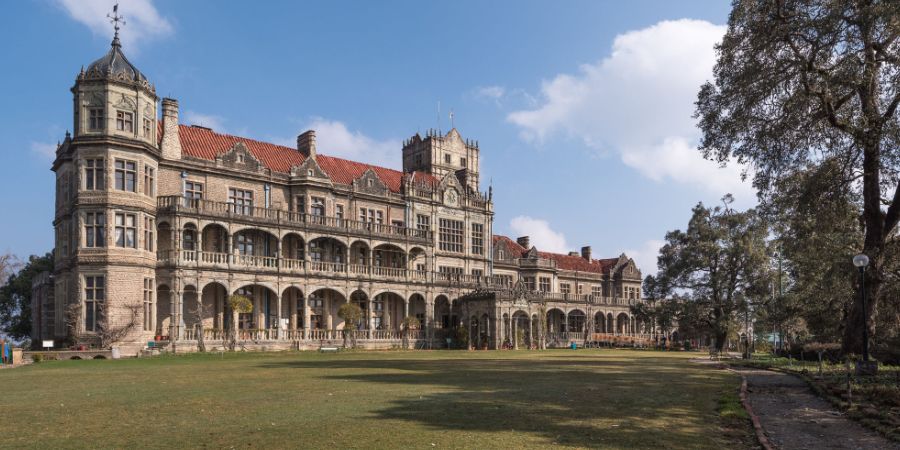


The fog rolls in from the Chadwick Falls side most mornings, thick enough to erase the deodar treeline and leave you standing on Observatory Hill with nothing but the smell of wet pine and the distant clang of a temple bell. Then it lifts — slowly, in strips — and Viceregal Lodge appears like a Victorian hallucination against the Himalayan sky, its grey stone facade and Tudor towers looking as though someone plucked a Scottish baronial estate from the Highlands and dropped it at 7,000 feet.
The building served as the summer headquarters of the British Viceroy of India from 1888 until independence in 1947. Decisions that shaped the fate of 400 million people were made in rooms heated by imported English fireplaces while monsoon clouds pressed against the windowpanes. Today, the Lodge houses the Indian Institute of Advanced Study, and scholars pace the same corridors where Lord Curzon once schemed over the partition of Bengal.
It is a building that refuses to be merely decorative. Every stone carries the weight of colonial ambition, political calculation, and the peculiar British obsession with recreating home in places that are emphatically not home. What follows is a close look at the Lodge's origins, its architecture, the political dramas it hosted, the art inside its walls, its remarkable gardens, and the practical details you'll need to visit it yourself.
Built on a Hilltop to Rule a Subcontinent
The Lodge owes its existence to Lord Dufferin, Viceroy of India from 1884 to 1888, who found the existing summer residence — Peterhoff — cramped and insufficiently grand for the administrative machinery of empire. He commissioned Henry Irwin, an architect already working on projects in Madras, to design something more fitting. Construction began in 1884 on Observatory Hill, the highest point in Shimla, using grey sandstone quarried from nearby hills and teak imported from Burma.
The project cost approximately 12 lakh rupees at the time, a staggering sum financed partly by the Indian treasury. Workers hauled materials up steep mountain paths, and the building took nearly four years to complete. Dufferin himself barely enjoyed the finished product; his term ended in 1888, the same year the Lodge was inaugurated. His successor, Lord Lansdowne, was the first to govern from its rooms through a full summer season.
Between April and October each year, the entire colonial government decamped from Calcutta to Shimla, transforming this hill station into the de facto capital of British India. The Lodge became the nerve center of that annual migration. Files, bureaucrats, and social climbers all converged on its grounds. After independence, the building saw brief use by the Indian government before being converted into the Indian Institute of Advanced Study in 1965, on the recommendation of Dr. S. Radhakrishnan, then President of India.
The building's transition from seat of imperial power to academic research institute is one of the more graceful repurposings of a colonial monument anywhere in South Asia. Scholars now occupy rooms where viceroys once held court, writing dissertations in spaces designed for dispatches. The ghosts of empire haven't left, but they've been made to share the premises with philosophy and sociology departments — a demotion they didn't see coming.
Scottish Bones in Himalayan Skin: The Architecture Nobody Expected
Henry Irwin designed Viceregal Lodge in the Jacobethan style — a revival mode that blends Elizabethan and Jacobean elements, heavy on gables, mullioned windows, and ornamental chimneys. The building spreads across a footprint far larger than most visitors anticipate, with its central tower rising above the treeline and visible from several vantage points across Shimla. The exterior grey stone gives it a fortress-like severity that contrasts sharply with the surrounding soft green hillsides.
The roof is covered with Burmese teak, and the interior woodwork — staircases, paneling, door frames — uses the same material throughout. Irwin incorporated fire-resistant steel beams imported from England, a surprisingly forward-thinking choice for the 1880s. The building also housed one of the earliest indoor electric installations in India; a hydroelectric plant at nearby Chaba powered the Lodge's lighting, making it one of the first electrified buildings in the country.
The floor plan reveals the building's dual function as both residence and administrative headquarters. The ground floor contains formal reception rooms, a large dining hall, and the Viceroy's study. Upper floors held private quarters and guest rooms. A separate wing accommodated staff and secretarial offices. The whole structure radiates outward from a central hall capped by a teak-coffered ceiling that still draws the eye upward with its geometric precision.
What surprises most visitors is how the building doesn't fight its environment so much as ignore it. There's no concession to Himalayan vernacular architecture — no sloped roofs designed for heavy snowfall, no local stone patterns. Irwin built a British country house and dared the weather to argue. The Shimla winters, with their ice and their silence, have been arguing back for over a century, and the Lodge, remarkably, still stands its ground.
The Room Where India Was Divided
Three events cemented Viceregal Lodge's place in the political history of South Asia, and none of them were ceremonial. The Simla Conference of 1945, convened by Lord Wavell, brought together leaders of the Indian National Congress and the Muslim League in an attempt to form an interim government before independence. The conference collapsed over the question of Muslim representation in the proposed executive council, with Muhammad Ali Jinnah insisting the Muslim League alone should nominate all Muslim members. The failure deepened the communal rift that would, two years later, produce partition.
The second pivotal moment came in 1946, when the Cabinet Mission met Indian leaders at the Lodge to discuss the transfer of power. Negotiations stretched over weeks in the building's formal rooms, with Jawaharlal Nehru, Vallabhbhai Patel, and Jinnah occupying the same corridors but rarely the same page. The third event, less discussed, is the 1972 Simla Agreement between India and Pakistan following the 1971 war, negotiated partly in this building and signed at the adjacent Indian Institute.
Walking through the Lodge's conference rooms, you notice the proportions were designed for authority — high ceilings, long tables, heavy curtains that absorb sound and dissent equally. The furniture hasn't changed much. The chairs are still arranged for confrontation across polished wood. The political ghosts here aren't romantic; they're specific, uncomfortable, and unresolved.
What the Lodge teaches, if you're paying attention, is that grand buildings don't produce grand outcomes. Some of the most consequential failures of twentieth-century diplomacy took place in rooms with exceptional crown molding. The architecture was impeccable. The politics were not. That gap between the beauty of the setting and the ugliness of the decisions made inside it is perhaps the most honest thing about Viceregal Lodge.
Teak, Brass, and the Ghost of Lord Curzon's Taste
The interiors of Viceregal Lodge operate on a principle of controlled intimidation. The entrance hall features Belgian glass panels and a grand teak staircase that sweeps upward in curves designed to make anyone ascending it feel watched. Portraits of former viceroys line the walls — stiff, formal, oil on canvas — their expressions uniformly suggesting mild indigestion and absolute certainty. The collection provides a visual timeline of British rule in India, each face slightly paler than the last, as though the altitude was slowly draining them.
The dining hall seats over a hundred guests at its central table. The ceiling bears ornamental plasterwork that has survived earthquakes and monsoon seepage with only minor restoration. Brass light fixtures, originally designed for the Lodge's pioneering electrical system, still hang from their original mounts, though the wiring has been updated. The Viceroy's study, smaller and more private, retains its original fireplace and a writing desk that would have looked at home in Whitehall.
Throughout the building, you notice an absence of Indian decorative influence. There are no Mughal arches, no jali screens, no nod to the artistic traditions of the subcontinent. The interiors are aggressively European, a deliberate aesthetic choice that told visiting Indian leaders exactly where they stood — or, more precisely, where the British intended them to sit.
The current occupants, researchers at the Indian Institute of Advanced Study, have added bookshelves and filing cabinets to some rooms, creating an odd layering of colonial grandeur and institutional pragmatism. A scholar's chai cup sitting on a marble mantelpiece that once held Lord Dufferin's crystal — that juxtaposition says more about postcolonial India than most history textbooks manage in a chapter. The art hasn't changed, but the people interpreting it have.
Where the Deodars Stand Watch Over a Century of Trimmed Hedges
The grounds of Viceregal Lodge spread across a ridge that catches afternoon light in a way that makes the lawns look almost artificially green against the dark bark of the surrounding deodar cedars. The gardens were originally laid out in the English style — geometric paths, clipped hedges, rose beds — and they've been maintained with reasonable fidelity ever since. The front lawn slopes downward toward a view of the Shimla rooftops and the valley beyond, and on clear days the snow line of the Pir Panjal range is visible to the north.
A walk around the perimeter takes roughly thirty minutes and passes through sections that shift in character every few hundred meters. The eastern side is denser, shaded by old-growth trees whose canopy blocks most direct sunlight. The western approach is more open, with a tennis court that the viceroys used and that still sees occasional play. Wild rhododendrons bloom in patches from March through May, their red flowers clashing productively with the orderly English planting around them.
Birds dominate the morning hours. Himalayan bulbuls, laughingthrushes, and the occasional grey treepie move through the canopy without much concern for the visitors below. The air at this altitude — roughly 2,200 meters — carries a crispness that makes sounds travel further than expected. You can hear a conversation from across the lawn with surprising clarity, which may explain why the viceroys preferred to discuss sensitive matters indoors.
The gardens are free to enter, and many Shimla residents use the grounds for morning walks. This informal daily use gives the place a lived-in quality that distinguishes it from more roped-off heritage sites. The history hasn't been preserved under glass here; it's been walked over, daily, by people with no particular interest in the Raj and every interest in getting their steps in before work.
What You Actually Need to Know Before Showing Up
Viceregal Lodge is open to visitors on a guided-tour basis only. You cannot wander the interior independently. Tours are conducted by the Indian Institute of Advanced Study staff, typically in groups, and they last about forty-five minutes. The guides vary in quality — some recite dates mechanically, others bring genuine curiosity to the building's contradictions. Photography is restricted inside the main building but permitted freely in the gardens and exterior areas.
Entry fees are modest. Indian nationals pay a nominal amount, while foreign visitors pay slightly more, though the total rarely exceeds a few hundred rupees. Tour timings shift seasonally, so checking the Institute's official schedule before visiting saves frustration. The Lodge is closed on Mondays and on national holidays, a detail that catches an surprising number of tourists mid-trek up the hill.
Practical considerations worth noting:
- The walk from the Mall Road to the Lodge takes about thirty to forty minutes on a paved uphill path through the woods — comfortable shoes matter more than you think.
- No food vendors operate on the Lodge grounds, so carry water and a snack if you're spending time in the gardens.
- The building is not fully wheelchair accessible, with several staircases and uneven stone thresholds throughout the interior.
- Mornings are less crowded than afternoons, especially on weekends when domestic tourists arrive in larger numbers.
Budget about two hours for the full experience — the tour itself, the gardens, and enough time to sit on the front lawn and let the scale of the place register. Rushing through Viceregal Lodge defeats its purpose. The building reveals itself in layers, and those layers require patience.
Getting There Without Losing Your Nerve on the Hairpin Turns
Viceregal Lodge sits on Observatory Hill, roughly two kilometers west of Shimla's central Mall Road. The most common approach is on foot, following the path from the Mall through thick deodar forest — a walk that doubles as one of the more pleasant stretches of exercise available in town. Auto-rickshaws and taxis can reach the Lodge gate via a winding road, though the final stretch is steep enough to make some drivers hesitate during monsoon season.
Shimla itself is accessible from multiple directions. The nearest major airport is Jubbarhatti, about 23 kilometers from the city center, with limited commercial flights connecting to Delhi and Chandigarh. Most travelers arrive by road from Chandigarh, a drive of roughly four to five hours depending on traffic and weather. The route passes through Kalka, Parwanoo, and Solan before climbing into Shimla's outskirts via a series of hairpin bends that test both patience and stomachs.
The Kalka-Shimla railway, a UNESCO-listed narrow-gauge line, offers an alternative for those with time and tolerance for slow travel. The train takes about five to six hours to cover 96 kilometers, passing through 102 tunnels and over 800 bridges. It's scenic, occasionally late, and entirely worth the effort if you're not in a hurry. The Shimla railway station sits below the main town, and you'll need a taxi or a steep walk to reach the Mall Road from there.
Once in Shimla, the most reliable way to orient yourself is simply to ask. Locals know the Lodge as "Rashtrapati Niwas" — its official post-independence name — and can point you toward Observatory Hill from almost any corner of the old town. GPS works intermittently on the mountain roads, but the Lodge is hard to miss once you're on the right ridge.
The Calendar Knows More Than the Guidebooks About This Place
March through June delivers the clearest skies and the most comfortable temperatures, with daytime highs hovering between 15 and 25 degrees Celsius. The deodars are at their most aromatic in spring warmth, and the gardens hit their visual peak as rhododendrons and roses open in sequence. This is also peak tourist season, which means the Lodge grounds get crowded by mid-morning, particularly on weekends and public holidays.
The monsoon months — July through September — transform the experience entirely. Fog and rain wrap the building for days at a time, and the stone facade takes on a darker, more brooding character. Fewer visitors come, which means quieter tours and more time to linger in the gardens. The trade-off is genuine: visibility drops, paths get slippery, and the walk from Mall Road becomes a wetter proposition than most travelers prefer. But the Lodge in the rain, with clouds drifting through the trees at eye level, has an atmosphere that fair-weather visits cannot replicate.
October and November bring a brief, sharp autumn. The air tightens, the leaves on the few deciduous trees around the property turn, and the Pir Panjal range appears in rare clarity on the northern horizon. This is arguably the best window for photography, with low-angle light catching the stonework in warm tones that the overhead summer sun flattens out.
Winter — December through February — drops temperatures below freezing at night. Snowfall is possible though not guaranteed. The Lodge under snow is striking, but services slow considerably, and tour availability becomes unpredictable. If you visit in winter, confirm the schedule in advance and dress for cold stone interiors that hold no warmth. The fireplaces that once roared for the Viceroy are strictly decorative now.
What Else Observatory Hill Puts Within Your Reach
The Indian Institute of Advanced Study campus shares Observatory Hill with the Botanical Gardens, a short walk from the Lodge that few visitors bother to make. The gardens aren't spectacular in a manicured sense, but they hold labeled specimens of Himalayan flora that serve as a useful primer on the region's ecology. The quiet there is the draw — ten minutes from the Lodge, the tourist foot traffic drops to almost nothing.
Jakhoo Hill, topped by a Hanuman temple and a 33-meter statue visible from across Shimla, lies about three kilometers east. The climb is steep and the resident langur monkeys are aggressive about food — carry nothing edible in exposed hands. The view from the top, at roughly 2,455 meters, puts the entire town and its zinc rooftops into perspective. Christ Church on the Mall Road, completed in 1857, is the second oldest church in North India and worth a visit for its stained glass windows alone, each dedicated to a Christian virtue and funded by different colonial-era donors.
A longer excursion takes you to Kufri, about 16 kilometers from Shimla, where a modest ski slope operates in winter and pony rides cater to domestic tourists in summer. The road passes through apple orchards and pine forests, and the drive itself outperforms the destination. For a more rewarding day trip, the village of Mashobra — roughly 13 kilometers northeast — offers walks through reserved forest and a retreat from Shimla's commercial core.
Taken together, these surrounding sites extend a Viceregal Lodge visit into a full day or longer. Each one adds a different angle on the same hill station — religious, botanical, colonial, recreational — and none requires more than a short drive or a determined walk. Shimla's compactness is its underrated advantage: everything worth seeing fits within a single day's radius of the Lodge.
Viceregal Lodge refuses the easy roles that heritage buildings usually play. It isn't a ruin to mourn over, nor a monument polished into harmlessness. The scholars working inside it haven't turned it into a museum; they've made it argue with itself daily, colonial architecture housing postcolonial thought. That tension is the point. Visit for the teak ceilings and the mountain light, certainly, but stay long enough to feel the discomfort of a beautiful building with an uncomfortable past. The places that matter most are the ones that don't let you leave feeling settled.