

The wind at the top of the Aravalli ridge carries the smell of dry scrub and hot stone, and somewhere below, the entire city of Jaipur spreads out in its faded terracotta haze like a rumor you've been hearing your whole life. Nahargarh Fort sits up here at 700 feet, its ramparts tracing the ridgeline with the casual authority of something that has never needed to prove itself. Built in 1734 by Maharaja Sawai Jai Singh II — the same ruler who designed Jaipur's grid plan and its famous astronomical instruments at Jantar Mantar — the fort never saw battle. Not once. Its cannons rusted in peace. And yet it remains the most compelling vantage point in Rajasthan's capital, a place where the architecture tells one story and the silence tells another. Most tourists give it forty-five minutes, snap a sunset photo from the parapet wall, and descend back to the bazaars of the old city. They leave behind the most interesting parts. The interconnected palace rooms, the peculiar naming legend, and the specific hours that transform this hilltop from a scorching oven into something close to transcendent — these are the details that separate a visit from an experience.
A Hilltop Fortress That Never Fired a Shot
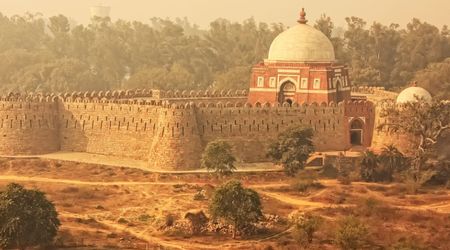
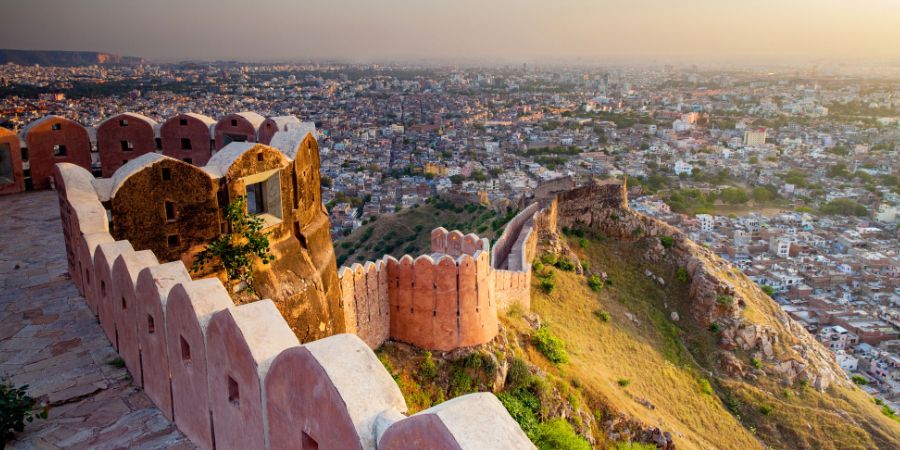
Nahargarh doesn't look like a fort that spent nearly three centuries doing nothing. Its crenellated walls snake along the Aravalli ridge above Jaipur with the kind of defensive seriousness that suggests sieges, boiling oil, last stands. The bastions jut outward at precise intervals. Arrow slits perforate the sandstone. Every architectural decision screams military function. The reality, though, confounds the appearance entirely — no army ever attacked Nahargarh, and no battle was ever fought within its walls.
Sawai Jai Singh II conceived the fort as part of a defensive ring around his new capital. Jaigarh Fort, a few kilometers to the northwest, held the armory and the treasury. Amer Fort, the old seat of power, guarded the approach from the north. Nahargarh completed the triangle, watching over the city's western and southern flanks. Its strategic position made it essential; its isolation made it unnecessary. Enemies who might have challenged Jaipur looked at those ridgeline walls and chose other routes.
The fort's primary use, as it turned out, was recreational. Successive maharajas treated it as a retreat — a place to escape the clamor and dust of the city below. During the Indian Mutiny of 1857, the fort served a more pragmatic purpose: sheltering European residents from potential unrest. The British officers reportedly found the accommodations tolerable, if austere.
Today the fort functions as a kind of open-air museum without much museology. You buy a 200-rupee ticket at the gate, and the interpretation mostly ends there. No audio guide, no comprehensive signage. You're left to piece together the story from the stones themselves, which is either maddening or liberating, depending on your temperament. The walls still carry the faint outlines of painted floral motifs in chambers where the plaster hasn't crumbled away. The cannons point outward at a city that long ago sprawled past any boundary the maharaja could have imagined.
What's striking, standing on those ramparts, is how the fort's unused military posture gives it an almost melancholy quality. It was built for a violence that never arrived. That absence shapes the atmosphere more than any relic or artifact could.
The Ghost Who Wouldn't Let the Walls Stand
The fort's original name was Sudarshangarh. Nobody calls it that. The name Nahargarh — "abode of tigers" — comes not from any actual tiger but from a dead Rathore prince named Nahar Singh Bhomia, whose spirit supposedly haunted the ridge during construction. According to local accounts, every wall the masons raised by day collapsed by night. Jai Singh's engineers couldn't explain it. The stonework was sound. The foundations were deep. And yet the walls kept falling.
A tantric priest was consulted, as was customary when engineering failed to satisfy the inexplicable. The priest identified the problem: Nahar Singh Bhomia's spirit occupied the ridge and resented the construction. The solution was straightforward Rajput diplomacy — even with the dead. Jai Singh dedicated a temple to the prince within the fort grounds and renamed the entire structure in his honor. The walls, according to the story, stood firm from that point forward.
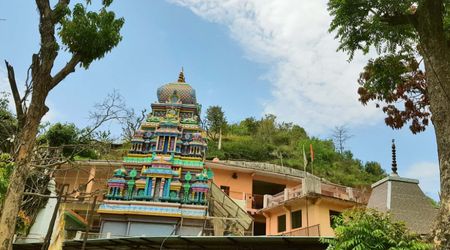
The temple still exists. It's a small, unremarkable structure near the fort's inner courtyard, easy to walk past if you don't know to look for it. A few marigold garlands drape the entrance. A caretaker occasionally lights incense. Most visitors assume it's a generic shrine. The specificity of its origin — a ghost story inseparable from the fort's engineering history — gets lost entirely without context.
What makes this legend worth dwelling on isn't its supernatural content but what it reveals about Rajput political culture. Naming a fort after a potential adversary, even a spectral one, was a form of co-option. You didn't destroy your enemies in Rajasthan; you absorbed them. The same instinct that made Rajput kings forge marriage alliances with Mughal emperors operated here on the metaphysical plane. Nahar Singh's spirit wasn't exorcised. It was promoted.
The legend persists in Jaipur's popular imagination. Taxi drivers and autorickshaw wallahs mention it without prompting. The fort is closed after 6 PM, and while the official reason involves safety and conservation, more than a few locals attribute the curfew to Nahar Singh's continuing displeasure with anyone who lingers past dark.
Where Jaipur Reveals Its True Scale and Its True Color
The terrace along the fort's western wall delivers a panorama that reorganizes your understanding of Jaipur. From the old city's streets, the Pink City feels intimate, compressed — lanes too narrow for two rickshaws to pass, sandstone facades pressing inward. From Nahargarh, you see the deception. Jaipur stretches in every direction, its pink-washed core just one dense cluster in a metropolitan area of over three million people. The modern city's concrete sprawl extends south and east toward the flat Rajasthani plain, grey and utilitarian, indifferent to the heritage zone's cosmetic restrictions.
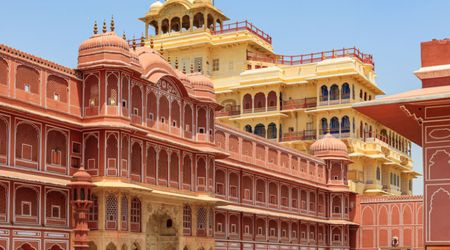
The pink, too, looks different from up here. At street level, the old city's buildings appear uniformly salmon-colored, the result of a 1876 paint job ordered for the Prince of Wales's visit. From the fort, the uniformity breaks down. Some buildings have faded to a dusty beige. Others have been repainted in shades that range from peach to something closer to burnt orange. The "Pink City" is actually twenty shades of not-quite-pink, and this inconsistency, invisible from below, gives the cityscape a watercolor quality that strict uniformity could never achieve.
Jal Mahal, the Water Palace, floats in Man Sagar Lake to the east, its upper stories visible above water that ranges from murky green in monsoon season to a cracked mud pan in the driest months of April and May. The Hawa Mahal's honeycomb facade, so overwhelming when you stand beneath it on Johari Bazaar, reduces to a sliver from this distance. Nahargarh imposes perspective, literally. Things that seemed monumental at ground level become details in a composition you didn't know existed.
Sunset draws the largest crowds, and for good reason — the light shifts from white to gold to amber across twenty minutes, turning the city's flat rooftops into a continuous warm surface that seems to generate light rather than reflect it. The Aravalli hills on the horizon go purple. The traffic noise from below, which you'd barely registered, fades as the air cools and the wind picks up. A curious thing happens: people stop talking. Even the selfie-takers lower their phones for a few seconds. The view doesn't simply impress; it imposes a brief, involuntary stillness.
If you arrive early enough — before 4 PM on most days — you'll have the parapet largely to yourself. The same view that silences a crowd at dusk feels entirely different in harsh afternoon light: starker, less romantic, more honest. Jaipur without its golden filter looks like what it is — a growing, contradictory Indian city wrapped around a Mughal-era experiment in urban planning.
The Twelve Identical Rooms Where Jealousy Was an Architectural Problem
Madhavendra Bhawan sits inside the fort's upper enclosure, and most visitors glance through a doorway or two before moving on to the parapet. This is a mistake. The palace, built in 1902 by Maharaja Sawai Madho Singh, contains twelve interconnected suites — one for each of the maharaja's twelve queens — arranged around a central corridor with a precision that had nothing to do with aesthetics and everything to do with domestic politics.
Every suite is identical in layout: a bedroom, a kitchen, a toilet, a store room. The dimensions match. The ceiling heights match. The windows face the same direction. This wasn't efficient design; it was defensive architecture of a different kind. The maharaja had learned, or intuited, that any visible difference in accommodation among twelve queens would generate a conflict no fort wall could withstand. The solution was radical symmetry. Each queen entered her suite through a separate door from the central hall; none could see another's entrance. The maharaja, meanwhile, could access all twelve suites through interconnected passages without crossing any shared space.
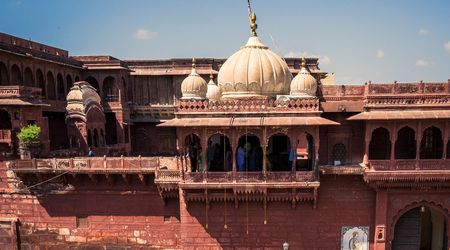
The frescoes inside these rooms survive in patches — floral motifs, geometric borders, the occasional peacock rendered in blue and green mineral pigments. Water damage and indifferent restoration have erased large sections, but enough remains to suggest the interiors were once vivid. The stucco work on some archways retains a delicacy that the fort's martial exterior doesn't prepare you for. These were living spaces designed for comfort, even luxury, within a building that presented itself to the world as a military installation.
Walk the central corridor slowly. The footstep echoes differently in each section depending on the thickness of the remaining plaster. In some rooms, the original colored glass panels still filter light into fragments of amber and green across the stone floor. The air in the deeper chambers stays noticeably cooler, ten or fifteen degrees below the exterior temperature — a product of the thick walls and ventilation channels that the builders understood with an intuitive precision. The twelve queens of Madhavendra Bhawan are long forgotten by name, but the architecture still holds the shape of their separate, parallel, meticulously equal lives.
The Four-Hour Window in December and the Furnace of May
Nahargarh sits on an exposed ridge with no shade worth mentioning, and this single fact should govern every planning decision you make. Between March and June, the temperature on the fort's stone terraces can exceed 45 degrees Celsius. The sandstone absorbs and radiates heat with a brutality that sunscreen and water bottles can only partially mitigate. Tourists who arrive at midday in April photograph themselves looking miserable, and the photographs don't lie. The fort's caretakers retreat to the deepest rooms of Madhavendra Bhawan during those hours, emerging only when shadows lengthen.
October through February offers the most tolerable conditions. December and January bring daytime highs around 22 degrees, and the fort's elevation catches a steady breeze that the city below doesn't receive. The golden window sits between 3 PM and 5 PM during these months — warm enough to be comfortable, angled enough for the light to perform its transformation across Jaipur's rooftops. Arrive earlier if you want to explore Madhavendra Bhawan's interiors without competing for doorway space with tour groups.
The monsoon months of July through September present a different proposition entirely. Rain makes the approach road slippery and occasionally impassable, and the fort's drainage system — adequate for the eighteenth century — creates standing water in the lower courtyards. The walls darken to a deeper ochre when wet, and the scrub vegetation on the surrounding hills turns an almost violent green. The crowds thin to nearly nothing. If you don't mind getting damp and can tolerate the risk of a shortened visit, monsoon mornings offer the most dramatic atmosphere — cloud banks rolling through the ramparts, the city below disappearing and reappearing in fragments.
Weekends and Indian public holidays bring a density of visitors that transforms the experience. The approach road congests. Parking fills. The parapet becomes a continuous wall of mobile phones held aloft. Tuesday tends to be the quietest weekday, though no one has offered a convincing explanation for why. The fort opens at 10 AM and closes at 5:30 PM; that closure is strictly enforced, and stragglers are shepherded out by guards who show no interest in negotiation.
The Road That Twists Eleven Times Before the Gate
The approach to Nahargarh from Jaipur's old city follows a narrow road that switchbacks eleven times through the Aravalli scrub. It takes roughly twenty minutes by car from Amer Road, and the driving is not for the nervous. The road narrows in places to barely one lane, with no barrier between the tarmac edge and the hillside drop. Local drivers handle this with the casual indifference that characterizes all mountain driving in India. If you've hired a taxi for the day, confirm that your driver has made the trip before — the turns are tight enough that an unfamiliar vehicle can create problems at the hairpins.
An autorickshaw from the old city to the fort gate costs between 300 and 500 rupees depending on your bargaining stamina and the time of day. Fix the price before you sit down. Some drivers will quote a round-trip fare that includes waiting time at the top — a reasonable arrangement, since the alternatives for getting back down are limited. Ride-hailing apps function inconsistently on the ridge; cellular coverage drops near the fort entrance.
A footpath connects Jaigarh Fort to Nahargarh along the ridge, covering roughly two kilometers through rocky terrain. The walk takes forty-five minutes to an hour at moderate pace, and the trail is clear if not well-marked. Carry water. The path offers no shade and no vendors. A second walking route ascends from the base of the hill near Charan Mandir, steeper and less maintained, used primarily by locals exercising in the early morning. This approach takes about an hour and rewards you with views the road doesn't provide — but it demands sturdy shoes and a tolerance for scrambling over loose stone.
Tour operators in Jaipur bundle Nahargarh with Jaigarh and Amer Fort in a single day trip, compressing three distinct sites into a five-hour blur. Resist this. Nahargarh deserves a separate visit — ideally a late-afternoon one — that allows you to move slowly through Madhavendra Bhawan and reach the western terrace before the light turns. The fort's small cafeteria, operated by the state tourism department, sells chai and packaged snacks. Expect nothing more. Eat before you come, or carry something. The nearest proper restaurants sit at the base of the hill, back in Jaipur's gravity.
Nahargarh's peculiar power lies in its contradiction — a fortress built for war that knew only peace, a lookout point that reveals a city to be vastly different from what its streets suggest. The best travel experiences don't confirm what you already believed; they rearrange your understanding in small, permanent ways. Jaipur seen from Nahargarh is not the same Jaipur you walked through that morning. The Pink City loses its pinkness and gains complexity. The fort loses its military swagger and reveals domestic quarters where twelve women lived identical, carefully separated lives. What you carry down from that ridge isn't a photograph. It's a correction.