

The butter melts on your fingertips before you can press it into the crack. Every monsoon season, lightning finds the stone Shiva lingam inside a small temple perched at 2,460 meters in Himachal Pradesh's Kullu Valley, shattering it into fragments. And every time, the temple priest gathers those pieces, packs them together with fresh butter and sattu — roasted barley flour — and waits. The stone reconstitutes. This isn't myth preserved in scripture alone; it's a ritual performed year after year, witnessed by pilgrims who climb the ridge specifically to see the aftermath.
Bijli Mahadev Temple sits on a grassy promontory called Mathan, overlooking the confluence of the Beas and Parvati rivers, and it operates on a logic that refuses easy categories. The lightning isn't feared here. It's invited. The destruction of the lingam isn't tragedy — it's the whole point, a cyclical act of divine contact that makes this one of Hinduism's most viscerally strange pilgrimage sites. What follows is a journey through the geography, mythology, architecture, and physical effort required to reach a place where the sky literally touches the sacred, and where the line between geological phenomenon and spiritual event has been deliberately, productively blurred for centuries.
At 2,460 Meters, Where Two Rivers Argue Below
Bijli Mahadev Temple occupies the flat summit of Mathan ridge, roughly 24 kilometers southeast of Kullu town. The ridge itself juts out like a blunt finger above the point where the Beas River absorbs the Parvati — a confluence visible from the temple grounds as a pale green thread merging into grey-blue. On clear days, the view extends across the full breadth of the Kullu Valley to the Pir Panjal range, though "clear days" is a relative concept here during the monsoon months when the temple earns its name.
The nearest road access is the village of Chansari, connected by a narrow road branching off from the Kullu-Naggar highway near the left bank of the Beas. From Chansari, a footpath climbs roughly three kilometers through deodar forest and open alpine meadow to the summit. The final approach crosses a grassland that feels oddly manicured, grazed short by the goats and sheep of Gaddi shepherds who use the surrounding slopes as seasonal pasture.
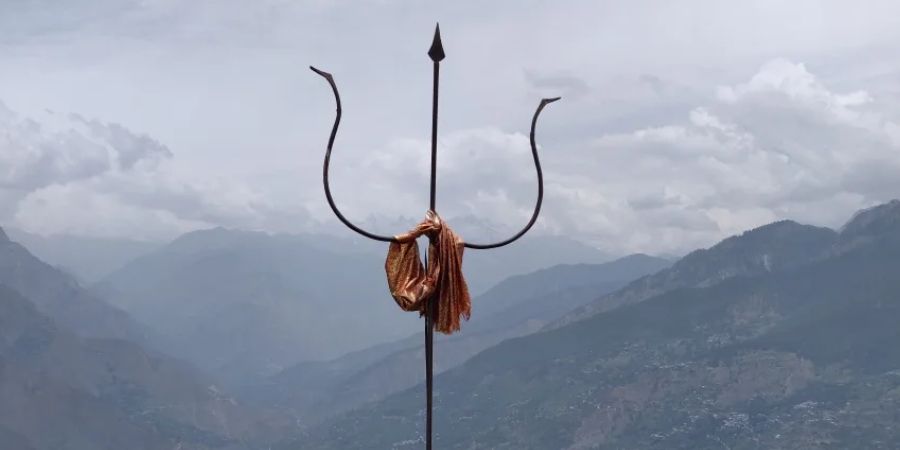
What makes the setting unusual isn't just the altitude or the valley panorama. It's the exposure. The temple sits on an open ridge with no taller peaks immediately adjacent, making it the highest point for a considerable radius. During monsoon storms, clouds roll up the valley and collide with the ridge at eye level. You don't watch storms from here; you stand inside them. The iron staff — roughly 60 feet tall — planted beside the temple acts as a lightning conductor, though the lingam inside still receives direct strikes. The position isn't accidental. Whoever chose this site understood atmospheric electricity long before anyone had a term for it, selecting a point where the mountain itself becomes an antenna.
Below the ridge, the villages of Chansari and Jana cling to terraced slopes planted with apple orchards and stone wheat. The contrast is sharp: domestic, agricultural life within walking distance of a site defined entirely by uncontrollable elemental force.
A Temple Older Than Its Own Records
Pinning a founding date on Bijli Mahadev is an exercise in frustration. No inscriptions survive on the structure, and the temple's historical record is almost entirely oral, transmitted through the lineage of priests — called pujaris — who have maintained the site for generations. Local tradition places the temple's origins in an unspecified ancient period tied to the broader Shaivite sacred geography of the Kullu Valley, which houses over 300 temples and has functioned as a Shiva-devoted region since at least the early medieval period.
The Kullu kings, who ruled from roughly the first century CE through British annexation, were vigorous temple builders, and the valley's religious infrastructure expanded dramatically under rulers like Raja Jagat Singh in the seventeenth century. Whether Bijli Mahadev predates the Kullu kingdom or emerged from it remains an open question. The temple's simplicity — a modest stone structure without elaborate ornamentation — suggests either great antiquity or deliberate austerity, and those two explanations pull in opposite directions.
What the historical record does confirm is the lightning ritual's continuity. British colonial officers passing through the Kullu Valley in the nineteenth century noted the practice of reconstituting the shattered lingam with butter, which means the cycle was already well-established and unremarkable to locals by that point. The ritual wasn't invented for tourism or revivalist purposes; it was simply ongoing.
The temple's relative obscurity compared to major Shaivite sites like Kedarnath or Amarnath has, paradoxically, preserved its authenticity. There's been no Archaeological Survey of India intervention, no major renovation campaign. The structure you see today is close to what it has been for a long time — small, functional, and secondary to the phenomenon it houses. The building serves the lightning, not the other way around.
The Storm That Comes on Purpose
The legend of Bijli Mahadev centers on a demon named Kulant, a serpent of enormous scale who blocked the course of the Beas River, flooding the valley and threatening all life within it. Shiva, as Mahadev, destroyed Kulant with a thunderbolt, shattering the demon's body across the valley. The lightning that strikes the temple's lingam is understood as a recurring echo of that original cosmic violence — Shiva's energy returning to the same spot, breaking the stone to re-enact the destruction of evil.
This framing inverts the usual relationship between worship and disaster. At most temples, structural damage from natural events is a crisis. At Bijli Mahadev, the destruction is the worship. The lightning strike doesn't interrupt the sacred cycle — it is the sacred cycle. The priest's task isn't repair; it's participation in a divine pattern. Packing the shattered lingam with butter and sattu isn't maintenance. It's ritual completion of a loop that begins in the atmosphere and ends in human hands.
The serpent Kulant also explains the local geography, at least in mythological terms. The Beas River's passage through the narrow gorge below Kullu town is attributed to the demon's body carving the valley. The landscape itself becomes a relic of the story, which means walking through the Kullu Valley is, for believers, walking through the aftermath of Shiva's intervention.
What's striking is how unsentimental the legend is. There's no gentle mysticism here, no meditative tranquility. The divine presence at Bijli Mahadev is violent, electrical, and seasonal. Shiva doesn't visit in whispers. He arrives as ten million volts hitting stone, and the evidence of that arrival is a pile of rubble that the priest quietly reassembles before the next strike. The theology is inseparable from the weather.
A Stone That Refuses to Stay Whole
The lingam inside Bijli Mahadev is not carved marble or polished granite. It's a rough stone form, dark and unadorned, sitting in the small sanctum of the temple. Its lack of refinement is the point. A highly finished lingam would make the shattering a loss. This one exists to be broken, and its crude surface carries the evidence of repeated fracture lines, filled and refilled with the butter-and-sattu mixture that functions as both adhesive and sacred offering.
The reconstitution process follows each lightning strike during the monsoon season, typically between July and September. The priest collects the fragments — sometimes as few as two large pieces, sometimes a scatter of smaller ones — and presses them back together using fresh unsalted butter mixed with sattu. The butter hardens in the cool mountain air, binding the pieces. Over time, the stone appears to fuse, though whether this is a genuinely mineralogical process or simply the compressive effect of the butter seal is a question nobody at the temple seems interested in answering.
Pilgrims who arrive shortly after a strike describe the sanctum smelling of ozone and warm stone, with fresh butter glistening in the cracks. The lingam in this state looks wounded and tended to, like a body under bandages. It's an image far removed from the sleek, flower-draped lingams of lowland temples.
The theological implication is profound: the sacred object here is not permanent. It's cyclically destroyed and remade, which mirrors Shiva's own identity as both destroyer and regenerator. Most lingams are treated as inviolable — you don't touch, chip, or disturb them. At Bijli Mahadev, violation is the mechanism of holiness. The stone's fragility isn't a problem to solve. It's the entire theology compressed into a physical object.
A Building Designed to Be Struck
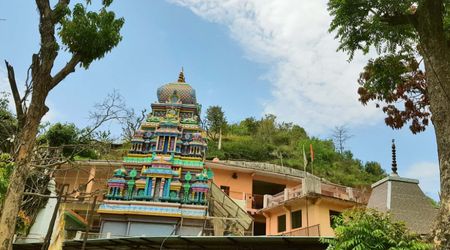
The temple structure is modest by any standard — a single-room stone building with a wooden-framed entrance and a slate roof, following the pahari architectural style common across Himachal Pradesh's mountain valleys. The walls are thick, built from dry-stacked local stone, and the interior is dim even at midday, lit primarily by oil lamps and whatever light enters through the low doorway. No ornate shikhara tower rises above it. No elaborate mandapa precedes it. The building is, architecturally, almost reluctant.
The most conspicuous feature isn't the temple itself but the tall iron staff planted beside it, rising roughly 60 feet from the ridge. This staff functions as a lightning rod, and its presence raises a genuine paradox: the temple simultaneously invites and mitigates the electrical strikes. The staff draws lightning toward the ridge while partially protecting the structure around the lingam. Whether this represents an original design intention or a later practical addition is unclear, but the effect is a kind of controlled channeling — the lightning comes, but the building survives.
Inside the sanctum, the floor is bare stone. The lingam occupies the center without pedestal or elaborate yoni base. Prayer flags and small bells hang from the wooden beams, and the walls carry the dark staining of decades of lamp smoke. The austerity is genuine, not aesthetic. There's no gift shop, no prasad counter, no queue management system.
The design philosophy, if you can call it that, treats the temple as a container rather than a monument. It exists to house the lingam and shelter the priest during the ritual cycle. Everything structural serves that function and nothing more. The sacred design isn't in the architecture — it's in the positioning, the decision to build exactly here, where stone and lightning maintain their ancient, violent correspondence.
Three Kilometers That Erase the Highway
The trek from Chansari to Bijli Mahadev covers roughly three kilometers and gains about 500 meters of elevation — manageable for anyone with functioning knees and basic footwear. The path begins at the road's end in Chansari, where a handful of tea stalls sell biscuits and boiled eggs, and immediately enters deodar forest. The canopy blocks most direct sunlight, and the trail smells of resin and damp earth, particularly after rain. Roots cross the path at irregular intervals, and the gradient is steady rather than punishing.
About two-thirds of the way up, the forest opens abruptly into alpine meadow, and the shift is disorienting. One moment you're enclosed in timber darkness; the next, the entire Kullu Valley unfolds below you, the Beas River a silver thread at the bottom. The final approach crosses this grassland on a narrow trail, exposed and windy, with the temple visible on the ridge ahead.
The trek's real function is transitional. Three kilometers isn't enough to constitute serious physical challenge, but it's precisely enough to separate you from the road, the car, the phone signal. By the time you reach the meadow, the town below feels distant in a way that has nothing to do with actual meters. The effort recalibrates attention. You arrive at the temple slightly winded, slightly humbled, and significantly more receptive than you would be if a bus dropped you at the door.
During monsoon months, the trail becomes slippery and leeches appear on the lower sections. This is also the season of lightning strikes, which means the most rewarding time to visit is also the least comfortable. The pilgrimage has never been designed for ease. The weather you endure on the trail is the same weather that shatters the lingam inside.
When the Valley Climbs to the Ridge
Maha Shivaratri — the great night of Shiva, falling in February or March — draws the largest crowds to Bijli Mahadev. Pilgrims climb from Chansari in the pre-dawn cold, often in snow, carrying marigold garlands and offerings of milk. The temple, barely large enough for a dozen people, becomes the focal point for hundreds who gather on the surrounding meadow, chanting and building small fires against the mountain chill. The pujari performs extended rituals through the night, and the atmosphere shifts from devotional calm to something rawer, fueled by cold and fatigue and collective intensity.
Navaratri, observed in both spring and autumn, also brings significant gatherings, though the autumn iteration — coinciding with the tail end of monsoon season — carries particular significance here. The last lightning strikes of the season may have occurred just weeks earlier, and the freshly reconstituted lingam is still visibly packed with butter. Pilgrims during this period see the evidence of the divine cycle at its most recent.
Local festivals tied to the Kullu Dussehra — a week-long celebration in October when deities from across the valley are carried in procession to Kullu town — also affect the temple's rhythm, though Bijli Mahadev's deity doesn't typically descend for the procession. The temple remains above the festivities, literally and figuratively, maintaining its separation from the valley's communal religious life.
What distinguishes Bijli Mahadev's festival calendar from more famous pilgrimage sites is the absence of institutional management. There are no official schedules posted online, no ticketing systems, no organized dharamshalas with booking portals. You arrive, you ask the pujari when things happen, and you adjust. The temple operates on a rhythm older than administrative convenience, and that rhythm is set as much by the weather as by the Hindu calendar.
Getting There Without Getting Lost
Kullu town is the practical base. Bhuntar Airport, roughly 10 kilometers south of Kullu, receives flights from Delhi, though cancellations during monsoon are routine. The more reliable approach is road — Kullu sits on National Highway 3, reachable by bus from Delhi (approximately 12 hours via Chandigarh) or from Manali (40 kilometers north). From Kullu, you'll need local transport to Chansari village. Options break down as follows:
- Shared taxis from Kullu's left bank road to Chansari cost a nominal fare and run irregularly — morning departures are most reliable.
- Private taxis can be arranged through any Kullu hotel; expect to pay between 800 and 1,200 rupees for the round trip with waiting time.
- HRTC buses on the Kullu-Naggar route can drop you at the turnoff for Chansari, from where a two-kilometer walk on a paved road reaches the village.
- Motorcycle rental in Kullu is possible but the final road to Chansari is narrow and potholed — not ideal during wet conditions.
Accommodation at the temple itself doesn't exist. A few basic guesthouses in Chansari offer rooms, but don't expect hot water or consistent electricity. Most visitors treat Bijli Mahadev as a day trip from Kullu or Naggar, climbing in the morning and descending by afternoon. Carry water and a rain layer regardless of the forecast — the ridge weather shifts within minutes.
The best window for the trek is May through June, before the monsoon arrives, when the meadow is green and visibility across the valley is strong. September and October offer post-monsoon clarity, but the trail may still be muddy. July and August bring the lightning but also heavy rain, leeches, and reduced visibility. Choosing your season is choosing what kind of experience you want: the spectacle of the storm or the calm after it.
Mobile coverage drops to nothing on the upper trail and at the temple. Carry cash — there's no ATM closer than Kullu town, and the tea stalls in Chansari don't accept digital payments.
Bijli Mahadev occupies a category of sacred site that resists the usual pilgrimage infrastructure — no ropeway proposals, no luxury tent camps, no audio guides. Its power derives from a geological fact that happens to align with a theological idea, and neither the geology nor the theology requires your comfort. The temple doesn't argue for Shiva's presence through gold leaf or carved narrative panels. It argues through broken stone and melted butter, through a ridge that takes the full force of the monsoon sky and converts it into something a priest can hold in his hands. Most sacred sites ask you to believe in something you cannot see. This one asks you to believe what the lightning already proved. The crack in the stone is still fresh.