

The guard at the entrance to Mehrangarh Fort's inner chambers barely glanced up as I stepped through a low doorway and into a room that stopped me mid-stride. Thousands of tiny mirrors — convex, each no wider than a thumbnail — caught the beam of a single candle held by another visitor and scattered it across every surface. The walls moved. The ceiling breathed light. I stood inside a jewel box designed for a king who understood that darkness, handled correctly, becomes spectacle.
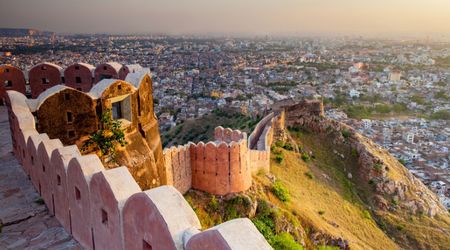
This is Sheesh Mahal, the Hall of Mirrors, buried deep within one of India's most imposing fortresses, and yet routinely passed through in under ninety seconds by tour groups fixated on the ramparts and cannon displays outside. Jodhpur's famous blue houses spread below the fort like a rumpled bedsheet, and most visitors come for that view. They photograph the panorama, buy miniature paintings from vendors along the ramp, and leave.
The mirror palace — small, easy to miss, tucked behind grander halls — rarely makes the highlight reel. That's a mistake. What follows is a closer look at why Sheesh Mahal deserves your full attention: its origins, its construction, what it feels like to stand inside it, and how to reach it without missing the details that matter most.
A Palace That Glitters in the Dark — First Impressions of Sheesh Mahal
You don't walk into Sheesh Mahal so much as you stumble upon it. The room sits along the museum route inside Mehrangarh Fort, after a sequence of increasingly ornate chambers — the Phool Mahal with its gold filigree ceiling, the Takhat Vilas with its Christmas-bauble glass ornaments from Belgium. By the time you reach the mirror palace, your eyes have adjusted to richness. Then the scale shifts.
Sheesh Mahal is not large. The room measures roughly the size of a modest hotel suite, and its ceilings hang lower than you'd expect from a space designed for Marwar royalty. That compression matters. Every surface — walls, ceiling, the recessed arches — is inlaid with fragments of mirror glass, some curved, some flat, set into painted plaster that has aged to the color of dark honey. The effect in low light isn't sparkle so much as pulse, a slow ripple of reflected flame that moves when you move.
Most visitors encounter the room with fluorescent museum lighting, which flattens the experience into something merely decorative. If you're lucky, a guide will produce a candle or a torch and dim the overheads. That transformation is the entire point. The mirrors were calibrated for oil lamps and flickering wicks, not electricity. Under candlelight, the room seems to expand; reflections multiply until the walls lose their solidity.
What strikes you last is the silence. Mehrangarh's outer courtyards carry the noise of tourists, hawkers, and the occasional trumpet blast from a wedding procession winding through the city below. Inside Sheesh Mahal, the thick sandstone walls absorb everything. You hear your own breathing. The contrast between the fort's military exterior — all bastions and murder holes — and this interior of concentrated, private beauty is disorienting. It was meant to be.
Built for a Maharaja Who Collected Light Like Other Rulers Collected Weapons
Maharaja Ajit Singh commissioned Sheesh Mahal in the early eighteenth century, somewhere around 1707, during a period when the Rathore dynasty was reasserting itself after decades of Mughal pressure. Ajit Singh had spent his childhood in hiding — smuggled out of Delhi as an infant, raised in secret while Aurangzeb's forces controlled Jodhpur. When he finally reclaimed the throne, he built not fortifications but pleasure rooms. Sheesh Mahal was a political statement dressed in mirror glass: sovereignty expressed through beauty rather than brute force.
The mirror-inlay tradition itself arrived in Rajasthan through Mughal influence, borrowed originally from Persian and Central Asian palace design. Amber Fort's Sheesh Mahal near Jaipur, built earlier under Man Singh I, is the more famous version. Jodhpur's iteration, completed later, is smaller and less visited, but its execution is arguably more refined. The mirrors here aren't arranged in simple geometric grids. They follow organic, almost floral patterns that suggest the influence of local Marwari craftsmen working alongside Mughal-trained artisans.
Ajit Singh's reign was turbulent — he was eventually murdered by his own sons in 1724 — but the rooms he commissioned inside Mehrangarh survived every succession crisis. The fort changed hands, absorbed cannon fire during regional conflicts, and weathered the slow erosion of princely power under the British Raj. Through all of it, Sheesh Mahal remained intact, its mirrors periodically restored but never redesigned.
The Mehrangarh Museum Trust, established in the 1970s under the guidance of the current Jodhpur royal family, now maintains the chamber. Their conservation work has kept the original plaster-and-mirror technique visible — you can see where older, slightly yellowed glass meets newer replacements. That patchwork is itself a kind of historical record, each restoration layer corresponding to a different era of Rathore patronage.
How Convex Glass and Dark Honey Plaster Create the Illusion of Infinite Space
The architectural trick of Sheesh Mahal depends on a detail most visitors miss: the mirrors aren't flat. Many of the glass fragments are slightly convex, ground and polished to create miniature wide-angle reflections. A single candle flame, reflected in one convex mirror, becomes a soft orb of light. Multiply that by several thousand mirrors across every surface, and the room generates its own constellation. Flat mirrors would produce sharp, predictable reflections. The convex ones diffuse light unpredictably, which is what gives the space its unsettling sense of movement.
The plaster surrounding each mirror fragment is equally deliberate. Craftsmen mixed lime with pigments and organic binding agents to create a surface that has darkened over three centuries to a warm amber. That tonal warmth matters — it absorbs excess light and prevents the room from becoming visually chaotic. The mirrors do their work against a background that recedes rather than competes.
Structural choices reinforce the optical ones. The ceiling is vaulted rather than flat, which allows reflected light to travel in arcs rather than straight lines. Recessed alcoves along the walls — originally designed to hold oil lamps — create pockets of concentrated illumination. The room's proportions force you close to the walls, where the mirror detail is most intricate, rather than allowing you to stand at a comfortable distance and admire the whole.
One counterintuitive element: the floor is plain stone. No mirrors, no inlay. That bare surface anchors the room and gives your eyes somewhere to rest. Without it, the visual overload would become claustrophobic rather than enchanting. Whoever designed Sheesh Mahal understood restraint as well as excess — a combination rarer than it sounds in Rajasthani palace architecture, where more typically means more.
Ninety Seconds or Thirty Minutes — The Room Rewards Whoever Stays Longest
The standard Mehrangarh Fort museum visit runs about two hours. Most visitors allocate ninety seconds to Sheesh Mahal — enough time for a photograph with flash (which ruins both the image and the atmosphere) and a glance at the information placard. The room deserves more. If you sit on the stone floor near one of the lamp alcoves and wait for a gap between tour groups, the silence returns, and the mirrors begin to do something different. Without other bodies blocking the reflections, the room's geometry opens up. You see patterns that disappear in a crowd.
The audio guide available at the museum entrance covers Sheesh Mahal briefly but competently. A better option is one of the fort's human guides, many of whom carry small battery-operated tea lights specifically for this room. Ask for a demonstration. The shift from electric overheads to a single warm light source changes the chamber so completely that it feels like entering a second room hidden inside the first.
Photography is permitted, but the results are almost universally disappointing. Flash obliterates the subtlety; without flash, you'll get motion blur unless you're carrying a tripod, which the museum discourages. The best images come from phone cameras pressed flat against the stone floor, shooting upward into the vaulted ceiling with a long exposure. Even then, the photograph captures maybe a tenth of what the eye perceives.
The emotional register of the room shifts depending on the time of day. Morning light, filtering through a small window in the adjacent corridor, introduces natural warmth. By late afternoon, the room grows cooler and the mirrors deepen in tone. Evening visits aren't possible — the museum closes by five — but the late-afternoon quality of light comes closest to what oil lamps would have produced three centuries ago. Arrive after three if you can.
Getting to the Mirrors Without Getting Lost in Rajasthan's Logistics
Jodhpur connects to Delhi by overnight train — the Mandore Express departs Old Delhi Station around nine in the evening and arrives by early morning, depositing you close enough to the fort that an auto-rickshaw ride takes fifteen minutes. Flights from Delhi, Mumbai, and Jaipur land at Jodhpur Airport, roughly five kilometers from the city center. From the airport, insist on a prepaid taxi to avoid the negotiation theater that awaits outside arrivals.
Mehrangarh Fort opens daily from nine in the morning to five in the evening. Entry tickets for the museum — which includes Sheesh Mahal — cost 200 rupees for Indian nationals and 600 for international visitors, as of recent pricing. Audio guides add another 150 rupees and come in several languages. The fort sits on a 125-meter-high hill above the old city, and the walk up the ramped approach takes about twenty minutes at a comfortable pace. An elevator exists for those who need it, accessed from the parking area.
Practical considerations worth noting:
- Sheesh Mahal sits roughly midway through the museum route — don't rush through the preceding halls or you'll arrive already fatigued.
- Carry a small flashlight or use your phone's torch on its lowest setting to appreciate the mirror work up close without disturbing other visitors.
- The fort's Chokelao Garden restaurant serves a decent thali lunch with views over the blue city — a good place to rest before or after your visit.
- Avoid visiting between eleven and one, when large bus-tour groups tend to cycle through the museum rooms in tight clusters.
Jodhpur's climate is desert-dry, and the fort's interior stays cooler than the outside, but summer months — April through June — push temperatures past forty-five degrees Celsius. October through February offers the most tolerable conditions for extended fort exploration.
What the Rest of Mehrangarh Reveals Once You Stop Looking at the Mirrors
Sheesh Mahal tends to recalibrate your attention. After spending time in a room where every surface demands focus, the rest of Mehrangarh unfolds differently. The Zenana Deodi, the women's quarters, features latticed sandstone screens — jali work — carved so finely that they filter sunlight into geometric patterns on the floor. You notice those patterns only because the mirror palace taught your eyes to look for manipulated light.
The fort's other notable halls include Moti Mahal, used for private audiences, where the walls carry a shellac finish made from crushed seashells, and Phool Mahal, the most lavishly gilded room in the complex, where Maharajas held celebrations. Neither matches Sheesh Mahal's intimacy. They were designed for spectators. The mirror palace was designed for the person standing inside it.
Beyond the fort, Jodhpur itself repays slow exploration. The Sardar Market near the clock tower sells spices piled in bright cones — turmeric, red chili, cumin — that you smell before you see. The Toorji Ka Jhalra stepwell, restored in recent years, sits a short walk from the market and offers a quiet architectural counterpoint to the fort's verticality. Bishnoi village visits, arranged through local operators, take you into the desert communities surrounding Jodhpur, where wildlife conservation practices predate modern environmentalism by five hundred years.
The blue-painted houses visible from the fort's ramparts were traditionally associated with Brahmin households, though the practice spread across castes over generations. Walking through the narrow lanes of Navchokiya — directly beneath the fort walls — puts you inside that blue wash rather than above it. The paint, a mixture of lime and copper sulfate, reportedly repels insects, which matters more than aesthetics in a desert city where termites threaten every structure.
Jodhpur's mirror palace is a room you can cross in eight steps, set inside a fortress that took five hundred years to build, overlooking a city painted in a color meant to keep bugs away. That combination — grandeur and practicality, spectacle and modesty, all compressed into a single hilltop — is Rajasthan's actual character, the one that exists beneath the tourist brochure version. Sheesh Mahal doesn't hide from the world. It simply asks you to slow down enough to find it, and most people won't. The ones who do carry something home that no photograph can hold: the memory of standing inside a room that turned a single flame into a universe, and understanding that someone built it not to impress visitors but to remind a king, in his most private hours, what light could become when you refused to waste it.