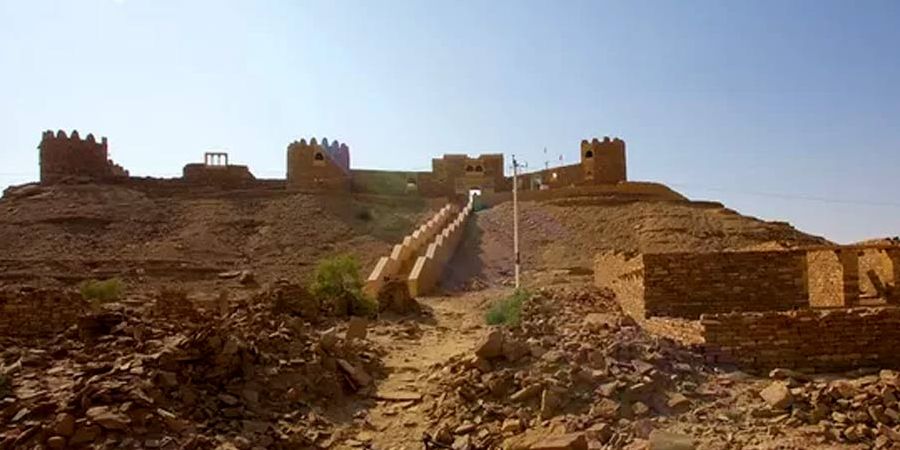


The sand here doesn't drift so much as creep. It piles against doorframes with a patience that outlasts stone. At Khaba Fort, thirty kilometers southwest of Jaisalmer on a road that barely qualifies as one, the Thar Desert has been slowly digesting the remains of a settlement that once held several hundred families. The walls still stand — most of them — but the rooms they define belong to scorpions and the occasional desert fox. No roof survives. The wind took those first.
What makes Khaba distinct from Rajasthan's more famous ruins isn't scale or grandeur. It's the completeness of the abandonment. The people who lived here — Paliwal Brahmins, a community of unusual sophistication — didn't fade gradually or succumb to siege. They vanished in a single night, roughly two centuries ago, leaving behind homes, a fort, and an irrigation system so advanced it still confuses engineers. The desert wasted no time moving in.
This is the story of that disappearance, the civilization it erased, and what remains for anyone willing to drive the unpaved stretch from Jaisalmer to find it. The fort, a small museum, and the surrounding ghost village of Kuldhara together form one of Rajasthan's most unsettling and least understood archaeological sites — a place where the sand itself seems to be keeping a secret it has no intention of sharing.
A Civilization That Built Its Own Erasure into the Desert Floor
Khaba's origins trace to the Paliwal Brahmins, a community that migrated to the western Thar sometime around the early medieval period. The settlement sits within a cluster of eighty-four villages that the Paliwals established across the Jaisalmer region, with Kuldhara as the most prominent among them. Khaba itself grew around a small fort — likely constructed in the fifteenth or sixteenth century — that served less as a military outpost and more as an administrative center for the surrounding agricultural community.
The Paliwals didn't merely survive in the desert. They engineered prosperity from it. Their settlements featured intricate rainwater harvesting systems, including underground channels and collection tanks called kunds, designed to capture and store every drop from the region's scant monsoon rains. Agricultural yields in their villages reportedly exceeded those of settlements with far greater water access. Trade routes passing through the Jaisalmer corridor brought additional wealth, and the Paliwals — literate, commercially astute, and organized — positioned themselves as middlemen between Sindh and the Rajput kingdoms to the east.
Khaba Fort likely served as one node in this network, a place where grain was stored, accounts were settled, and disputes were mediated. The fort's construction reflects local yellow sandstone masonry techniques, consistent with the building traditions of the Jaisalmer region. Its walls were thick enough to moderate the desert's extreme temperatures — cool in the punishing summers, retaining warmth through frigid winter nights.
What's striking about the historical record is how little of it exists. The Paliwals left no chronicles, no inscriptions at Khaba, no temple carvings narrating their achievements. For a community that clearly valued knowledge and organization, their documentary silence feels deliberate, as though they understood that the desert would eventually speak on their behalf — and say nothing at all.
Eighty-Four Villages Emptied Before Dawn
The accepted local account — and it is an account, not a verified history — holds that the Paliwal Brahmins abandoned all eighty-four of their villages in a single night, sometime around 1825. The catalyst, according to the oral tradition preserved in Jaisalmer, was Salim Singh, the diwan (prime minister) of the Jaisalmer kingdom, whose taxation policies had grown increasingly extortionate. When Salim Singh reportedly turned his attention toward a young woman in Kuldhara, the Paliwals made a collective decision. Rather than submit, they left.
Not a partial exodus. Not a slow migration. Every family, from every village, in one coordinated departure. They cursed the land as they went, the story says — decreeing that no one would ever settle these villages again. The curse, whether you credit it or not, has proven remarkably durable. Kuldhara and Khaba remain uninhabited to this day.
The logistical reality of such a departure deserves scrutiny. Coordinating the simultaneous evacuation of thousands of people across eighty-four settlements, in an era without telecommunications, would have required extraordinary planning. Some historians suggest the abandonment was more gradual than the folklore admits — perhaps occurring over weeks or months rather than a single dramatic night. Declining water tables, increasingly punitive taxation, and the erosion of trade routes may have combined to make departure inevitable long before Salim Singh's final provocation.
But the overnight version persists, and the Thar's villagers around Jaisalmer tell it with the conviction of eyewitnesses. The absence of Paliwal remains — no graves, no abandoned possessions of significance — lends an eerie plausibility. These people packed completely and thoroughly, as though they'd rehearsed the leaving. Where they went remains genuinely unclear, scattered references placing descendant communities across Rajasthan and Gujarat without consensus.
Merchants and Mathematicians Who Chose Sand Over Submission
The Paliwal Brahmins complicate nearly every assumption outsiders bring to the Thar Desert. They were Brahmins — the priestly caste — yet their identity was defined by commerce, agriculture, and civic engineering rather than ritual authority. They derived their name from the town of Pali in southern Rajasthan, from which they migrated westward, but they didn't carry Pali's culture with them so much as reinvent themselves for an environment that demanded invention.
Their villages were not haphazard clusters of huts. Kuldhara and Khaba both show evidence of grid-pattern streets, standardized house plots, and communal infrastructure. Each home connected to the village's water management system. The Paliwals appear to have governed by consensus, with a panchayat structure that linked individual villages into a regional confederation — the eighty-four villages functioned as a single political and economic unit. This explains how a coordinated departure was even conceptually possible.
Their agricultural knowledge was exceptional by any standard. In a region receiving less than twenty centimeters of annual rainfall, the Paliwals cultivated crops successfully enough to generate surplus for trade. Their understanding of soil salinity, water conservation, and crop rotation anticipated techniques that modern dryland farming experts now promote as cutting-edge. A civilization this capable doesn't simply evaporate without leaving intellectual descendants somewhere.
The counterintuitive element is this: the Paliwals' very competence may have made them targets. A prosperous, self-governing Brahmin community operating semi-autonomously within a Rajput kingdom represented both a tax base too tempting to ignore and a political challenge too organized to control. Salim Singh's aggression wasn't random cruelty — it was likely the inevitable collision between a feudal state and a community that had outgrown its protection. The Paliwals didn't flee as victims. They withdrew as a sovereign entity exercising its final option.
Sandstone Walls Built to Outlast Their Builders
Khaba Fort is not large. It occupies a modest elevation — a slight rise in the otherwise flat desert terrain — and consists of a central structure surrounded by the skeletal remains of the village that once served it. The fort's walls, constructed from locally quarried yellow sandstone, rise to roughly two stories in the sections that remain intact. The masonry is dry-fitted in places, mortar-bonded in others, suggesting either multiple construction phases or a pragmatic flexibility in building technique.
The floor plan reveals rooms of varying size arranged around a central courtyard, a design consistent with Rajasthani fort architecture but executed on a domestic scale. Several rooms retain carved stone brackets that once supported wooden beams — the wood itself long since scavenged or rotted. Window openings, small and positioned high, served ventilation rather than views. Defensive features are minimal. No battlements, no arrow slits, no gatehouse worthy of the name. This was a fort in the administrative sense: a place of authority, not warfare.
The surrounding village structures show more uniformity. Houses follow a common template: thick outer walls, interior courtyards, raised platforms for sleeping during the hot months, and integrated niches for storage and oil lamps. Sand has filled many rooms to waist height. Walking through the village means navigating a series of roofless chambers where domestic life — cooking, sleeping, conversation — played out against the same beige backdrop that now buries it.
The most technically impressive features aren't visible. Beneath the village, remnants of the water channeling system survive — stone-lined conduits that directed rainfall runoff toward collection points. The engineering required precise gradient calculations across the settlement. These channels represent the real architecture of Khaba: invisible infrastructure that made the visible life above it possible, and which the sand has preserved better than anything built to be seen.
Three Rooms That Hold What the Desert Didn't Take
The museum at Khaba Fort occupies a few restored rooms within the fort structure itself. The Rajasthan government and local heritage organizations maintain it, though "maintain" is generous — the displays are static, the lighting is natural, and the labels are hand-painted in Hindi with uneven English translations. None of this diminishes the collection's value. What's here is genuine, and the setting — inside the ruin it documents — gives the objects a weight that a climate-controlled gallery in Jaisalmer never could.
The artifacts fall into predictable categories: pottery fragments, stone tools, household implements, and ornamental items recovered from the Khaba and Kuldhara sites. Several terracotta pieces show decorative patterns consistent with Sindhi and Kutchi traditions, reinforcing the Paliwals' trade connections westward. Metal objects include cooking vessels and what appear to be agricultural tools — hoe blades, grinding stones — in various states of corrosion. A few carved stone fragments, possibly architectural details from homes or small temples, display the geometric precision characteristic of Jaisalmer's stone-carving tradition.
Photographic panels document the surrounding village's layout and deterioration over recent decades. These before-and-after comparisons reveal how rapidly the desert reclaims exposed structures once maintenance stops. Walls that stood cleanly in photographs from the 1990s now lean at precarious angles, their bases undermined by wind erosion.
The museum's most unexpected exhibit isn't an artifact at all — it's a hand-drawn map showing the locations of all eighty-four Paliwal villages across the Jaisalmer district. Seeing the network plotted geographically transforms the Paliwal story from a local curiosity into something far more ambitious: a planned colonization of one of Earth's most hostile environments, sustained across centuries, and abandoned so completely that a map in a three-room museum constitutes the most comprehensive visual record of its existence.
What the Thar Sounds Like After Everyone Leaves
Kuldhara, the larger and more accessible of the ghost villages, sits about fifteen kilometers from Khaba and draws the bulk of tourist traffic. The Rajasthan tourism department has formalized it with a ticket booth, a parking area, and designated walking paths between the ruins. Khaba remains comparatively unmanaged, which means the experience there is rawer and more disorienting. No ropes guide your path. No signs explain what you're standing in. The fort and village simply exist, and you move through them on your own terms.
The ghost village effect intensifies in the late afternoon, when the sun drops low enough to throw long shadows through doorless entryways. The silence here isn't peaceful. It's pressurized — the kind of quiet that makes you aware of your own breathing. Wind moves through the empty rooms with a low, irregular moan that locals attribute to the Paliwal curse. The rational explanation involves aerodynamics and sandstone apertures. Both explanations produce the same sound.
Some visitors report unease that goes beyond atmosphere. The Rajasthan government officially lists Kuldhara as a "haunted" site, which is partly a tourism strategy and partly a reflection of genuine local belief. Overnight stays are prohibited at both Kuldhara and Khaba. Whether this protects visitors from ghosts or from the very real dangers of unsupported walls and venomous wildlife in the dark is a distinction the authorities don't bother making.
The honest experience of walking through Khaba's ruins is less supernatural and more melancholic. These were homes. The raised platform in the corner was where someone slept. The niche in the wall held a lamp. The courtyard hosted meals, arguments, children. Now the sand is in the courtyard, and the courtyard is becoming the desert, one grain at a time. You don't need ghosts to find that haunting.
Getting to the Edge of Vanished History
Khaba Fort lies approximately thirty-five kilometers southwest of Jaisalmer, accessible by a road that transitions from paved to semi-paved to optimistic as you approach the site. A hired car or jeep from Jaisalmer is the most reliable option; expect the drive to take about an hour depending on road conditions and the driver's willingness to navigate sand drifts. Motorcycle rentals from Jaisalmer work for experienced riders comfortable with loose surfaces. Public transport doesn't serve Khaba directly.
Most visitors combine Khaba with a stop at Kuldhara, which lies on a slightly better road and offers more interpretive infrastructure. A practical itinerary from Jaisalmer covers both sites in a half-day trip, though rushing defeats the purpose. The key details worth planning around:
- Visit between October and March — summer temperatures exceed 45 degrees Celsius and the site offers zero shade.
- Carry at least two liters of water per person; there are no vendors at Khaba.
- The fort museum keeps irregular hours, so arrive before 4 PM to improve your chances of finding it open.
- Sturdy closed-toe shoes matter — the ground is uneven sandstone rubble mixed with thorny scrub.
- Photography is permitted throughout the site without additional fees.
Entrance fees at both Khaba and Kuldhara are nominal — typically under fifty rupees for Indian nationals and a modest surcharge for foreign visitors, though these figures shift. No accommodation exists at or near Khaba; Jaisalmer is your base. Late afternoon light produces the most dramatic conditions for photography, but don't linger past sunset — the return road is unlit and poorly marked.
The isolation is the point. Khaba doesn't compete with Jaisalmer Fort or Mehrangarh for your attention. It simply waits, indifferent to whether you come at all, which is precisely what makes the journey worth the dust on your shoes.
The Thar Desert is not a museum. It doesn't preserve — it consumes, slowly and without malice, reducing human ambition to geometry: walls without roofs, streets without footsteps, a fort without purpose. Khaba forces a reckoning with the fragility of settlement itself. A community can be brilliant, prosperous, and organized enough to thrive for centuries in one of the planet's harshest environments, and still disappear so thoroughly that a three-room museum and a hand-drawn map constitute the bulk of its memorial.
The Paliwals built something remarkable and then chose to walk away from it rather than compromise what they valued. That decision — the refusal to endure diminished — may be the most sophisticated thing they ever engineered. The desert has no opinion on the matter. It simply continues its work, filling the rooms one grain at a time, until the walls themselves forget they were walls.