

The curtain weighs more than you'd expect. Heavy crimson velvet, dusty with the residue of a hundred and fifty monsoons, hangs above a proscenium arch in Shimla that most Indians have never heard of and most British colonials never forgot. The Gaiety Theatre sits on the Ridge, at roughly 7,200 feet above sea level, where the air thins just enough that actors in the 1880s complained of losing their breath during soliloquies. The building's Gothic facade faces the valley with the quiet confidence of something that knows it has outlasted empires.
Inside, 300 seats — wooden, creaking, original — slope toward a stage where Rudyard Kipling once helped paint backdrops and where, more recently, Bollywood directors have come scouting for atmosphere they couldn't fabricate on a set in Mumbai. The Gaiety Heritage Cultural Complex is not a museum, though it contains one. It's not a ruin, though parts of it nearly became one. It is a working theatre in a hill station that was once the summer capital of British India, and its survival says something uncomfortable about preservation, neglect, and the strange afterlife of colonial pleasure. What follows traces how this building came to exist, who shaped it, what almost destroyed it, and why it still matters — specifically, concretely, and without nostalgia.
A Theatre Born from Boredom at 7,000 Feet
Shimla in the 1880s was a peculiar invention — a town conjured into administrative existence because the British couldn't stand the Calcutta heat. Every April, the entire machinery of colonial government migrated north by rail and road, dragging clerks, files, and social expectations up into the Himalayan foothills. The problem, once you arrived, was what to do in the evenings. The answer, for a certain class of Englishman, was always theatre.
Amateur dramatics had been a fixture of Shimla life since at least the 1830s, performed in makeshift spaces — assembly rooms, officers' messes, even tents during particularly ambitious monsoon seasons. But by the 1880s, the Amateur Dramatic Club (ADC) wanted something permanent, something befitting a town that functioned, however absurdly, as the capital of an empire for six months a year. The push for a proper theatre building gathered momentum under successive viceroys, and in 1887, the Gaiety Theatre opened its doors on the Mall Road, adjacent to the Ridge.
Henry Irwin, the architect responsible for several notable colonial buildings across India, designed the structure. Construction took roughly two years, funded partly by public subscription and partly through government allocation — a financial arrangement that reflected the theatre's dual identity as both civic amenity and social pressure valve. The ADC became the building's primary tenant and creative engine, staging productions that ranged from drawing-room comedies to full Shakespeare runs.
The theatre didn't emerge from artistic vision so much as social necessity. Colonial Shimla needed a place where hierarchies could be performed offstage as much as on — where the Viceroy's wife could be seen in a box, and a junior clerk could demonstrate cultural refinement to his superiors. The Gaiety was born less from a love of art than from the anxieties of a displaced ruling class trying to recreate English life at altitude.
When an Empire Needed a Stage to Rehearse Itself
The British Raj at its zenith operated on performance. Durbar ceremonies, military parades, formal dinners with rigid seating charts — governance was spectacle. Shimla concentrated this impulse. The town's population swelled each summer with officials, their families, and the vast servant economy that sustained them. Social life was codified to an almost theatrical degree: who could ride on the Mall, who sat where at the Cecil Hotel, which invitations mattered.
The Gaiety Theatre fit into this structure as naturally as a stage direction. The ADC's productions weren't simply entertainment — they were social events where attendance signaled belonging. The Viceroy often attended opening nights, and the resulting guest lists functioned as informal power maps of the colonial administration. A good review of one's performance in a light comedy could, in certain circles, advance a career more reliably than a well-drafted memorandum.
Kipling captured this world in his Shimla stories, where flirtation, ambition, and farce collide on verandas and at parties. He spent time at the Gaiety as a young journalist in the late 1880s, involved in backstage work and occasionally contributing to productions through the Simla Amateur Dramatic Club. The theatre was the social drawing room of the Raj's summer capital, and its repertoire — Wilde, Gilbert and Sullivan, Pinero — reflected a community determined to remain culturally English despite the deodars and the monkeys on the roof.
What's striking is how this insularity produced, almost accidentally, one of India's most durable cultural institutions. The colonial world that created the Gaiety couldn't imagine the building would outlast the empire. Yet the habits of performance it instilled — the infrastructure, the tradition of live theatre in this particular hill town — proved more resilient than the ideology that built it. The stage remained after the audience changed.
Kipling Painted Scenery and a Viceroy Took a Bow
Rudyard Kipling's involvement with the Gaiety is the name most frequently cited, though his role was more backstage than center stage. As a young reporter for the Civil and Military Gazette in Lahore, Kipling visited Shimla repeatedly in the late 1880s and involved himself in ADC activities — painting scenery, helping with stage management, absorbing the social theater that would fuel his fiction. He never starred in a production here, but the building fed his imagination in ways his published work makes clear.
Lord Curzon, Viceroy from 1899 to 1905 and a man not known for self-effacement, attended performances regularly and considered the Gaiety part of his administrative domain. Lady Curzon participated in tableaux vivants — staged living pictures that were popular in the period — and the viceregal box became a fixed point around which the social geometry of the auditorium arranged itself. The Gaiety's programs from this era list names that appear in history books for entirely different reasons: military officers who would later command in the First World War, civil servants who would draft the policies of India's last colonial decades.
After independence in 1947, the theatre's association with famous names shifted. Indian theatre companies brought Hindi and Urdu drama to the stage. Balraj Sahni, the actor who would become one of Hindi cinema's most revered performers, had connections to Shimla's cultural circuits. Prithviraj Kapoor's Prithvi Theatres toured here. The Indian People's Theatre Association (IPTA), with its progressive politics and commitment to vernacular drama, used the Gaiety as a venue during the 1950s.
The building's guest book, if such a thing survived intact, would read as a compressed history of cultural power in India — colonial, transitional, and post-independence — with the stage as the only constant.
Gothic Arches at Altitude: Henry Irwin's Unlikely Masterpiece
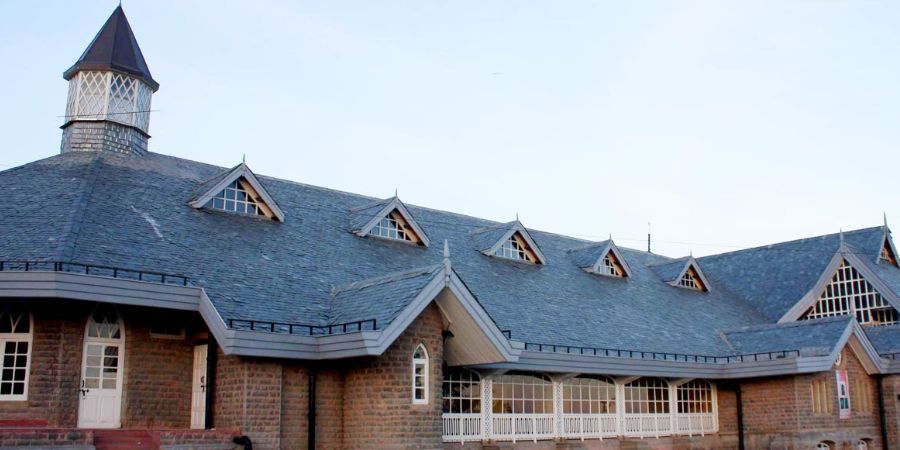
Henry Irwin designed the Gaiety in a Victorian Gothic style that, at this altitude and in this light, produces an effect more melancholy than grand. The exterior features pointed arches, ornamental woodwork, and a facade that borrows from English parish church architecture without committing fully to any single precedent. The building sits along the Mall, its entrance almost modest compared to the drama it contains. You could walk past it on a foggy Shimla afternoon and mistake it for a municipal office.
Inside, the proportions shift. The auditorium seats approximately 300 in a horseshoe arrangement, with a dress circle and boxes that maintain the Victorian hierarchy of seating. The proscenium arch frames a surprisingly deep stage — deep enough for full set changes, which the ADC's ambitious productions demanded. The ceiling features decorative plasterwork, and the original gaslights were eventually replaced by electric fixtures, though the conversion happened with enough care that the atmosphere wasn't entirely lost.
The woodwork throughout is Himalayan deodar, a material that has proven both blessing and vulnerability — beautiful and aromatic but susceptible to termite damage over decades of inconsistent maintenance. Restoration work, particularly a significant effort in the early 2000s by the Indian National Trust for Art and Cultural Heritage (INTACH), addressed structural decay while attempting to preserve the theatre's original character. New timber was sourced to match old, and the stage machinery — traps, fly systems, counterweights — was assessed and partially restored.
The most counterintuitive quality of Irwin's design is its intimacy. For a building that represented imperial power, the Gaiety feels small, almost domestic. The actors are close enough that you can hear them breathe. That proximity is the theatre's secret advantage, and it's something no restoration committee had to manufacture — it was there from the first night.
The Rooms Behind the Curtain Call
The Gaiety Heritage Cultural Complex extends well beyond the theatre itself, encompassing several adjoining spaces that most visitors either overlook or discover by accident. The complex includes the old Town Hall, an art gallery, and a multi-purpose exhibition space that has served various civic functions since the colonial period. The Town Hall, directly connected to the theatre building, once hosted municipal meetings, public lectures, and social gatherings that were the bureaucratic counterpart to the theatrical entertainments next door.
The art gallery within the complex houses rotating exhibitions — sometimes local Himachal artists, sometimes traveling shows from Delhi or Chandigarh. The quality varies. On a good visit, you'll encounter watercolors of the Shimla landscape by painters who actually understand the light here — how it turns silver before a storm, how the deodars go nearly black against snow. On a less fortunate day, you'll find the gallery half-empty or hosting school projects. This inconsistency is part of the complex's unpolished charm and its ongoing struggle for sustained institutional support.
A small heritage museum occupies a portion of the complex, displaying photographs, playbills, and documents from the theatre's history. The playbills alone deserve a careful hour — printed programs from the 1890s listing casts made up entirely of British civil servants performing Sheridan and Goldsmith, with advertisements for Shimla tailors and sellers of Darjeeling tea running along the margins. These ephemeral documents reveal more about the social texture of colonial Shimla than most formal histories manage.
The complex, taken whole, functions as a kind of cultural commons for the town — a space that serves multiple purposes imperfectly rather than one purpose brilliantly. That messiness, the way a municipal building bleeds into a theatre bleeds into a gallery, mirrors Shimla's own layered identity. Nothing here exists in clean categories.
From Oscar Wilde to Street Theatre: What the Stage Has Held
The Gaiety's repertoire across its lifespan maps the cultural anxieties of whoever controlled the building. In its first decades, the ADC staged works that would have been familiar on any English provincial stage — light comedies, melodramas, operettas. Gilbert and Sullivan were reliable favorites. Oscar Wilde's plays appeared shortly after their London premieres, an impressive cultural turnaround given the logistics of transporting scripts and costumes to a Himalayan hill station in the 1890s. The productions were amateur in the technical sense but mounted with a seriousness that suggests the performers understood their dual audience: the people in the seats and the society watching from beyond the footlights.
After 1947, the stage accommodated a broader dramatic vocabulary. Hindi-language productions — including adaptations of Premchand, Mohan Rakesh, and later, Vijay Tendulkar — brought post-independence India's political and social questions into a space originally designed for colonial diversion. The contrast was jarring and productive. Tendulkar's confrontational dramas about caste and gender, performed under a Victorian proscenium arch with plaster cherubs looking down, created a cognitive dissonance that no director needed to manufacture.
Local theatre groups from Himachal Pradesh have used the Gaiety as their primary serious venue for decades, performing in Hindi, Pahari, and occasionally English. The annual Shimla Theatre Festival, which has run intermittently since the 1990s, brings companies from across North India. Children's theatre, experimental one-act plays, and classical dance performances share the schedule with more conventional fare.
The most revealing thing about the Gaiety's performance history is what didn't change: the scale. The 300-seat auditorium enforces an intimacy that makes spectacle difficult and honesty unavoidable. You can't hide behind pyrotechnics on this stage. The actor and the audience are stuck with each other, and that constraint has kept the work here fundamentally human.
When the Fog Lifts and the Curtains Open: Shimla's Festival Calendar
The Shimla Summer Festival, typically held in May or June, uses the Gaiety as one of its anchor venues, programming a mix of theatrical performances, musical concerts, and cultural showcases that draw both tourists and residents. The festival's quality depends heavily on its organizers and budget in any given year — some editions feature established theatre companies from Delhi's National School of Drama; others lean toward local folk performances and school groups. The unpredictability is part of attending: you might witness a genuinely accomplished production of a contemporary Hindi play, or you might sit through an earnest but under-rehearsed musical program.
The Gaiety Theatre Festival, a more focused event organized in collaboration with Himachal Pradesh's Department of Language, Art and Culture, concentrates specifically on stage drama. Over three to five days, companies perform back-to-back, and the programming attempts to balance regional voices with national ones. Pahari-language theatre, rarely given prominent platform elsewhere, finds space here alongside Hindi and English productions. For anyone interested in the state of live Indian theatre outside Mumbai and Delhi — where commercial pressures distort the art form in predictable ways — this festival provides a more honest picture.
Cultural events at the complex also include occasional literary readings, heritage walks that start from the Gaiety's entrance and wind through the Ridge and Mall Road, and small exhibitions tied to specific anniversaries of the building's history. The Indian National Trust for Art and Cultural Heritage has periodically organized awareness programs here, framing the Gaiety within broader conversations about heritage preservation in hill towns threatened by unregulated construction.
The festivals matter less as polished cultural products than as evidence of institutional life. A building that hosts events, argues about programming, and occasionally disappoints its audience is a building that's alive. The Gaiety's cultural calendar, for all its unevenness, is proof that this isn't a monument. It's a working house.
Getting There, Getting In, and Getting the Most from a Shimla Stage
Shimla is accessible by air through Jubbarhatti Airport, roughly 23 kilometers from the town center, though flights from Delhi are limited and frequently disrupted by weather. The more reliable approach is rail — the Kalka-Shimla narrow gauge railway, a UNESCO World Heritage route, climbs through 102 tunnels and over 800 bridges in roughly five to six hours from Kalka, which connects to Delhi and Chandigarh by regular broad-gauge service. The journey itself is one of the subcontinent's great rail experiences, and arriving in Shimla by train puts you in the right frame of mind for a town that resists hurry.
The Gaiety Heritage Cultural Complex sits on the Mall Road, near the Ridge — the central promenade that functions as Shimla's civic spine. The theatre is open to visitors during daytime hours, typically 9 AM to 5 PM, though schedules shift during performances and festivals. Entry fees are nominal. If a production is scheduled during your visit, attending is non-negotiable — the experience of watching live theatre in this particular room, at this altitude, with the sound of wind against the windows competing with dialogue, is unlike anything a larger venue can offer.
Practical considerations worth noting:
- Check the Himachal Pradesh tourism website or local listings for performance schedules before your visit — the Gaiety doesn't maintain a robust online presence.
- The complex is within walking distance of most Shimla hotels on the Mall and Ridge, though the steep terrain means "walking distance" can leave you winded.
- Photography inside the auditorium is sometimes restricted during performances but generally permitted in other parts of the complex.
- Combine a visit with the nearby Christ Church and the Indian Institute of Advanced Study at the former Viceregal Lodge, both within a manageable walk.
Shimla's peak tourist season — May through June and again in December — fills hotels and clogs the Mall with day-trippers from the plains. The best months for the Gaiety are September and October, when the monsoon retreats, the light turns golden, and the crowds thin enough that you can stand in the auditorium alone and hear what silence sounds like in a room designed for applause.
The Gaiety Heritage Cultural Complex is not the most famous theatre in India, and it's not the most beautiful. What it is, more precisely, is the most historically layered — a space where the pleasures of a colonial ruling class, the aspirations of a newly independent nation, and the stubborn persistence of live performance in a digital age have all left their marks on the same creaking wooden seats. Buildings like this don't survive because someone decides to preserve them. They survive because enough people, across enough generations, keep showing up to fill the seats and raise the curtain. The Gaiety endures not as heritage frozen in amber, but as a stage that still asks the only question any theatre can: who are we, tonight, in this room, together? The fog outside will answer with silence; the actors, if they're good, will not.