

Founded in 1988, Norbulingka Institute exists to preserve Tibetan artistic and literary traditions that were nearly obliterated after 1959. It's not a museum. The work happening inside these walls — woodcarving, metalwork, appliqué, painting — is alive, practiced daily by artisans who trained for years under masters who carried their knowledge across the Himalayas on foot. The institute also houses a temple, a literary center, workshops, a shop, and a small café where you can sit with ginger tea and watch clouds settle into the Kangra Valley. What follows is a close look at how this place works, what it protects, and why visiting it changes the way you think about what survival actually looks like.
A Compound Born from Exile and the Fear of Forgetting
Norbulingka Institute takes its name from the Dalai Lama's summer palace in Lhasa — "Norbulingka" translates roughly as "Jewel Park." The original complex, built in the 1740s, served as a retreat for successive Dalai Lamas until the 14th Dalai Lama fled Tibet in March 1959 during the Chinese military crackdown. When he arrived in Dharamsala, he brought with him not just a government in exile but an entire civilization's worth of endangered knowledge.
The institute was established in 1988 by the Department of Religion and Culture of the Central Tibetan Administration, under the guidance of the Dalai Lama himself. Its founding wasn't sentimental. By the late 1980s, many of the master artisans who had escaped Tibet were aging. Their apprentices were few. Younger Tibetans in exile, scattered across India and Nepal, were assimilating into local economies. The specific techniques behind Tibetan thangka painting, wood sculpture, and textile arts risked disappearing within a generation.
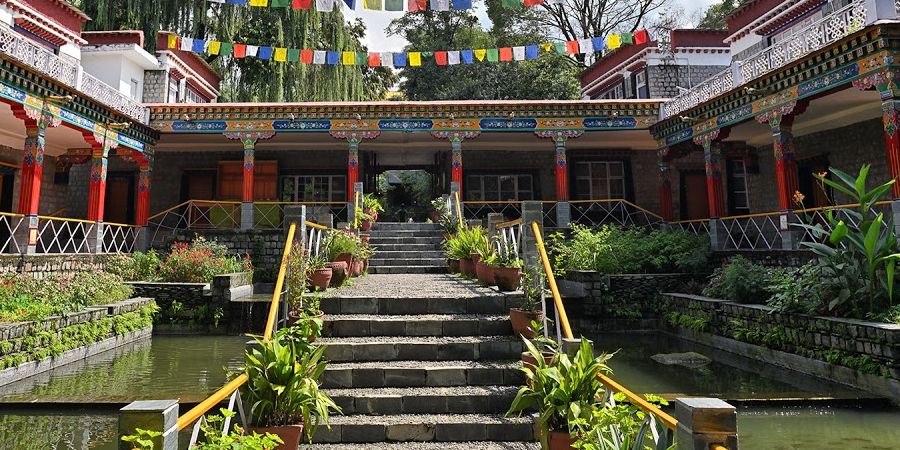
The location — Sidhpur, about nine kilometers from McLeod Ganj — was chosen for practical reasons. The lower Kangra Valley offered flatter ground, more space, and a climate gentler than the steep ridges above Dharamsala. Construction drew on traditional Tibetan architectural principles: thick walls, painted wood beams, open courtyards designed to catch afternoon light. Japanese landscape architecture influenced the surrounding gardens, an unexpected detail that gives the grounds a layered, meditative quality.
By the early 1990s, the institute had begun training its first cohort of young artisans. Today it houses over 300 people, including artists, scholars, monks, and staff. The compound functions as a self-contained creative village — not frozen in nostalgia but actively producing new works rooted in centuries-old methods. The fact that it exists at all is less a miracle than a calculated act of cultural defiance.
Gold Thread, Iron Tools, and the Patience to Use Both
Walk into the thangka painting studio at Norbulingka and the first thing you notice is the silence. Five or six painters sit on low cushions, bent over cotton canvases stretched on wooden frames. Each brushstroke — mineral pigment mixed with animal-skin glue — takes seconds to apply and years to learn. A single thangka can require six months to complete. The painters don't use magnifying glasses. They use memory, trained eyes, and hands that have repeated the same gestures thousands of times.
The institute trains artisans in several traditional disciplines:
- Thangka painting — religious scroll paintings following strict iconographic proportions passed down through lineage masters.
- Wood carving — furniture, altar pieces, and decorative panels carved from walnut and deodar using hand tools with almost no power equipment.
- Metalwork — statue casting in bronze and copper using the lost-wax method, a technique that predates the institute by centuries.
- Appliqué and tailoring — elaborate fabric compositions stitched into wall hangings and ceremonial garments, some containing thousands of individual silk pieces.
What surprises most visitors is that these aren't reproductions made for tourists. The thangkas follow the same iconometric grids used in monasteries across pre-1959 Tibet. The statues are consecrated and placed in temples. The artisans don't consider themselves craftspeople in the Western sense — they see the work as a form of spiritual practice, each piece an offering.
Training lasts between five and ten years depending on the discipline. Apprentices receive a stipend, housing, and meals. Most come from Tibetan refugee settlements across India. The counterintuitive truth is that this institute, perched in the Indian foothills, now produces some of the finest traditional Tibetan art anywhere — including Tibet itself, where many of these practices have been commercialized or simplified beyond recognition.
Where the Butter Lamps Never Go Out
The Seat of Happiness Temple — Deden Tsuglakhang — stands near the center of the Norbulingka compound, and it isn't the kind of place that overwhelms you with scale. It's intimate, roughly the proportions of a large chapel, with murals covering every interior wall from floor to ceiling. The paintings depict the life of the Buddha in 1,173 individual scenes, executed over several years by institute artists. Stand close and you'll see individual eyelashes on figures no bigger than a thumb.
Inside, a four-meter gilded copper statue of the Buddha Shakyamuni occupies the central altar. It was cast on-site using the lost-wax technique practiced in the metalwork studio — a detail that collapses the distance between art and devotion. Butter lamps flicker in rows along the base. The air smells of melted yak butter and sandalwood, a combination that clings to your clothes for hours after you leave.
The temple grounds include a Japanese-influenced garden with a stream running through shaped rocks and flowering shrubs. Prayer flags stretch between trees. Monks and visitors share the paths without ceremony. There's no entrance fee for the temple, and no one monitors how long you stay or whether you're Buddhist. The space operates on an assumption of respect rather than enforcement.
What the temple reveals, if you pay attention, is the inseparability of Tibetan art from Tibetan religion. Every mural in the building was painted not for aesthetic admiration but as an act of merit. The artisans who created them consider the work itself a form of prayer. For a secular visitor, this reframes the entire institute — you're not touring a gallery. You're walking through rooms where the line between making and believing has been deliberately erased, and that erasure is the whole point.
Keeping a Language Alive One Manuscript at a Time
The Lotsawa Rinchen Zangpo Translator Programme operates out of a quiet wing of the institute that most visitors walk past without entering. It focuses on translating canonical Tibetan Buddhist texts into English and other languages — work that sounds academic until you realize the stakes. Many of these texts exist only in Tibetan. If the language contracts further among exile communities, entire philosophical traditions become inaccessible. Translation isn't preservation for the archive. It's preservation for use.
The literary center also produces publications through Norbulingka Publications, including illustrated books on Tibetan art, religion, and history. These aren't coffee-table decorations. Several serve as reference texts for practicing artisans and scholars working in monasteries across South Asia. The center employs translators, editors, and researchers — many of them young Tibetans trained in both classical Tibetan and contemporary English.
On the artisan side, the institute's training programs function as a five-to-ten-year education in cultural continuity. Students don't just learn technique. They study Tibetan history, iconography, Buddhist philosophy, and the specific symbolic systems that govern how a statue's hand position conveys meaning or why a thangka's background must follow a particular color sequence. Technique without context is decoration. The institute teaches both.
The unexpected dimension here is demographic. Most trainees are second- or third-generation refugees. They weren't born in Tibet. They've never seen Lhasa. The culture they're preserving exists for them primarily through their parents' stories and through institutions like Norbulingka. This gives the education a double weight — it's not just skill transfer but identity formation. A young woman learning to paint a Green Tara thangka is simultaneously learning who she is and where her people come from. The brush becomes a kind of memory.
Silk, Ginger Tea, and the Economics of Survival
The Norbulingka Shop sits near the compound entrance, and it's the kind of place where your assumptions about gift shops collapse within ten seconds. The shelves hold hand-stitched silk brocade jackets, painted wooden tables, bronze statues, and thangkas — all made on-site by the institute's artisans. Prices reflect the labor: a small thangka might cost several thousand rupees, a carved altar table considerably more. Nothing here was stamped out by a machine or stitched in a factory in Ludhiana.
The shop operates as the institute's primary revenue source. Government funding and donations cover part of the operating costs, but sales of finished art and craft sustain the daily operations, including artisan stipends and trainee housing. Buying a silk scarf here isn't charity — it's participating in an economic model designed to make cultural preservation financially viable. Few places manage that balance without tipping into kitsch. Norbulingka holds the line because the artisans who make the goods are the same people being preserved by the profits.
Adjacent to the shop, a small café called Hummingbird serves Tibetan and Western food — momos, thukpa, sandwiches, fresh ginger-lemon tea. The seating overlooks the gardens, and the pace is slow enough that you'll see birds you don't recognize landing on the railing. It's a good place to sit after walking the compound, not because the food is extraordinary but because the setting gives you time to absorb what you've just seen.
The shop also accepts custom commissions for thangkas and statues, a process that can take months. Orders arrive from monasteries, private collectors, and Buddhist centers worldwide. This quiet international demand keeps the pipeline of trained artisans relevant — the skills taught here have buyers, which means the next generation of students will have reason to learn them. Commerce, in this case, serves continuity.
Getting There Without Getting Lost in McLeod Ganj
Norbulingka Institute sits in Sidhpur, roughly nine kilometers south of McLeod Ganj and about four kilometers from lower Dharamsala. Most travelers base themselves in McLeod Ganj and assume the institute is a quick walk away. It isn't. The road descends steeply through switchbacks, and the distance by road is deceptive. A taxi from McLeod Ganj costs around 300-400 rupees one way and takes about 25 minutes depending on traffic and the driver's relationship with gravity.
Local buses run between Dharamsala and Sidhpur, though schedules shift seasonally. Auto-rickshaws are available from lower Dharamsala. If you're staying in Dharamsala proper rather than McLeod Ganj, the institute is considerably closer — a useful fact that most guidebooks bury.
Practical details worth knowing before you go:
- The institute is open Tuesday through Sunday, typically from 9:00 AM to 5:30 PM. It closes on Mondays.
- There's a small entry fee for the museum and workshops — modest by any standard.
- Photography policies vary by section. The temple interior may have restrictions. Ask before shooting.
- Plan at least two to three hours. Rushing through defeats the purpose — the artisans work slowly, and watching them is half the experience.
- The monsoon months (July through September) make the gardens lush but the roads unpredictable. October through March offers clearer skies and drier paths.
One thing that catches visitors off guard: the compound is quiet. There are no loudspeakers, no guided tour groups shouting over each other, no souvenir hawkers outside the gate. If you've spent three days navigating the compressed energy of McLeod Ganj's main square, the shift in atmosphere feels almost physical. Wear comfortable shoes — the grounds involve gentle walking on stone and packed earth paths, and the gardens reward anyone willing to wander slowly.
What the Kangra Valley Holds Once You Step Outside the Gate
The area around Norbulingka offers more than most visitors expect, largely because the lower Kangra Valley doesn't carry the tourist cachet of McLeod Ganj. That's its advantage. The Kangra Art Museum in Dharamsala holds miniature paintings from the Kangra school — delicate, pastel-hued works from the 18th and 19th centuries that influenced regional art long before the Tibetan exile community arrived. The museum is small and sparsely visited, which means you can stand inches from a 250-year-old painting without anyone's elbow in your ribs.
South of Sidhpur, the town of Palampur sits in the tea-growing belt of the valley. The Kangra tea produced here — a light, floral oolong — is less famous than Darjeeling but arguably more interesting, with a grassy sweetness that tastes distinctly of the altitude. A few estates allow drop-in visits, though calling ahead helps. The road from Sidhpur to Palampur passes through mustard fields and small Gaddi shepherding communities whose seasonal migration routes predate the British colonial presence.
Closer to McLeod Ganj, the Tsuglagkhang Complex — the Dalai Lama's primary temple and residence — provides essential context for what Norbulingka is doing. The Tibet Museum inside the complex documents the exile experience through photographs, personal accounts, and artifacts. Visiting it before Norbulingka sharpens your understanding of why the institute was built with such deliberate urgency.
The Bir-Billing area, about 70 kilometers southeast, has become a paragliding hub, but it also hosts several small Tibetan settlements and monasteries worth a half-day detour. Chokling Monastery in Bir maintains its own tradition of ritual arts. The connection between these scattered communities — Dharamsala, Sidhpur, Bir — forms a loose constellation of exile culture across the Kangra Valley, each node sustaining a different piece of what was lost. Norbulingka is the anchor, but the story extends well beyond its walls.
Norbulingka Institute doesn't ask for your sympathy. It asks for your attention — to the painter's hand, the carver's chisel, the translator's careful word choice. What it preserves isn't abstract heritage but specific, practiced knowledge: the exact mineral pigment for a deity's skin, the precise angle of a bronze statue's wrist, the grammar of a philosophical text written eight centuries ago. These things survive not because they were stored in a vault but because someone is still doing them, today, in a yellow-walled compound in the foothills.
Travel often promises transformation. Norbulingka offers something rarer — the chance to witness a culture refusing to let itself become past tense.