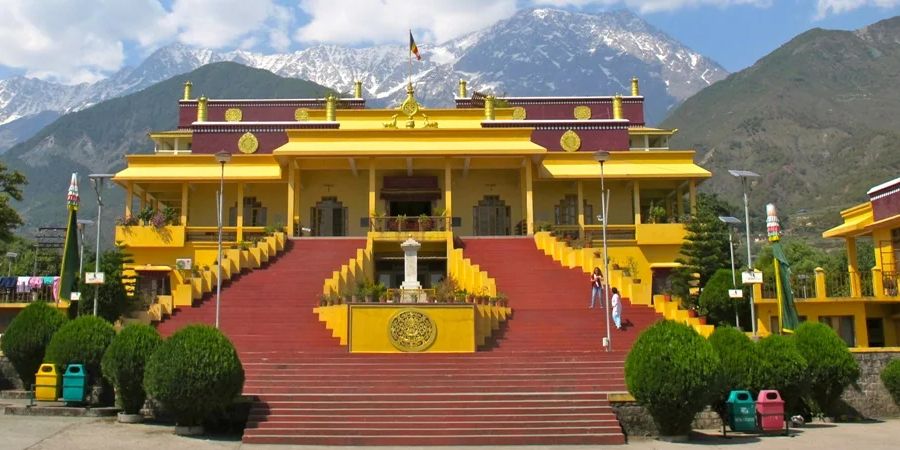


The Tsuglagkhang Complex, known to most visitors simply as the Dalai Lama Temple, sits at the southern end of McLeodganj in Dharamsala, Himachal Pradesh, at roughly 1,770 meters above sea level. It has served as the principal residence and spiritual headquarters of the 14th Dalai Lama, Tenzin Gyatso, since 1960. The temple is not a monument to history sealed behind velvet ropes. It's a working center of Tibetan Buddhist practice, where monks debate philosophy in the courtyard and elderly women prostrate on wooden boards polished smooth by decades of devotion. This is where a government-in-exile anchored itself, where a displaced culture planted new roots in Indian soil, and where travelers from six continents come searching for something they can't quite articulate. What follows traces the temple's origins, its architecture, its sacred contents, the lived spiritual practice inside its walls, and the mountain town that grew up around it.
How a Hill Station Became the Capital of Exiled Tibet
The British built McLeodganj in the 1850s as a garrison town, naming it after Sir Donald Friell McLeod, then Lieutenant Governor of Punjab. For a century, it was a minor colonial hill station — a place the British went to escape the plains heat, not to make history. A devastating earthquake in 1905 killed nearly 20,000 people across the Kangra Valley and reduced much of the settlement to rubble. The British largely abandoned it. McLeodganj spent the next five decades as a quiet, half-ruined hamlet on a forested ridge.
That changed in 1959, when the Dalai Lama fled Lhasa during the Tibetan uprising against Chinese rule. He crossed into India on March 31, arriving in Tewang, Arunachal Pradesh, after a harrowing two-week journey through the Himalayas. Prime Minister Jawaharlal Nehru offered asylum, and the Indian government eventually settled the Dalai Lama and his administration in Dharamsala. The specific choice of McLeodganj owed something to its remoteness, something to its climate — which resembled the Tibetan plateau more than the sweltering Indian lowlands — and something to the practical fact that land was available.
The Tsuglagkhang Complex was established in 1960 as a modest place of worship. It wasn't designed to replicate the Potala Palace or the Jokhang Temple in Lhasa, both of which the Dalai Lama had left behind. The original structures were functional, built from local materials, intended to serve an immediate spiritual need for a refugee community still in shock. The grandeur came later, incrementally, as the Tibetan diaspora stabilized and the temple's significance expanded beyond its congregation.
What strikes anyone who studies this history is the accidental symmetry: a town abandoned after a natural disaster became the refuge for a people displaced by a political one. Neither the British nor the earthquake planned for what McLeodganj would become. The town's second life was entirely unscripted.
Three Temples, One Courtyard, and a Museum That Refuses to Forget
The Tsuglagkhang Complex doesn't announce itself with soaring gates or a dramatic approach. You walk through McLeodganj's commercial area — past momos stalls and shops selling singing bowls — and arrive at a security checkpoint that feels more bureaucratic than sacred. Beyond it, the complex unfolds across a terraced hillside with distinct zones that reward slow exploration rather than a hurried circuit.
The main temple, the Tsuglagkhang itself, occupies the central position. It serves as the primary assembly hall where the Dalai Lama delivers teachings during scheduled events, sometimes to audiences exceeding 10,000 people who spill out onto the surrounding grounds with FM radio receivers tuned to translations. Adjacent to it sits the Kalachakra Temple, smaller and intensely decorated, dedicated to the Kalachakra Tantra — one of the most complex doctrinal systems in Vajrayana Buddhism. A third structure, the Namgyal Monastery, functions as the personal monastery of the Dalai Lama and houses around 200 monks.
Below the temple grounds, the Tibet Museum tells the story of Tibetan resistance and exile through photographs, video testimonies, and documentary panels. The content is unflinching — images of self-immolation protests, accounts of political prisoners, timelines of cultural destruction. It's the kind of museum that empties quietly, visitors walking out with less to say than when they entered.
The courtyard connecting these spaces does double duty. On ordinary days, monks sit cross-legged in pairs, engaged in vigorous philosophical debate — a practice involving sharp hand claps and theatrical gestures that can look, to the uninitiated, like an argument. During teachings, the same courtyard transforms into a dense gathering of maroon-robed monastics and lay practitioners. The layout has no single focal point by design; the complex asks you to move through it, not merely stand and look at it.
Why the Temple Looks Nothing Like What You'd Expect in India
The Tsuglagkhang's architecture draws almost entirely from Tibetan building traditions, which makes it a visual anomaly on an Indian hillside. The rooflines are flat or gently sloping, topped with gold-colored ornamental finials called ganjira — the dharma wheel flanked by two deer, symbolizing the Buddha's first sermon at the Deer Park in Sarnath. The exterior walls are thick, painted in muted earth tones, with window frames outlined in black trapezoids. None of this resembles the shikhara towers or ornate gopurams of Indian temple architecture.
Inside the main hall, the ceiling beams are painted in traditional Tibetan patterns — interlocking clouds, lotus motifs, and mythological creatures rendered in deep blues, reds, and golds. The columns are wrapped in silk brocade, and thangka paintings hang from the walls, their iconographic precision governed by centuries-old proportional rules. Every element in a thangka — the angle of a deity's gaze, the number of arms, the objects held — conveys specific doctrinal meaning. These aren't decorative choices; they're theological statements made in pigment.
The Kalachakra Temple contains elaborate sand mandala reproductions and wall murals depicting the Kalachakra deity system. The murals are dense, almost hallucinatory in their detail, layering concentric circles of deities, celestial bodies, and geometric patterns that encode teachings about the nature of time and consciousness. You don't read these walls so much as you slowly decipher them.
One architectural feature catches most visitors off guard: the simplicity. Compared to the Potala Palace's thirteen stories and thousand rooms, the Tsuglagkhang is modest. The Dalai Lama has spoken publicly about this intentional restraint, linking it to the impermanence of exile. The architecture doesn't project power or permanence — it projects practice. The building exists to be used, not admired from a distance, and that functional humility gives the space a gravity that opulence rarely achieves.
A Four-Meter Buddha and the Statue That Carries a Thousand Arms
The central image inside the Tsuglagkhang is a gilded statue of Shakyamuni Buddha, seated in the earth-touching gesture — the right hand reaching down to call the ground as witness to his enlightenment. The statue stands approximately four meters tall and dominates the main prayer hall. Butter lamps flicker in rows before it, their flames casting unstable shadows across the gilded surface. The air near the altar carries a faint, waxy sweetness from the yak butter used to fuel them.
Flanking the Shakyamuni are two other significant images. Avalokiteshvara, the bodhisattva of compassion, appears in the thousand-armed form known as Sahasrabhuja — each arm representing a different capacity to aid sentient beings. The Dalai Lama is considered a living incarnation of Avalokiteshvara in Tibetan tradition, which charges this particular statue with an immediacy that goes beyond iconography. Beside it stands Padmasambhava, or Guru Rinpoche, the 8th-century figure credited with bringing Buddhism to Tibet. His expression, half-fierce and half-serene, reflects his role as both teacher and tantric practitioner.
The Kalachakra Temple houses its own distinct treasures, including detailed three-dimensional mandala models and ritual implements used in Vajrayana ceremonies — vajras, bells, offering bowls, and damaru drums. These objects aren't displayed in glass cases. They sit on altars and shelves as working tools of active practice. Monks pick them up, use them, and return them.
Visitors often photograph the large prayer wheels lining the external pathways — copper cylinders inscribed with the mantra Om Mani Padme Hum. Each rotation is believed to release the prayers contained within. The wheels are not ornamental; they're worn at the handles where thousands of palms have gripped and spun them daily for decades. That physical wear, that smooth brass depression, tells you more about the temple's spiritual life than any plaque could.
The Sound of Sixty Monks Chanting at Dawn Changes How You Hear Silence
Arrive at the Tsuglagkhang before 6 a.m., when the courtyard is still cold and the pine trees drip with overnight moisture, and you'll hear the monks of Namgyal Monastery begin their morning prayers. The chanting is polyphonic — a bass drone underlying sharper melodic phrases, punctuated by the crash of cymbals and the low moan of dungchen, the long Tibetan horns. The sound doesn't invite contemplation so much as it reorganizes your attention. Background noise drops away. Your breathing slows without you deciding it should.
The temple allows visitors to sit during these sessions, provided they observe basic etiquette: shoes off, phones silent, no pointing feet toward the altar. Most travelers position themselves along the edges of the hall, backs against the painted columns, watching monks recite from long unbound texts called pechas. The pages are loose, stacked between wooden boards, and the monks flip them with a rhythmic efficiency that suggests thousands of repetitions.
During the Dalai Lama's public teachings — scheduled several times a year, typically announced a few weeks in advance on the official website — the spiritual atmosphere intensifies considerably. Thousands of practitioners fill the courtyard, and simultaneous translations are broadcast in English, Hindi, Mandarin, Korean, Japanese, and other languages via FM radio. Visitors rent small receivers from shops near the temple entrance. The Dalai Lama's teaching style is famously conversational, punctuated by laughter — his own and the audience's — which strikes newcomers as incongruous in a religious context but is entirely characteristic of Tibetan pedagogy.
The counterintuitive thing about the spiritual experience here is how unperformative it is. Nobody orchestrates a mood. There's no ambient music piped through speakers, no guided meditation offered at the door. The devotion is simply present, the way humidity is present in a coastal town — you walk through it, and it changes what you feel, whether or not you subscribe to any of its premises.
What the Hand Claps and Spinning Wheels Actually Mean
Tibetan Buddhism belongs to the Vajrayana tradition, which distinguishes it from the Theravada Buddhism practiced in Southeast Asia and the Zen Buddhism more familiar in Japan and Korea. Vajrayana incorporates tantric practices, elaborate ritual, and a vast pantheon of deities and bodhisattvas that can seem bewildering to first-time visitors. The wrathful faces painted on temple walls aren't demons — they represent enlightened energy manifesting in fierce form to cut through ignorance. That distinction matters.
The debating you'll witness in the courtyard follows a formalized structure rooted in Indian Buddhist logic traditions, particularly the works of Dharmakirti and Dignaga. One monk sits while another stands, posing philosophical questions with a sharp clap of the hands — the clap symbolizing the union of wisdom and compassion. The seated monk must respond using logical reasoning, not scriptural quotation. These sessions train monks in critical thinking and doctrinal precision, and they're taken as seriously as any academic examination.
The prayer wheels, prostrations, and butter lamps you'll see throughout the complex all serve specific functions within Tibetan Buddhist practice:
- Prayer wheels are spun clockwise to accumulate merit and spread the mantras inscribed inside them, based on the belief that the written word carries the same power as the spoken one.
- Full-body prostrations express surrender of body, speech, and mind to the Three Jewels — the Buddha, the Dharma (teachings), and the Sangha (community).
- Butter lamps symbolize the dispelling of ignorance through the light of wisdom, and offering them generates merit for the practitioner and for all beings.
The concept of merit — kusula in Pali, sonam in Tibetan — underlies nearly every visible practice here. It's not transactional in the way Western observers sometimes assume. Merit functions more like a gradual transformation of mental habits, a slow reorientation of intention that practitioners believe carries across lifetimes. Watching these rituals without understanding merit is like watching a chess game without knowing the rules: you see the movement, but you miss the strategy.
The Town That Grew Around a Government-in-Exile
McLeodganj has a split personality. One version caters to the international backpacker circuit — cafes serving banana pancakes, bookshops stocked with Osho paperbacks, and shops hawking dream catchers alongside Tibetan singing bowls. The other version is a functioning Tibetan community, with its own schools, medical clinics, newspaper offices, and political organizations. These two McLeodganjs coexist uneasily, overlapping on the same narrow roads.
The Tibetan Institute of Performing Arts, located about a kilometer from the temple complex, preserves traditional lhamo opera and folk dances that were at risk of disappearing entirely after the Chinese occupation. The Men-Tsee-Khang, or Tibetan Medical and Astrological Institute, offers consultations in traditional Tibetan medicine — a system that diagnoses through pulse reading and prescribes treatments using herbal compounds formed into small, dark pills. Neither institution exists primarily for tourists, though both welcome visitors.
Bhagsu Nag, a ten-minute walk from the main square, has its own Shiva temple and a waterfall that swells dramatically during the monsoon months of July and August. The trail to Triund, starting from the Galu Devi Temple area, climbs roughly 1,000 meters over nine kilometers to a ridge campsite offering direct views of the Dhauladhar snow line. The trek is strenuous enough to thin out casual walkers but accessible to anyone with reasonable fitness and proper footwear.
The food scene reflects McLeodganj's layered identity. Tibetan thukpa — a hearty noodle soup — and momos filled with yak meat or vegetables are everywhere, alongside Punjabi dhabas serving dal makhani and fresh roti. A handful of places serve Tibetan butter tea, po cha, made with salt and yak butter rather than sugar. Most travelers try it once and quietly switch back to masala chai. The honest ones admit it tastes like warm, salted broth — which is exactly what it is, and exactly why it works at altitude.
Getting There, Getting In, and What Nobody Tells You About the Monsoon
The nearest airport is Gaggal Airport in Kangra, roughly 15 kilometers from McLeodganj, served by limited domestic flights from Delhi on carriers including Air India and SpiceJet. Flights are frequently delayed or canceled due to weather, especially during the monsoon. The more reliable option is an overnight bus from Delhi's ISBT Kashmere Gate terminal — a journey of roughly 12 hours on Himachal Road Transport Corporation or private Volvo services. The road from Dharamsala up to McLeodganj is a series of sharp switchbacks that test both vehicles and stomachs.
The Tsuglagkhang Complex is open to visitors daily, generally from morning until early evening, though hours shift during special teachings and events. Entry is free. Security screening is mandatory, and you'll need to leave bags and electronic devices larger than a phone at the checkpoint during certain events. Photography is permitted in most outdoor areas but restricted inside the main temple hall.
Practical details that make the difference between a good visit and a frustrating one:
- The Dalai Lama's public teaching schedule is posted on dalailama.com, usually a few weeks in advance — plan around it if attending teachings matters to you.
- October through mid-December offers the clearest skies and most comfortable temperatures, with daytime highs around 15-20 degrees Celsius.
- The monsoon season from late June through September brings heavy rainfall, landslides that close roads, and leeches on forest trails — but also far fewer tourists and a dramatic green intensity to the hillsides.
- Accommodation ranges from budget guesthouses around 500-800 rupees per night to mid-range hotels in the 2,000-4,000 rupee range; booking ahead is essential during teachings and the October high season.
One thing nobody warns you about sufficiently: McLeodganj is small, and during peak season or major teachings, the main road becomes nearly impassable with pedestrians, taxis, and motorbikes competing for the same narrow lane. Arrive a day early and walk the town before the crowds build. The temple at 5:30 a.m., with only monks and a few devoted practitioners present, is a fundamentally different place than the temple at noon.
The Tsuglagkhang is not a tourist attraction that happens to be spiritual. It's a spiritual center that happens to accept tourists. The distinction shapes everything about the experience — the lack of entry fees, the absence of audio guides, the way nobody directs you through a prescribed route. You're welcome, but the place doesn't need you. It was here before you came, chanting and spinning its prayer wheels in the mountain fog, and it will continue long after you leave. What you carry away from it depends entirely on what you were willing to set down at the security gate — not just your bags, but the expectation that meaning would be handed to you. The Dalai Lama Temple gives you silence, smoke, and space. What you build from those materials is your own concern.