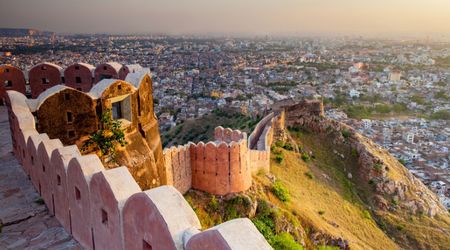


The sandstone turns the color of burnt honey at four in the afternoon. From the scrubland east of town, Jaisalmer Fort doesn't look like a ruin or a museum — it looks like something the desert itself pushed upward, a geological accident that happens to have walls and bastions. About a quarter of Jaisalmer's old city population still lives inside those walls, hanging laundry from medieval balconies, running guesthouses in rooms where Rajput soldiers once slept. The fort sweats with the Thar; it cracks in summer, absorbs monsoon moisture into its porous yellow stone, and slowly — measurably, worryingly — it erodes. UNESCO placed it on its World Heritage list in 2013, acknowledging both its magnificence and its fragility.
This is not a preserved fortress behind a velvet rope. It is a living, leaking, crumbling, functioning neighborhood perched on Trikuta Hill, seventy-six meters above the surrounding plain. What follows traces the fort's founding under Rawal Jaisal in 1156, its architecture and inner monuments, the Jain temples that rival anything in Ranakpur, and the Silk Road trade routes that made this remote desert citadel rich enough to build them. The fort demands more than a photograph from below. It demands you walk its narrow lanes, press your hand against its warm stone, and understand why it's still standing — and why it might not be forever.
A Bhati Rajput, a Hilltop, and the Year Everything Shifted to Sand
Rawal Jaisal didn't choose Trikuta Hill by accident. In 1156, the Bhati Rajput ruler abandoned his previous stronghold at Lodurva, roughly fifteen kilometers to the northwest, after repeated sackings by Afghan invaders. Lodurva had water, temples, a settled population — but it sat on flat ground, indefensible against cavalry. Trikuta's three peaks offered natural triangulation, a military geometry that meant attackers would always be climbing, always exposed. Jaisal read the terrain the way a chess player reads the board three moves ahead.
The founding legend involves a hermit named Eesaal, who supposedly told Jaisal that Lord Krishna had prophesied a descendant of his Yadav clan would build a fort on this exact spot. Whether or not you credit divine real estate advice, the strategic logic was sound. The hill commanded views across the Thar in every direction, and the desert itself served as a moat — no army could march through it without being spotted days in advance.
What's counterintuitive about Jaisalmer Fort is that its remoteness was its greatest asset and its greatest liability simultaneously. The same desert that protected it from easy invasion also isolated it from fertile land, reliable water, and the political centers of Rajput power further east. The Bhati Rajputs survived not by farming or conquest but by taxing — extracting tolls from the camel caravans that crossed the Thar between India and Central Asia. The fort was less a military garrison than a tollbooth with ninety-nine bastions.
Jaisal's descendants held the fort for the better part of eight centuries. The walls were raised and reinforced multiple times, most significantly in the fourteenth and fifteenth centuries. But the bones of the place — its position, its orientation, its relationship to the wind and sun — those belong to the twelfth century, to a man who looked at a rocky hill in the middle of nothing and saw permanence.
Why Jaisalmer Glows Like It's Running a Fever
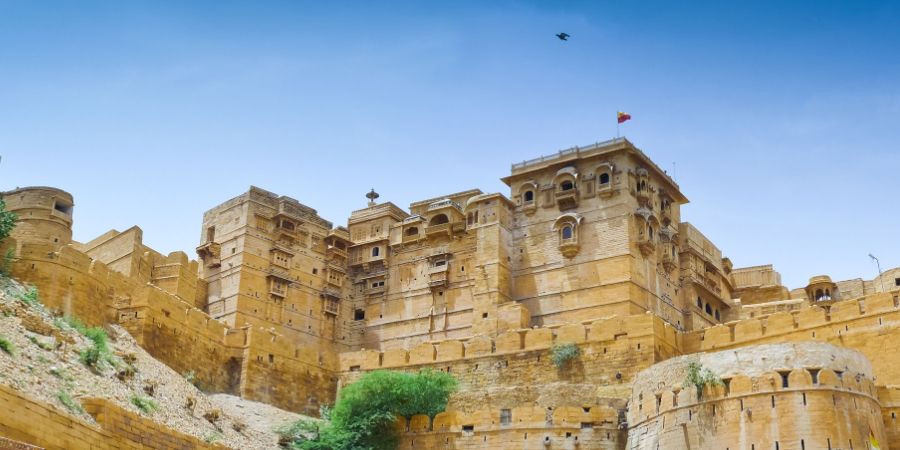
The epithet "Golden City" isn't poetic license. Jaisalmer Fort is constructed almost entirely from yellow sandstone quarried from the surrounding desert, and the stone does something remarkable with light. In the early morning, the walls appear pale, almost white. By midday, they've deepened to a warm ochre. At sunset, the entire structure turns a deep amber that looks, from a distance, like the hill itself is molten. The color shift isn't subtle — it's the difference between a candle and a bonfire.
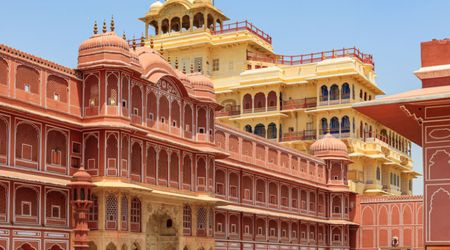
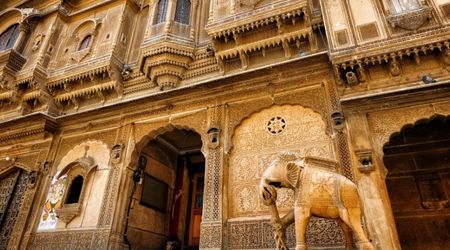
This golden effect extends beyond the fort into the city below. Jaisalmer's havelis — the ornate merchant mansions built between the seventeenth and nineteenth centuries — use the same stone, creating a visual continuity between the fort on the hill and the streets at its base. The effect is of a single organism rather than a city with a citadel sitting on top of it. Patwon Ki Haveli, Salim Singh Ki Haveli, and Nathmal Ki Haveli all share the same warm glow, though each uses the stone differently, carved into jharokha balconies and latticed screens of varying intricacy.
The sandstone's porosity is both blessing and curse. It absorbs and releases heat slowly, making interiors surprisingly bearable even when the Thar pushes past forty-five degrees Celsius in May. But that same porosity means the stone drinks water. Since the 1990s, increased water usage from guesthouses and homes inside the fort has caused several bastions and wall sections to crack and partially collapse. The 1999 and 2001 incidents were severe enough to prompt international conservation efforts. The fort's beauty carries its own corrosion — the same softness that lets artisans carve stone like wood also lets moisture eat it from within.
Stand below the fort at dusk and you'll understand why every photographer who visits Jaisalmer takes the same shot. They can't help it. The stone demands it.
Ninety-Nine Bastions and a Fortress That Breathes
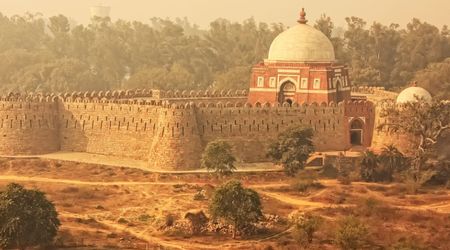
Jaisalmer Fort's design follows no single architectural blueprint. It accumulated over centuries, each generation of Bhati rulers adding, patching, reinforcing. The outermost wall, roughly thirty feet high in most places, is punctuated by those ninety-nine bastions — round towers positioned to eliminate blind spots for defenders. The walls taper slightly inward as they rise, a technique that both strengthens the structure and deflects projectiles. Four massive gateways — Akhai Pol, Suraj Pol, Ganesh Pol, and Hawa Pol — control access along a winding path designed to slow invaders and expose them to fire from above.
The approach through these gates is deliberately disorienting. Each gate forces a sharp turn, preventing a battering ram from building momentum and breaking the psychological confidence of anyone storming the entrance. Suraj Pol, the outermost gate, faces east — toward the sunrise, a symbolic choice, but also a practical one, since attackers approaching from the morning sun would be squinting into the light.
Inside, the fort doesn't feel like a military installation. The lanes are narrow, rarely wider than two meters, lined with residences, shops, and temples. Drainage channels carved into the stone direct rainwater — rare but torrential when it comes — away from foundations. Ventilation happens through jali screens, perforated stone panels that allow airflow while blocking direct sunlight. The thermal regulation is passive and effective, a design achievement that modern architects have begun studying seriously.
The most surprising element is scale. The fort covers roughly fifteen hundred feet from its eastern to western extremity, and its interior can absorb hours of wandering without repetition. Staircases appear in unexpected corners. Rooftop terraces offer sightlines across the Thar that make the desert feel less like emptiness and more like intention — as though someone cleared everything away just so you could see the horizon uninterrupted.
What the Fort Keeps Behind Its Walls
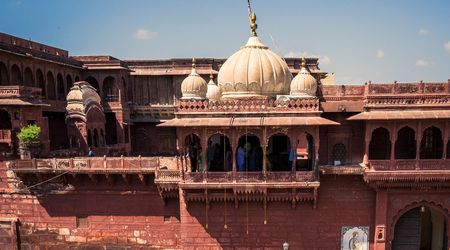
The Raj Mahal, or Royal Palace, dominates the fort's upper levels. Built and expanded between the fifteenth and nineteenth centuries, it's a composite structure — part museum, part ruin, part living testimony to the aesthetic ambitions of minor desert royalty. The rooms are small by palatial standards, but the stone carving compensates. Doorways are framed with floral motifs so dense they resemble textile embroidery frozen in sandstone. The Maharawal's throne room contains tilework and mirror work that reflects the Mughal influence that seeped into Rajput courts over centuries of alternating warfare and alliance.
Below the palace, the fort contains a series of interconnected courtyards that once served as public gathering spaces. The largest, Dussehra Chowk, still hosts cultural events during the annual Desert Festival in February. The acoustics are unexpectedly good — sound bounces off the surrounding stone walls and carries clearly, a feature that likely mattered when royal pronouncements were delivered here without amplification.
The Merchant Havelis within the fort walls tell a different story from the palace. These aren't homes of warriors but of traders — Marwari and Jain merchants whose wealth, in many cases, exceeded that of the ruling family. Their homes feature carved facades of astonishing detail, with brackets, cornices, and window screens worked into representations of deities, animals, and geometric patterns. One haveli near the Jain temples contains a carved stone screen so thin that afternoon light passes through it, casting patterned shadows across the interior floor.
The fort also houses several active shrines and water tanks. Jaisalvav, a reservoir attributed to the fort's founder, once supplied drinking water to the entire citadel. It's largely silted up now, but its stone ghats remain — steps descending into what was once water, now mostly dust and memory. Each monument inside the fort carries the residue of continuous habitation, which means none of them look pristine, and all of them feel real.
Stone Lace in the Desert: The Jain Temples Inside the Fort
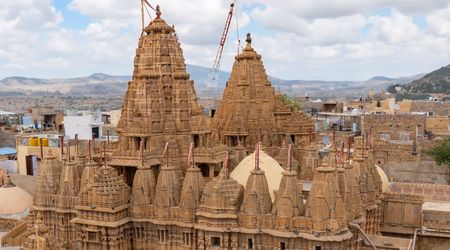
Seven Jain temples, built between the twelfth and fifteenth centuries, occupy the fort's northeastern quadrant. They're dedicated to various Tirthankaras, and they represent some of the finest examples of Dilwara-style Jain architecture outside Mount Abu. The carving here reaches a level of obsessive refinement that borders on the irrational — ceilings worked into concentric rings of figures so small and so numerous that counting them feels futile. The stone is the same local yellow sandstone, but the artisans treated it like ivory, coaxing details that seem to defy the material's grain.
The Chandraprabhu Temple, the largest in the complex, features a mandapa (pillared hall) with columns carved into shapes that rotate from square at the base to octagonal at mid-height to circular at the top. Each transition is seamless. The Rishabdev Temple, likely the oldest, is simpler but carries a weight of accumulated devotion — oil lamps burning in the sanctum leave a faint scent of ghee that hangs in the still desert air.
What surprises most visitors is that these temples are not preserved relics. Jain worshippers use them daily. Shoes come off at the entrance, cameras require separate permission, and the atmosphere inside shifts palpably from tourist curiosity to something quieter. The Gyan Bhandar, a library housed within the complex, contains manuscripts dating to the eleventh century — palm leaf texts on astronomy, philosophy, and grammar. Some are illustrated with miniature paintings that survived the desert centuries because the library's thick stone walls maintained relatively stable temperature and humidity.
The Jain temples challenge an assumption many travelers carry into Rajasthan — that this region's architectural heritage belongs primarily to Hindu Rajput warriors and Mughal emperors. The merchants who financed these temples operated on a different axis entirely, one defined by commerce, devotion, and a willingness to invest staggering sums in stone that would outlast every transaction they ever made.
Camels, Caravans, and the Economy That Built the Fort
Jaisalmer's wealth never came from the land beneath it. The Thar is one of the most arid regions on the subcontinent, incapable of supporting large-scale agriculture. The fort existed because of geography — specifically, its position along the overland trade routes connecting the Indian subcontinent to Persia, Arabia, Egypt, and Central Asia. Silk, spices, opium, precious stones, indigo, and textiles moved through here on camelback, and the Bhati Rajputs taxed every load that passed through their territory.
The merchants who settled inside and around the fort — predominantly Jain and Marwari traders — served as intermediaries, brokers, and financiers for this long-distance commerce. Their wealth explains the disproportionate grandeur of the havelis and temples relative to the city's modest size. Jaisalmer was never large in population terms, but per capita, it punched absurdly above its weight in architectural ambition. A city of perhaps twenty thousand people produced buildings that rival those in capitals ten times larger.
The Silk Road connection withered in stages. The development of Bombay's port under British colonial administration in the nineteenth century shifted trade to maritime routes. The Partition of 1947 sealed the border with Pakistan barely a hundred kilometers to the west, severing the overland corridors completely. Jaisalmer entered a long economic decline that only reversed with the arrival of tourism in the latter twentieth century and, more recently, the establishment of military installations near the border.
The irony is sharp: the same isolation that once made Jaisalmer a necessary stop on transcontinental trade routes eventually made it a backwater. The fort, built to profit from movement, was marooned by the disappearance of the caravans that justified its existence. What saved it, finally, was not trade but spectacle — the realization that a living medieval fort glowing gold in the desert could attract a different kind of caravan entirely.
Getting Inside the Walls Without Losing Your Bearings
Jaisalmer sits roughly three hundred kilometers west of Jodhpur, connected by both road and rail. The most practical rail option is the overnight train from Jodhpur, which arrives early enough to beat the morning heat. There's a small airport at Jaisalmer with limited domestic flights, mostly from Delhi and Jaipur, though schedules shift seasonally. From November through February, the weather cooperates — daytime temperatures hover between twenty and twenty-five degrees Celsius, and the light is superb. March onward, the heat builds rapidly, and by May, you're looking at temperatures that make outdoor exploration genuinely punishing.
Inside the fort, the logistics are straightforward but worth thinking through. Key practical points:
- Entry to the fort itself is free, but the Raj Mahal (Royal Palace) and the Jain temples charge separate admission fees — roughly fifty to one hundred rupees for Indian visitors, higher for foreign nationals.
- The Jain temples open early, around eight in the morning, and the light inside the mandapas is best before ten, when the angle through the doorways is low and warm.
- Footwear must be removed before entering the Jain temple complex — carry socks if the stone is too hot or too cold for bare feet.
- Several guesthouses operate inside the fort walls; staying overnight means experiencing the fort after the day-trippers leave, which changes its character entirely.
- Hiring a local guide at the entrance gate — the official ones carry laminated ID cards — is worth the modest fee for the first visit, particularly for understanding the palace's room sequence.
Allow at least half a day for the fort alone, a full day if you intend to visit the havelis in the lower town as well. The fort rewards slow movement. Its lanes were built for walking, and the discoveries that matter — a carved bracket, a doorway leading to an unexpected terrace, the sound of a prayer bell from somewhere inside the Jain complex — arrive only when you stop trying to see everything efficiently.
The golden hour from the fort's western ramparts, overlooking the Thar, is not something to rush toward and photograph. It's something to sit inside. The desert holds the last light longer than you expect.
Jaisalmer Fort belongs to a rare category of places that function simultaneously as monument, neighborhood, and argument. The argument is about resilience — about what a small desert kingdom could build with trade revenue and sandstone and the conviction that permanence matters. Eight and a half centuries after Rawal Jaisal chose his hill, the fort still holds a living population, still absorbs the heat and cold of the Thar's extreme seasons, still glows that same impossible amber at dusk. Its survival is not guaranteed; water damage, overtourism, and deferred maintenance threaten its structural integrity in ways that aren't always visible to visitors. But for now, it stands — not as a relic of something lost, but as ongoing proof that the desert, given enough ambition and enough carved stone, can produce something the flatlands never forget.