

Five connected mansions, built over half a century, commissioned by a single merchant family whose wealth once stretched from the Thar Desert to Afghanistan and China. The carvings are so fine in places that the stone appears to breathe — latticed screens thin enough to filter light into geometric patterns on the floor, balconies that seem to float unsupported above the lane below. Locals call it the largest haveli in Rajasthan, though the claim is contested by partisans of other desert palaces. What isn't contested is the sheer ambition of the thing. A Jain trading family, operating at the edge of empire, poured decades of profit into yellow sandstone and created something that has outlasted the trade routes, the kingdoms, and the currency that paid for it. This is the story of that building and the people who built it — what it says about wealth, craft, and the strange durability of stone in a land made of sand.
A Merchant's Bet Against Sand and Time
Construction began in 1805, commissioned by Guman Chand Patwa, a Jain merchant who had made his fortune in brocade trading and opium exports — two commodities that flowed easily along the Silk Route tributaries passing through western Rajasthan. Jaisalmer in the early nineteenth century wasn't the tourist curiosity it is today. It was a critical node in overland trade between India, Persia, and Central Asia. Guman Chand understood something about permanence: in a desert city where sandstorms could bury a settlement in a season, stone was the only material that argued back.
The haveli wasn't built all at once. It took roughly fifty years to complete, with work continuing well into the 1860s under Guman Chand's five sons, each of whom occupied one of the five distinct mansions that make up the complex. The construction timeline alone tells you something about the family's confidence in their own future — they weren't hedging, they were doubling down across generations.
The choice of yellow sandstone was practical and symbolic. Jaisalmer sits atop a ridge of the stuff, and local masons — known as silawats — had carved it for centuries. The stone is relatively soft when freshly quarried, which allows for the kind of intricate jali work that defines the haveli's exterior. Over time, exposure to sun and wind hardens it. The material cooperates with ambition and then resists decay.
What makes the historical context unusual is the political irrelevance of the Patwas. They held no titles, commanded no armies, governed nothing. Their power was entirely financial. The haveli was their way of writing themselves into a city's physical record — a strategy that, two centuries later, has clearly worked. The Maharawals who ruled Jaisalmer are footnotes in most guidebooks. The Patwa name is printed on every tourist map.
Brocade, Opium, and the Routes That Built a Dynasty
The Patwa family were Oswal Jains, a community with deep roots in Rajasthani commerce. Their trading network was startlingly wide for a family based in a mid-sized desert town. Brocade and embroidered textiles moved west toward Kabul and Persia. Opium — legal and enormously profitable at the time — travelled east and north. Silver and gold came back. The family maintained agents and intermediaries across multiple kingdoms, operating in a corridor that predated the British consolidation of India by decades.
Guman Chand's business acumen was inherited, but the scale he achieved was his own. He reportedly maintained trading relationships extending to China, though the specifics of those connections are murky, filtered through oral history and hagiographic family accounts. What's clear is that by the early 1800s, the Patwas were among the wealthiest non-royal families in western Rajasthan. Their influence was economic, not political, and their social standing within Jaisalmer was complicated by caste hierarchies that placed Rajput warriors above Jain traders regardless of wealth.
The haveli was, in part, a response to that hierarchy. You couldn't buy a title, but you could build something that dwarfed the palaces of minor royals. Each of the five sons received a mansion of his own, a physical division of inheritance that doubled as a display of surplus. Jain communities across Rajasthan built temples and havelis as acts of religious merit and social positioning — the Patwas simply did it on a scale that embarrassed everyone else.
The family's fortunes declined sharply with the arrival of British maritime trade, which rendered overland desert routes obsolete. By the late nineteenth century, the Patwas had largely dispersed. The haveli remained, suddenly the most expensive relic in a city that had lost its economic reason for existing. Trade moves on; stone stays.
Where Geometry Becomes Devotion in Yellow Stone
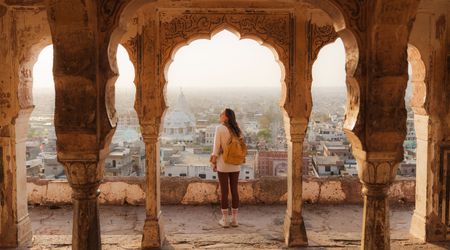
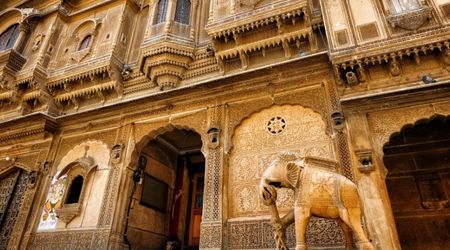
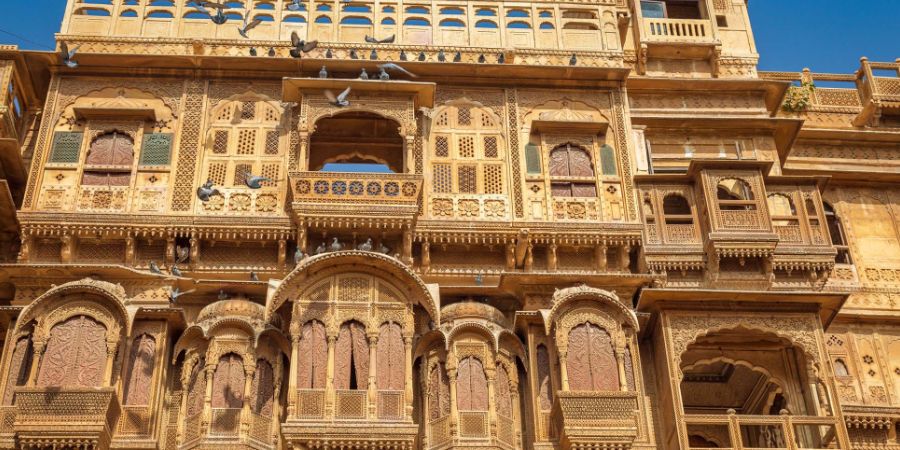
The facade of Patwon Ki Haveli is a catalog of techniques that silawat masons perfected over generations. Jali screens — perforated stone lattices — cover dozens of windows across the five mansions, each panel carved from a single slab. The patterns are geometric but not repetitive; no two jali screens on the haveli are identical, a fact you can verify by standing in the lane below and looking up with any degree of patience. The effect from inside is cinematic: desert light passes through the stone and breaks into shifting grids on the floor.
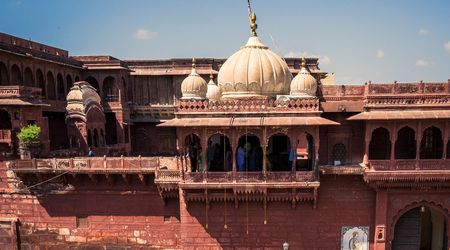
Projecting balconies, called jharokhas, extend from the upper floors supported by elaborately carved brackets. These aren't decorative afterthoughts. In the Thar Desert's climate, jharokhas create shade on the floors below while allowing ventilation — a passive cooling system encoded in ornament. The brackets themselves feature motifs drawn from Jain iconography, Hindu mythology, and everyday life: elephants, dancing figures, floral arabesques, and parrots.
The arched doorways deserve individual attention. The main entrance to the first mansion is framed by concentric bands of carved sandstone, each band featuring a different pattern — lotus chains, scrolling vines, miniature figures in narrative sequences. The depth of the carving reaches several inches into the stone in places, creating shadows that shift throughout the day and give the facade a quality of constant motion.
One counterintuitive detail: the most intricate carvings face inward, toward the courtyards, not outward toward the lane. The public display is impressive, but the private spaces received the finest work. This inverts the assumption that the haveli was built primarily to impress passersby. The Patwas were decorating for themselves, or perhaps for a divine audience they considered more important than any human one.
Painted Walls and Mirror Work Behind the Sandstone Shell
Step through the entrance and the temperature drops immediately — the thick sandstone walls hold the desert at bay. The interior spaces are organized around central courtyards, each mansion following a broadly similar plan: ground-floor storage and business rooms, upper-floor living quarters, and rooftop areas for sleeping during the brutal summer months. But the plan is where the similarity ends. Each mansion's interior decoration reflects its original occupant's tastes, and possibly the specific decade of its completion.
The wall paintings are the first surprise. Gold leaf, mineral pigments in deep blue and vermillion, and narrative scenes from Jain and Hindu traditions cover the interior walls of several rooms. The pigments have faded unevenly — some walls glow with their original intensity while others have dimmed to near invisibility. In the better-preserved rooms, you can trace entire mythological sequences panel by panel, like walking through a graphic novel rendered on plaster.
Mirror work — small pieces of reflective glass set into painted plaster — appears in the upper chambers of at least two of the mansions. The technique, called ayna mahal in some regional traditions, creates a flickering, candlelit atmosphere even in daylight. Combined with the jali-filtered sunlight, the effect inside certain rooms is genuinely disorienting: you lose track of where the light originates.
The floors in the main reception rooms are polished stone, cool underfoot. Carved niches in the walls once held oil lamps, and their soot marks remain visible in some alcoves — a small, accidental record of centuries of evenings. The wooden doors and window frames, where they survive, feature their own carved panels, though wood has fared less well than stone in the dry desert air. What strikes you most inside the haveli isn't grandeur — it's density. Every surface has been worked.
Five Families, Five Mansions, Five Degrees of Survival
The five mansions of Patwon Ki Haveli are not identical copies of one another, and their current conditions vary dramatically. The first and largest mansion, attributed to Guman Chand himself, is the best maintained and the most visited. It now operates partly as a museum, with rooms displaying period furnishings, textiles, and artifacts that give a rough approximation of merchant-class domestic life. The curation is modest — handwritten labels, minimal interpretation — but the rooms speak clearly enough on their own.
The second mansion, adjacent to the first, is managed by the Archaeological Survey of India. Its interiors are sparer, the furnishings mostly removed, which paradoxically makes it the better building to study. Without the clutter of display cases, you can see the proportions of the rooms, the placement of ventilation channels, the way light moves through the space at different hours. The ASI's maintenance is functional rather than inspired — cement patches appear in places where sandstone has crumbled — but the structural bones remain legible.
The remaining three mansions are in varying states of private ownership and repair. Some rooms are occupied by families; others stand empty, their courtyards collecting sand. Access to these sections is inconsistent — sometimes a resident will wave you in, sometimes a locked gate ends the conversation. This patchwork of preservation is typical of heritage properties across Rajasthan, where ownership disputes and restoration costs create a slow attrition that formal protection hasn't solved.
The contrast between the five mansions is itself instructive. You see what active maintenance achieves, and what neglect costs, in the span of a single walk. The carving on one mansion's facade remains crisp enough to cast hard shadows; on another, fifty feet away, the same motifs have softened into suggestions. Time doesn't treat even identical stone equally when human attention is distributed unevenly.
The Tension Between a Tourist Site and a Lived-In Building
Parts of Patwon Ki Haveli are still occupied. This is not a sanitized museum experience. Laundry dries on carved balconies. A television flickers behind a jali screen that a nineteenth-century mason spent weeks carving. The coexistence of daily life and heritage tourism creates a friction you feel immediately — and it's a productive friction, because it forces you to reckon with the fact that preservation without habitation often kills the thing it claims to save.
The residents of the occupied sections are descendants of later owners, not the Patwa family. Their relationship to the building is pragmatic: it's housing, not a monument. They tolerate tourists with varying degrees of warmth, and their presence complicates the clean narrative of "heritage site" that guidebooks prefer. You'll see cooking smoke staining a centuries-old archway and feel a twinge of concern, followed by the realization that cooking smoke has been staining that archway since it was built.
Conservation efforts face the classic dilemma of Rajasthani havelis: the structures are too numerous and too expensive to maintain at museum standards, yet too significant to demolish or abandon. Organizations working on Jaisalmer's built heritage have documented the decay, but funding remains inconsistent and legal frameworks for privately owned heritage properties are weak. The haveli's sandstone is resilient but not invincible — water infiltration, structural cracks, and the vibration from increasing vehicle traffic in the surrounding lanes all exact a toll.
There's something honest about a heritage building that hasn't been fully curated. The imperfection tells the truth. A perfectly restored haveli would be a replica of itself. Patwon Ki Haveli, in its current state — part museum, part ruin, part home — is still accumulating history rather than merely displaying it.
Getting There, Getting In, and What to Do With Your Eyes
Patwon Ki Haveli sits inside Jaisalmer's walled city, reachable on foot from the main fort entrance in roughly fifteen minutes through narrow, sloping lanes. Auto-rickshaws can get you to the lane's entrance, but the final approach is pedestrian only. The haveli is open daily, typically from 9 AM to 5 PM, though hours shift seasonally and without much formal announcement. Carry cash — the entry fee is modest, around 100 rupees for the museum section, with separate charges sometimes levied by private occupants offering access to their portions.
The best time to visit is mid-morning, between 10 and 11 AM, when the sun is high enough to illuminate the upper facades and the jali screens cast their strongest interior patterns. Late afternoon brings golden-hour light on the exterior, but the interiors grow dim. Avoid midday in summer — the lanes trap heat, and the haveli's natural cooling only goes so far when the outside air exceeds 45 degrees Celsius.
Practical notes worth carrying with you:
- Bring a small flashlight or use your phone's torch to examine wall paintings in the darker interior rooms — details invisible to the unaided eye emerge under directed light.
- Photography is generally permitted in the museum sections; ask before shooting in occupied portions.
- Local guides cluster at the entrance and charge around 200 to 300 rupees — some are excellent, some recite memorized scripts. Ask them a specific question about the carvings before committing.
- The lane outside the haveli hosts a few shops selling miniature paintings and textiles — the quality varies, but prices are lower than in the fort's main tourist corridor.
Spend at least ninety minutes here. Most visitors pass through in thirty, glance at the facade, take a photograph, and leave. That's enough time to see the surface but not enough to register the differences between the five mansions, or to notice how light changes a room's character in the span of a single cup of chai.
The haveli demands the one thing most tourist itineraries refuse to budget: patience. Give it that, and the stone gives back.
Two centuries after a brocade trader broke ground on a lane in Jaisalmer, his family's name is known not for the textiles they shipped or the opium they sold but for the building they left behind. The trade routes collapsed. The empire that tolerated them dissolved. The currency that paid the masons is no longer legal tender. What persists is carved sandstone and the human compulsion to make something that outlasts the reasons for making it. Across Rajasthan, hundreds of havelis are quietly disintegrating — their owners gone, their carvings softening into the sand they were cut from. Patwon Ki Haveli survives partly through luck, partly through tourism, and partly through the stubbornness of the people who still live inside it. Every building is a wager against forgetting, and this one, so far, is winning.