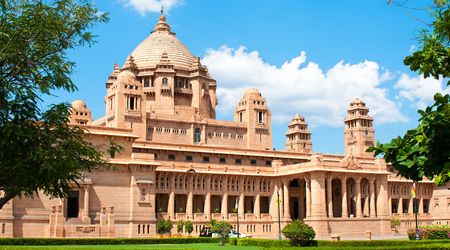
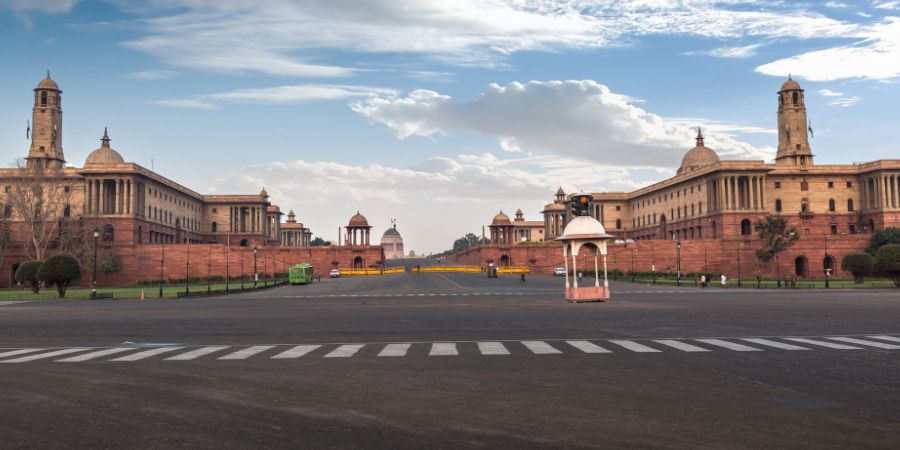


Rashtrapati Bhavan is the official residence of the President of India, but calling it a residence is like calling the Ganges a river — technically accurate, spiritually insufficient. This is where constitutional crises are resolved over tea, where foreign dignitaries walk corridors that once served British viceroys, and where a garden opens each spring that draws hundreds of thousands of visitors for a few fleeting weeks. The building tells a story that predates Indian independence, entangles itself with colonial ambition, and continues to evolve as a living symbol of democratic governance. What follows is a close examination of its origins, its architecture, the rituals and politics contained within its walls, and what it means to stand inside a building that has watched a nation remake itself.
A 340-Room Assertion That Power Doesn't Need to Shout
Most visitors expect grandeur, and Rashtrapati Bhavan delivers it — but not in the way you'd anticipate. The building doesn't dazzle through ornament or excess. Its authority comes from proportion. The main structure covers an area of 200,000 square feet, contains 340 rooms, and sits on an estate larger than the grounds of Versailles. Yet the effect isn't one of spectacle. It's one of gravity.
Part of that gravity comes from placement. Edwin Lutyens, who designed the building, insisted that it occupy the highest point of New Delhi's ceremonial axis. The long approach from India Gate creates a forced perspective that makes the building appear to grow as you move toward it — or, depending on the gradient debate that plagued its construction, to partially disappear behind Raisina Hill's slope. That optical tension, whether intentional or accidental, gives the Bhavan a quality rare in state architecture: it refuses to be fully grasped from a single vantage point.
The sheer scale resists easy comparison. Buckingham Palace has 775 rooms but sits on 39 acres. The White House occupies a modest 18 acres. Rashtrapati Bhavan's 330 acres include staff quarters, stables, a museum complex, and gardens that shift character with the seasons. The estate functions less like a single building than like a self-contained precinct of governance, ceremony, and daily life.
What commands real awe, though, isn't the acreage or the room count. It's the way the building absorbs the contradictions of Indian democracy — colonial inheritance repurposed for republican ideals, imperial design serving egalitarian ceremony — without ever seeming to strain under the weight. The Bhavan doesn't explain itself. It simply persists, forcing everyone who enters to reckon with what it contains.
A Viceroy's Palace That Outlasted the Empire That Built It
Construction began in 1912, the same year the British shifted India's capital from Calcutta to Delhi. King George V had announced the move at the Delhi Durbar of 1911, and the decision carried an unmistakable message: the Raj intended to stay. The new capital needed a viceroy's residence that would project permanence — a building so monumental that the idea of British withdrawal would seem physically absurd.
Edwin Lutyens received the commission, alongside Herbert Baker, who took charge of the flanking Secretariat Buildings. The two architects clashed almost immediately. Their most famous dispute — over the gradient of Raisina Hill's approach road — resulted in a design flaw Lutyens never forgave. The road's incline partially obscures the palace from India Gate, an effect Lutyens called his "Bakerloo," a bitter pun he carried to his grave. The argument reveals something about the project's temperament: even its creators couldn't agree on what the building should look like from a distance.
Construction took seventeen years. Over 29,000 laborers worked the site, quarrying sandstone from Dholpur in Rajasthan and hauling it across the Gangetic plain by rail. The building was completed in 1929, and Lord Irwin became its first resident viceroy. Only eighteen years later, in 1947, the last viceroy — Lord Mountbatten — handed the keys to independent India's first governor-general, C. Rajagopalachari. The palace built to cement British rule became the seat of Indian sovereignty within two decades of its completion.
That speed of historical reversal gives the building its peculiar emotional charge. It wasn't destroyed or abandoned. It was simply claimed — a colonial artifact absorbed into the body of a new republic, its meaning overwritten without a single stone being moved.
Where Lutyens Met the Mughals and Neither Fully Won
The architecture of Rashtrapati Bhavan defies a single label. Lutyens drew primarily from European classicism — the symmetry, the colonnaded porticos, the central dome — but the building incorporates Indian motifs so thoroughly that separating the two traditions becomes a fool's errand. The dome, the structure's most recognizable element, doesn't trace its lineage to St. Peter's Basilica or the Pantheon alone. It borrows from the Buddhist stupa at Sanchi, its profile flattened and broadened in a way that reads as unmistakably South Asian against Delhi's skyline.
The red and cream Dholpur sandstone gives the exterior a warm, mineral quality that shifts tone throughout the day — pale gold at noon, deep ochre at dusk. Lutyens integrated Indian stone-carving traditions into the detailing: elephant heads emerge from column capitals, lotus motifs punctuate balustrades, and jaali screens filter light through geometric perforations drawn from Mughal and Rajput palace design. These aren't decorative afterthoughts. They're structural elements that control ventilation and shade in ways suited to Delhi's extreme summers.
The floor plan follows a butterfly shape, with the ceremonial wing extending forward and residential quarters spreading to the rear. Twelve courtyards punctuate the interior, creating pockets of light and air within the sandstone mass. The main entrance features a portico supported by columns arranged in pairs, each column rising over 25 feet — a scale that makes arriving dignitaries feel the building's authority before they've crossed the threshold.
The counterintuitive truth about the design is that its hybrid character, which critics initially dismissed as neither fully Indian nor fully Western, became its greatest asset. The building belongs to no single tradition, which means it could belong to India — a country that has never been a single tradition either.
Durbar Hall at Dusk, When the Chandeliers Start Their Work
The interior of Rashtrapati Bhavan operates on a different register than the exterior. Outside, everything is sandstone and sunlight. Inside, the mood shifts to teak, marble, and a particular quality of filtered Delhi light that enters through high clerestory windows. The Durbar Hall, the ceremonial heart of the building, sits directly beneath the central dome. Its circular plan, rising through tiered galleries to a coffered ceiling, was originally the throne room where viceroys held court. Today, it hosts the swearing-in ceremonies of presidents and prime ministers — the same physical space repurposed for democratic ritual.
The Ashoka Hall, used for state banquets and receptions, runs the length of the building's central wing. Its long Persian carpet, pale walls, and restrained neoclassical detailing give it a formality that can feel almost austere until the evening light hits the chandeliers and the room ignites with reflected warmth. State dinners here seat upwards of 100 guests, with place settings laid according to a protocol manual that hasn't changed fundamentally since independence.
The Marble Hall functions as an informal museum, displaying portraits of past presidents and viceroys alongside gifts received from foreign heads of state. The juxtaposition can be jarring — a painting of Lord Curzon hanging near a photograph of APJ Abdul Kalam — but the Bhavan makes no effort to sanitize its layered history. Everything coexists.
The private residential quarters remain off-limits to visitors, occupying the rear of the estate behind the ceremonial rooms. What surprises most people who tour the accessible sections is how lived-in the spaces feel. The Bhavan isn't a museum costuming as a residence. Footsteps echo on the marble floors with the unmistakable sound of a building still in daily use.
Fifteen Acres of Geometry Disguised as a Garden
The Mughal Gardens — renamed Amrit Udyan in 2023 — open to the public each year for a limited window, typically from late January through March. During those weeks, lines stretch down Raisina Hill as visitors wait hours to enter what is, in raw terms, a fifteen-acre formal garden on the western side of the main building. The experience rewards the wait, though not for the reasons most expect.
The gardens follow a chaharbagh plan, the quadrilateral layout inherited from Persian and Mughal garden design. Water channels divide the space into geometric sections, each planted according to a strict chromatic and seasonal logic. Lutyens supervised the original planting scheme, but successive presidents have added species and redesigned sections — the garden today is a collaborative work spanning nearly a century. Over 150 varieties of roses grow in the main section alone, alongside seasonal beds of marigold, sweet william, and larkspur.
The Long Garden, Circular Garden, and Purdah Garden each have distinct characters. The Circular Garden features a butterfly-shaped hedge arrangement surrounding a central fountain. The Purdah Garden, enclosed by high walls, originally served as a private space for the viceroy's family and retains an atmosphere of inward quiet that the larger sections lack. A herbal garden, added in recent years, grows medicinal plants referenced in Ayurvedic texts.
The most striking feature isn't any single planting but the way the garden uses water. The channels, fountains, and reflecting pools create a microclimate that drops the ambient temperature noticeably — you feel the shift the moment you cross from open lawn into the chaharbagh grid. In a city where summer temperatures exceed 45 degrees Celsius, the garden's cooling effect isn't decorative. It's an engineering solution dressed in flowers.
The Room Where Governments Are Made and Unmade
The President of India holds a position that textbooks often describe as ceremonial, and that description is both accurate and deeply misleading. The Constitution vests executive power in the President, who then acts on the advice of the Council of Ministers. In practice, this means that every act of the Indian government — every law, every appointment, every declaration of emergency — requires presidential assent to take legal effect. Rashtrapati Bhavan is where that assent is given or, in rare and seismic moments, withheld.
The building has witnessed pivotal constitutional episodes. President Zail Singh's fraught relationship with Prime Minister Rajiv Gandhi in the 1980s raised the specter of a presidential refusal to act on ministerial advice. President K.R. Narayanan's decision to return a proposal for imposing President's Rule in Uttar Pradesh in 1998 demonstrated that the office, however circumscribed, carries real discretionary weight in moments of political ambiguity.
The Bhavan's role in government formation is perhaps its most consequential function. After a general election, the President invites the leader best positioned to command a majority in the Lok Sabha to form a government. In an era of coalition politics, this decision involves real judgment — assessing letters of support, weighing competing claims, and occasionally making calls that shape the direction of governance for five years. These consultations happen inside the Bhavan, in rooms designed for a colonial viceroy, now hosting the arithmetic of parliamentary democracy.
The building's constitutional significance rests on a paradox: it houses the most powerful office in the country, an office whose power depends almost entirely on restraint. The walls of Rashtrapati Bhavan contain authority precisely by containing it — holding it in check so democracy can function outside the gates.
Two Thousand Staff, One Dairy Farm, and the President's Morning Walk
Approximately 2,000 people work on the Rashtrapati Bhavan estate. The number includes everyone from the President's Bodyguard — a cavalry regiment that traces its origins to 1773 — to gardeners, cooks, clerks, and technicians maintaining the building's aging electrical and plumbing systems. The estate operates its own dairy farm, and until recent decades, it maintained a functioning polo ground. A golf course still occupies a section of the grounds, though its use has varied with each president's inclinations.
Daily life inside the Bhavan follows a rhythm that mixes state protocol with domestic routine. The President's schedule typically begins with a morning briefing, followed by meetings with ministers, dignitaries, and delegation heads that can stretch through the afternoon. Evenings often involve state dinners or cultural events hosted in the Ashoka Hall or on the lawns. The President's personal quarters occupy a modest portion of the building's vast footprint — a deliberate choice, reinforced by successive occupants, to keep the residential space proportional to the office rather than the architecture.
Each president has left a distinct imprint. APJ Abdul Kalam, who served from 2002 to 2007, was known for inviting schoolchildren to the estate and for taking late-night walks across the grounds. Pranab Mukherjee, a lifelong parliamentarian, reportedly treated the library as his primary workspace. The Bhavan absorbs these individual habits without fundamentally changing — the building is always larger than the person who occupies it.
The staff quarters, spread across the estate's periphery, form a small township with its own markets, places of worship, and social life. Living on the grounds creates a sealed community where the line between workplace and home dissolves. For many staff members, the Bhavan isn't the seat of power. It's simply where they live, raise their children, and mark the passage of ordinary time beneath an extraordinary dome.
A Colonial Shell Running on Solar Panels and Streaming Tours
Rashtrapati Bhavan has undergone significant modernization in recent years, though the changes rarely make headlines. A solar power plant installed on the estate generates a portion of the building's electricity. Rainwater harvesting systems supplement the water supply for the gardens and grounds. The estate's waste management has been overhauled to reduce its environmental footprint — an ironic twist for a building originally designed with no consideration for resource efficiency in a colonial era that assumed limitless extraction.
Public access has expanded considerably. The Rashtrapati Bhavan Museum Complex, inaugurated in 2014, occupies the former stables and garage blocks and houses exhibits on the building's history, the presidency, and India's independence movement. Virtual tours, introduced during the COVID-19 pandemic, allow remote visitors to move through the Durbar Hall and Ashoka Hall via their screens. The Change of Guard ceremony, held on Saturday mornings at the forecourt, draws crowds who watch the President's Bodyguard perform a mounted drill that hasn't changed in its essentials for over a century.
The Bhavan also functions as a venue for diplomatic signaling. State visits include carefully choreographed arrivals at the forecourt, where the visiting head of state receives a 21-gun salute and inspects a guard of honor. The imagery — broadcast globally — projects Indian sovereignty through the visual grammar of the very building the British built to project theirs. The appropriation is deliberate, and it works.
Recent initiatives have opened the gardens for extended periods and introduced night-time illumination viewings. These moves reflect a broader shift: from treating the Bhavan as a fortress of state to positioning it as a public institution that belongs, in principle if not in daily practice, to every citizen who walks through its gates.
Rashtrapati Bhavan is not a monument frozen in the past and not a government office stripped of memory. It is both simultaneously — a building that carries the full weight of colonial ambition and postcolonial reinvention in every stone, every corridor, every seasonal bloom in its gardens. To visit it is to feel, physically, the scale of the project India undertook in 1947: not the demolition of the old order, but its quiet absorption into something larger and more complicated.
The building will outlast every president who occupies it, every political crisis resolved within its walls, every rose that flowers and fades in Amrit Udyan. What it cannot outlast is its own contradictions, and that is precisely what makes it worth seeing. A democracy housed in an emperor's shell — still standing, still inhabited, still arguing with itself about what it means.