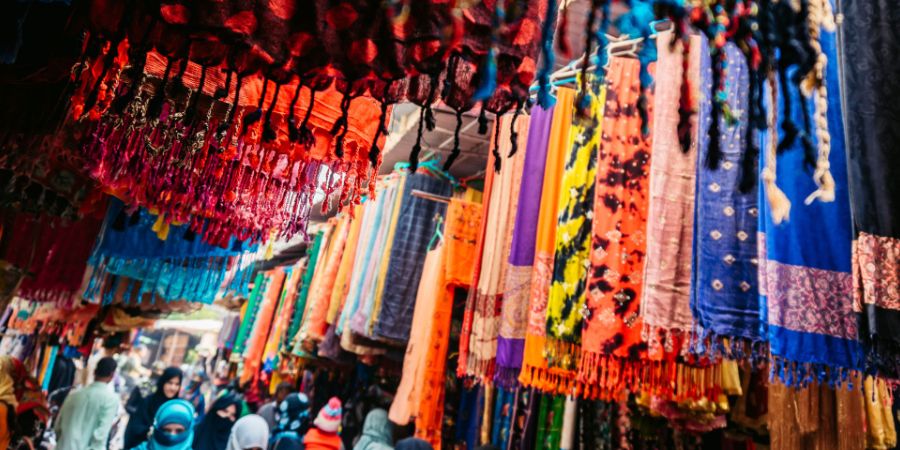


On any given afternoon, the narrow lanes between North Campus colleges and the residential blocks of north Delhi carry a human current so dense that walking against it feels like wading upstream. Students in oversized band tees haggle over jhumkas at a roadside stall. A grandmother in a starched cotton sari inspects polyester curtains three shops down. A delivery rider threads his motorcycle between a parked autorickshaw and a thela cart piled with momos, and nobody flinches. This is Kamla Nagar — not a curated retail experience, but a living, sweating, shouting organism that has fed, clothed, and accessorised generations of Delhiites without ever appearing in a tourist brochure.
The market sits in the shadow of Delhi University's North Campus, and that proximity has shaped everything about it — the prices, the aesthetics, the operating hours, the sheer volume of cheap sunglasses per square metre. But Kamla Nagar isn't just a college-kid hangout. It's a place where middle-class Delhi does its serious shopping, where food vendors have perfected single dishes over decades, and where the character of a neighbourhood reveals something honest about the city itself. What follows is a close look at how this market became what it is, what you'll actually find there, and how to move through it without losing your wallet or your patience.
How a Government Housing Colony Accidentally Built Delhi's Most Democratic Market
Kamla Nagar didn't start with commerce in mind. The area was developed in the 1950s and 1960s as a residential colony, part of Delhi's post-independence expansion when the city was absorbing waves of displaced families and growing bureaucracies. The original plan envisioned orderly rows of residential flats, small parks, and the modest ground-floor shops that every Delhi colony needs — a chemist, a grocer, a tailor. Nothing about those early blueprints hinted at what would come.
The catalyst was Delhi University's North Campus, which consolidated its presence barely a kilometre south. As student populations swelled through the 1970s and 1980s, so did demand for cheap food, affordable clothing, and places to kill time between lectures. The ground-floor shops adapted. The tailor started stocking readymade kurtas. The grocer added snacks and cold drinks. New stalls materialised on sidewalks, then multiplied.
What made Kamla Nagar different from, say, Connaught Place or Khan Market was its complete lack of pretension. There were no colonial arcades, no architectural grandeur to maintain, no landlords charging rents that demanded upscale tenants. The colony's utilitarian design — those plain concrete blocks with their standardised shop fronts — actually became a democratic equaliser. A chaat vendor could set up next to a fabric store, and neither looked out of place.
By the late 1980s, the transformation was irreversible. Residential ground floors had been almost entirely converted to retail. The colony's internal roads, designed for light local traffic, now carried the weight of a full commercial district. Kamla Nagar had become a market not by design but by the accumulated force of thousands of daily transactions, each one nudging it further from its original purpose. No city planner approved that shift. The students and the shopkeepers just made it happen.
The Slow Accumulation of Thirty Years: How Word-of-Mouth Replaced Urban Planning
Through the 1990s, Kamla Nagar's evolution accelerated in a pattern familiar to anyone who's watched Indian retail districts grow — not through investment decks and anchor tenants, but through imitation and proximity. One shop selling women's kurtas at student-friendly prices would succeed, and within a year, three more would open on the same block. A momos vendor drawing a lunchtime crowd at one intersection would inspire another vendor to set up at the next corner, and then another after that.
The early 2000s brought branded retail into the mix. National chains — names like Bata, Archies, and later Jockey and Levi's — began leasing space alongside the unbranded stalls. This created an unusual layering effect that persists today: you can buy a branded polo shirt in an air-conditioned showroom, then step outside and find a nearly identical unbranded version for a third of the price on a street rack. The coexistence isn't hostile. It's symbiotic. The branded stores draw foot traffic; the street sellers capture the overflow.
The rise of North Campus as one of Delhi's most sought-after college clusters — Hindu College, Hansraj, Kirori Mal — kept injecting fresh cohorts of eighteen-year-olds into the market every July. Each generation shaped Kamla Nagar's inventory slightly. The baggy jeans of the late '90s gave way to fitted shirts in the 2000s, then graphic tees and athleisure after 2015. The food shifted too, from pure North Indian chaat toward pan-Asian street snacks and cafe culture.
Despite the rise of online shopping, physical foot traffic hasn't cratered the way some predicted. The sensory experience of touching fabric, tasting food, and bargaining face-to-face still pulls people off their phones and into the lanes. Kamla Nagar adapted not by resisting change but by absorbing every trend the city threw at it.
A Grid That Only Makes Sense Once You Stop Trying to Map It
Kamla Nagar Market doesn't have a single entrance or a logical starting point. The main commercial artery runs roughly parallel to the road connecting Jawahar Nagar to the university area, but side lanes branch off unpredictably, some ending at residential staircases, others opening onto secondary shopping clusters that feel like entirely different markets. A first-time visitor will get turned around. A second-time visitor will get turned around slightly less.
The main road carries the highest-rent shops — branded outlets, multi-storey clothing stores, electronics retailers. Step into the side lanes and the economics shift. Rents drop. Stalls shrink. The merchandise gets cheaper and more eclectic: phone covers printed with Bollywood faces, hair accessories sold by the dozen, costume jewellery displayed on velvet boards propped against walls. The deeper you go, the more the market resembles a bazaar in the traditional sense — goods spilling out of doorways, prices unwritten and negotiable.
Street food vendors cluster at specific intersections, creating informal food courts where the seating is a shared bench and the menu is whatever's being fried or steamed within arm's reach. The chaat corners near Spark Mall form one such cluster. Another gathers near the Vishwavidyalaya Metro station exit, catching the student crowd as it surfaces.
One counterintuitive detail: the market's most interesting shops aren't always at street level. Some of the better fabric stores, tailoring units, and jewellery dealers occupy cramped first-floor spaces above the main shops, accessible by narrow staircases that most visitors walk past without noticing. Locals know to look up. The ground floor is for browsing. The floors above are for buying with intent. This vertical dimension gives Kamla Nagar a density that its modest footprint doesn't immediately suggest.
Where a College Budget Buys a Full Wardrobe (If You Know What to Skip)
Kamla Nagar's clothing economy operates on a principle that would horrify any luxury retailer: volume over margin. The average shop here stocks fast-fashion pieces — trend-responsive, season-specific, and priced to move within days. A printed rayon kurti that appeared on a Bollywood actress's Instagram two weeks ago will already be hanging on a Kamla Nagar rack in four sizes, priced between 200 and 500 rupees depending on fabric weight. The turnaround is astonishing.
Women's ethnic wear dominates the inventory. Kurta sets, dupattas, anarkalis, palazzo pants, and cotton saris fill the majority of shops along the main road. The quality varies enormously within a single store — you might find a decently stitched cotton kurta next to a polyester piece that would disintegrate after three washes. The skill is in the sorting, and experienced buyers here develop an almost tactile literacy, running fabric between their fingers the way a sommelier swirls a glass.
Western wear occupies a smaller but growing share of shelf space, driven entirely by the student demographic. Crop tops, graphic tees, cargo pants, and oversized hoodies sell briskly during college fest season. Most of this stock is unbranded and sourced from wholesale markets in Gandhinagar or Surat, which means the prices are startlingly low but the sizing is inconsistent. Try everything on. The fitting rooms are cramped, poorly lit, and shared, but skipping them guarantees a return trip.
Men's options lean toward casual shirts, jeans, and basic cotton kurtas for festival season. The selection is narrower than the women's range, a gap the market hasn't seriously tried to close. Men who want variety tend to migrate toward nearby Sadar Bazaar or head to Lajpat Nagar. Kamla Nagar knows its primary customer, and it stocks accordingly.
The Jhumka Economy and Everything Else That Glitters for Under 200 Rupees
Accessories in Kamla Nagar operate as an impulse economy. Nobody travels across Delhi specifically for a pair of oxidised silver earrings, but almost everyone who enters the market leaves carrying a small plastic bag of something they hadn't planned to buy — a beaded bracelet, a hair clip, a nose pin, a set of bangles. The stalls are designed for this. They line the edges of the main road and colonise every available inch of sidewalk, their merchandise displayed at eye level on rotating stands or spread across folding tables.
Jhumkas — the dangling bell-shaped earrings that are practically a uniform among North Campus students — sell here in a staggering variety. Oxidised metal, mirror-work, threadwork, beaded, tassel-trimmed, oversized, miniature. Prices start around 30 rupees for a basic pair and climb to 300 or 400 for something with genuine semi-precious stones or intricate metalwork. The quality at the low end is predictably disposable; the metal will discolour within weeks. But a discerning buyer can find pieces in the mid-range that hold up for months, particularly from the vendors who source directly from Jaipur's artisan workshops.
Beyond earrings, the accessory stalls stock hair accessories, anklets, rings, brooches, sunglasses (mostly unbranded, occasionally convincing knockoffs), scarves, phone cases, tote bags, and wallets. Kolhapuri chappals and jutis appear seasonally, their leather soles hardening to a comfortable shape within a week of wear. The key detail most buyers miss: bargaining here isn't just expected — it's structurally necessary. Initial asking prices are typically marked up by 40 to 60 percent. Start at half the quoted price and settle somewhere in between. The vendors expect it, and the interaction is often warmer for it.
Chaat, Momos, and the Aloo Tikki That Has Outlasted Three Decades of Competition
The food at Kamla Nagar isn't elevated or Instagrammable in any meaningful sense. It's working food — fuel for students between lectures, sustenance for shoppers, and a reason for people who've long graduated to return. The standout items are specific and stubbornly traditional. Chhole bhature served on steel plates from stalls that haven't changed their oil or their recipe since the early 1990s. Aloo tikki that arrives scorching hot, its potato crust shattered and doused in tamarind and green chutneys so assertive they make your eyes water.
Momos arrived in the late 1990s with the Tibetan and Northeastern vendors who found a ready market among students, and they've since become Kamla Nagar's most consumed street snack. Steamed, fried, and the Delhi-specific innovation of "tandoori" momos — stuffed dumplings brushed with red chutney and crisped on a hot plate — line up at vendor after vendor. The chilli sauce served alongside varies from mildly tangy to genuinely punishing. Ask before you pour.
Golgappa vendors near the Spark Mall intersection draw crowds that spill into the road during peak hours. The experience is communal and slightly chaotic: you stand in a loose semicircle, the vendor fills each hollow puri with spiced water and hands it to you directly, and you eat it in one motion before the shell collapses. There's a rhythm to it, and regulars develop a wordless rapport with their preferred vendor.
The one surprise for first-timers is the sheer density of sweet shops mixed into the street food ecosystem. Rabri, jalebi, and kulfi stalls sit between the savoury vendors, and the local habit is to end a street food circuit with something cold and sweet. Kulfi from the hand-cranked steel canisters — dense, slightly grainy, flavoured with pistachio or mango — is the most reliable closer. It's never fancy, but it's always right.
When Students Needed Somewhere to Sit Down: The Rise of the Kamla Nagar Café
Cafés in Kamla Nagar exist because students need electricity, Wi-Fi, and somewhere to sit that isn't a lecture hall or a hostel room. The café culture here isn't aspirational — it's functional. The furniture is usually mismatched. The menus are long, covering everything from pasta to parathas to waffles. The coffee ranges from competent to barely drinkable, but nobody's here for the single-origin pour-over. They're here for the table.
The better-known spots — places that have survived more than five years in a market where café turnover is brutal — tend to occupy first-floor spaces with balcony seating overlooking the street below. These balconies function as observation decks. You sit with a plate of garlic bread and watch the market churn beneath you, which turns out to be one of the more honest ways to understand how the place works.
Food quality in the sit-down restaurants is a tier above the street stalls but not dramatically so. North Indian thalis, Chinese-Indian hybrids, and pizza account for most of what gets ordered. The pricing is calibrated for college wallets — most meals fall between 150 and 350 rupees, including a drink. The portions are sized to compensate for the modest cooking, which is to say they're large.
One thing the cafés do well is adapt to temporal rhythms. Morning slots attract students cramming for exams, their tables covered in photocopied notes. Afternoon crowds are shoppers pausing between purchases. Evening brings mixed groups — friends, couples, families from the surrounding colony — who linger over chai and conversation until the staff starts stacking chairs. The cafés aren't destination dining. They're the market's living rooms, and their value lies precisely in the fact that nothing about them tries too hard.
Getting In, Getting Out, and Not Losing Your Mind in Between
The most efficient way to reach Kamla Nagar is via the Vishwavidyalaya Metro station on the Yellow Line. The station drops you at the market's southern edge, and from there you're on foot whether you like it or not — vehicular access within the market's core lanes is theoretically possible but practically miserable. Auto-rickshaws will bring you to the periphery and refuse to go further. They're right to do so.
Timing matters more than most visitors realise. The market's character shifts dramatically across the day:
- Morning (10 AM to noon): Shops are open but the crowds are thin. Ideal for serious clothing or fabric shopping when you want to inspect merchandise without elbows in your ribs.
- Afternoon (1 PM to 4 PM): Peak street food hours. The vendors are at full capacity and the food is freshest. The heat, particularly between April and September, is merciless — carry water.
- Evening (5 PM to 8 PM): The densest crowds arrive. Shopping is competitive. Bargaining gets harder because vendors have enough customers to refuse a lowball offer.
- Sunday: Many shops close or operate on reduced hours. Street food vendors stay active. Don't plan a major shopping run on a Sunday.
Cash remains the dominant currency at street stalls and smaller shops, though UPI payments via apps like PhonePay and Google Pay have made significant inroads. Branded stores accept cards. Keep small denominations — change is perpetually scarce, and a 500-rupee note at a golgappa stall will earn you a look of genuine despair.
Safety is largely a non-issue during daylight hours, but keep bags zipped and phones secured in front pockets during peak crowds. The lanes get narrow enough that pickpocketing, while not epidemic, is possible. Stay alert without being anxious, and you'll be fine.
Kamla Nagar Market doesn't reward the visitor who comes with a precise list and a tight schedule. It rewards the one who shows up with loose plans, an empty stomach, and enough patience to let the place reveal itself in its own disordered time. This isn't a market that has been polished for consumption — it's a place that still belongs to the people who use it daily, from the first-year student buying her first dupatta to the retired uncle picking up a kilo of sweets on his evening walk. In a city that increasingly builds shopping experiences for the Instagram grid, Kamla Nagar remains defiantly unreconstructed — loud, cluttered, occasionally exhausting, and more honest about how Delhi actually shops than anywhere with air conditioning and a parking validation machine.