

The cable car lurches forward and the ground drops away fast — suddenly you're swinging over a dry ravine littered with temple flags, and the entire floodplain of Haridwar spreads below like a crumpled green cloth tossed against the foothills. The smell of woodsmoke and marigolds gives way to cool, thin air. Somewhere down there, the Ganges bends sharply west, and the evening aarti fires at Har Ki Pauri are already being stacked. But you're heading up, toward the Bilwa Parvat ridge and the small, crimson-walled compound of Mansa Devi Temple, where Hindu pilgrims have climbed for centuries to whisper a wish to the goddess and tie a thread to a sacred tree. This isn't Varanasi's operatic spectacle or Rishikesh's yoga-retreat sheen.
Mansa Devi operates in a different register — intimate, steep, and stubbornly local even as the tourist buses multiply. The temple sits at roughly 350 meters above the city, close enough to hear the distant temple bells of Haridwar, far enough to feel separated from everything below. What follows traces the history, the climb, the architecture, the spiritual texture, and the practical realities of visiting a hilltop shrine that remains, against all commercial pressures, a place where people come not to photograph but to pray.
Where the Ganges Bends and the Faithful Look Upward
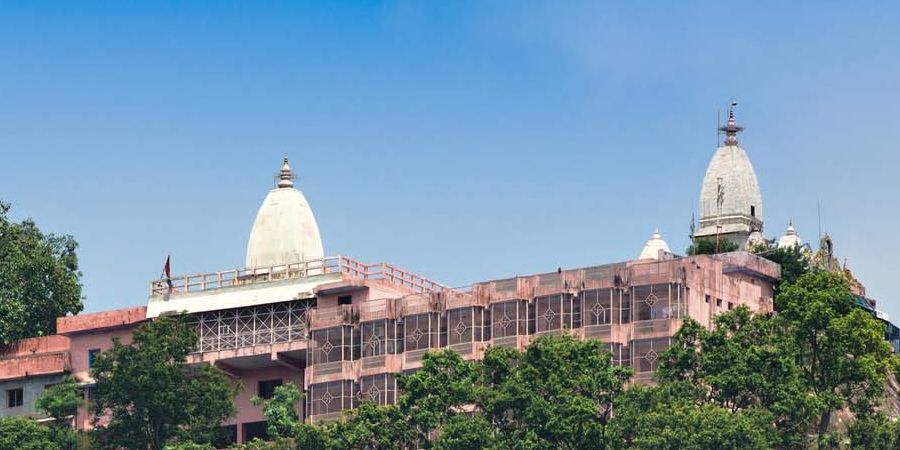
Stand at the southern bank of the Ganges canal in Haridwar and look east. Past the concrete hotels and the tangle of electrical wires, the Shivalik hills rise abruptly, covered in scrubby thorn forest that turns almost golden in late afternoon light. On the nearest ridgeline, you'll spot a cluster of white and saffron structures — Mansa Devi Temple. It doesn't dominate the skyline the way a European cathedral might. It perches, compact and deliberate, as if the hill itself decided to hold something sacred in its palm.
The relationship between the temple and Haridwar below is symbiotic. The city exists because the Ganges exits the mountains here, and Mansa Devi exists because the city needed a place above the flood line where prayers could ascend without interruption. Pilgrims who've bathed at Har Ki Pauri often make Mansa Devi their next stop, still dripping, their foreheads freshly marked with sandalwood paste. The temple functions as the second movement of a ritual that begins at the river.
What surprises most visitors is the scale — or rather, the lack of it. The main sanctum is small, barely large enough for a dozen people at a time. There are no towering gopurams, no sprawling courtyards. The power of this place comes from its position, not its footprint. You feel it in the way the wind shifts as you approach the summit, carrying incense from the shrine and diesel fumes from the ropeway simultaneously. The collision of the sacred and the mechanical is constant here.
The temple draws its largest crowds during the Navratri festivals in spring and autumn, when the wait for the cable car can stretch past two hours. Off-season, on a Tuesday morning — Tuesdays being auspicious for the goddess — you might share the hilltop with just a few dozen devotees and a troop of langurs who treat the compound walls as a gymnasium. The contrast between festival chaos and weekday stillness defines the place as much as any architectural feature.
A Goddess Born From a Severed Head and a Thousand Years of Longing
The name "Mansa Devi" translates loosely as "the goddess who fulfills wishes," and the mythology behind her is darker than that gentle title suggests. She's linked to the Shakti Peethas — the network of sites across South Asia where, according to tradition, pieces of the goddess Sati's body fell after Vishnu's discus dismembered her corpse to halt Shiva's destructive grief. Some accounts claim Sati's navel fell here; others say it was the back of her head. The disagreement itself is revealing. These origin stories were never fixed texts — they were oral traditions shaped by local priestly families competing for legitimacy and pilgrimage income.
Historical documentation of the temple's age remains thin. No inscriptions survive from before the medieval period, and the current structures show repeated reconstruction, most recently in the early twentieth century. What's clear from traveler accounts — including those of British colonial surveyors who mapped the Shivalik foothills — is that the hilltop has been a pilgrimage site for at least several hundred years. The path up was once a bare footpath, treacherous in monsoon.
The temple's mythology also intersects with Haridwar's identity as one of the four Kumbh Mela sites. During Kumbh years, the hilltop becomes an extension of the enormous gathering below, and the goddess's role shifts subtly — from personal wish-granter to cosmic protector overseeing the mass bathing in the Ganges. The temple's priests have long maintained that Mansa Devi's blessings are conditional: you must return to untie the thread you knotted if your wish is granted. This creates a literal cycle of return, binding devotees to the place across years, sometimes across generations.
The counterintuitive truth about Mansa Devi's history is that its relative obscurity in the textual record is precisely what has kept it authentic. Temples with thicker bureaucracies and richer endowments attract political attention. Mansa Devi has, for most of its existence, been too small and too steep to bother with.
Crimson Walls and Crowded Sanctums Built for Proximity, Not Grandeur
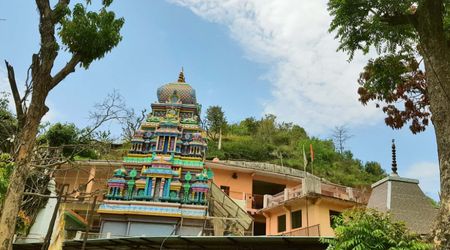
The main temple compound sits on a flattened section of the Bilwa Parvat ridge, enclosed by low walls painted in the deep saffron-red common to North Indian shrines. There are two primary sanctums. The larger one houses an idol of Mansa Devi with eight arms, each bearing a different weapon or symbolic object. The smaller sanctum contains a representation of the goddess with three mouths and five arms — an unusual iconographic combination that you won't encounter in most Shakti temples elsewhere.
Architecturally, the structures are modest. The shikhara — the tower above the main sanctum — is squat by temple standards, its whitewashed surface frequently repainted and showing the faint streaks where monsoon rain drags grime down from the finial. The mandapa, or covered hall in front of the sanctum, is too narrow for comfortable crowds, which means that during peak hours, the darshan line extends outside and wraps around the compound. The flooring is marble, cool underfoot in the morning, scalding by midday. Shoes are deposited at a stand near the entrance, and the barefoot walk across sun-heated stone is its own small act of devotion.
The sacred trees within the compound, draped with red and yellow threads knotted by wish-makers, create a visual density that the architecture itself doesn't provide. These threads — called "mannat ke dhage" — accumulate in such numbers that temple workers periodically cut them away, only for new ones to appear within days. The trees look perpetually bandaged.
One detail most visitors overlook: the compound's outer walls feature small recessed niches housing subsidiary deities, including forms of Hanuman and Bhairava. These satellite shrines serve practical crowd-management purposes — they distribute devotees across the compound rather than concentrating everyone at the main sanctum door. The architecture, in other words, is optimized not for aesthetic effect but for the physics of human faith under pressure.
Two Paths to the Top, and What Each One Costs You
You have two options for reaching Mansa Devi: the Mansadevi Udankhatola ropeway or the old foot trail. The ropeway — operated by the Ujjain and Haridwar Development Authority — runs from a station near the base of the hill in Haridwar's temple district. A round-trip ticket costs roughly 120 Indian rupees for adults, a price that hasn't changed significantly in years. The ride takes about five minutes and drops you at a platform just below the temple entrance. The cable cars are small, holding four to six passengers, and they move continuously, which means you step onto a slowly swinging cabin rather than waiting for it to stop. This alarms first-timers.
The foot path, by contrast, takes thirty to forty-five minutes depending on fitness and heat. It begins near the Chandi Devi road and winds up through dry deciduous forest, past small chai stalls and resting platforms built at intervals by various donors whose names are engraved in Hindi on the stone benches. The trail is paved but steep, with uneven steps that punish tired knees on the descent. Walking up, you'll share the path with sadhus, families carrying infants, and the occasional goat.
The choice between the two routes reveals something about what you want from the visit. The ropeway delivers you efficiently to the sacred site. The foot trail makes your body participate in the pilgrimage — the sweat, the labored breathing, the slow vertical progress that mimics, in small measure, the austerities the goddess is said to reward. Most repeat visitors walk up. Most tourists take the cable car. Both arrive at the same gate, but they arrive differently, and the difference shapes everything that follows.
One practical note: during Navratri and Kumbh periods, the ropeway queue can exceed two hours, making the foot trail the faster option despite the physical effort. The trail also offers something the cable car cannot — a gradual sensory transition from the noise of Haridwar to the relative quiet of the hilltop, punctuated only by birdsong and the rhythmic clanging of small bells that devotees ring at trailside shrines.
Incense, Thread, and the Sound of Private Bargains With the Divine
The spiritual atmosphere at Mansa Devi operates on a frequency different from the grand ritual theatrics of Haridwar's ghats below. Here, worship is transactional in the most honest sense. People come with a specific wish — a child, a job, recovery from illness, resolution of a legal dispute — and they make a direct, private appeal to the goddess. The act of tying a thread to the sacred tree formalizes this contract. It's prayer as negotiation, and there's no pretense otherwise.
The air inside the compound carries a permanent haze of incense and camphor smoke. Sandalwood agarbatti mixes with the sharper chemical tang of synthetic incense sold at the stalls just outside the gate. Bells ring constantly, not in any coordinated rhythm but in the irregular percussion of individual arrivals and departures, each devotee pulling the bell chain once to announce themselves to the goddess. The cumulative sound isn't melodic. It's insistent.
Priests stationed near the sanctum doors offer to perform personalized pujas for fixed fees, listed on laminated cards. The fees range from basic offerings of coconut and vermilion to elaborate multi-step rituals involving ghee lamps and chanted mantras. The commercialism is visible and unbothered — these priests have families and mortgages like anyone else. What keeps the place from feeling like a mere transaction counter is the behavior of the devotees themselves. You'll see a woman press her forehead against the sanctum's outer wall for five full minutes, eyes closed, lips moving. You'll see an elderly man sit on the marble floor, motionless, staring at nothing, for half an hour.
The most unexpected element of Mansa Devi's spiritual texture is the silence that erupts in small pockets. Between the bell strikes and the priest chants, there are gaps — three seconds, five seconds — when the wind shifts and everything goes quiet. In those moments, the hilltop feels genuinely apart from the world below, and you understand why someone chose this ridge, centuries ago, as a place where the divine might actually be listening.
Getting There, Getting In, and What Nobody Tells You About the Timing
Haridwar sits approximately 220 kilometers northeast of Delhi and is reachable by train, bus, or car. The Shatabdi Express from New Delhi Railway Station takes around four and a half hours; the Jan Shatabdi is slower but cheaper. From Haridwar's main railway station, Mansa Devi's ropeway base is a two-kilometer autorickshaw ride costing around 30 to 50 rupees, though drivers will quote higher to anyone carrying a backpack.
The temple opens at dawn — around 5:00 AM in summer, slightly later in winter — and closes between 8:00 and 9:00 PM depending on the season. The ropeway operates from approximately 7:00 AM to 7:00 PM. The gap matters: if you want the quietest visit, arrive on foot before the cable cars start running. The temple at 5:30 AM, with dew still on the trees and only a handful of devotees performing their morning prayers, is a fundamentally different place than the temple at noon.
Practical essentials worth knowing:
- Carry water. The climb generates real thirst, and the hilltop vendors charge double the base-rate price for bottled water.
- Leave bags at the locker facility near the ropeway station. Security at the temple entrance is strict about large bags, and the lockers are free or nominally priced.
- Wear shoes you can slip off quickly. The shoe-deposit area gets chaotic during peak hours, and sandals are faster to reclaim than laced boots.
- Photography is restricted inside the main sanctum. Phone cameras are generally tolerated in the outer compound, but pointing a lens at a praying devotee will earn you a sharp reprimand.
The best months for a visit are October through March, when the heat is manageable and the Shivalik hills carry a faint green tinge from post-monsoon growth. April through June, temperatures on the exposed hilltop can exceed 40 degrees Celsius, turning the marble walkways into griddles. Monsoon months bring their own risk — the footpath becomes slippery, and the ropeway occasionally shuts during heavy rain.
What the Hilltop Sees That You Might Miss From Below
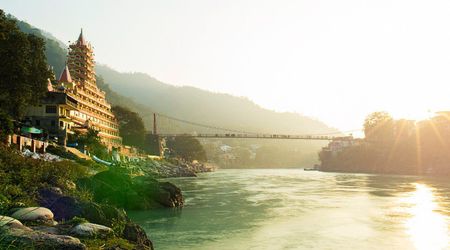
Mansa Devi's ridge offers a vantage point that reframes Haridwar entirely. From above, the city's chaotic density resolves into a legible pattern: the Ganges canal running straight as a ruled line, the temple district packed tight along its banks, and then the abrupt shift to agricultural land and scrub forest beyond. You can trace the pilgrimage routes — the roads feeding devotees toward Har Ki Pauri — and see how the city's entire infrastructure bends around the river. Haridwar, from up here, is not a city with a river. It's a river with a city attached.
The surrounding Shivalik hills hold other temples worth combining into a longer visit. Chandi Devi Temple sits on the adjacent Neel Parvat ridge and is reachable by a separate ropeway from Gaurikund. Together, Mansa Devi and Chandi Devi form the "Siddh Peeth" pair — pilgrims traditionally visit both in a single day, beginning with Mansa Devi. The Chandi Devi ropeway ride is longer and more dramatic, passing over the Ganges itself.
Below, Haridwar's ghats reward an evening visit. Har Ki Pauri's aarti ceremony, held at dusk, involves dozens of priests swinging multi-tiered fire lamps in synchronized arcs while loudspeakers broadcast devotional hymns across the water. The ceremony is loud, crowded, and visually overwhelming — the exact opposite of Mansa Devi's hilltop austerity. Experiencing both on the same day creates a useful spiritual contrast.
Day trips from Haridwar to Rishikesh, 25 kilometers upstream, are straightforward by shared taxi or local bus. But Rishikesh serves a different audience — yoga practitioners, backpackers, rafting tourists. Haridwar and Mansa Devi belong to the older, less curated India of active Hindu pilgrimage, where the primary motivation for travel isn't self-improvement or Instagram content but the stubborn, ancient hope that climbing a hill and tying a thread might change something in your life that you cannot change yourself.
The longer you sit at the top of Bilwa Parvat and watch the valley below fill with late-afternoon haze, the more Mansa Devi's endurance makes sense. This temple has survived not because it's grand or famous or architecturally remarkable, but because it answers a need that no amount of modernity has managed to erase — the need to go somewhere high and quiet and ask for something you cannot earn. Haridwar changes constantly; the hotels multiply, the roads widen, the loudspeakers get louder. The hilltop stays small. The thread gets tied. The pilgrim descends. And the cycle holds, indifferent to whatever century happens to contain it.