

The yellow cloth catches your eye first. Draped across the sanctum, wound around the wrists of devotees filing in through the narrow entrance, piled in bundles at the offering stalls — yellow saturates everything at the Baglamukhi Mata Temple in Kangra. The color is so persistent it changes how you perceive the surrounding green of the Kangra Valley, as though the temple has imposed its own chromatic will on the mountainside. This is not a place that receives visitors passively. The air inside the main hall carries a weight — part incense, part concentration, part something harder to name — that makes even the casually curious grow quiet.
Kangra, in Himachal Pradesh, already holds one of India's most important Shakti Peethas, but the Baglamukhi temple operates in a different register entirely. Where other temples in the region attract pilgrims through devotional gentleness, this one draws seekers of a more urgent kind: those facing court battles, political adversaries, or personal crises they believe have a supernatural dimension. The goddess worshipped here, Baglamukhi, is the eighth of the ten Mahavidyas — the tantric wisdom goddesses — and her particular power is the ability to paralyze enemies. That specificity shapes everything about this place, from the rituals performed to the kinds of people who arrive at its doors.
Before the Temple Stood: The Deep Roots of Baglamukhi Worship in Kangra
Tracing the exact founding date of the Baglamukhi Mata Temple in Kangra is an exercise in navigating layers of oral tradition, local chronicle, and theological assertion. No single inscription or historical document pins down a year. What local priests and scholars generally agree on is that worship of Baglamukhi in this part of Himachal Pradesh predates the current temple structure by several centuries, with tantric practices associated with the goddess finding fertile ground in the broader Kangra region during the medieval period.
The Kangra Valley has been a locus of goddess worship since at least the early centuries of the Common Era. The famous Kangra Devi temple — the Vajreshwari Devi shrine, one of the 51 Shakti Peethas — established the region as a magnet for Shakta traditions. Tantric lineages, particularly those devoted to the Mahavidyas, found the valley hospitable. The dense forests, the relative isolation from plains-based political upheaval, and the existing infrastructure of priestly communities all contributed.
Baglamukhi worship itself has roots in the Pitambara Peeth tradition, centered historically in Datia, Madhya Pradesh. How and when this tradition branched into the Kangra hills is debated. Some local accounts connect it to wandering tantric practitioners who established ritual seats — peethas — in Himalayan locations during the late medieval period. Others attribute the temple's origins to royal patronage from the Katoch dynasty, which ruled Kangra for much of its recorded history and invested heavily in temple construction.
What's clear is that the temple's historical significance is inseparable from the broader tantric geography of the western Himalayas. Kangra wasn't a random choice. The region's association with Devi worship created a kind of spiritual magnetism, drawing increasingly specialized forms of goddess veneration over the centuries. The Baglamukhi temple is one product of that long accumulation.
The Valley Where Mountains Make Theology Physical
Kangra doesn't announce itself the way Shimla or Manali does. You arrive and the valley simply absorbs you — terraced fields dropping toward the Baner River, Dhauladhar peaks standing as a white wall to the north, and a particular quality of afternoon light that turns the air gold without effort. The town of Kangra itself sits at roughly 733 meters above sea level, low enough to feel warm in summer, high enough to carry that mountain sharpness in winter mornings.
The sacred density of this valley is astonishing. Within a radius of about thirty kilometers, you'll find the Kangra Devi Vajreshwari temple, the Chamunda Devi temple, the Brajeshwari Devi temple, the Jwala Ji temple (with its eternal flame), and the Baglamukhi temple. Nowhere else in the western Himalayas concentrates so many active, heavily visited goddess shrines in such a compact area. This isn't coincidence; it reflects centuries of deliberate establishment by successive waves of Shakta practitioners and royal patrons who understood the valley as inherently charged territory.
For the Baglamukhi temple specifically, the Kangra setting matters because the valley's geography reinforces the temple's psychological effect. You approach through agricultural land, past ordinary life — chai stalls, schoolchildren, tractors — and then the temple appears, modest in scale but insistent in its presence. The transition from mundane to sacred happens without architectural grandeur. It happens through atmosphere, through the sudden awareness that you've entered a zone where the rules feel slightly different.
Kangra also provides practical infrastructure that a remote mountain shrine could not. Rail connectivity via the narrow-gauge Kangra Valley Railway, road access from Dharamsala (only about 30 kilometers away), and a network of guesthouses and dharamshalas make the temple accessible to the wide range of devotees it attracts. The valley's accessibility is part of its sacred function — it keeps the doors open.
The Goddess Who Seizes Your Enemy's Tongue
Baglamukhi is not a deity you encounter in casual Hinduism. She doesn't appear on calendar art in the average household or feature in popular devotional songs played at festivals. She belongs to the Mahavidya tradition — a group of ten tantric wisdom goddesses, each representing a specific cosmic function. Baglamukhi is the eighth. Her name derives from "Bagla" (a corruption of "Valgamukhi," meaning "she whose face has the power to stun or paralyze") and "mukhi" (face). Her defining act, depicted in iconography across traditions, is grabbing the tongue of a demon, mid-speech, and pulling it from his mouth.
That image is not merely violent. It encodes a precise theological idea: Baglamukhi controls speech, stops lies, silences slander, and halts the power of adversaries who weaponize language. In the Kangra context, this function gets sharpened by the local priestly tradition into a very specific set of applications. Devotees here seek her intervention in legal disputes, political conflicts, competitive examinations, and situations where someone's words or actions threaten their well-being.
The emphasis on yellow — yellow clothes, yellow flowers, yellow sweets offered as prasad, even turmeric-laden rituals — connects to her association with the Pitambara tradition, where yellow symbolizes the quality of stambhana (immobilization). Wearing yellow to visit the Kangra temple isn't decorative. Priests consider it functionally necessary, a way of aligning the devotee's energy with the goddess's specific power.
What makes the Kangra iteration distinctive is the directness of the relationship between devotee and goddess. There's little of the devotional sweetness associated with, say, Lakshmi or Saraswati worship. People come here with problems — specific, named, urgent problems — and the rituals are designed to address them with corresponding specificity. The goddess, in this framework, is not a source of comfort. She is a weapon you ask to be wielded on your behalf.
Yellow Walls, Low Ceilings, and the Architecture of Intensity
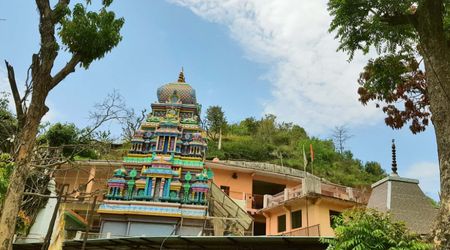
The Baglamukhi temple in Kangra won't make any architectural history books. It lacks the soaring shikhara of Khajuraho, the geometric complexity of South Indian gopurams, or the sheer mass of Varanasi's riverside shrines. Its power operates through compression rather than expansion. The structure is relatively compact, built in a style typical of Himachali hill temples — stone foundation, painted exterior walls, and a sanctum that forces you to stoop slightly as you enter, which changes your posture from upright observer to something closer to supplication.
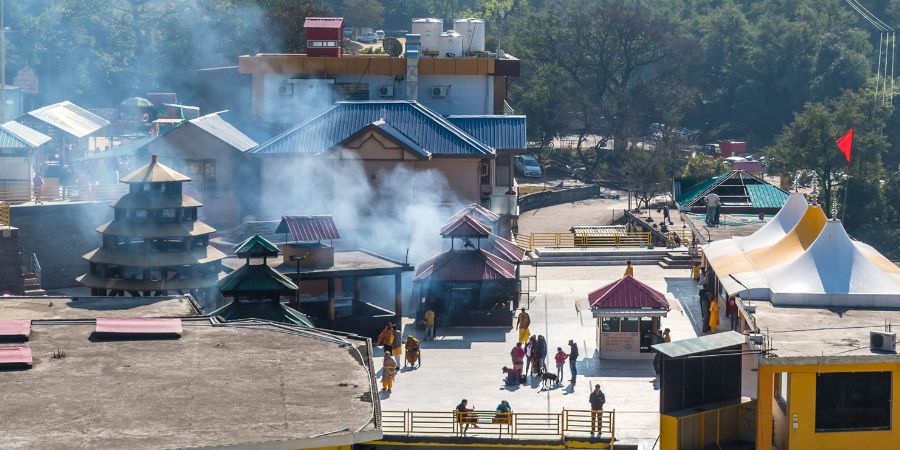
The dominant color of the exterior and interior is, predictably, yellow, with walls painted or draped in golden-hued cloth. The courtyard area, where devotees gather before and after darshan, is an open space that allows groups performing havan (fire rituals) to operate without crowding the sanctum itself. This spatial arrangement is practical: the temple hosts a significant volume of specific ritual activity — especially tantric pujas that require fire, ghee, and chanting — and the architecture accommodates this by keeping the inner sanctum intimate while the outer area handles the logistical overflow.
Inside the main shrine, the ceiling is low enough that the smoke from oil lamps and incense doesn't dissipate easily. It hangs, creating a layered atmosphere that feels deliberately enclosed. Natural light enters sparingly. The effect is one of deliberate sensory reduction — the outside world fades, replaced by lamplight, chanting, and the presence of the murti. This is not accidental. Tantric worship traditions generally favor enclosed, dim spaces because the practices performed within them require concentrated attention, and architectural openness works against that concentration.
The absence of monumental scale is itself an architectural statement. The temple communicates that power does not require grandeur. It requires focus. And the physical structure enforces that focus on every body that passes through its narrow doorway.
The Murti Behind the Yellow Veil
The central idol of Goddess Baglamukhi in the Kangra temple depicts her in the act that defines her mythology: seizing the tongue of a demon with her left hand while raising a mace (gada) in her right. The murti is dressed daily in yellow garments and adorned with marigold garlands, also yellow. The cumulative effect of seeing the decorated idol in the dim sanctum, lit by oil lamps, is more confrontational than devotional. The goddess does not invite contemplation. She demands acknowledgment of her function.
The idol's positioning within the garbhagriha (inner sanctum) means that darshan — the act of seeing and being seen by the deity — happens at close range. There's no long processional approach building anticipation. You're simply there, face to face, with barely a meter between your body and the murti. This proximity is charged with meaning in the tantric tradition, where the relationship between devotee and deity is understood as an exchange of energy, not merely a visual or emotional experience.
Priests at the temple describe the idol as "jagrut" — awakened, or spiritually alive. This is a common claim at Hindu temples, but here it carries weight because of the specific rituals performed to maintain the idol's energetic state. Daily abhishekam (ritual bathing), offerings of yellow-colored sweets, and the continuous recitation of the Baglamukhi stotram and kavach are understood not as worship in the conventional sense but as maintenance — the ongoing care required to keep a powerful spiritual instrument operational.
One detail that surprises first-time visitors: the intensity of the gaze. The murti's eyes, often described by devotees as "piercing," are painted to create the impression of direct eye contact regardless of where you stand. Whether you attribute this to skilled craftsmanship or something less easily categorized, the effect is undeniable. You feel watched.
What Happens Before Dawn and What It Means
The temple's daily rhythm begins before sunrise. The first ritual, the Mangala Aarti, takes place in the earliest morning hours, when the sanctum is at its darkest and the air carries the previous night's chill. Priests perform the aarti — circling lamps before the deity — accompanied by the ringing of brass bells and recitation of specific mantras dedicated to Baglamukhi. The sound carries differently in those pre-dawn hours, sharper and more isolated than it will be once the day's visitors arrive.
Through the day, the temple follows a structured schedule of pujas and offerings. The key rituals include:
- Shringar — the dressing and adorning of the murti, performed with particular attention to yellow garments and ornaments.
- Bhog — the offering of food to the goddess, typically featuring items prepared with turmeric and yellow lentils.
- Sandhya Aarti — the evening aarti, which tends to draw larger crowds than the morning ceremony.
- Special havans — fire rituals commissioned by individual devotees, often performed in the courtyard by temple priests following specific tantric procedures.
The havans deserve particular attention because they represent the primary mechanism through which devotees engage the goddess's power for personal purposes. A devotee commissions a havan, specifying the intention — victory in a court case, protection from a rival, success in a competition — and the priests conduct the ritual using prescribed mantras, offerings of ghee, samagri (herbal mixture), and yellow-colored items into a consecrated fire.
What's striking about the daily worship cycle is its lack of casual devotional activity. There's no kirtan singing, no meandering bhajan sessions. Every act is purposeful, directed, and framed by specific tantric protocols. The temple functions less like a place of worship in the broadly understood sense and more like a ritual workshop, where spiritual operations are conducted with precision and clear intent.
The Left-Hand Path in the Hill Country
Tantra makes people nervous, and the Baglamukhi temple in Kangra sits squarely within that tradition. The Mahavidya system to which Baglamukhi belongs is inherently tantric — it emerged from texts and practices that emphasize direct engagement with cosmic forces through mantra, yantra (sacred geometric diagrams), and ritual action rather than through purely devotional surrender. At this temple, the tantric dimension isn't hidden or euphemized. It's the operating system.
The primary tantric instrument associated with Baglamukhi is her specific mantra, often referred to as the Baglamukhi mantra or Pitambara mantra. Serious practitioners — typically those who've received initiation (diksha) from a qualified guru — undertake extended mantra chanting sessions (anushthans) at the temple, sometimes lasting several days. These anushthans follow rigid rules: specific dietary restrictions, celibacy during the period, wearing only yellow clothing, and maintaining a fixed number of daily repetitions, often numbering in the tens of thousands.
The yantra associated with Baglamukhi — a geometric diagram used as a focus for meditation and ritual — is also a significant element of temple practice. Yantras are available at the temple and are ritually energized (pran-pratishthit) by priests before being given to devotees for home worship. The yantra functions as a portable extension of the temple's power, allowing continued engagement with the goddess's energy beyond the physical premises.
Here's what complicates the popular understanding: the temple's tantric practices are not the dark, transgressive rituals that the word "tantra" conjures in the popular imagination. No animal sacrifice occurs here. The practices are disciplined, systematic, and rooted in textual traditions that prioritize internal transformation alongside external results. The misconception that tantric means dangerous or morally dubious misses the actual character of what happens at this temple — rigorous, highly structured spiritual work performed within an established tradition that values precision above all else.
The Politician, the Litigant, and the Student in Line Together
Stand near the temple entrance on any given morning and the diversity of visitors will tell you more about the goddess's function than any text can. A district-level politician arrives with an entourage, commissioning a havan before election season. Behind him, a middle-aged woman from Punjab, here because her property dispute has been dragging through courts for seven years and she's exhausted every rational option. A young man preparing for competitive government exams carries a yellow cloth bundle containing turmeric, sweets, and a printed copy of the Baglamukhi kavach he intends to have blessed.
The common thread isn't demographics or geography. It's urgency. People who visit the Baglamukhi temple in Kangra are almost never casual tourists or general-purpose pilgrims making rounds of Himalayan shrines. They come with a problem. Specifically, they come with a problem that involves opposition — a person, an institution, or a circumstance that they believe is actively working against them. The goddess's power of stambhana (immobilization of enemies) is the draw, and the devotees self-select accordingly.
Lawyers and their clients form a significant subset of visitors, particularly around crucial hearing dates. The temple sees noticeable surges in footfall during examination seasons and election cycles. Astrologers in North India routinely prescribe Baglamukhi puja as a remedy for unfavorable planetary combinations — particularly those involving Mars and Saturn — which brings another stream of devotees acting on astrological counsel rather than personal devotion.
This creates an atmosphere different from most Hindu temples. There's less leisure, less sociability, and more transactional intensity. Conversations in the courtyard tend to be low-voiced and purposeful. People share the specifics of their situations with priests, who then calibrate the recommended ritual accordingly. The temple, in this sense, operates as a place of last resort — not the first stop on a spiritual journey, but the one you reach when gentler approaches haven't worked.
Getting There, Getting In, and What to Carry in Yellow
The Baglamukhi temple sits in the Kangra district of Himachal Pradesh, accessible from several directions depending on your starting point. The nearest significant town is Kangra itself, and the nearest city with full transport infrastructure is Dharamsala, approximately 30 kilometers away. Gaggal Airport (also called Kangra Airport) receives flights from Delhi, and from there, the temple is a short drive. The Kangra Valley Railway, a narrow-gauge line running from Pathankot, stops at Kangra Mandir station — a name that tells you exactly what the town's primary identity is.
Practical details that matter for planning your visit:
- The temple is open daily, typically from early morning (around 5:00 or 6:00 AM) through evening (8:00 or 9:00 PM), though exact timings can shift seasonally.
- Yellow clothing is strongly recommended, not just as tradition but because priests may restrict entry to certain rituals if you're not wearing it. Carry at least a yellow dupatta or shawl.
- Special pujas and havans must be arranged through the temple's priests and involve a dakshina (offering fee) that varies based on the complexity of the ritual requested.
- Accommodation is available in Kangra town and in Dharamsala; the temple itself may have a dharamshala for overnight stays, but confirm availability in advance.
- The best visiting months are March through June and September through November, avoiding the heavy monsoon rains of July-August and the deep cold of December-January.
Photography policies inside the sanctum vary and are at the discretion of the presiding priests on any given day — ask before pulling out a phone. The temple area includes shops selling yellow cloth, turmeric, marigold garlands, and yellow sweets for offering, so you don't need to bring everything from outside. Footwear is removed before entering the temple premises.
One piece of advice that guidebooks won't give you: arrive early, before 8:00 AM if possible. The temple's atmosphere is most potent and least crowded in those first hours. The late-morning and afternoon crowds change the energy entirely, and the experience of darshan in a compressed, smoky sanctum loses something essential when you're being pushed forward by the person behind you.
The Baglamukhi temple in Kangra exists at an unusual intersection — a living tantric tradition operating inside the accessible framework of a hill-country pilgrimage site. It doesn't offer the scenic distractions that other Himachal temples provide as a bonus. It doesn't soften its purpose with cultural programming or heritage tourism packaging. The temple remains, stubbornly and specifically, a place where people come to engage a fierce goddess for fierce reasons, using methods that have survived precisely because those who use them believe they work. Whether you arrive as a devotee, a student of tantra, or simply someone drawn by the valley's extraordinary concentration of sacred sites, the temple doesn't adjust itself to meet you. You adjust to it — starting with the yellow cloth you drape across your shoulders as you duck through the doorway. That small act of compliance is the first thing the goddess asks, and it won't be the last.