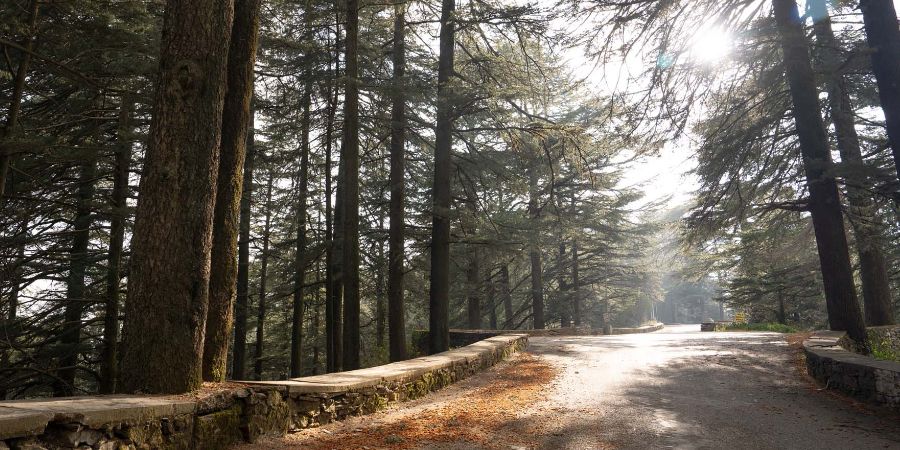


The road from Shimla to Chail climbs through deodar forests so dense the afternoon sun breaks through only in thin, moving slats. For forty-five kilometers, the bus groans upward, and the air shifts — first cool, then cold, then carrying the sharp resinous bite of pine sap. When you step off at the Chail bus stand, elevation 2,226 meters, the silence hits harder than the altitude. No horns. No hawkers. Just wind moving through branches and the distant metallic clink of a temple bell somewhere below the ridge. This is the summer retreat that a Maharaja built not out of love for the mountains, but out of spite toward the British.
Chail exists because of a scandal, a banishment, and a king's wounded pride — which makes it, perhaps, one of the most honestly motivated hill stations in India. The palace still stands. The cricket ground still operates on an impossible plateau. The Kali temple still draws pilgrims who climb barefoot through mist. Over the following sections, you'll find Chail's tangled royal origins, its unlikely sporting claim to fame, its spiritual architecture, its forests that shelter Himalayan pheasants and barking deer, and the practical details you need to reach it all without a tour operator's inflated itinerary.
How a Scandalized Maharaja Built a Rival Capital in the Pines
Chail owes its existence to a bedroom and a grudge. In the late 1890s, Maharaja Bhupinder Singh of Patiala — then barely into his twenties — reportedly had an affair with a British officer's daughter in Shimla. The details remain disputed, smeared by colonial gossip and royal counter-narratives, but the consequence was concrete: Lord Kitchener, then Commander-in-Chief of the Indian Army, ordered the Maharaja banned from Shimla. No more access to the social capital of British India.
Most exiles sulk. Bhupinder Singh built. He selected a ridge about forty-five kilometers southeast of Shimla, purchased vast tracts of forested land, and set about constructing a summer capital that would rival the one he'd been cast out of. The Chail Palace rose on one of three hills, its stone and timber facade looking out across the Shivalik range toward the plains of Punjab. He carved a cricket ground out of a hilltop by flattening it with manual labor. He commissioned a temple. He planted orchards.
The palace was never simply a holiday retreat — it functioned as an administrative seat, a place where Patiala's state business continued through the summer months. British officials who needed the Maharaja's cooperation had to come to him, climbing his road, sleeping in his guesthouses. The power dynamic inverted neatly. Bhupinder Singh understood that architecture is politics in solid form, and Chail became his rebuttal to colonial humiliation.
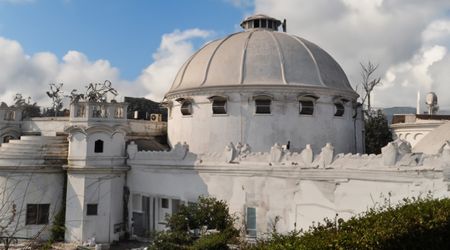
Today the palace operates as a heritage hotel managed by the Himachal Pradesh Tourism Development Corporation. The rooms still have original wooden floors and fireplaces, though the plumbing tells a more modern story. You can walk the corridors where state dinners once mixed Punjabi royalty with visiting dignitaries, and the views from the upper balcony face exactly the direction of Shimla — as if the Maharaja wanted to keep watch on the city that expelled him.
The Architecture of Revenge: Chail's Origin Story in Full
Bhupinder Singh's father, Maharaja Rajinder Singh, had already begun acquiring land near Chail before the scandal, using it as a hunting reserve. The forests teemed with kalij pheasants, leopards, and Himalayan black bears, and the Patiala royals used the area the way British aristocrats used Scottish estates — for sport, leisure, and demonstrating wealth through controlled wilderness. But it was Bhupinder Singh who transformed hunting ground into statecraft.
Construction began around 1891 and continued in phases over the next two decades. The Maharaja employed local Himachali laborers alongside craftsmen from Punjab, and the resulting architecture reflects that collision. The palace blends colonial hill-station symmetry with Sikh-Rajput decorative instincts — arched windows framed by carved wooden balconies, slate roofs pitched steep against monsoon rains. A network of walking paths connected the three principal hills: Rajgarh, where the palace sat; Pandhewa, where the cricket ground was leveled; and Sidh Baba ka Tibba, where the Kali temple occupied the highest point.
The Patiala state maintained Chail as its summer headquarters until Indian independence in 1947. After the princely states merged into the Indian republic, the property transferred first to the Punjab government and later to Himachal Pradesh when the state was carved out in 1966. The transition was not seamless. Decades of institutional neglect dulled the palace's grandeur, though renovation efforts from the 1970s onward stabilized the main structure.
What makes Chail's history unusual among Indian hill stations is its motivation. Shimla was built for British comfort. Mussoorie served colonial convalescence. Darjeeling grew around tea commerce. Chail alone was built as an act of defiance — a Maharaja saying, in stone and timber and manicured grounds, that he didn't need their city. The irony is that most visitors today arrive from Shimla, having grown tired of its crowds, seeking exactly the quiet that Bhupinder Singh chose for different reasons entirely.
Where Bowlers Run in at 2,444 Meters Above Sea Level
The Chail Cricket Ground sits on top of Pandhewa Hill at an altitude of 2,444 meters, making it — by most credible accounts — the highest cricket ground in the world. Bhupinder Singh had the hilltop flattened in the 1890s to create the playing surface, a feat of manual earth-moving that seems almost absurd given the terrain. The pitch sits on what was once a ridgeline, and the outfield slopes gently enough that a mishit can roll toward a treeline of deodar and oak, where the ball disappears into mulch and pine needles.
Bhupinder Singh was himself a capable cricketer. He captained the Patiala team, played against touring sides from England, and later served as a patron of Indian cricket during its formative decades. The Chail ground was his private arena — a place where visiting teams found themselves gasping at altitude while the Maharaja's players, acclimatized and well-fed, dominated with the advantage of familiarity.
Today the ground hosts local school matches, army training exercises, and occasional exhibition games organized by Himachal tourism authorities. A military polo ground adjoins it, though polo rarely happens there now. The flat expanse feels surreal — you walk across cropped grass with the Shivalik foothills falling away on every side, and the sensation is less like standing in a sports field and more like balancing on a green platform suspended between valleys.
Most visitors photograph the ground and leave within ten minutes. That's a mistake. The perimeter walk, especially in the late afternoon when the light turns amber, offers one of the finest vantage points in the area. You can see the snow line of the Greater Himalayas to the north and the haze of the Punjab plains to the south, both from the same spot where a leather ball once crossed a boundary carved from a mountaintop by a king with something to prove.
The Kali Temple at the Summit Where the Air Thins and the Bells Don't Stop
The Kali Ka Tibba temple stands on Sidh Baba ka Tibba, the highest of Chail's three hills, at roughly 2,250 meters. Locals will tell you the site predates the Maharaja's arrival by centuries, that sages and wandering ascetics recognized the hill's spiritual charge long before anyone thought to build a palace nearby. The temple itself is modest — a small stone structure surrounded by prayer flags, iron bells hung from chains, and the accumulated soot of thousands of oil lamps darkening the inner walls.
The climb from the main Chail bazaar takes about twenty minutes on a paved but steep path that switches back through pine forest. Monkeys sit along the route, entirely unbothered by pilgrims. The temple honors the goddess Kali, and during Navratri — the nine-night autumn festival — the site draws worshippers from surrounding villages who arrive carrying offerings of coconuts, red cloth, and marigold garlands. The atmosphere during those nights is thick with incense smoke and the drone of chanted mantras echoing off stone.
A smaller shrine dedicated to a local Siddh Baba, a regional holy figure, sits adjacent. Villagers consult this shrine for matters of health, fertility, and livestock — practical concerns that reflect Chail's rural economy more honestly than any tourism brochure. The temple complex hasn't been polished for visitors. The floor is uneven stone. The inner sanctum is dim. There's no ticket counter or audio guide.
What strikes you most isn't the temple itself but the stillness above it. Stand behind the shrine and face north, and you confront an unbroken line of forested ridges layered in receding shades of green and blue. No road is visible. No rooftop. The spiritual claim of the site becomes less mystical and more logical — anyone standing here for long enough would conclude that something important must reside at this altitude, if only because the human noise of the valleys simply cannot reach it.
Barking Deer, Silver Firs, and a Forest That Hasn't Learned to Perform for Tourists
The Chail Wildlife Sanctuary covers approximately 108 square kilometers of mixed Himalayan forest — deodar cedar, blue pine, oak, and rhododendron at higher elevations. It's not a manicured national park. The trails are rough, markers sparse, and guides available only by arrangement through the forest department or local hotels. You don't drive through this sanctuary in an air-conditioned SUV. You walk, and you listen.
The sanctuary shelters barking deer, goral (a goat-antelope native to the Himalayas), Indian muntjac, common langur, red fox, and — less frequently spotted — leopards and Himalayan black bears. Birdwatchers do well here too, especially between March and June, when kalij pheasants, Himalayan woodpeckers, and blue magpies move through the canopy. The undergrowth crackles with life, though most of it prefers not to be seen.
The forest floor in late monsoon is a different world entirely. Ferns grow waist-high. Moss coats every fallen trunk in lurid green. The air smells of wet earth and rotting leaves, a smell so organic it borders on aggressive. Leeches appear on the lower trails from July through September — tuck your trousers into your socks or accept the consequences.
A counterintuitive fact: Chail's forests benefit from their relative obscurity. The sanctuary receives a fraction of the footfall that hits places like Shimla's Jakhu or Manali's Solang Valley, and the reduced human pressure shows in the density of birdcall and the frequency of animal sightings. The trees here haven't been thinned for parking lots. The trails haven't been widened for selfie angles. The sanctuary operates on the assumption that the forest is the point — not the amenities around it — and that assumption, increasingly rare in Himachal's tourism economy, is precisely what makes the walking here feel earned rather than curated.
Snow, Mist, Monsoon, and the Month Most Visitors Get Wrong
The standard advice says visit Chail between March and June, and that advice isn't wrong — but it's incomplete. Spring brings clear skies, blooming rhododendrons along forest trails, and temperatures hovering between 10 and 25 degrees Celsius. The palace grounds look their sharpest. The cricket ground dries out. April and May draw the bulk of visitors, mostly families escaping the plains heat, and by June the early monsoon clouds begin to gather along the southern ridges.
July through September belongs to the rain. Heavy, persistent, sometimes violent. Roads occasionally close. Landslides aren't uncommon on the stretch between Kufri and Chail, and you should carry updated road condition information from local sources, not from Google Maps, which doesn't always register temporary closures. The payoff for braving monsoon is the forest at its most alive — waterfalls that exist only during these months, mushrooms colonizing every stump, and a green so saturated it makes photographs look artificially enhanced.
October and November bring the best-kept seasonal secret. Post-monsoon, the air clears dramatically, and the Greater Himalayan range — invisible for months behind cloud and humidity — snaps into focus from Chail's higher vantage points. The forests turn amber and rust. Tourist numbers drop sharply. Nights grow cold, dropping to 5 or 6 degrees, and mornings carry frost on the grass of the cricket ground. This is the month most visitors overlook, and it's the one that rewards most generously.
Winter, from December through February, delivers snowfall — sometimes light dustings, sometimes enough to block roads for a day or two. The palace hotel stays open, fires lit in the common rooms, and the silence of a snow-covered Chail is something distinct from its warmer-weather quiet. Fewer than a dozen tourists may be in town on a January weekday. If solitude is what you're after, that's your window.
Getting There, Staying There, and What to Pack That Nobody Tells You
Chail has no railway station and no airport. The nearest major transport hub is Shimla, connected by narrow-gauge rail to Kalka (which itself links to Delhi and Chandigarh by broad-gauge trains). From Shimla, you take a road journey of about 45 kilometers — roughly two hours by car or three by HRTC bus, depending on road conditions and driver temperament. A less common but worthwhile approach is via Solan, which avoids the Shimla congestion entirely.
Accommodation ranges from the HPTDC Chail Palace Hotel, with its colonial-era rooms and institutional service, to a handful of private guesthouses and budget lodges near the main bazaar. Booking ahead matters only during peak season (April–June) and the Christmas–New Year window. Off-season, you can walk in and negotiate.
A practical checklist that most guides omit:
- Carry cash — ATMs exist but don't always function, and card machines in smaller shops are unreliable.
- Bring a headlamp or flashlight if you plan evening walks; street lighting outside the bazaar is minimal.
- Pack leech socks or salt if visiting during monsoon — standard hiking boots won't stop them.
- Sunscreen is essential even in cool weather; UV exposure intensifies above 2,000 meters.
- Download offline maps before arriving; mobile data coverage is patchy once you leave the main road.
Food in Chail is simple — North Indian staples, Himachali siddu (steamed wheat bread stuffed with poppy seed paste), and dal served with rice. Don't expect Shimla's cafe culture. The bazaar offers a few dhabas that serve well-spiced rajma-chawal, and the palace hotel has a dining room where the food is adequate if uninspired. Carry snacks for long forest walks — there are no trailside vendors, and the sanctuary has no facilities once you're past the entry point. Chail asks you to come slightly prepared, and it rewards that preparation with an absence of the commercial clutter that has swallowed so many of its neighboring hill stations.
Chail occupies an unusual position among Himalayan hill stations — born from royal anger rather than colonial comfort, preserved more by neglect than by deliberate conservation, and visited by people who have already been disappointed by somewhere more famous. It doesn't perform for its audience. The palace sags slightly. The cricket ground has no floodlights. The temple doesn't sell trinkets. And yet precisely this absence of polish is what gives the place its particular weight. India's mountains are full of towns rushing to become the next Manali, the next Shimla, the next overrun destination with a traffic jam at the entry gate. Chail hasn't joined that race, and every year it doesn't, it becomes more valuable for having stayed still. Some places are worth visiting not because they've been developed, but because they've been left mostly alone.