

Lajpat Nagar doesn't announce itself with monuments or manicured parks. It announces itself with noise, heat, and the particular brand of organized chaos that only a market colony born from Partition can sustain. For over seven decades, this South Delhi neighbourhood has functioned as a kind of living archive — of displacement, reinvention, and a commercial energy so stubborn it survived the wrecking ball of multiple municipal "beautification" drives. It's not a tourist destination in any conventional sense. You won't find it on most itineraries stitched together by travel agencies. But if you want to understand how Delhi actually works — how the city metabolizes loss into enterprise, how a refugee colony becomes a commercial powerhouse — Lajpat Nagar is the place. This is a neighbourhood where the personal and the transactional are the same thing, where every shop counter holds a family's history in its grain. What follows is a walk through its roots, its people, its food, its markets, and the very particular rhythm that makes it irreplaceable.
A Colony Built on Rubble and Refugee Memory
Lajpat Nagar didn't exist before 1947. The land it occupies was largely open terrain south of Lutyens' Delhi, and its transformation into a residential colony happened not through urban planning but through catastrophe. After the Partition of India, waves of Hindu and Sikh refugees from West Punjab arrived in Delhi with almost nothing — some carrying trunks, most carrying less. The government allotted them plots in newly carved-out colonies across the city. Lajpat Nagar, named after the freedom fighter Lala Lajpat Rai, was one of these.
The earliest structures were rudimentary. Refugees built single-storey homes from whatever material they could find or afford. The colony was divided into four parts — Lajpat Nagar I through IV — and the layout still reflects that original grid, though the buildings have since grown vertically, floor upon floor added as families expanded and prospered. What's remarkable is the speed of that prosperity. Within a generation, shopkeepers and small traders who had lost everything across the border had rebuilt commercial networks that rivalled established Delhi bazaars.
The market that now dominates the neighbourhood's identity started as a row of modest stalls serving the colony's residents. By the 1960s, it had grown into a destination. The Central Market in Lajpat Nagar II became one of Delhi's first purpose-built commercial zones outside of Old Delhi, and its trajectory tells a story about how commerce in this city rarely follows a master plan — it follows need, proximity, and sheer persistence.
What most visitors don't realize is that the colony's layout itself encodes its history. The narrower lanes, the tightly packed shops, the absence of green buffers — these aren't design flaws. They're the physical imprint of a community that built fast because it had to, that valued function over form because survival demanded it. The aesthetic came later, and only partially.
Partition's Children and the Traders Who Rebuilt from Zero
The families who settled Lajpat Nagar came predominantly from Rawalpindi, Lahore, Multan, and Sialkot — cities with deep mercantile traditions. They brought skills, trade networks in their heads, and an almost genetic instinct for retail. Many of the colony's founding families had been cloth merchants, jewellers, or grain traders in what became Pakistan. In Delhi, they started again from the bottom, often selling goods from handcarts before graduating to rented stalls, then permanent shops.
This origin story matters because it shaped the neighbourhood's culture in ways that persist today. Lajpat Nagar's commercial DNA is Punjabi — loud, direct, and transactional in a way that prizes relationships as much as profit margins. The shopkeepers here don't just sell; they negotiate, cajole, and build repeat customers through a combination of charm and stubbornness. Bargaining isn't a tourist performance. It's embedded in the social contract between buyer and seller.
The generational turnover has been uneven. Some families still run the same shops their grandparents opened in the 1950s. Others have moved on — their children becoming engineers, doctors, or IT professionals, leaving the storefronts to tenants. This shift has diluted some of the old community bonds but hasn't erased them. During Diwali, you can still see the older shopkeepers on the main road performing puja together, their rituals a quiet echo of a shared displacement.
One counterintuitive truth about Lajpat Nagar's people: the community's commercial success didn't come despite the trauma of Partition but, in some sense, because of it. The loss of property, status, and homeland created a relentless drive to rebuild — and the tight quarters of a refugee colony meant neighbours became business partners, creditors, and customers all at once. That density of social capital fuelled an economic engine no government scheme could have designed.
Where Haggling Is a Performing Art and Every Rack Tells a Lie About the "Original Price"
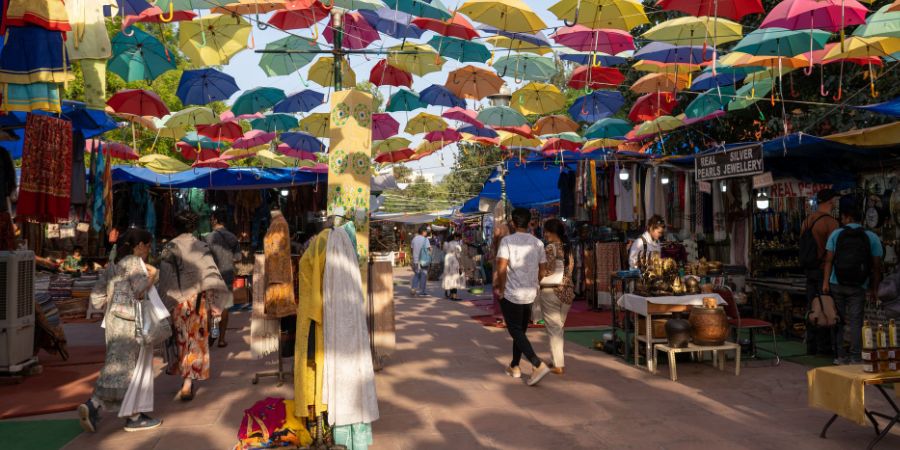
Lajpat Nagar Central Market doesn't look like much from the road. The entrance near the Defence Colony flyover opens onto a narrow lane flanked by shops selling everything from bridal lehengas to kitchen hardware, the kind of visual overload that makes first-time visitors freeze mid-step. There's no anchor store, no atrium, no escalator — just an organic sprawl of roughly 2,000 shops spread across a dense grid of lanes that curve and fork without warning.
The market's speciality is fabric and women's clothing, particularly ethnic wear. During wedding season — roughly September through February — the lanes become so packed that forward movement happens in inches. Shops like Mangal Bazar, Variety Silk House, and the cluster of export-surplus stores near the inner lanes stock everything from handloom sarees to machine-embroidered suits at prices that undercut most malls by forty to sixty percent. The catch is that quality varies wildly within a single shop, and the marked price is almost always fictional. Expect to negotiate down by at least a third.
Beyond clothing, the market sells footwear, costume jewellery, home furnishings, and cosmetics. The mehndi shops near Gate No. 1 are particularly well-known — women travel from across Delhi and NCR to get intricate bridal henna done here, sometimes sitting on plastic chairs in the lane itself while the artist works.
The market's survival in the age of e-commerce deserves attention. Online retailers can beat it on convenience, but they can't replicate the tactile experience — touching fabric, holding an embroidered dupatta up to light, watching how a colour shifts against your skin. Lajpat Nagar endures because its product is not just the merchandise but the act of shopping itself, the sensory negotiation between hand and cloth that no screen can replicate.
Where the Chaat Cart Outperforms the Restaurant
Lajpat Nagar's food reputation rests not on fine dining but on street stalls and modest eateries that have been doing one thing well for decades. The stretch between the Central Market and the Lajpat Nagar Metro station holds a concentration of flavour that most Delhi food neighbourhoods can't match within such a compact area. Amar Colony market, technically adjacent but functionally inseparable, adds another layer — its momos, chaat, and kebab stalls draw evening crowds that spill onto the road.
Start with Dolma Aunty Momos in Lajpat Nagar IV. The steamed chicken momos here — sold from what is essentially a house window — helped ignite Delhi's momo obsession in the early 2000s. The chutney, red and unforgiving, is what people return for. A few lanes away, the golgappa stalls near the Central Market offer the purest distillation of Delhi street food: crisp shells, tangy water, and the risk of a minor digestive incident that every local cheerfully accepts.
For sit-down meals, the dhaba-style restaurants along Ring Road serve Punjabi staples — dal makhani, butter chicken, stuffed parathas — at prices that haven't kept pace with inflation, which is part of their charm. The kulfi shops near the inner lanes of the market sell dense, cardamom-heavy slabs of frozen milk that taste nothing like ice cream and are better for it.
The counterintuitive lesson of eating in Lajpat Nagar is this: the fancier the signboard, the worse the food. The best meals here come from places with no English menu, no air conditioning, and a proprietor who looks mildly irritated that you've walked in. That irritation is a good sign. It means they're busy enough not to need your approval.
Living Inside the Machine: Domestic Life in a Market Colony
Residential Lajpat Nagar sits just behind and above the market — literally, in many cases, since families live on upper floors while shops occupy the ground level. This vertical coexistence creates a particular rhythm of daily life. The sound of metal shutters rolling up at nine in the morning is the neighbourhood's alarm clock. By eleven, the commercial hum drowns out birdsong. By ten at night, the shutters come down again, and the lanes empty with surprising speed.
The residential blocks — Lajpat Nagar I, III, and IV — are quieter than the market zone but far from suburban. DDA flats and builder floors share space with older kothi-style houses, some still occupied by original allottee families, others subdivided into rental units. The area around Gurudwara Singh Sabha in Lajpat Nagar IV anchors community life for many Sikh families, while the temples scattered through the colony serve the Hindu majority.
Culturally, the neighbourhood retains a Punjabi flavour that expresses itself in festivals, food, and a general volume level. Lohri celebrations in January involve actual bonfires in the lanes. Karva Chauth turns the market into a surge of red and gold as women buy bangles, cosmetics, and ritual items. The colony parks — small, overcrowded, and slightly neglected — fill with morning walkers and evening cricket games, a democratic use of space that no urban planner intended.
What surprises many newcomers is the rent. Despite its central location and Metro connectivity, residential Lajpat Nagar remains cheaper than neighbouring Defence Colony or Greater Kailash. The tradeoff is noise, density, and parking that functions on a system of mutual aggression. For those who can tolerate the sensory load, it offers something rare in South Delhi: a genuine neighbourhood, not just a residential address.
Arriving Smart: Timing, Transport, and the Things Nobody Posts Online
The Violet Line of the Delhi Metro stops directly at Lajpat Nagar station, making it one of the most accessible markets in the city. Exit from Gate 2 and you're a two-minute walk from the Central Market entrance. Auto-rickshaws from nearby Defence Colony or South Extension cost between thirty and fifty rupees, though the fare doubles without argument during festival season. Driving your own car is technically possible but practically masochistic — parking is scarce, lanes are narrow, and the one-way system changes logic depending on the day.
Timing matters enormously. The market opens around 10:30 AM, but most serious shoppers arrive between 11 and 1, before the afternoon heat flattens the energy. The second wave starts around 5 PM and runs until 9. Tuesday is the weekly off for most shops in the Central Market — a fact that catches out a surprising number of visitors. Sunday is the busiest day, and the crowds between 4 and 7 PM can reduce walking speed to a shuffle.
Seasonal timing is equally important. October through December, the wedding-season rush turns the market into a pressure cooker of humanity. If you're shopping for ethnic wear, go in August or early September — stock is fresh, crowds are thinner, and shopkeepers are more willing to negotiate before the frenzy begins.
A few things the travel blogs won't tell you:
- Carry cash. Many smaller stalls don't accept UPI or cards, despite the QR codes taped to their walls.
- Wear shoes you don't mind getting dirty. The lanes are uneven and occasionally waterlogged after rain.
- The public restrooms near the market's central square exist but should be treated as a last resort. The McDonald's near the Metro station is the cleaner option.
- If a shopkeeper quotes you a price without hesitation, it's too high. The best deals come from the stores that make you work for the number.
These details are unglamorous but they separate a good visit from a frustrating one.
Seven Stops That Justify the Trip Across Town
Not every stall in Lajpat Nagar deserves your time. Most of the 2,000-odd shops sell similar goods at similar margins. The ones listed here have earned their reputation through consistency, product quality, or a specific offering you can't easily find elsewhere. Treat this as a starting grid, not a complete map.
- Dolma Aunty Momos (Lajpat Nagar IV) — steamed chicken or veg momos sold from a residential window. The red chutney alone is worth the queue. Expect a fifteen-minute wait on weekends.
- Variety Silk House (Central Market, Lane 3) — one of the older fabric shops, known for unstitched suit material and a selection of Banarasi silk that the staff will pull down from towering shelves with theatrical patience.
- The Mehndi Lane (near Gate No. 1) — a row of henna artists who specialize in bridal and festival designs. Prices range from fifty rupees for a simple pattern to several thousand for full-arm work. Quality peaks at the artist level, not the shop level, so ask to see a portfolio before sitting down.
- The Export Surplus Cluster (inner lanes, Central Market) — a loosely grouped set of shops selling overstock and rejected export garments at steep discounts. Check stitching and seams carefully; the rejects are rejected for a reason.
- Giani's (near Central Market entrance) — a kulfi and ice cream chain that started in Chandni Chowk, but the Lajpat Nagar outlet serves a rabri faluda that justifies a detour in summer.
- The Chaat Stalls (Amar Colony side) — no single stall dominates, but the golgappa and aloo tikki vendors along the main stretch operate at a level of spice and tang that separates Delhi street food from imitations everywhere else.
- The Jewellery Lanes (Central Market, inner ring) — costume and imitation jewellery in staggering variety. Bridal sets, oxidized silver pieces, and statement earrings sell for a fraction of what South Extension boutiques charge for similar designs.
The common thread across these stops is that none of them trades on ambiance. The food is served on paper plates or in steel bowls. The shops are cramped and lit with fluorescent tubes. The mehndi artists work in the open air. What they offer instead is expertise sharpened by decades of repetition and competition so fierce that mediocrity doesn't survive a single season. In Lajpat Nagar, the product is the point — everything else is stripped away.
Lajpat Nagar doesn't fit neatly into any of the categories Delhi likes to assign its neighbourhoods. It's not heritage like Shahjahanabad, not aspirational like Hauz Khas, not manicured like Vasant Vihar. It's a place that exists because history forced a community to build fast and trade hard, and three generations later, the momentum hasn't stopped. For travelers who want to understand how a modern Indian city actually functions — not the curated version, but the metabolic one — this colony offers more honest material than any museum or monument. Walk its lanes with your eyes open and your wallet ready, and you'll leave knowing something about Delhi that no guidebook bothers to say: the city's truest architecture isn't stone or steel, it's the daily act of selling and surviving.