

Krishnapuram Palace sits about two kilometers south of Kayamkulam town in Alappuzha district, a stretch of central Kerala where the backwaters thin out and the land turns drier, more laterite, more red. It doesn't draw the crowds that Padmanabhapuram does, and it certainly doesn't have the marketing budget of the Mattancherry Palace up in Kochi. That anonymity is precisely what makes it worth your time. The silence inside the rooms, the particular smell of old teak and lime plaster, the way the afternoon light enters through wooden slats and falls across painted walls — these things require the absence of a crowd. This is a palace best experienced slowly, room by room, with the patience to notice what most guidebooks don't bother to describe.
A Travancore King's Political Statement in Laterite and Lime
Krishnapuram Palace dates to the reign of Marthanda Varma, the ruler who unified Travancore in the mid-eighteenth century and turned it into the most powerful princely state in southern India. He didn't build Krishnapuram from scratch — the structure likely existed as a smaller residence before his time — but Marthanda Varma expanded and transformed it into something grander, a symbol of Travancore's authority over the newly annexed territory of Kayamkulam. The palace functioned as an administrative seat as much as a royal retreat.
Kayamkulam had been an independent kingdom until Marthanda Varma conquered it in 1746. Placing a palace here wasn't decorative; it was strategic. The building announced Travancore's presence in a region that had only recently been absorbed, a physical reminder to local chieftains that the political map had been redrawn. This context matters because it explains the palace's scale and ambition — it was built to impress people who hadn't asked to be impressed.
After Travancore's political center shifted, Krishnapuram fell into neglect. Centuries of monsoon rain and indifference did their work. By the time the Archaeological Survey of India and Kerala's state government intervened in the twentieth century, sections of the building had deteriorated significantly. Restoration efforts preserved the core structure and its most important artistic elements, though some rooms still carry the scars of abandonment — patches of plaster missing, wooden beams darkened by moisture and time.
The palace changed hands and purposes several times before becoming a museum. It served briefly as a court, then a government office. Each use left traces. You can still see modifications — blocked doorways, added partitions — that reveal these institutional afterlives. The building tells a layered story, not just of kings, but of what happens to royal spaces once the royalty leaves. Few palaces in Kerala wear their decline and recovery this openly.
Gabled Roofs and Double Walls: How the Building Thinks About Rain
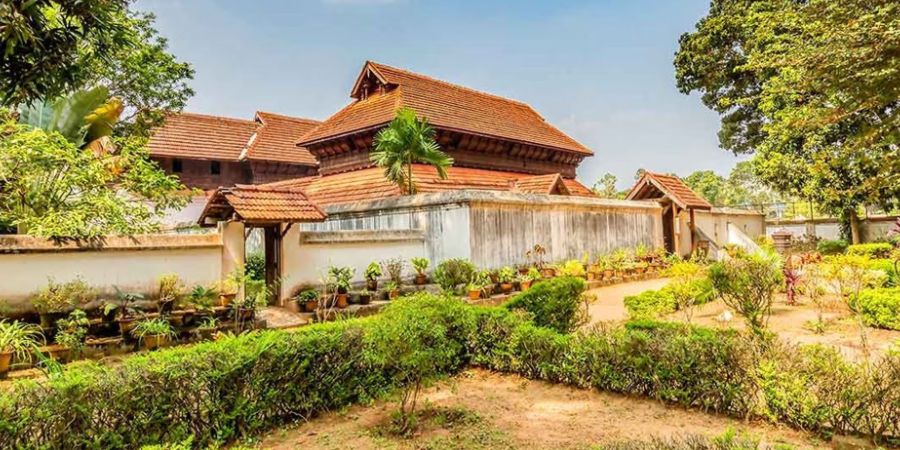
Kerala-style palace architecture begins with a single obsession: the monsoon. Krishnapuram Palace answers that obsession with a steeply pitched gabled roof covered in terracotta tiles, the kind of roof that sheds water with almost aggressive efficiency. The overhang extends well beyond the walls, creating shaded verandas where air circulates even in the humid pre-monsoon months. Everything about the building's form follows the logic of water management — where it falls, how it drains, what it must never touch.
The palace is a double-storied structure built around a central courtyard, following the traditional nalukettu pattern common across Kerala's aristocratic architecture. Laterite blocks form the walls, their rough iron-red surface left exposed in some sections and plastered smooth in others. Laterite absorbs heat slowly and releases it gradually, which keeps the interior noticeably cooler than the outside — a difference you feel the moment you step through the front entrance. The window frames and door panels are carved teak, darkened now to near-black with age and oil.
Dormer windows punctuate the upper floor, their peaked frames echoing the main roof's pitch. These aren't ornamental; they pull light into the upper rooms where the thickest walls would otherwise create perpetual dimness. The corridors connecting rooms are deliberately narrow, funneling air and amplifying any breeze. One counterintuitive detail: the palace has relatively few windows on its ground floor, which seems wrong for a tropical building but makes sense when you consider security — this was, after all, built during a period of regional warfare.
Stone-carved steps lead to the upper level, each tread worn into a shallow curve by generations of feet. The staircase is steep and slightly cramped, a reminder that these buildings were designed for a people who moved through them barefoot and unhurried. The architecture doesn't try to overwhelm. It earns your attention through proportion, through the quiet intelligence of its response to climate and terrain.
Forty-Nine Square Meters of Gajendra Moksham, Painted on a Single Wall
The mural that draws scholars and art historians to Krishnapuram depicts Gajendra Moksham — the salvation of the elephant king from the jaws of a crocodile, a scene from the Bhagavata Purana. Covering approximately forty-nine square meters of wall, it's considered the largest single mural in Kerala. The elephant stands chest-deep in water, trunk raised toward Vishnu who descends on Garuda. The crocodile grips the elephant's leg. The composition radiates outward from this central struggle, filling the available wall space with celestial figures, attendants, and decorative borders.
What strikes you standing before it isn't the size but the color palette. Kerala mural painting traditionally works within five primary colors — yellow ochre, red ochre, green from a plant source, white from lime, and lampblack. The artists at Krishnapuram achieved remarkable tonal variation within these constraints. The elephant's skin carries three different shades of grey, each mixed from the same limited pigments. Vishnu's blue-black body glows against the warmer tones surrounding it, an effect produced by layering lampblack over a lime-white base.
The mural has suffered. Sections have faded, and moisture damage has eaten away corners where the wall meets the ceiling. Restoration work has stabilized the surviving portions, but you can clearly see where original paint gives way to bare plaster. This visible damage is, paradoxically, what makes viewing the mural so affecting — you're looking at something actively disappearing, and the urgency of that fact sharpens your attention.
Beyond the Gajendra Moksham, the palace houses smaller mural fragments in adjacent rooms, depicting scenes from Krishna's life and various mythological episodes. The museum also displays a collection of bronze sculptures, antique jewelry, and coins spanning several centuries. A set of Chola-period bronzes deserves particular attention; their detailing is precise enough to reveal individual fingernails on figures barely eight inches tall. The art collection here rewards close looking, not casual scanning.
Laterite Paths Under Jackfruit Canopy: What the Garden Knows
The palace grounds cover a modest area compared to the sprawling estates of northern Kerala's colonial hill stations, but what exists has been maintained with a kind of deliberate understatement. Laterite pathways cross a lawn dotted with coconut palms, jackfruit trees, and a few mango trees whose branches have been shaped by decades of monsoon wind into lopsided canopies leaning away from the prevailing westerlies. The air smells of damp earth and overripe fruit.
A large ornamental pond sits to one side of the palace, its stone-edged banks green with moss. Local lore connects this pond to the palace's original water management system — rainwater from the extensive roof would have been channeled into it through carved stone gutters, some of which are still visible along the building's base. The pond now hosts a population of turtles that surface occasionally with a soft plop, breaking the water's green membrane of algae.
The surrounding area of Kayamkulam doesn't advertise itself as a tourist zone. The roads leading to the palace pass through ordinary residential neighborhoods — houses with tiled roofs, small shops selling tea and newspapers, auto-rickshaws idling at corners. This ordinariness is the palace's best frame. You arrive without the emotional buildup that accompanies more famous sites, and the shift from everyday Kerala street life into an eighteenth-century royal compound feels abrupt, almost disorienting in its contrast.
A Buddhist granite statue and a few megalithic artifacts are displayed in the garden, suggesting the site's significance predates Travancore by centuries. Kayamkulam's position along ancient trade routes linking the coast to the interior hills meant this land was occupied long before anyone thought to put a palace on it. The garden doesn't merely surround the building — it holds a longer, deeper history that the palace simply borrowed.
Fifteen Rupees and a Room Full of Swords Nobody Talks About
The palace operates as a museum under Kerala's Department of Archaeology. The collection spans several rooms on both floors, organized loosely by category rather than strict chronology. Bronze figures from the Chola and Vijayanagara periods share space with Travancore-era wooden carvings. A set of ancient coins occupies a glass case near the entrance, their inscriptions worn to near-illegibility, which somehow makes them more compelling than a perfectly preserved specimen would be.
One room contains a display of weapons — swords, daggers, and spearheads — that receives surprisingly little attention in most visitor accounts. The blades have the characteristic curve of South Indian martial design, and several show the watered-steel patterning that indicates high-quality forging. These aren't ceremonial pieces; they carry the marks of use. Standing before them, you're reminded that the Travancore expansion under Marthanda Varma was a military campaign, not a diplomatic transition, and these weapons were the instruments of that reality.
The museum labels are sparse — sometimes a name and approximate date, sometimes nothing at all. This is either a frustration or a liberation, depending on your disposition. Without detailed interpretive panels directing your attention, you're left to move through the rooms at your own pace, deciding for yourself what deserves a longer look. The school group I encountered treated the experience like a treasure hunt, pointing excitedly at objects their teacher hadn't mentioned. That unguided quality gives the museum a character that more polished institutions have designed out of existence.
Photography rules vary; the murals are generally off-limits to flash photography, and enforcement depends on which guard happens to be on duty. The museum is small enough to see thoroughly in ninety minutes, but those ninety minutes pack a density of material that larger museums often dilute across dozens of rooms. Density, here, works in the visitor's favor. Nothing feels like filler.
Getting There Without Getting Lost, and What to Wear for Laterite Dust
Krishnapuram Palace sits along National Highway 66, roughly forty-seven kilometers south of Alappuzha town and about midway between Alappuzha and Kollam. If you're traveling by road from either city, the journey takes between one and two hours depending on traffic and the particular mood of Kerala's truck drivers that day. The nearest railway station is Kayamkulam Junction, a well-connected stop on the Thiruvananthapuram-Ernakulam line, and the palace is a short auto-rickshaw ride from there — agree on the fare before you get in.
The palace keeps standard government museum hours, typically opening at 9:30 AM and closing by 5:00 PM, with a lunch break that's observed with the seriousness of a sacred ritual. Tuesday is the usual closing day. These timings can shift without public announcement, so calling ahead or checking with your hotel isn't paranoia — it's common sense. The entry fee remains remarkably low; foreign visitors pay slightly more than Indian nationals, but the amount is still trivial.
Practical considerations worth noting:
- Wear shoes that handle uneven laterite surfaces, especially if it's rained recently — the red dust turns into a slippery clay that stains everything it touches.
- Carry water; there's no reliable refreshment stand inside the grounds, though tea shops exist on the road outside.
- The upper floor gets warm by midday, so morning visits are more comfortable.
- A basic camera without flash is generally fine for the building and grounds, though mural photography has restrictions.
Combining Krishnapuram with a trip along the Alappuzha-Kollam backwater route is logistically simple and makes for a day that balances water and stone, boat and building. The palace works best as a deliberate stop, not a rushed detour between houseboats.
What Kayamkulam Gives You That the Palace Cannot
The area around Krishnapuram rewards those who linger. Kayamkulam's backwater canals, narrower and less commercialized than those around Alappuzha, offer a version of the Kerala houseboat experience stripped of its tourist infrastructure. Country boats still carry coconuts and coir along these waterways, and the birdlife — kingfishers, cormorants, pond herons — operates without regard for your camera's zoom capacity. A morning spent on these canals gives you the texture that the palace's historical displays can only describe.
Ambalappuzha Sri Krishna Temple lies roughly twenty kilometers north, famous for its daily distribution of palpayasam, a rice pudding whose preparation follows a recipe said to be centuries old. The sweet has a particular consistency — grainier than restaurant versions, cooked slowly in brass vessels over wood fire — that you won't replicate from a cookbook. The temple's own murals, while less celebrated than Krishnapuram's, belong to the same artistic tradition and serve as a useful comparative study.
Heading south, the coastal town of Kollam offers access to Ashtamudi Lake, a palm-shaped backwater body that connects eight channels. Kollam's cashew-processing industry fills certain neighborhoods with the distinctive smell of roasting shells — acrid, slightly sweet, entirely specific to this place. The town's old quarter contains remnants of its history as a major trading port, including crumbling warehouses near the waterfront that once stored pepper and coir for export.
The region between Alappuzha and Kollam is, in a sense, the unpolished middle of Kerala — too far south to catch Kochi's cultural gravity, too far north for Thiruvananthapuram's administrative energy. That in-between status keeps it honest. The food is cooked for locals, the temple festivals happen on their own calendar, and a palace like Krishnapuram can sit quietly by the highway, holding its centuries of stories, waiting for someone curious enough to pay fifteen rupees and walk in.
Kerala's tourism narrative orbits around houseboats, spice gardens, and Kathakali performances — and these things genuinely deserve their reputation. But the state's depth lies in places like Krishnapuram, where a single wall carries a mural that three centuries of monsoons have been slowly erasing, where bronze figures stand in dim rooms with no one watching, where the architecture itself is an argument about how to live intelligently in a place that receives three thousand millimeters of rain a year. The palaces that don't make the postcards are often the ones that teach you the most. Krishnapuram doesn't compete for your attention — it simply holds what it holds, and trusts that the right visitor will notice.