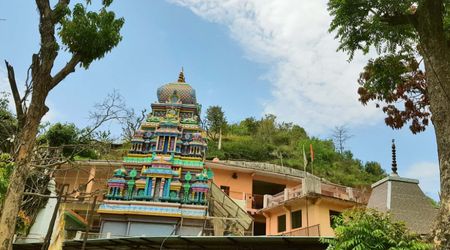
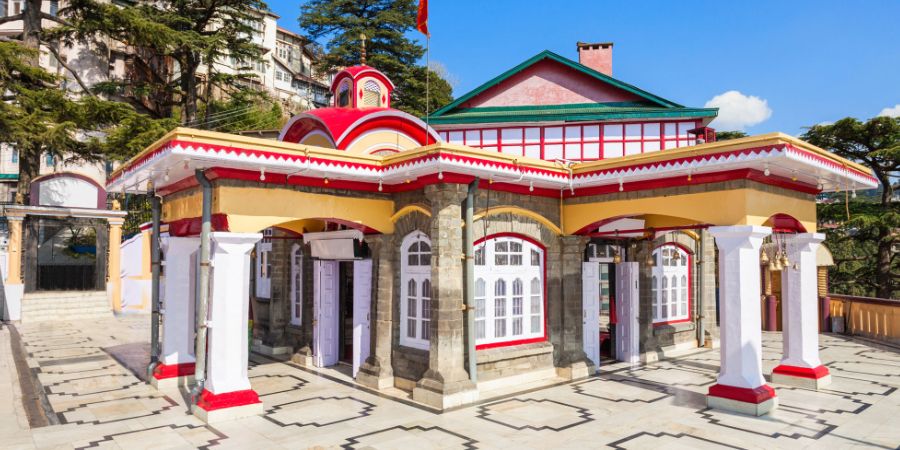


Kali Bari Temple is located in Ban Bazaar, Shimla, along a narrow lane off the main road, accessible by a short flight of stone steps. Painted in deep vermillion, the temple has a modest entrance that many tourists tend to overlook. There is no grand gateway or towering gopuram. It sits on a small hillside that was once part of British-controlled Shimla, not far from Christ Church and the Ridge.
Built in the early nineteenth century, Kali Bari is a working temple, not a heritage site. It has stood through the colonial period, earthquakes, and the commercial growth that has built up around it over the decades. What follows is a look at its origins, the goddess it is dedicated to, its daily rituals, and the festivals that make it a central place of worship for the people of Shimla.
Before the British Had a Name for Shimla, Kali Already Had a Home on This Hill
Kali Bari Temple dates to 1845, a period when Shimla was rapidly transforming from a scattered hill settlement into the summer capital of British India. The shrine was established by Bengali devotees who had followed the colonial administration into the mountains — clerks, translators, minor officials who carried their faith with them like luggage. They weren't building for posterity or prestige. They needed a place to worship Goddess Kali in a town that was being reshaped by Anglican churches and Masonic lodges.
The temple's founding coincided with a surge in Bengali migration to Shimla's administrative apparatus. These families, mostly from Calcutta and its surrounding districts, found the Himalayan foothills spiritually disorienting — no Kalighat, no Dakshineswar, no familiar riverbank for their evening prayers. Kali Bari filled that void. The name itself, "Kali Bari," translates simply to "Kali's House," a term used across Bengal for neighborhood shrines dedicated to the goddess.
What makes this particular origin story compelling is its ordinariness. This wasn't a temple commissioned by a king or prophesied by a sage. It grew out of homesickness and communal need. The early structure was modest — some accounts describe little more than a covered platform with an image of Kali installed upon it. Over the following decades, the shrine expanded incrementally, funded by donations from the Bengali community and, eventually, by devotees from across northern India who settled in Shimla.
The temple has survived Shimla's post-independence transformation, the explosion of tourism, and the slow commercial encroachment of the surrounding bazaar. Its walls have been rebuilt and repainted multiple times, but the site has never moved. The ground it occupies near the Mall Road area carries almost two centuries of continuous worship, making it one of Shimla's oldest active religious sites — older, in fact, than several of the colonial buildings tourists line up to photograph.
The Goddess Who Wears a Garland of Skulls and Still Draws Mothers to Pray
Goddess Kali unsettles people who encounter her iconography for the first time. Dark-skinned, wild-haired, tongue extended, standing atop the prone body of Lord Shiva — her image at Kali Bari Temple doesn't soften these details. The idol inside the sanctum presents Kali in her traditional fierce form, draped in red cloth and adorned with garlands of hibiscus flowers, which devotees offer because the deep red petals are said to resemble the goddess's preferred color of blood and vitality.
Kali occupies a paradoxical space in Hindu theology. She's the destroyer of evil, the annihilator of ego, and simultaneously the protective mother figure to whom millions of Bengalis direct their most intimate prayers. The Sanskrit root of her name — "kala," meaning time — positions her as the force that devours all things, including death itself. She isn't benevolent in the way Lakshmi or Saraswati might appear; her benevolence is violent, surgical, stripping away illusion with the same dispassion a surgeon brings to an operating table.
At Kali Bari Temple in Shimla, this theological complexity plays out in the daily behavior of visitors. You'll see young mothers asking for protection for their children. You'll see students before exams. You'll see elderly men sitting quietly in the courtyard, not asking for anything at all. The same goddess whose image might alarm a first-time visitor is, for regulars, as familiar and comforting as a kitchen fire on a cold Shimla evening.
The temple's priests perform aarti — the ritual waving of oil lamps — before Kali's image twice daily, and the atmosphere during these moments shifts palpably. The air thickens with incense, and the brass bells ring in a pattern that experienced devotees recognize instinctively. Kali's presence here doesn't feel abstract or symbolic. It feels specific to this room, this hillside, this thin mountain air.
A Small Temple Built With the Logic of a Bengali Courtyard, Not a Mountain Shrine
Kali Bari's architecture won't stop you in your tracks. It's compact, painted in shades of red and yellow ochre, with a low ceiling that forces even moderately tall visitors to duck slightly at the entrance. The structure follows the general pattern of Bengali temple design rather than the Nagara or Dravidian styles common to many North Indian hill temples. This makes it architecturally unusual for Shimla — a building that belongs, in its bones, to the riverine plains of Bengal, transplanted onto a Himalayan slope.
The main sanctum houses the idol of Goddess Kali, positioned at the far end of a narrow hall. The walls carry painted depictions of other deities from the Hindu pantheon, including Lord Shiva, Hanuman, and Radha-Krishna, giving the interior a dense, layered visual quality. There's a secondary shrine dedicated to Lord Shiva within the same complex, which devotees typically visit after completing their prayers to Kali. The courtyard, small as it is, serves as both a gathering space and an overflow area during festivals when the interior can hold no more bodies.
One design element worth noting is the temple's doorway, framed by carved woodwork that shows clear influence from Himachali craft traditions. The fusion is subtle but deliberate — Bengali religious intention expressed through local materials and artisan hands. The roof, too, has been modified over the years to withstand Shimla's heavy monsoon rains and occasional snowfall, departing from the curved terracotta rooflines typical of Bengal's temple towns.
Approach the temple from the main road and you'll notice how seamlessly it blends into the surrounding commercial architecture. Shops press against its outer walls. A narrow stairway separates sacred from commercial space by just a few meters. This lack of monumental separation is itself a design statement — Kali Bari doesn't stand apart from daily life in Shimla. It sits right inside it, sharing walls with the mundane world, which is precisely how Bengali neighborhood temples have always functioned.
Before Eight in the Morning, the Temple Belongs to a Different Shimla Entirely
Arrive at Kali Bari Temple by 7 a.m. and you enter a version of Shimla that most visitors never encounter. The tourist crowds won't materialize for hours. The bazaar below is still shuttered. The only sounds are a priest's Sanskrit chanting, the metallic ring of the temple bell as each arriving devotee announces their presence, and the steady drip of water from Shimla's overnight condensation running off the temple roof.
The morning aarti begins early and follows a precise sequence. The priest lights a multi-wicked brass lamp fueled by ghee, circles it before the Kali idol in a clockwise motion, and recites invocations specific to the goddess. Devotees stand or sit on the cool floor of the narrow hall, some with eyes closed, some watching the flame's reflection dance across Kali's dark face. The smell of ghee, camphor, and sandalwood incense mixes into something singular — a scent you'll associate with this temple long after you leave Shimla.
After the aarti, prasad is distributed. At Kali Bari, this typically consists of small portions of sweets or fruit that have been offered to the goddess and are now considered blessed. Devotees cup their hands to receive it, touch it to their foreheads, and eat it on the spot or carry it home wrapped in paper. The ritual is brief but its rhythm is deeply specific: bell, chant, flame, offering, silence.
What surprises most first-time visitors is the intimacy of the space during these morning hours. There's no separation between the priest and the congregation, no roped-off areas or ticketed queues. You stand close enough to feel the heat from the lamp. The temple's small size, which might feel cramped during a festival, becomes its greatest asset at dawn — it concentrates the ritual experience into something physically immediate. You don't observe worship here. You're inside it.
When October Arrives in Shimla, Kali Bari Stops Being a Temple and Becomes a Pulse
Navratri — the nine-night festival honoring the goddess Durga and her manifestations, including Kali — transforms Kali Bari Temple from a quiet neighborhood shrine into the gravitational center of Shimla's Hindu devotional life. The festival typically falls in September or October, and during these nine days, the temple operates on an entirely different frequency. Evening aartis grow longer, louder, and far more crowded. The courtyard fills with devotees who spill out onto the stairway and into the lane below. Flower sellers along the approach road triple their stock of marigolds and red hibiscus.
Each night of Navratri is dedicated to a different form of the goddess, and the temple's decorations shift accordingly. Colored fabrics drape the interior walls, the idol receives fresh garments and ornaments, and special puja ceremonies are conducted by the resident priests with an intensity that daily worship doesn't approach. On the eighth night — Ashtami — the temple reaches its peak, with a havan (sacred fire ritual) performed and large numbers of devotees fasting since dawn gathering for the evening prayers.
The sound environment changes drastically during Navratri. Dhol drums and devotional songs — bhajans sung in Hindi and sometimes Bengali — echo up the hillside. The temple's usual quiet clang-and-murmur soundtrack is replaced by something more collective and urgent. Locals describe the atmosphere as electric, though that word undersells the physical density of bodies, sound, smoke, and conviction packed into such a small area.
For travelers who happen to be in Shimla during Navratri, Kali Bari offers something rare: a festival experienced not in a vast temple complex where thousands become anonymous, but in a space so small that you share the moment with every person present. The scale forces connection. You can't be a spectator at Kali Bari during Navratri. The crowd won't allow it.
Getting There, Getting In, and the Things No Guidebook Mentions
Kali Bari Temple sits near Shimla's Mall Road, roughly a ten-minute walk from the Ridge and Scandal Point — two landmarks every visitor to Shimla will encounter whether they intend to or not. The temple is accessible on foot; no vehicles are permitted on the Mall Road stretch. If you're arriving from the main bus stand or the railway station at the bottom of the hill, the walk involves a steep climb of about twenty minutes, or you can take the passenger lift from the lower bazaar area to the Ridge and walk from there.
A few practical considerations will improve your visit:
- Remove shoes before entering the temple premises — a small shoe rack near the entrance serves this purpose, though carrying your shoes in a bag is safer during crowded hours.
- Photography is generally restricted inside the sanctum; ask the priest before raising a camera, and expect the answer to be no during aarti.
- Visiting between 7 and 8 a.m. or after 6 p.m. gives you the most atmospheric experience with the fewest crowds.
- Dress modestly — covered shoulders and knees are expected, and this applies equally to men and women.
- The temple does not charge any entry fee, but a small donation box is available near the entrance for those who wish to contribute.
One thing that catches visitors off guard: the temple's location within the bazaar means it's surrounded by shops selling everything from woolens to cheap electronics. The sensory jump from commercial chaos to sacred stillness happens within a few steps, and that abrupt transition is itself part of the experience. Don't expect a serene approach path lined with gardens. Expect to walk past a luggage shop, turn a corner, and find yourself facing a two-hundred-year-old shrine. Shimla has never separated the sacred from the everyday, and Kali Bari is the purest expression of that fact.
If you're visiting during Navratri, budget extra time. The lanes around the temple become congested after 5 p.m., and the evening aarti draws enough people to make the stairway impassable for short stretches. Come early, stay patient, and eat something substantial beforehand — the energy inside the temple during festival nights is absorbing enough to make you forget you haven't had dinner.
Shimla markets itself through colonial architecture, mountain panoramas, and the toy train that climbs from Kalka. These are fine reasons to visit. But Kali Bari Temple offers something the Ridge and the Mall cannot — a direct line into the town's lived spiritual identity, unmediated by heritage boards or tourist infrastructure. It's a place where Shimla stops performing for visitors and simply exists as itself: a hill town where people have been carrying their gods uphill for nearly two centuries, building small rooms for them in crowded bazaars, and returning every morning before the shops open. The most honest thing you can learn about a place is what its residents do when they think no one is watching. At Kali Bari, that answer is pray.