

The cannon barrel measures over twenty feet long and weighs fifty tons. When Jaivana — the largest wheeled cannon ever cast — was test-fired once in the early eighteenth century, the cannonball reportedly traveled twenty-two miles and landed in a lake. The recoil carved ruts into the earth. It was never fired again. This singular weapon sits on the ramparts of Jaigarh Fort, pointed outward across the Aravalli hills like a threat still being made, centuries after anyone was listening. The fort that houses it was built with the same philosophy: overwhelming, singular, designed to make conflict unthinkable.
Perched on the Cheel ka Teela — the Hill of Eagles — above Jaipur, Jaigarh has never been conquered. Not by the Mughals, not by the Marathas, not by the British. Its walls remain unbreached, its interiors largely intact, its reputation as a military fortress undiminished by tourism or time. Unlike its more photogenic neighbor Amber Fort, which draws thick crowds and Instagram poses, Jaigarh attracts a different kind of visitor — someone interested in how wars were planned, how water was stored in a desert, and how a dynasty kept power for seven centuries. This is a fort that rewards patience and a willingness to walk uphill.
Seven Centuries of Kachwaha Ambition on a Ridgeline
Jaigarh Fort owes its existence to the Kachwaha Rajput rulers who recognized, as early as the eleventh century, that the ridge above the Amber valley was the single most defensible position in the region. The earliest fortifications on this site date to around 1036 CE, built by the Meena rulers who preceded the Kachwahas. When Dulha Rai and his successors took control of Amber in the twelfth century, they inherited those walls and began expanding them with the slow, generational patience of a dynasty that planned in centuries, not decades.
The fort as it stands today took its definitive shape under Jai Singh II in 1726, the same Maharaja who founded Jaipur and whose obsession with astronomy produced the Jantar Mantar observatories. Jai Singh didn't build Jaigarh for glory. He built it as a weapons factory and treasury vault, a place where cannons could be cast in an on-site foundry and where the state's gold could be stored beyond the reach of anyone without an army and a death wish. The foundry still exists, its stone furnaces and casting pits visible to visitors.
The Kachwaha alliance with the Mughal Empire gave Jaigarh a paradoxical role. It was a fort maintained at enormous expense that never faced a serious siege, precisely because its reputation made siege pointless. The Mughals, who absorbed the Kachwahas as vassals and generals, saw no reason to attack a fortress held by allies. Later powers did the math and came to similar conclusions. This absence of battle damage is why Jaigarh's structures survive in such remarkable condition — war preserves nothing, but the credible threat of war preserved everything here.
Persistent legends claim Jaigarh conceals a vast treasure buried by Man Singh I after his campaigns in Afghanistan and Bengal. In 1976, the Indian government authorized an excavation led by the Archaeological Survey of India. They dug for months and found nothing — or so the official report stated. The rumor persists in Jaipur that the treasure was discovered and quietly removed. No one has produced evidence either way, which is exactly how the best legends sustain themselves.
Every Wall an Equation: How Jaigarh Made Siege a Losing Bet
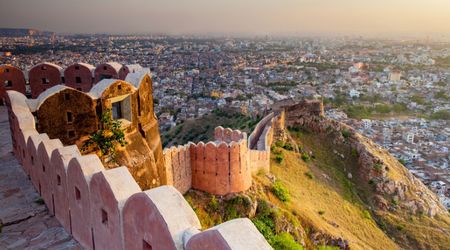
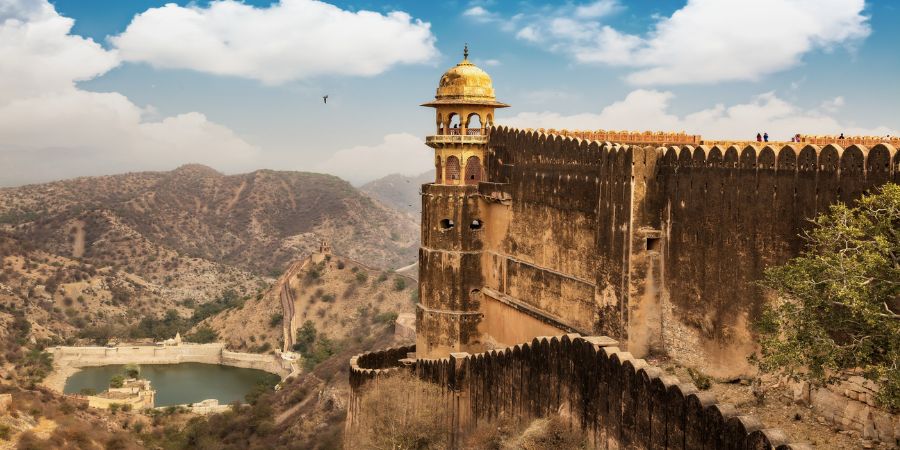
Jaigarh's three-kilometer perimeter wall follows the ridgeline so precisely that it creates no blind spots. Attackers approaching from any direction would be visible from multiple watchtowers long before reaching arrow range. The wall thickness — in some sections exceeding three meters — wasn't designed merely to absorb cannonball impacts. It was built to house interior passages where defenders could move along the full length of the fortification without ever exposing themselves to fire from below.
The fort's water management system reveals a military mind thinking about endurance, not spectacle. Underground tanks carved into the rock can store six million gallons of rainwater, enough to sustain a garrison and its dependents through years of blockade in a region where rainfall is scarce and unpredictable. Channels cut into the hillside funnel every drop of monsoon rain into these reservoirs. A besieging army in Rajasthan's heat, camped on exposed ground with limited water, would break before the fort's supplies ran low.
The foundry positioned inside the walls gave Jaigarh something few forts possessed: the ability to manufacture its own weapons during a prolonged conflict. Cannon barrels were cast here from locally smelted iron and bronze, using techniques that the Kachwaha metallurgists refined over generations. Jaivana itself was produced in this foundry in 1720, an engineering achievement that European visitors of the period noted with unease. The strategic calculation was ruthless: any enemy that managed to reach Jaigarh's walls would face artillery produced on-site, fired downhill, from behind cover they couldn't breach.
What's counterintuitive about Jaigarh's military design is that its greatest success was making itself unnecessary. A fort this well-supplied, this well-armed, sitting on ground this difficult to assault, functions less as a battlefield and more as an argument. The Kachwahas understood that the most efficient fort is the one that never fights, and they built accordingly.
Red Sandstone and Rain Gutters: The Architecture That Tells the Story
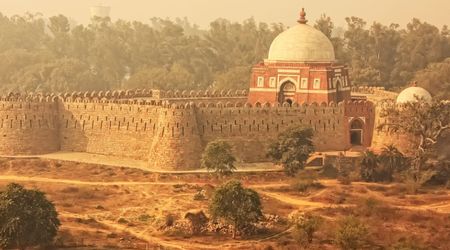
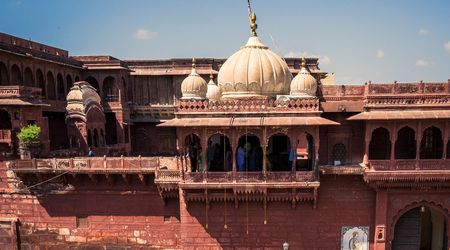
Jaigarh's architecture splits into two distinct personalities. The outer fortifications — massive curtain walls, bastions, and cannon platforms — are blunt and utilitarian, built from the same red sandstone as the hill itself, making the fort appear to grow directly from the rock. Inside those walls, the palace complex shifts register entirely. Laxmi Vilas, the main palace, features latticed windows, painted ceilings, and a mirror hall that belongs more to a courtly residence than a military installation. This duality wasn't accidental. The fort served as both arsenal and retreat, a place where the Maharaja could conduct state business while surrounded by his most lethal hardware.
The Vilas Mandir, a smaller temple within the complex, displays carved pillars and ornamental arches that draw from the same Rajput-Mughal hybrid style visible at Amber Fort below. The craftsmanship here is less lavish than at Amber — no inlaid mirrors, no pietra dura — but the proportions are more honest, less concerned with impressing ambassadors. You'll notice the ceilings are lower than in comparable palaces, the corridors narrower. These are rooms designed for use, not for ceremony.
Walk past the residential quarters toward the armory, and the architecture turns severe again. Stone chambers with thick walls and low doorways stored gunpowder, shot, and bladed weapons. The armory museum today displays swords, shields, and small arms from across several centuries, including matchlock rifles whose mechanisms are still intact. A few of the swords bear blade patterns suggesting Persian or Afghan origin — spoils from the campaigns that may or may not have filled Jaigarh's legendary treasury.
The Dungar Darwaza, the main gate, forces visitors through a sharp ninety-degree turn designed to slow any ram or elephant charge. This defensive technique appears across Rajput fortification, but Jaigarh's version is particularly tight — even a modern car couldn't make the turn without a three-point maneuver, which tells you everything about what an elephant carrying a battering ram would have faced.
The Aravalli Spread Out Below Like a Topographic Lesson
From the western ramparts, the Aravalli hills fold outward in brown-green ridges that look like crumpled cloth dropped from a great height. On a clear winter morning, the visibility extends far enough that you can trace the old caravan routes that connected Amber to the plains of Marwar. This isn't a curated viewpoint with a railing and a plaque. You're standing on a cannon platform, the stones worn smooth by soldiers who stood in the same spot three hundred years ago, scanning for dust clouds that might mean a Maratha army on the move.
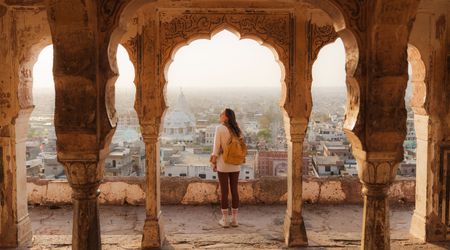
Looking east, Amber Fort sits directly below, close enough that you can see tourists moving through its courtyards like colored beads. The physical relationship between the two forts becomes obvious from this angle: Jaigarh commands Amber completely. Any force that took Amber but failed to take Jaigarh would find itself under plunging fire from a position it could not suppress. The two forts are connected by a subterranean passage that allowed the royal family to retreat uphill if Amber's palatial defenses were compromised. The passage entrance is sealed to visitors, but the knowledge of it changes how you understand both structures.
The experience of Jaigarh differs sharply from most Rajasthani tourist forts. Crowds are thin, especially on weekday mornings. You'll walk entire sections of the rampart alone, with only langur monkeys and the occasional watchman for company. The silence is specific to this place — not the silence of emptiness, but of altitude and stone and wind moving over battlements. Sound carries strangely; you'll hear a motorcycle on the road far below with startling clarity, then nothing for long minutes.
Bring water and wear shoes with grip. The walkways along the ramparts are uneven sandstone, beautiful but treacherous when dusty. The fort rewards a slow visit of two to three hours, not the rushed forty-five-minute circuit that guides sometimes propose. Linger at the Jaivana cannon — not because of its size, which photographs communicate well enough, but because of the view it was positioned to dominate, which photographs cannot.
Dry Scrub and Langurs: The Hill of Eagles Earns Its Name
The Nahargarh Wildlife Sanctuary wraps around Jaigarh's perimeter, and the transition from fort to forest is gradual enough that you don't notice it happening. Dry deciduous scrub — dhok, salar, and kair trees — covers the slopes in vegetation that looks sparse until you sit quietly and watch it come alive. Nilgai antelope move through the underbrush in the early mornings, their blue-grey hides blending with the rock. Spotted deer are less common but present, particularly near the reservoirs where water collects during the monsoon months.
Langur monkeys own the fort walls. They sit on battlements, groom each other in arched doorways, and occasionally steal food from visitors foolish enough to eat in the open. They're bold but rarely aggressive — a sharp clap will send them leaping along the ramparts in a display of casual acrobatics that makes the stone architecture feel alive. The fort's name, taken from the Cheel ka Teela, references the black kites and other raptors that ride thermals above the ridge. On warm afternoons, you'll spot them circling without effort, carried by the same updrafts that made this hilltop strategically valuable.
The vegetation changes dramatically between October and March, when the post-monsoon greenery slowly dries to the yellow-brown that defines Rajasthan's visual identity. Visit in September or early October and the hills are surprisingly lush, the water tanks full, the air still carrying moisture. By February, the same landscape is austere and dry, the stone and earth merging in a monochrome palette that feels more honest to the fort's martial character.
What surprises most visitors is the birdsong. Jaigarh's relative emptiness — no food stalls, no loud speaker systems, no tuk-tuk engines idling in parking lots — creates acoustic space for the Indian robin, the white-eared bulbul, and the occasional grey francolin calling from the scrub. It's a strange thing, hearing birdsong bounce off walls designed to withstand cannon fire, and the incongruity stays with you longer than you'd expect.
Getting There Without the Runaround: A Practical Guide to Jaigarh
Jaigarh Fort sits approximately fifteen kilometers from Jaipur's city center, reachable by a winding road that climbs through the Aravalli hills past Amber Fort. The most efficient approach is to visit Amber first, then continue uphill to Jaigarh — the road connects the two, and auto-rickshaws or taxis make the trip in about ten minutes from Amber's parking area. Negotiate the fare before departing; expect to pay between 200 and 400 rupees for a return trip with waiting time. Ride-hailing apps work inconsistently in this area, so securing your return transport in advance saves frustration.
The fort charges an entrance fee of approximately 100 rupees for Indian nationals and 200 rupees for foreign visitors, with an additional camera fee. These prices shift periodically, so carry extra cash. A composite ticket covering Amber, Jaigarh, and Nahargarh forts offers savings if you plan to visit all three within two days. The fort opens at 9:00 AM and closes at 4:30 PM. Arriving at opening time gives you cooler temperatures and near-empty ramparts.
Essential items to bring:
- At least one liter of water per person — there's a small canteen near the entrance, but its hours are unreliable.
- Sturdy closed-toe shoes, because the walkways are rough stone with occasional steep descents.
- Sunscreen and a hat from October through March, when the sun is deceptive at altitude.
- A light jacket for early mornings in December and January, when hilltop temperatures drop into single digits Celsius.
Budget two to three hours for a thorough visit. The armory museum, the foundry, the Jaivana cannon, and the palace complex each deserve at least twenty minutes. Guided tours are available at the gate, but the fort's signage has improved in recent years, and a self-guided walk with a decent map — available at the ticket counter — is sufficient for most visitors. Skip the souvenir shops near the entrance; the same items appear at lower prices in Jaipur's old city markets.
What the Fort Opens Onto: Amber, Nahargarh, and the Pink City Below
Jaigarh makes the most sense as part of a triangle. Amber Fort, directly below, is the ornamental counterpart — where the Kachwahas held court, received diplomats, and displayed wealth through inlaid mirrors and carved marble. Visiting Amber after Jaigarh reverses the usual tourist sequence but produces a better understanding of both. You arrive at Amber already knowing where the escape tunnels lead, where the artillery was pointed, and where the real power sat. The palace below starts to look less like a monument and more like a performance.
Nahargarh Fort, the third point of the triangle, stretches along the ridge to the south. Built as a hunting lodge and retreat, Nahargarh serves a completely different mood — sunset views over Jaipur, chai vendors on the ramparts, a more relaxed atmosphere that draws local couples and families. The road connecting Nahargarh to Jaigarh runs along the ridgeline through the wildlife sanctuary, and the drive itself is worth the detour, particularly during the golden light of late afternoon.
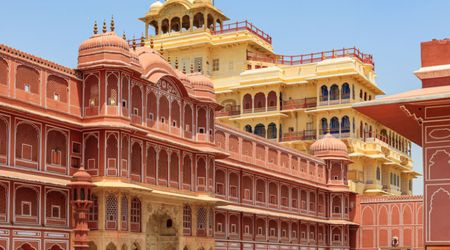
In Jaipur proper, the City Palace and Jantar Mantar observatory connect directly to Jaigarh's history. Jai Singh II, the fort's principal architect, built all three projects within the same decade. The astronomical instruments at Jantar Mantar and the military engineering at Jaigarh came from the same mind — a ruler who believed precision was the foundation of power, whether measuring the arc of a star or the trajectory of a cannonball.
The Amer town below the fort complex has its own quieter appeal: narrow lanes with family-operated sweet shops selling ghevar and mawa kachori, temples to Shila Devi and Jagat Shiromani with stonework that rivals the more famous sites. Spending a morning in Amer's streets, where the tourism economy thins and daily life reasserts itself, provides the human scale that forts, by design, eliminate. You'll eat better here than at any restaurant on the tourist circuit, and the walk back up toward the forts feels earned.
The three forts and the city they protected form a single story told across different altitudes. Jaigarh is the chapter most visitors skip, which is precisely why it retains the quality that the more popular sites have traded away: the feeling that the place exists for itself, not for you. Rajasthan's tourism industry has learned to polish its monuments into experiences, complete with sound-and-light shows and elephant rides. Jaigarh resists that treatment. Its stones are too heavy, its purpose too blunt, its silence too specific to be packaged. And that resistance, in a state where every fort competes for your attention, is the most interesting thing about it.
A fort that never fell and never fought tells a different kind of story than the ones we usually celebrate — not about courage or sacrifice, but about calculation so thorough it made courage unnecessary. Jaigarh sits on its ridge the way a strong argument sits in a debate: quietly, with no need to raise its voice.