

The smell hits you first — a collision of fresh paint, industrial carpet adhesive, and somewhere underneath, the warm oil from a dozen food stalls frying samosas at seven in the morning. Pragati Maidan on setup day carries an urgency that few public spaces in Delhi can match. Forklifts weave between half-constructed pavilions while exhibitors from Moradabad and Tirupur argue with electricians about booth lighting. This is not a convention center in the sanitized Western sense. It's a civic arena where India's commercial ambitions, diplomatic performances, and cultural impulses share the same concrete floor.
Spanning roughly 150 acres near the heart of New Delhi, Pragati Maidan has served as India's principal exhibition ground since 1972. It has hosted heads of state and hawkers of plastic kitchen goods with equal regularity. The complex underwent a sweeping redevelopment in recent years, repositioning itself for the kind of geopolitical stage management that came with hosting the G20 Summit in 2023. Yet its oldest function — connecting Indian industry with Indian consumers during the annual India International Trade Fair — remains the event most Delhiites associate with the name. This is the story of a place that keeps reinventing itself without ever losing the slightly chaotic energy that makes it distinctly Indian.
Before the Pavilions: How a Fairground Grew from Nehruvian Ambition
Pragati Maidan owes its existence to a specific political conviction: that independent India needed a permanent stage to demonstrate industrial progress. The India Trade Promotion Organisation, under the Ministry of Commerce, established the grounds in 1972, but the intellectual roots reach back further. Jawaharlal Nehru's faith in planned industrialization demanded visible symbols — dams, steel plants, and yes, exhibition halls where citizens could witness the machinery of national development firsthand.
The name itself — Pragati Maidan, meaning "Progress Ground" — was not decorative. It carried ideological weight. In a country still defining its economic identity two decades after independence, a fairground dedicated to progress served a purpose closer to propaganda than entertainment. Early exhibitions showcased heavy engineering, textiles, and agricultural equipment, all framed within Five-Year Plan narratives.
What's less often acknowledged is how quickly the space outgrew that original didactic purpose. By the late 1970s, Pragati Maidan had become a venue for book fairs, auto expos, and consumer electronics shows that had little to do with Nehruvian socialism. The marketplace impulse overtook the pedagogical one. Traders from across India recognized the commercial potential of a centralized exhibition space in the national capital, and the calendar filled accordingly.
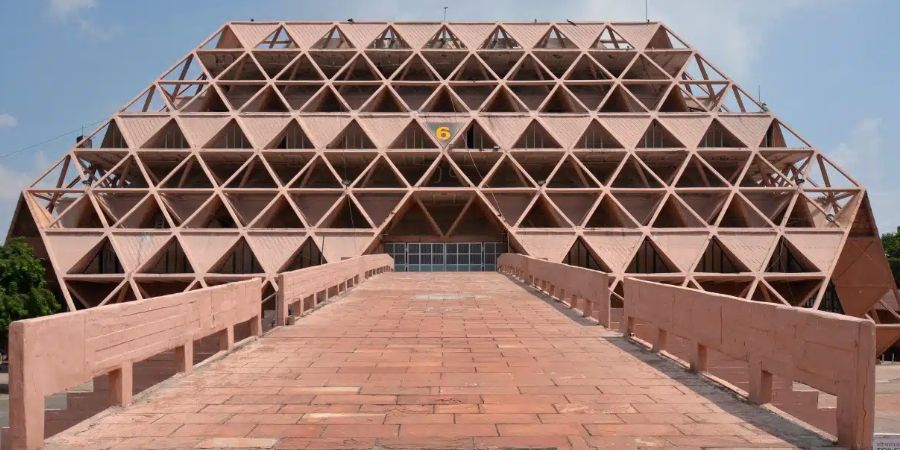
The original Hall of Nations, designed by architect Raj Rewal and structural engineer Mahendra Raj, became an icon of Indian Brutalist architecture. Its interconnected concrete geometry drew international admiration. When it was demolished in 2017 to make way for redevelopment, the backlash from architects and preservationists was fierce — a reminder that Pragati Maidan's history isn't just commercial. It carries architectural and political memory in its foundations, even the ones that no longer exist.
Central Delhi's Most Strategic 150 Acres
Pragati Maidan sits along Mathura Road, flanked by the old walls of Purana Qila to its north and the Yamuna floodplain stretching east. This is Lutyens' Delhi bleeding into Mughal Delhi — a seam line where the city's colonial geometry collides with its medieval topography. The Supreme Court lies three kilometers northwest. India Gate is closer still. There is no exhibition complex anywhere in India with this kind of proximity to the administrative core of the republic.
That location has always been both asset and complication. During major events, traffic on Mathura Road grinds to a standstill, and the surrounding Bhairon Marg and Ring Road arteries absorb the overflow. The Pragati Maidan metro station on the Blue Line was built partly to relieve this pressure, depositing visitors within walking distance of the main gates. A dedicated underground vehicular tunnel, completed during the redevelopment phase, now connects India Gate to the Ring Road, rerouting through-traffic beneath the complex.
The strategic value of the site extends beyond logistics. Foreign delegations arriving for trade exhibitions or diplomatic summits find themselves minutes from Rashtrapati Bhavan and South Block. The optics matter — India's showcase exhibition ground shares a postcode with its corridors of power. This wasn't accidental. The original planners understood that placing Pragati Maidan in central Delhi would give commercial exhibitions a gravity they wouldn't carry in a suburban industrial zone.
One counterintuitive consequence: the location has arguably slowed Pragati Maidan's expansion. Unlike sprawling convention complexes in cities like Guangzhou or Frankfurt, which sit on cheap peripheral land, every square meter here competes with some of the most valuable real estate in South Asia. Growth has had to go vertical and inward, not outward.
Raj Rewal's Concrete Cathedral and the Complex That Was
The original Pragati Maidan was not one building but a loose federation of exhibition halls, open-air grounds, and semi-permanent structures accumulated over decades. Hall of Nations, completed in 1972 for the International Trade Fair, anchored the complex with its space-frame concrete vaults — a structural system that used interlocking tetrahedra to span vast interior spaces without columns. Hall of Industries stood nearby, equally imposing. Together, they gave the fairground an architectural identity rare among Indian public infrastructure of that era.
Raj Rewal's design drew on principles he'd observed in traditional Rajasthani stepped wells and havelis — geometry as structural logic, not decoration. Mahendra Raj engineered the concrete framework to achieve spans that many international peers considered impractical for the material. The result was a building that functioned as both exhibition space and architectural statement, cited in textbooks from Zurich to Tokyo.
The demolition of Hall of Nations and Hall of Industries in April 2017 provoked open letters from the Indian National Trust for Art and Cultural Heritage, condemnation from the International Council on Monuments and Sites, and public protests by Delhi's architecture community. The government's position was pragmatic: the structures had degraded, maintenance costs were rising, and India needed a modern, integrated exhibition complex capable of hosting events on a global scale.
Both arguments carried truth. The old halls leaked during monsoons, lacked contemporary fire safety systems, and couldn't accommodate the wiring demands of modern digital exhibitions. But what replaced them would need to justify the loss. The redeveloped International Exhibition-cum-Convention Centre, known as Bharat Mandapam, opened in 2023 with 73,000 square meters of exhibition space. Whether it carries the same architectural soul is a question Delhi's design community hasn't stopped debating.
September 2023: When a Convention Centre Became a Diplomatic Stage
India's presidency of the G20 in 2023 gave the newly completed Bharat Mandapam its most consequential debut. Heads of state from twenty major economies — along with invited guests from the African Union, which gained permanent G20 membership during the summit — gathered in a building that had been a construction site barely months earlier. The pressure to finish on time shaped everything from labor shifts to landscaping schedules across the Pragati Maidan campus.
The summit, held on September 9-10, 2023, produced the New Delhi Leaders' Declaration, a consensus document whose adoption surprised many observers given the deep fractures over the Russia-Ukraine conflict. The venue itself became part of the messaging. India positioned Bharat Mandapam as evidence of its infrastructure ambitions — a modern, self-sufficient convention facility that could manage the security, media, and logistical demands of a G20 summit without borrowing capacity from hotels or satellite venues.
For visitors who'd known the old Pragati Maidan — its patchy lawns and aging halls — the transformation was jarring. The new complex featured a grand amphitheatre, multiple convention halls, a media center built to accommodate over a thousand journalists, and climate-controlled corridors connecting the major spaces. Public art installations referencing India's craft traditions lined the walkways, a deliberate curatorial choice that framed the venue as culturally grounded rather than generically global.
The less visible legacy is operational. Hosting the G20 forced Indian agencies to build security protocols, crowd management systems, and waste handling procedures that now form the baseline for every subsequent major event at the complex. The summit didn't just christen Bharat Mandapam. It established a new operational standard that every future exhibition organizer at Pragati Maidan now has to meet — or justify falling short of.
Fourteen Days in November That Define Delhi's Consumer Calendar
The India International Trade Fair, held annually from November 14 to 27, is not really a trade fair in the way Munich or Canton host trade fairs. It's something more peculiar — part wholesale marketplace, part state tourism pitch, part family outing. On general public days, attendance figures regularly cross 200,000 in a single day. Families from across the NCR region arrive by metro and bus, armed with cloth bags and a loose plan to visit the state pavilions, eat Kashmiri wazwan from the J&K stall, and leave with a wooden chess set from Saharanpur they didn't know they wanted.
Each Indian state and union territory operates its own pavilion, and these become competitive exercises in regional branding. Kerala leans hard on its spice exports and Ayurvedic products. Rajasthan deploys miniature paintings and block-printed textiles. The northeastern states, often underrepresented in mainland Indian commerce, use IITF as a rare direct channel to Delhi's consumer market — Naga shawls, Meghalayan honey, Manipuri handlooms find buyers who might never visit the source.
Business days, restricted to the first five days of the fair, carry a different energy. International exhibitors from countries including China, Thailand, Iran, and several African nations display industrial goods, machinery, and handicrafts. Deals are struck in temporary offices behind curtained booth partitions, handshake agreements that may or may not survive the paperwork phase.
The fair's most honest function is as a barometer. Walk the aisles in any given year and you can read the Indian consumer economy in real time — which states are investing in branding, which product categories are surging, and which foreign countries are most aggressively courting Indian buyers. It's commerce as ethnography, if you're paying attention.
Beyond November: The 365-Day Cycle at India's Busiest Exhibition Ground
IITF dominates popular imagination, but Pragati Maidan's calendar runs year-round with an intensity that few Indian venues match. The New Delhi World Book Fair, organized by the National Book Trust every January, draws publishers, remaindered-book dealers, and bibliophiles into the same halls that hosted diplomats weeks earlier. Auto Expo, held biennially, transforms the grounds into a showcase for everything from two-wheelers to concept electric vehicles, pulling automotive journalists from across Asia.
The events span a staggering range of industries and interests:
- AAHAR, the international food and hospitality fair held each March, targets hotel chains, restaurant suppliers, and commercial kitchen equipment buyers across South Asia.
- ELECRAMA, the biennial electrical equipment exhibition, draws power sector professionals from over 100 countries.
- The India International Garment Fair, held twice yearly, serves as a sourcing platform where international apparel brands negotiate with Indian textile manufacturers.
- Convergence India, focused on telecom and digital technology, typically runs in January or February and charts the country's tech infrastructure trends.
The redeveloped campus, with Bharat Mandapam as its anchor, can now host multiple concurrent events across separate halls — a logistical impossibility in the old layout, where shared corridors and overlapping footprints caused scheduling conflicts. The new complex added dedicated loading docks, underground parking for several thousand vehicles, and segregated entry points for exhibitors and visitors.
Pragati Maidan's year has a rhythm to it: the monsoon months see lighter programming, while September through March stacks events so tightly that teardown crews from one fair often cross paths with the advance setup teams of the next. The grounds rarely sleep for long.
Getting There, Getting In, and Getting the Most Out of a Visit
Pragati Maidan metro station on the Blue Line drops you at the western edge of the complex. From Indira Gandhi International Airport's Terminal 3, expect a 45-minute taxi ride via Aurobindo Marg or the Barapullah Elevated Road — traffic permitting, which in Delhi is never a safe bet. During major fairs, dedicated shuttle buses run from Kashmere Gate and Central Secretariat metro stations, though their frequency varies by event.
Entry logistics depend entirely on the event. IITF general public tickets are sold at the gates and increasingly through the ITPO's online portal, with pricing typically under 100 rupees for adults. Business-day passes require trade credentials. For G20-scale diplomatic events, public access was naturally restricted, but the standard exhibition calendar maintains a welcoming posture for walk-in visitors. Carry a government-issued photo ID — security screening at the gates is thorough and can produce 20-minute queues during peak hours.
Accommodation in the immediate area is limited. The closest hotels sit along Mathura Road and near Nizamuddin Railway Station, a 10-minute auto-rickshaw ride south. Connaught Place, roughly five kilometers northwest, offers a wider range from budget lodges to upscale options, with metro connectivity on the Blue and Yellow Lines.
Footwear matters more than most guides acknowledge. You'll cover several kilometers across concrete and temporary flooring during a full day at any major fair, and Delhi's November weather — warm afternoons, cool evenings — catches visitors off guard. Bring water; the complex has food courts and chai stalls, but hydration points are unevenly distributed across the grounds. The best strategy for IITF is to arrive early on a weekday, target specific pavilions, and accept that you won't see everything. Pragati Maidan rewards the focused visitor over the completionist.
Pragati Maidan has spent five decades absorbing India's evolving self-image — from Nehruvian industrial showcasing to G20 diplomatic theater, from regional handicraft commerce to tech expos wired with 5G demos. No single venue in the country has served such contradictory purposes with such persistence. The redevelopment gamble, whatever architectural purists may mourn, has equipped the complex for a century where India's exhibition needs will only intensify. Whether you visit for a book fair, a trade negotiation, or simply to eat your way through the state pavilions in November, you're walking on ground where India has been rehearsing its future since 1972 — and the rehearsals have never stopped.