

Dilli Haat sits on a strip of land between INA Market and the chaos of Ring Road in south Delhi, and yet crossing its threshold feels like stepping sideways into a different country — or rather, into twenty-nine different countries, one for each Indian state, all compressed into six acres of open-air walkways and mud-plastered stalls. This is not a sanitized heritage park. The craft sellers sleep behind their displays. The cooks work without uniforms. The dust is real.
Opened in 1994 as a joint project between the Delhi Tourism and Transportation Development Corporation and the Ministry of Textiles, Dilli Haat was designed to give rural artisans and regional food vendors a permanent urban stage without the seasonal dependency of traveling melas. It succeeded beyond any planner's projection. What follows is a close look at why this place works — its architecture, its food, its handmade objects, its live performances, and the practical details you need to get there and get the most from a visit.
A Government Scheme That Actually Worked: The Unlikely Origin of Dilli Haat
Most government-backed cultural projects in India calcify into neglected monuments within a decade. Dilli Haat broke that pattern. The original concept came from architect Pradeep Sachdeva, who won the design commission in the early 1990s with a proposal rooted in the village haat — the weekly rural market where farmers, potters, weavers, and food sellers gather under temporary shade. Sachdeva's insight was structural: he didn't build permanent shops. He designed open-air stalls with thatched and tile roofing that could be rotated among artisans every fifteen days, preventing any single vendor from becoming a fixture.
That rotation system remains the core mechanism keeping Dilli Haat alive. Roughly 62 craft stalls and 25 food stalls operate at the INA location at any given time, and the roster shifts regularly, drawing from a nationwide pool of artisans selected through state handicraft boards. A weaver from Pochampally in Telangana might occupy a stall for two weeks, then yield the space to a Pashmina embroiderer from Srinagar. The effect is that no two visits produce the same market.
The entry fee — kept deliberately low at 30 rupees for Indian visitors — was a conscious choice to make the space accessible without making it free, which planners feared would invite overcrowding and devalue the artisans' work. That small friction of a ticket window also creates a psychological boundary: you enter knowing you've chosen to be here, and the vendors inside know you're not just passing through.
The first Dilli Haat opened at INA in 1994. Two more followed — at Pitampura in 2008 and Janakpuri in 2014 — but the INA original remains the anchor. It draws roughly 4,000 visitors on a weekday and nearly double that on weekends. The counterintuitive part: its success hasn't come from spectacle or renovation, but from the discipline of keeping things deliberately unfinished, temporary, and rotating.
Mud Walls and Open Sky: Why the Layout Refuses to Feel Like a Mall
Dilli Haat's design works against everything modern retail architecture teaches. There are no air-conditioned corridors, no escalators, no glass facades. The stalls are arranged along winding pathways paved with stone and brick, separated by low terracotta walls that let sound and cooking smoke drift from one section into the next. The rooflines stay low — mostly thatch, bamboo, and clay tile — so the sky is always visible. This isn't accidental. Sachdeva modeled the spatial rhythm on the organic sprawl of village markets, where you discover things by wandering, not by following directional signage.
The central amphitheater sits roughly in the middle of the compound, sunken slightly below the walkways. Around it, mature trees — neem, peepal, and ashoka — provide shade that no architect could have engineered as effectively. On hot April afternoons, the temperature under those canopies drops several degrees compared to the exposed paths, and vendors know this; the most experienced sellers position their displays to catch foot traffic moving toward shade.
There's a deliberate absence of visual clutter. No neon signs. No branded banners. Each stall gets a simple placard identifying the artisan's name, state, and craft. The uniformity of the stall structures paradoxically makes the diversity of the goods more visible — a display of blue Jaipur pottery looks startlingly vivid against the same mud-plastered backdrop that, three stalls later, frames black Bidri metalwork from Karnataka.
The atmosphere shifts across the day. Mornings are quiet, almost drowsy — artisans arranging their goods, food stalls prepping mise en place. By late afternoon, the compound fills with families, college students, foreign tourists, and office workers ducking out early. The noise builds. Bargaining voices layer over folk music drifting from the amphitheater. The dust rises. Dilli Haat becomes, for a few hours, the closest thing Delhi has to a living village square inside a metropolis of 20 million.
Thirty Cuisines Before Lunch: Eating Your Way Across India in Six Acres
The food stalls at Dilli Haat don't serve "Indian food." They serve Manipuri food, Rajasthani food, Kashmiri food, and Coorgi food — side by side, with no fusion, no compromise, and no concession to a hypothetical mainstream palate. The Naga stall sells akhuni chutney made from fermented soybeans that will stop most north Indian diners cold. The Gujarati counter offers undhiyu — a slow-cooked vegetable casserole from Surat — that tastes nothing like the Gujarati thali chains proliferating across Delhi. These vendors cook regional, not national.
Pricing stays remarkably low. A full plate of momos from the Sikkim stall costs around 80 rupees. Laal maas from the Rajasthan counter runs about 150. The economics work because stall rents at Dilli Haat are subsidized, and most vendors operate with family labor — a husband at the stove, a wife handling the counter, sometimes a teenage son washing plates in a basin behind the stall.
The seating is communal: stone benches and shared tables arranged under open-air canopies. You'll eat your Hyderabadi biryani next to someone working through a plate of Assamese fish tenga, and the proximity is part of the education. Conversations start over food. A Keralite vendor once explained to me the difference between Malabar and Travancore styles of fish curry while ladling both into separate bowls for comparison — an impromptu lesson no restaurant would offer.
The counterintuitive discovery: the best stalls aren't always the busiest. Crowds cluster around the momos and the chaat. Walk past them. The quieter counters — Meghalaya's jadoh rice, Odisha's dalma, the Chettinad chicken from Tamil Nadu — reward patience and a willingness to eat something you can't identify by sight. Dilli Haat's food court is less a dining experience than an argument against the idea that Indian cuisine is a single thing.
Buying Direct From the Hands That Made It: Handicrafts Without the Middleman
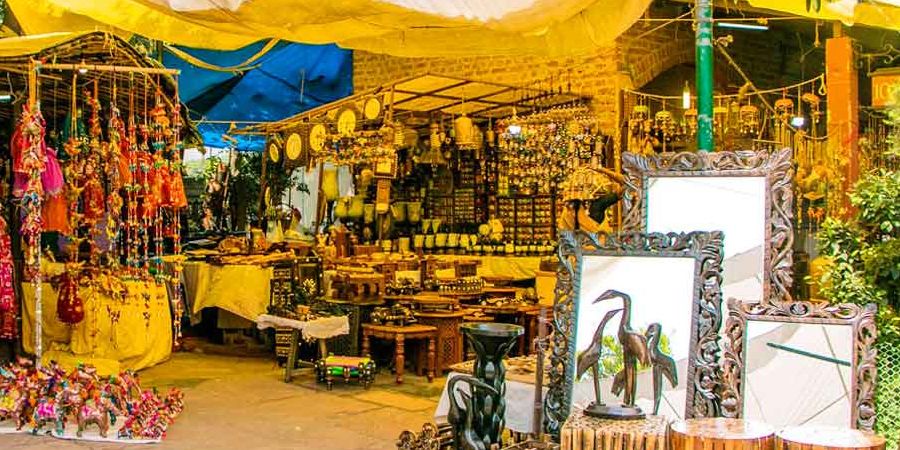
The craft stalls at Dilli Haat sell objects you won't find on Amazon, and that's precisely the point. A Chikankari embroiderer from Lucknow sits cross-legged behind his display, stitching a kurta panel while you browse. A Dhokra metal caster from Bastar in Chhattisgarh has brought his wax molds and can show you, if you ask, the lost-wax technique that produced the brass figurine you're holding. This directness — maker to buyer, no packaging, no brand narrative — is what separates Dilli Haat from the upscale handicraft emporiums on Baba Kharak Singh Marg where the same goods arrive marked up threefold.
The rotating roster means the craft selection genuinely changes. One visit might feature Madhubani paintings from Bihar's Mithila region, their dense ink-and-color compositions spreading across handmade paper. The next fortnight could bring Kalamkari textiles from Andhra Pradesh, hand-painted with vegetable dyes in mythological scenes that take weeks to complete. The artisans set their own prices, and bargaining is expected but not aggressive — a 10 to 15 percent reduction is typical, not the theatrical halving you'd attempt at Janpath Market.
What catches most visitors off guard is the price range. You can buy a hand-block-printed cotton scarf for 200 rupees, or you can spend 15,000 on a Pashmina shawl with authentic sozni embroidery. The spectrum reflects the reality of Indian craft — some traditions survive on volume, others on the prestige of painstaking labor.
A practical note: carry cash. Many artisans now accept UPI payments through their phones, but connectivity inside the compound is unreliable. The stalls have no trial rooms, no return policies, no gift wrapping. You buy what you see, from the person who made it, and you walk away with something that has a provenance more specific than any luxury brand could fabricate. That transaction, stripped of retail theater, is the quietest radical thing about Dilli Haat.
Drum Beats Between the Stalls: Live Performance as a Daily Fact, Not a Special Event
The central amphitheater at Dilli Haat hosts performances most evenings, and the programming reads like a syllabus for Indian folk traditions you've never heard of. Pandavani ballad singers from Chhattisgarh — who perform episodes of the Mahabharata in a single-voice, single-instrument format — share the stage calendar with Bihu dancers from Assam and Lavani performers from Maharashtra. The performers rotate as frequently as the craft vendors, tied to the same state-sponsored cycles that bring artisans to Delhi for brief residencies.
What makes these performances unusual is their context. You're not sitting in a concert hall with controlled acoustics and printed programs. You're watching a Rajasthani Kalbelia dancer spin on a stone stage while the smell of frying pakoras drifts from forty meters away and someone's toddler wanders across the front row. The informality strips away the preciousness that often smothers folk art when it's presented in institutional settings. The performers respond to the crowd — a puppeteer from Rajasthan will pull a child from the audience, a Baul singer from Bengal will walk among the seated viewers.
During annual festivals — the Mango Festival in July, the Dilli Haat anniversary celebrations in April — the programming intensifies. Multiple stages operate simultaneously, and visiting troupes sometimes number forty or fifty performers. These events draw dedicated audiences who plan their visits around the performance calendar, which DTTDC publishes, somewhat erratically, on its website and social media pages.
The unexpected dimension: these performances function as job interviews. State tourism boards use Dilli Haat appearances to scout talent for larger national festivals, Republic Day tableaux, and international cultural delegations. For a Chhau dancer from Purulia or a Theyyam performer from Kerala, a two-week stint at Dilli Haat can open doors that years of village-level performances never would. The amphitheater is entertainment for visitors and opportunity for the artists — a dual purpose that neither side needs to acknowledge for it to work.
Getting In, Getting Around, and Getting the Timing Right
Dilli Haat INA sits directly above the INA Metro station on the Yellow Line, making it one of the most accessible cultural sites in Delhi. Exit from Gate 1, cross the footbridge, and the entrance is fifty meters ahead. The compound opens daily from 10:30 AM to 10:00 PM. Entry costs 30 rupees for Indian nationals and 100 rupees for foreign visitors — negligible either way, though the ticket counter sometimes runs a slow queue on weekends. Consider these details before planning your visit:
- Weekday afternoons between 2:00 and 4:00 PM offer the thinnest crowds and the best conditions for unhurried conversations with artisans.
- Evening visits, especially Friday and Saturday after 6:00 PM, coincide with live performances but also with peak congestion at the food stalls.
- October through March provides the most comfortable weather; Delhi summers push midday temperatures above 42 degrees Celsius, and the open-air layout offers limited respite.
- Carry a cloth bag — the stalls provide minimal packaging, and you'll accumulate purchases faster than you expect.
- Photography is permitted throughout the compound, but ask artisans before photographing their work up close; some view it as a precursor to design theft.
Allow at least two hours for a meaningful visit. Three is better if you intend to eat at multiple stalls and linger over the crafts. The Pitampura and Janakpuri Dilli Haats follow a similar format but attract smaller crowds and feature fewer food options. Neither matches the INA location's energy or artisan density.
Restrooms are available but basic — functional, not pleasant. Drinking water stations exist near the food court area. ATMs cluster outside the INA Market entrance, a three-minute walk from Dilli Haat's gate. If you're combining the visit with other south Delhi stops, Safdarjung's Tomb is a ten-minute auto ride north, and the Lodi Garden entrance at Jor Bagh sits two metro stops away on the same Yellow Line.
What the Dilli Haat Model Sparked Across India
Dilli Haat's influence shows up in places that rarely credit it. Shilparamam in Hyderabad, Surajkund Crafts Mela in Faridabad, and Nature Bazaar in central Delhi all borrow from the same principle: give rural artisans a subsidized urban venue and let the quality of the work create its own market. The Surajkund Mela, held every February, scales the concept to 1,200 stalls across a vast fairground, drawing delegations from partner countries. But its annual format means artisans must wait twelve months between appearances — a gap that Dilli Haat's rolling roster was specifically designed to eliminate.
State governments have launched their own permanent craft bazaars. Raghurajpur Artisan Village in Odisha and Dastkar Haat in Andhra Pradesh function as year-round markets with resident craftspeople. The results are mixed. Without the foot traffic that a metro-connected Delhi location generates, some of these ventures depend heavily on tour bus schedules, and the artisans' income fluctuates with tourist seasons rather than flowing steadily.
The private sector has noticed too. Dastkar, the NGO founded by Laila Tyabji, runs its own seasonal bazaars in Delhi — Dastkar Nature Bazaar in spring and Dastkar Diwali Mela in autumn — attracting an audience that overlaps with Dilli Haat's but skews toward a wealthier, design-conscious buyer. The prices at Dastkar events run higher, and the curation is tighter, which some artisans prefer because it signals a market willing to pay for exceptional work rather than volume.
The broader shift matters. India's handicraft sector employs an estimated seven million artisans, most of them in rural areas with limited market access. Dilli Haat didn't solve that problem, but it proved something that policy papers couldn't: that urban consumers will buy handmade goods at fair prices when they can meet the maker. The model's most lasting contribution isn't architectural — it's commercial proof of concept.
A handful of cities still lack anything comparable. Kolkata, Bengaluru, and Chennai — each home to millions of potential buyers — have no permanent, rotating artisan market of Dilli Haat's scale. The gap between proof of concept and replication, it turns out, is filled with bureaucratic inertia, land disputes, and the chronic undervaluation of craft as economic activity. Dilli Haat works because someone built it. The question hanging over Indian cultural policy is why so few have bothered to build another.
Dilli Haat is not a museum, not a food court, not a shopping mall, and not a performance venue — it's all of those pressed together with the seams showing, and the honesty of that compression is what gives it life. In a city that tears down its old quarters to build malls with "heritage themes," this six-acre compound insists that the real thing doesn't need a theme. The artisans rotate, the cooks change, the performers cycle through, and somehow the place remains itself — rough, functional, alive. If you visit Delhi and spend your time only at the monuments, you'll learn what the city was. Spend an afternoon at Dilli Haat, and you'll taste, hear, and hold what the rest of India still is.