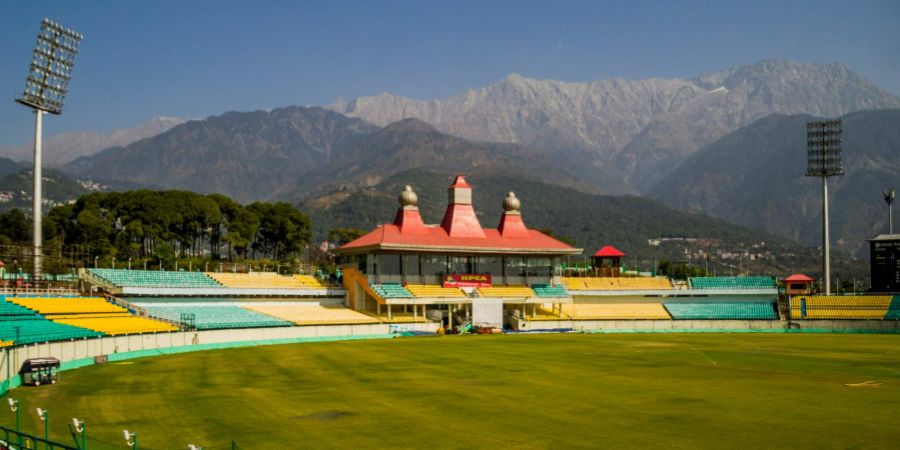


The ball left the bowler's hand at 140 kilometers per hour and sailed past the batsman's outside edge, continuing its trajectory toward a wicketkeeper framed against a wall of Dhauladhar snow peaks. That's the thing about HPCA Stadium in Dharamshala — the cricket is secondary to the absurdity of its setting. At 1,457 meters above sea level, this is the highest international cricket ground in India, a place where fast bowlers claim the ball swings more, where fielders lose catches against white mountain backgrounds, and where spectators forget to watch the game because their eyes drift upward to ridgelines that belong on a monastery calendar, not behind a scoreboard.
The stadium arrived late to Indian cricket. It didn't host its first international match until 2013, decades after the grounds in Mumbai, Kolkata, and Chennai had already accumulated their legends. Yet Dharamshala has done something those grounds never could — it has made the setting part of the sport itself. Every broadcast becomes a tourism advertisement. Every slow-motion replay carries snow-capped peaks in the background. The ground occupies a peculiar space in Indian cricket: too remote for regular scheduling, too spectacular to ignore. What follows is a close examination of how this stadium came to exist, what it feels like to play and watch cricket here, and what the surrounding Kangra Valley offers those who make the steep journey up.
How Tea Planters and a Cricket-Mad Bureaucrat Built a Stadium in the Clouds
The Himachal Pradesh Cricket Association, or HPCA, didn't always have ambitions this grand. For most of its existence, it operated from modest grounds in lower Himachal Pradesh, running age-group tournaments and state-level fixtures that attracted more pigeons than spectators. The shift began in the early 2000s when Anurag Thakur, then a young politician and HPCA secretary, pushed for a permanent international-standard venue. The site chosen was a narrow plateau above McLeod Ganj, in the village of Dharamshala proper — land that had once been part of colonial-era tea estates.
Construction began around 2003, and the challenges were immediate. Building materials had to travel narrow mountain roads that close during monsoon. The soil composition at that altitude required specialized drainage systems. Workers dealt with freezing temperatures in winter months that halted progress for weeks. The nearest major supply chain sat in Chandigarh, nearly 250 kilometers of winding mountain road to the south.
The ground hosted its first Ranji Trophy match in 2005, a low-key affair between Himachal Pradesh and a visiting side that played before a few hundred locals wrapped in wool shawls. But word spread quickly among domestic cricketers: there was a new ground up in the mountains, and it was unlike anything else in India. By 2013, the ICC cleared it for international matches, and Dharamshala hosted its first ODI — England versus India, a rain-affected game that still drew global television attention simply because cameras couldn't stop panning to the mountains.
The stadium's transformation from a regional ground to an international venue took barely a decade. Thakur, who later became BCCI president, leveraged political connections and HPCA revenues from IPL hosting rights to fund expansions. The speed of development attracted both admirers and critics — some locals questioned land acquisition practices, while cricket administrators praised the vision. The ground's history is inseparable from the politics of Himachal Pradesh, a reminder that even the most photogenic stadiums have stories more complicated than their postcards suggest.
Where the Pitch Ends and the Himalayas Begin
Dharamshala sits in the Kangra Valley, in the upper reaches of Himachal Pradesh, about 18 kilometers from the Tibetan exile community in McLeod Ganj. The stadium occupies a flat shelf of land at roughly 1,457 meters elevation, flanked on its northern edge by the Dhauladhar range — a wall of rock and ice that rises to over 4,500 meters and seems close enough to hit with a well-timed pull shot. The southern side opens to the valley below, a green patchwork of tea gardens, deodar forests, and scattered settlements that drop toward the Kangra town floor.
The orientation matters. Batsmen facing the mountain end look directly into snow during winter and spring fixtures. Late afternoon light hits the peaks at an angle that turns them orange-pink, a phenomenon that regularly distracts television commentators mid-sentence. The altitude affects the ball's behavior — thinner air means less resistance, and both pace and spin bowlers report different movement patterns compared to plains venues. Dew forms earlier here than at lower-elevation grounds, which has tactical implications for teams batting second under lights.
The weather adds unpredictability. Monsoon clouds roll in fast from July through September, and pre-monsoon storms in May and June can halt play with almost no warning. March and April offer the clearest conditions — crisp air, unobstructed mountain views, temperatures around 15 to 22 degrees Celsius. The stadium's location makes it one of the few cricket grounds in the world where you might see snow on surrounding peaks while watching a T20 in shirt sleeves.
Reaching the ground involves a final approach through tight Dharamshala streets, past monasteries and chai stalls, which creates a match-day atmosphere unlike any flat-city stadium approach in the country. The journey upward is part of the experience — your ears pop slightly on the drive from Gaggal Airport, 13 kilometers away, a signal that you've left the familiar cricketing world behind.
A Stadium Carved into a Mountainside, Not Plonked on a Plain
The HPCA Stadium holds approximately 23,000 spectators, modest by Indian standards — the Eden Gardens in Kolkata seats nearly three times that. But the design compensates for intimacy rather than scale. The stands wrap tightly around three sides of the oval, bringing spectators close to the boundary rope. There's no running track separating fans from fielders, no cavernous gap between the crowd and the action. A batsman hooking a short ball can hear individual voices from the stands, not just a generalized roar.
The pavilion and media center sit on the eastern side, a modern glass-and-steel structure that contrasts sharply with the mountain backdrop. Floodlights were installed for day-night matches, six towers that required specialized foundations to handle the altitude's wind loads. The pitch itself sits on a red-soil square that drains faster than most Indian grounds, courtesy of its slope and the naturally porous substrate at this elevation. Groundskeepers have noted that the pitch behaves differently here — it tends to offer more for seam bowlers early on, then settles into a batting surface as the day warms.
The infrastructure tells a story of phased investment. The initial build was functional — concrete terracing, basic facilities, adequate but unspectacular. IPL hosting fees, particularly from the Kings XI Punjab franchise (now Punjab Kings), which used Dharamshala as a home venue for several seasons, funded significant upgrades. Electronic scoreboards replaced manual ones. The dressing rooms received air conditioning. A gymnasium and indoor practice facility were added behind the pavilion.
One design element stands out: the open northern terrace. Where most stadiums close off all sides to maximize seating revenue, Dharamshala leaves its mountain-facing end partially open. The result is a frame — the playing field in the foreground, the Dhauladhar range filling the top third of your vision. This wasn't architectural generosity; it was structural necessity, as the terrain drops steeply on that side. But the accident produced the stadium's most defining feature.
Why 23,000 People in Wool Caps Make More Noise Than 66,000 Anywhere Else
Watching a match here alters your expectations of what a cricket stadium should feel like. The compact bowl amplifies sound in a way that sprawling arenas cannot. During India's matches, the noise ricochets off the mountain-facing concrete and comes back at you, creating a layered echo that makes every wicket feel like a detonation. Add the altitude — where visitors sometimes feel a mild lightheadedness — and the sensory experience becomes genuinely disorienting in the best way.
The crowd composition differs from metropolitan venues. You get local Himachali fans, many attending their only live international match of the year, mixed with tourists from the plains who've timed their Dharamshala trips around the fixture list. The result is an audience that's both fiercely enthusiastic and slightly awestruck. During IPL games, the atmosphere intensifies further — Dharamshala's small population swells with visiting fans, and the town's limited infrastructure means people spill out of restaurants and watch on screens in the street when they can't get tickets.
Match-day logistics demand patience. Parking is scarce, approach roads congest quickly, and the single-lane access points create bottlenecks that begin hours before the first ball. The HPCA runs shuttle services from designated lots, but the walk up the final stretch to the gates involves a steep incline that leaves sea-level spectators breathing harder than they'd like. Food inside the ground is standard Indian stadium fare — samosas, chai, cold drinks — though the chai here, brewed strong against the mountain cold, tastes better than any stadium tea you'll find in Chennai or Hyderabad.
The cold itself shapes the experience. Evening sessions during March or October fixtures drop temperatures enough that spectators pull out blankets and shawls. You watch cricket while your breath steams. It's the opposite of the sweltering, dehydrating experience most Indian grounds offer, and it changes the rhythm of spectatorship — people stay alert, lean forward, engage. Nobody dozes off in the afternoon heat because there is no afternoon heat.
Thin Air, Strange Swing, and Catching Balls Against a White Sky
Players talk about Dharamshala differently. Fast bowlers describe the ball carrying through to the keeper with unexpected pace, a consequence of the thinner air offering marginally less resistance. The effect is subtle — not enough to transform a medium-pacer into a genuine quick — but experienced batsmen have noted that the ball arrives a fraction earlier than on plains grounds. Virat Kohli, who has played multiple matches here, once remarked on the crispness of the conditions, how the cold air sharpens reflexes and makes the ball feel harder off the bat.
Fielders face a specific challenge: the white Dhauladhar backdrop. Catches hit into the air toward the mountain end can disappear momentarily against the snowline, particularly in winter and early spring when the peaks carry heavy snow cover. Fielding coaches have discussed this in pre-match briefings for visiting teams, recommending sunglasses even on overcast days. The ground's compact size means boundary fielders stand closer to the crowd than at larger venues, adding a psychological pressure that some players thrive on and others find intrusive.
Spin bowlers report mixed experiences. The lower air density theoretically reduces the amount of drift a spinner can extract, but the pitch's characteristics — typically a harder, less dusty surface than most subcontinental tracks — offer decent bounce. Leg-spinners, in particular, have found the extra bounce useful. The dew factor complicates matters in day-night games: moisture settles quickly at this altitude, and the ball becomes slippery enough to affect grip by the time floodlights take over.
Visiting teams from overseas often find Dharamshala the most agreeable Indian venue. The temperatures resemble English or South African conditions more than typical subcontinent heat. The pitch behaves more predictably than the turning tracks of Ahmedabad or Nagpur. Several touring sides have privately expressed a preference for playing here, a fact that inverts the usual home-advantage calculation. Dharamshala might be India's most scenic ground, but it's also, paradoxically, the one where the home side's conditions advantage is thinnest.
The Tibetan Monks, Tea Gardens, and Momo Stalls That Frame a Cricket Ground
Walk fifteen minutes downhill from the stadium and you'll find yourself in a different world entirely. The Tsuglagkhang Complex, the Dalai Lama's main temple in exile, sits in McLeod Ganj, and its prayer flags flutter in the same wind that swings the cricket ball on match days. The coexistence of Tibetan Buddhist monasticism and Indian cricket fanaticism gives Dharamshala a cultural texture that no other cricket town possesses. On match mornings, you can hear both the low hum of chanting monks and the testing of the stadium's PA system, two soundscapes bleeding into each other across the hillside.
The Kangra Valley's tea heritage surrounds the stadium. The Kangra tea estates, established by the British in the 1850s, produce a green tea that's less famous than Darjeeling but holds its own in blind tastings. The Dharamshala Tea Estate, visible from the stadium's upper tiers on clear days, still operates, and its factory welcomes visitors outside of harvest season. You can taste the terroir in the local chai — a slightly grassy, less astringent quality that distinguishes it from the milk-heavy tea served at plains cricket grounds.
Food around the ground reflects the multicultural population. Tibetan momo stalls compete with Himachali dham thali restaurants and Punjabi dhabas. The momos — steamed dumplings filled with vegetables or mutton — are the default match-day snack for locals, eaten with a fiery red chili sauce that clears sinuses faster than the mountain air. You'll find them from street vendors on the approach road, sold in newspaper wraps for thirty or forty rupees, a fraction of the price of stadium concessions.
The local economy transforms during match weeks. Guesthouses that charge 800 rupees a night suddenly ask for 3,000. Auto-rickshaw drivers negotiate aggressively. Souvenir shops stock team jerseys alongside Tibetan singing bowls. This economic surge is both a lifeline and a disruption — it brings revenue to a hill town with limited industry but also strains water supply and waste management systems that weren't designed for sudden population spikes.
Getting There Is Half the Game — And Worth Every Switchback
Gaggal Airport, officially the Kangra Airport, lies 13 kilometers south of Dharamshala. It handles limited commercial flights — primarily from Delhi, with seasonal service from Chandigarh. The runway is short, the approach tricky between valley walls, and cancellations due to poor visibility are frequent enough that experienced travelers always have a backup plan. That backup is usually the road from Chandigarh, a five-to-six-hour drive through progressively narrower highways that climb from the Punjab plains into the Himalayan foothills. The Volvo bus services from Delhi take approximately ten hours overnight, arriving in the early morning chill.
Accommodation options cluster around McLeod Ganj and Dharamshala's lower town. Budget guesthouses start around 600 rupees on non-match days, while mid-range hotels like the Chonor House — run by a Tibetan welfare organization — offer clean rooms with mountain views for 2,500 to 4,000 rupees. During IPL or international fixtures, booking two to three weeks ahead is essential. The more adventurous stay in homestays in Dharamkot, a village twenty minutes above McLeod Ganj, where the quiet is total and the stadium is a taxi ride away.
The best time to visit for cricket coincides with the best time to visit for everything else: March through May, and late September through November. These windows offer clear skies, comfortable temperatures, and the highest likelihood of uninterrupted play. The monsoon months — July and August — bring heavy rainfall that makes both travel and match scheduling unreliable. Winter brings snow to the upper reaches, and while the stadium itself rarely accumulates significant snowfall, the surrounding roads can become treacherous.
Travel within Dharamshala requires calibrated expectations. Distances are short on paper but long on mountain roads. A five-kilometer journey can take thirty minutes. The town has no metro, no organized public bus route between the stadium and McLeod Ganj — you rely on taxis, auto-rickshaws, or your own legs. Walking remains the most reliable transport option for short distances, and it forces you to notice things a vehicle would blur past: the monasteries, the cedar groves, the abrupt views that open between buildings.
What Lies Within an Hour of the Boundary Rope
The Bhagsunag Waterfall, a thirty-minute walk from McLeod Ganj, drops about 20 meters into a rocky pool where locals bathe and tourists photograph. It's not Niagara — the flow diminishes to a trickle by late autumn — but the walk through the Bhagsunath Temple complex to reach it passes through one of the area's oldest Shiva shrines, its stones slick with centuries of water and devotion. Go early in the morning before the crowds arrive, and the sound of falling water is the only competition for birdsong.
The Triund trek, starting from the Galu Temple trailhead above Dharamkot, is a nine-kilometer hike that gains roughly 1,100 meters of elevation. The payoff at the top is a broad grassy ridge at 2,828 meters, where the Dhauladhar peaks loom directly overhead and the Kangra Valley spreads below like a topographic map. You can camp overnight — permits are required and campsite numbers are now restricted due to environmental damage — or do the round trip in a single long day. The trail is steep in its final third, enough to humble anyone who treats it casually.
The Kangra Fort, about 20 kilometers south of Dharamshala, dates to at least the 4th century BCE and ranks among the oldest forts in India. Earthquake damage from the 1905 Kangra earthquake — which killed an estimated 20,000 people — left it partially ruined, but the remaining walls and Jain temples within the complex repay a slow, two-hour visit. The Maharaja Sansar Chand Museum inside houses miniature paintings from the Kangra school, a tradition of delicate, romantic art that flourished in these valleys during the 18th and 19th centuries.
Norbulingka Institute, situated about six kilometers from Dharamshala's lower town, preserves Tibetan arts and crafts in a campus modeled on the Dalai Lama's summer palace in Lhasa. You can watch thangka painters at work, their fine brushes applying mineral pigments with a concentration that makes a test match's fourth innings look frantic. The gift shop sells handmade items at fair-trade prices, and the Japanese-style gardens offer the kind of silence that feels earned after the roar of a match-day crowd.
The day after a cricket match in Dharamshala belongs not to the sport but to the place that hosts it. The Kangra Valley has been drawing travelers, monks, painters, and refugees for centuries, long before anyone thought to lay a pitch at 1,457 meters. Cricket gave Dharamshala international visibility, but the mountains were already doing the work of making people stop and stare. Every stadium tells the story of its city. Dharamshala's tells the story of what happens when you build a sport's arena where a monastery's contemplation garden might have gone — and discover that the two impulses, watching and wondering, aren't so different after all. The most extraordinary thing about this ground isn't that it exists; it's that it makes you forget, for entire overs at a time, that a game is being played at all.