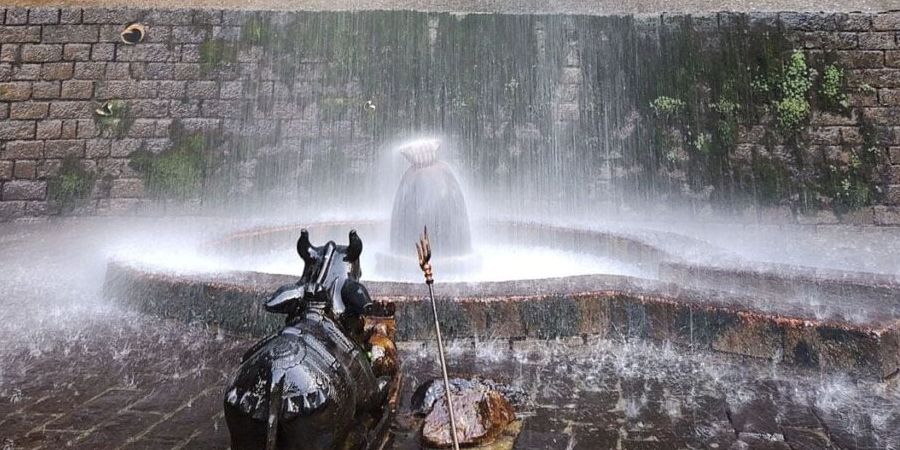


The water hits the black rock face at roughly 40 feet, splitting into threads of white before pooling at a formation that, from a certain angle and in a certain light, resembles a Shivling. It's late September in the Solang Valley, and the mist is thick enough to taste — cold, mineral, faintly sweet. A group of pilgrims from Varanasi stands ankle-deep in the icy runoff, chanting, their breath visible. Behind them, the trail they've just walked still glistens with overnight rain.
Anjani Mahadev Temple sits at roughly 7,000 feet above sea level, about 20 kilometers from the center of Manali in Himachal Pradesh, and it occupies a peculiar place in the region's spiritual geography — neither a grand temple complex nor a simple wayside shrine, but something that uses the raw terrain itself as its architecture. The Shivling here isn't carved by human hands. It's formed by the waterfall, by mineral deposits and erosion, by the slow geological patience of the Himalayas. For the devout, that's precisely the point. For the skeptical traveler, the setting alone justifies the two-hour trek through deodar forest and alpine meadow. This is a place where the line between pilgrimage and hike dissolves entirely, and where the mountain does most of the talking.
Before the Temple Existed, the Mountain Already Had a Name
Pinning exact dates to Anjani Mahadev Temple is an exercise in frustration, and that's partly by design. Local oral traditions in the Kullu Valley rarely bother with chronology the way historians prefer. What's known is that the site has been a point of worship for Shiva devotees for centuries, long before the current pathway was carved out or the small shrine structure was added near the waterfall's base. The earliest references to the site appear in the folk songs of Kullu, where the valley's connection to Hindu mythology runs deep — the Kullu Dussehra festival, after all, centers on Lord Raghunath and draws from Ramayana traditions that predate the Mughal era.
The name "Anjani" connects the site to Anjana, the mother of Lord Hanuman, and it's this Ramayana-era association that gives the temple its particular character. Unlike most Shiva shrines in the region, which tie to Shaivite lineages or Nath traditions, this one braids Shiva worship with the Hanuman origin story. That dual identity is unusual in Himachal Pradesh, where temples tend to claim a single mythological thread and hold it tight.
The temple's modern history is more modest. The Solang Valley itself was primarily known to shepherds and seasonal herders before tourism infrastructure reached it in the 1980s and 1990s. The trail to Anjani Mahadev likely served as a grazing route before it became a pilgrim path. You can still see evidence of this — stone cairns along the trail that predate any religious markings, placed by Gaddi shepherds navigating the slopes with their flocks.
What's counterintuitive is that the temple's growing fame hasn't eroded its isolation. The trek filters out casual visitors. The mountain imposes its own entry fee in sweat and lung capacity, and that physical barrier has done more to preserve the site's atmosphere than any heritage regulation could.
Anjana's Meditation and the Shivling No Sculptor Touched
The mythology around Anjani Mahadev is a layered thing, and the layers don't always agree with each other. The most commonly told version holds that Anjana — a celestial being cursed to live on earth as a mortal — performed intense penance to Lord Shiva at this exact spot in the mountains. Her devotion was so absolute that Shiva blessed her with the boon that the god Vayu would grant her a son. That son, according to the tradition, was Hanuman, the monkey god central to the Ramayana.
The Shivling formed by the waterfall is the narrative's physical anchor. Pilgrims treat the naturally occurring rock formation not as a geological curiosity but as a direct manifestation of Shiva's presence — proof, in their framework, that divinity shaped the stone rather than human craft. The absence of a sculptor's hand is the whole argument. It's an interesting inversion of the logic that governs temple art elsewhere in India, where the beauty of human carving is itself considered an offering to the gods.
Local priests in the Kullu Valley add details that don't appear in any standardized Ramayana text. Some claim that the cave behind the waterfall was Anjana's meditation chamber. Others say that Shiva himself appeared in the waterfall during her penance, and the formation we see today is the frozen echo of that apparition. These embellishments vary from guide to guide, priest to priest, season to season. That fluidity is itself revealing — the mythology at Anjani Mahadev is still alive, still being shaped by the people who tell it.
For the traveler without a devotional stake, the myth still matters. It determines the mood of the place. It shapes how people behave at the waterfall — with quiet awe rather than selfie-stick bravado. Belief, here, functions as a kind of atmosphere control.
The Solang Valley's Best-Kept Secret Sits Above the Ski Slopes
Solang Valley is typically associated with paragliding operators, snow-sport tourists, and the traffic jams they create on the narrow road from Manali. The temple sits above all of this — literally and temperamentally. From the trailhead near Solang village, you climb north through a mixed forest of deodar cedar, blue pine, and birch, gaining roughly 1,500 feet of elevation over about four kilometers. The valley floor, with its ziplines and quad-bike rental stalls, disappears within the first twenty minutes of walking.
The setting changes character with altitude. The lower trail passes through grassy clearings where horses graze and where, in spring, wild iris and primula push through the softening ground. Higher up, the forest thins and the terrain turns rockier, exposing views of the Pir Panjal range to the north. On clear days, you can make out the ridgeline that separates the Kullu Valley from Lahaul — a geological wall that also serves as a climatic one, keeping the monsoon on one side and the rain shadow on the other.
The temple's immediate surroundings have a cirque-like quality. The waterfall drops from a cliff face that curves inward, creating a natural amphitheater of dark rock and moss. Mist from the falls keeps the air permanently damp, and the temperature here can be 10 degrees Celsius cooler than at the trailhead, even in July. Ferns cling to every ledge. The sound of falling water fills the space completely — not a background sound but the dominant acoustic presence.
What surprises most visitors is the absence of any settlement. There's no tea stall, no guesthouse, no permanent structure beyond the small shrine. The mountain gives you the temple and nothing else. You carry your own water, your own food, and your own willingness to walk back down before dark.
Where Mineral Deposits Become a God's Signature
The waterfall at Anjani Mahadev doesn't behave the way most visitors expect. It's not a single dramatic curtain of water but a dispersed cascade, splitting across the rock face into multiple streams depending on the season and recent rainfall. During the monsoon months of July and August, the flow is heavy enough to obscure the Shivling formation entirely — you know it's there, but the water buries it. The clearest views come in late September and October, when the flow diminishes and the mineral-stained rock stands exposed, pale gray with streaks of white calcite deposit that reinforce the Shivling's organic shape.
These deposits are the geological engine of the whole site's mythology. Calcium carbonate, leached from the limestone above, gets redeposited as the water slows and evaporates across the rock surface. The process is identical to stalagmite formation in caves, just open to the air. Over decades — centuries, likely — this has built up the smooth, tapered form that devotees recognize as a Shivling. The shape isn't accidental, but it isn't supernatural either. It sits in that ambiguous zone where geology and faith share the same evidence.
Pilgrims pour milk and water over the formation, an abhishek ritual you'll find at Shiva temples across India. Here, the ritual feels less performative because the waterfall is already doing the pouring. You're joining a process the mountain started long before you arrived. The water is bracingly cold — snow-fed, originating from the upper Solang glacial area — and touching it is a full-body shock that works as its own kind of awakening, spiritual or otherwise.
The pool at the base is shallow, rarely more than knee-deep, with a gravel bottom that shifts underfoot. Priests who maintain the site periodically clear debris after heavy rains but otherwise let the water do what it will. The waterfall, in this sense, is both the deity and the devotee — endlessly performing its own worship.
A Shrine Built by Gravity, Not Architects
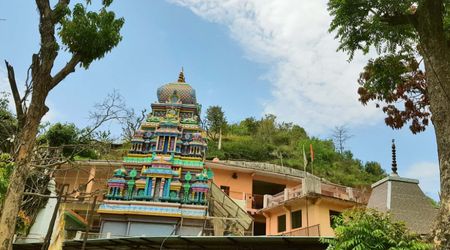
Don't come to Anjani Mahadev expecting the stone-carved grandeur of Kedarnath or the painted elaboration of a Kullu Valley devta temple. The human-made structure here is almost comically modest: a small open-sided shelter with a corrugated roof, a few tridents (trishuls) planted in the ground, and a collection of bells that pilgrims tie to a metal frame. The construction uses local stone and basic cement. There's no gopuram, no mandapa, no sanctum in the traditional sense. The sanctum is the waterfall itself.
This minimalism isn't poverty — it's philosophy. The entire architectural argument of the site is that nature provides the temple. The cliff face serves as the back wall. The cirque of rock overhead acts as a canopy. The waterfall performs the eternal abhishek. Human additions are kept deliberately subordinate, almost apologetic. A few orange and red flags mark the spot where visitors leave offerings — flowers, coconut, incense — but these feel provisional, like annotations in the margin of a much older text.
The trishuls deserve specific attention. Planted in clusters near the shrine, some are decades old, rusted to the color of dried blood. Others are newer, wrapped in red cloth. Each one represents a vow fulfilled or a prayer offered, and their accumulation creates an unintentional sculpture garden — metal spikes rising from moss-covered ground, catching light between the trees. It's one of the most visually striking elements of the site, and it owes nothing to any design plan.
The absence of formal architecture creates a practical consequence too: there's no entry fee, no queue system, no ticket counter, no opening or closing time. The temple operates on the honor system of the Himalayas. You come, you pay your respects, you leave. The mountain doesn't keep business hours.
Two Hours Uphill Where Every Shortcut Is a Lie
The trek to Anjani Mahadev starts from a point near Solang Valley's main road, roughly 14 kilometers from Manali's Mall Road. Most visitors reach the trailhead by taxi or by the local bus service that runs to Solang. From there, you walk. There is no motorable road to the temple, no ropeway, no shortcut that doesn't cost you in slippery ground and lost elevation. The trail is approximately four kilometers one way, and the ascent takes between 90 minutes and two and a half hours depending on fitness, weather, and how often you stop to let your heart rate return to a reasonable number.
The path is well-marked but uneven. The lower section follows a wide dirt track through forest, where roots cross the trail at irregular intervals and the ground stays damp even in dry weeks. Higher up, the track narrows and steepens, with loose stones that roll underfoot. Trekking poles help. Sturdy shoes are not optional — people attempt this in sandals every season and regret it within the first kilometer. Locals sometimes offer mule rides for a portion of the route, though the mules tend to look as unenthusiastic about the gradient as you feel.
The trek's most underappreciated feature is its soundscape. The forest muffles the Solang Valley's tourist noise within minutes. You hear birdsong — nuthatches, laughingthrushes, the occasional flash of a Himalayan monal's call. Streams cross the path in three places, and each one forces a small recalibration: step on the wet rocks or leap and hope. These micro-decisions accumulate into a physical attentiveness that changes how you arrive at the temple. You don't just show up. You earn the place with your legs and lungs.
The return is faster but harder on the knees. Descending on loose stone demands more concentration than climbing, and the afternoon light fades fast once you drop below the treeline. Plan to start back by 3 PM at the latest if you're visiting between October and March.
What to Pack, When to Go, and What Nobody Tells You First
The best window for visiting Anjani Mahadev runs from May through October, with two distinct experiences on either end. May and June offer dry trails and wildflowers but also larger crowds — the Manali tourist season overlaps with the pilgrimage calendar. July and August bring the monsoon: the waterfall swells to its most dramatic, but the trail turns treacherous with mud, leeches appear on the lower sections, and fog can reduce visibility to a few meters. September and October hit a sweet spot — diminishing crowds, clear skies, and the Shivling formation at its most visible as the water flow eases.
Key practical details to carry with you:
- No food or water is available on the trail or at the temple — carry at least two liters of water and energy snacks per person.
- Waterproof layers are essential even in summer; the microclimate near the falls is permanently cold and damp.
- Mobile network coverage is unreliable above the first kilometer — don't depend on GPS navigation or emergency calls.
- The nearest medical facility is in Manali town; the trailhead area has no first-aid resources.
- No accommodation exists near the temple — this is strictly a day trek, and you'll return to Manali or Solang for the night.
Taxis from Manali to the Solang trailhead cost between 800 and 1,200 rupees one way, negotiable depending on season. The HRTC bus to Solang is cheaper but runs on a limited schedule. If you're staying in Old Manali, add an extra 30 minutes for the drive to the trailhead. There's no entrance fee, no registration, and no permit requirement — just the trail, the forest, and whatever you're willing to carry on your back and in your head.
One thing nobody mentions in advance: the final approach to the waterfall involves crossing a stretch of wet rock with no railing. It's manageable but demands attention. Rushing the last hundred meters is how ankles get twisted and pilgrimages end early.
Anjani Mahadev Temple resists the usual categories. It's not a heritage monument, not a trekking destination, not a pilgrimage site in the institutional sense — and yet it functions as all three simultaneously. The place reminds you that the oldest temples on earth weren't built at all; they were found. A waterfall shapes rock into something that looks like devotion, and people walk uphill for two hours to stand in the cold spray and feel whatever it is they came to feel. Manali's main strip, with its cafes and fleece-jacket shops, sits just 20 kilometers away but belongs to an entirely different universe. Anjani Mahadev exists in the gap between geography and belief, and the only way to understand that gap is to lace up your boots and walk into it yourself.