

Jakhu Temple sits on the highest point in Shimla, which is itself the capital of Himachal Pradesh and a town that has spent a century and a half negotiating between its British Raj inheritance and its Hindu devotional roots. This single hilltop manages to hold both — the legacy of colonial summer retreats and one of the most venerated Hanuman shrines in northern India. The temple draws pilgrims, tourists, fitness walkers chasing the steep 2-kilometre climb, and troops of rhesus macaques who have claimed the surrounding forest with a territorial confidence that borders on intimidation. What follows traces the mythology embedded in these stones, the reality of the climb, and the strange ecosystem of faith, monkeys, and mountain light that makes Jakhu unlike any other temple perch in the Indian Himalayas.
Where Hanuman Paused Mid-Flight and Left a Footprint in Stone
The origin story of Jakhu Temple belongs to the Ramayana, and specifically to one of its most dramatic episodes. When Lakshmana, brother of Lord Rama, lay wounded in battle against Ravana's forces, the physician Sushena prescribed a herb — Sanjeevani — found only on the Dronagiri mountain in the distant Himalayas. Hanuman flew north to retrieve it. According to local belief, he rested briefly on this peak during that flight, and the impression of his foot left a permanent mark on the rock. The temple was built around that mark.
Whether you accept the literal footprint or treat it as devotional symbolism, the story has anchored this hilltop in Hindu sacred geography for centuries. The temple's age is difficult to pin down with precision. Some local accounts place its origins in the early medieval period, though the current structure reflects renovations and additions spanning the last several hundred years. No single historical record provides a definitive founding date, which is itself typical of many Himalayan shrines where oral tradition outpaces written documentation by generations.
The name "Jakhu" is widely understood as a derivation of "Yakhsha," referring to the nature spirits of Hindu and Buddhist cosmology who were believed to guard the forests and mountains of this region. That etymological thread connects the temple to a much older layer of belief — pre-Brahmanical, animist, tied to the worship of mountain spirits rather than the Vaishnavite tradition that now dominates the site. You can feel that layering if you pay attention: the deodars surrounding the temple are themselves considered sacred in Himachali folk religion, and the forest's density suggests that this hilltop has been left deliberately uncleared for a very long time.
The Ramayana connection gives Jakhu its fame. But the older, quieter story — of a peak so high it attracted worship before anyone gave the gods proper names — gives it something less marketable and more interesting: depth.
A 108-Foot God and the Architecture of Accumulated Devotion
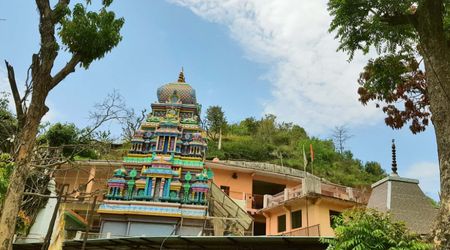
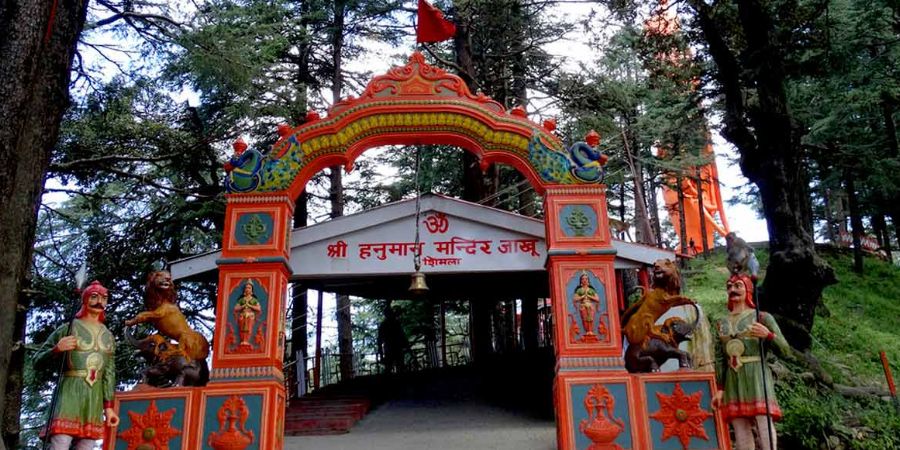
The temple itself is modest. If you arrive expecting the scale of Varanasi's ghats or the ornamental density of a South Indian gopuram, Jakhu will disappoint you — and that disappointment is part of its character. The main shrine is a compact stone-and-wood structure, its interior dim and smoky with ghee lamps, centred on the Hanuman idol that pilgrims come to touch and garland. The floor is cool underfoot. The ceiling is low. The space forces intimacy with the ritual rather than spectacle.
Outside, however, scale arrives in a single gesture. The 108-foot statue of Hanuman, completed in 2010, dominates the summit and is visible from much of Shimla. It was designed and installed under the direction of the temple trust, and its sheer size has divided opinion since its unveiling. Some devotees find it a fitting tribute to the deity's mythological power. Others — including a few local architects I spoke with — consider it aesthetically jarring against the forested peak, a piece of devotional maximalism that overwhelms the subtlety of the original shrine. Both views have merit, which is what makes the statue interesting rather than merely large.
The surrounding complex includes smaller shrines, a courtyard where priests perform aarti ceremonies at dawn and dusk, and a series of stone pathways worn smooth by foot traffic. The building materials reflect what was locally available across different eras: Himalayan stone, deodar wood, and more recent concrete additions that haven't aged with the same grace. No single architectural vocabulary governs the site.
What the temple lacks in stylistic coherence, it compensates for in atmospheric density. The combination of forest canopy, incense smoke, bell clappers ringing in the wind, and the distant murmur of pilgrims chanting creates a sensory environment that architecture alone couldn't produce. The building is a vessel. The experience is everything around it.
The 2-Kilometre Climb That Earns You Half of Himachal Pradesh
Most visitors begin the walk from the Ridge, Shimla's central open plaza, or from Christ Church — the yellow neo-Gothic building that appears on every postcard the town has ever produced. From there, the path to Jakhu climbs steeply through deodar forest along a paved but uneven trail that will take anywhere from 30 to 50 minutes depending on your fitness and your willingness to stop for the macaques. A ropeway also operates on the route now, cutting the journey to minutes, but it removes the part of the experience that makes arrival feel earned.
The climb is the view, or rather, the views multiply as you gain elevation. At lower points, you catch angled glimpses of Shimla's layered rooftops through gaps in the tree cover. Higher up, the Shivalik foothills begin to reveal themselves, ridge after green ridge receding toward the plains of Punjab. On clear winter mornings, the snow-draped peaks of the Pir Panjal range become visible to the northeast — a sight that requires no embellishment, only clean air and luck.
The path itself deserves attention. Sections of it are lined with small painted stones and faded signage from the forest department. The air temperature drops perceptibly as you climb. Sound changes too: the traffic noise of Shimla's lower town fades, replaced by wind in the deodars, the cracking of branches, and — inevitably — the bark-scream of monkeys asserting their presence in the canopy above. It's a walk that recalibrates your senses incrementally, so that by the time you reach the summit, the quiet feels like something you've earned through effort rather than stumbled into by accident.
The counterintuitive thing about Jakhu's elevation is that the views downward are more arresting than the views outward. Watching Shimla from directly above — seeing the chaos of its construction, the way buildings cling to slopes that seem to reject them — teaches you more about the town than any heritage walk through the Mall ever could.
The Rhesus Macaques Who Own the Mountain and Know It
Every travel account of Jakhu Temple mentions the monkeys, usually with a note of charm. Here's the less charming reality: the rhesus macaques of Jakhu Hill are aggressive, numerous, and highly habituated to human food. They will take your glasses off your face. They will unzip your bag. I watched one peel open a sealed plastic water bottle with a technique that suggested years of practice. The temple trust and local authorities have posted warnings, and vendors at the base of the trail sell bamboo sticks for the walk — not as hiking aids, but as deterrents.
The monkeys' presence is theologically consistent with the temple's identity. Jakhu is a Hanuman shrine, and Hanuman is the monkey god. Pilgrims feed the macaques as an act of devotion, which has inflated the troop's numbers over decades and made them bolder with each generation. The feeding creates a feedback loop: more food attracts more monkeys, more monkeys attract more visitors bearing offerings, and the animals grow increasingly assertive in extracting those offerings whether they're freely given or not.
Wildlife officials have periodically attempted population management and relocation, with mixed results. The macaques are protected under Indian wildlife law, and any intervention draws opposition from religious groups who view the animals as sacred extensions of the deity. The situation is genuinely complicated — a collision of animal behavior, religious sentiment, municipal governance, and tourist expectations that nobody has cleanly resolved.
Your best strategy is practical: carry nothing visible in your hands, keep bags zipped and held close to your body, avoid making direct eye contact with any macaque that approaches, and don't eat anything on the trail. The monkeys are not dangerous in the medical sense — bites are rare — but they are opportunistic with a sophistication that would impress a pickpocket. Treat them with the respectful wariness they deserve, and you'll be fine. Treat them as cute photo subjects, and you'll learn quickly why the locals carry sticks.
Getting There, Getting In, and Getting the Timing Right
Shimla is accessible by air through Jubbarhatti Airport, roughly 23 kilometres from the town centre, with limited domestic connections. The more common approach is by road from Chandigarh (about 4 to 5 hours by car or bus) or by the narrow-gauge Kalka-Shimla railway, a UNESCO-listed route that takes approximately 5 hours and passes through 102 tunnels. From Shimla's main town area — the Ridge, the Mall, or Lakkar Bazaar — the walk to Jakhu Temple is roughly 2 kilometres uphill. The ropeway from the Ridge offers a faster alternative for those unable or unwilling to climb.
The temple is open daily, generally from early morning (around 5:00 or 6:00 AM) through evening (around 9:00 PM), though timings can shift with the season. There is no entry fee for the temple itself. The ropeway charges a separate fare. A few practical considerations worth noting:
- Wear sturdy closed-toe shoes — the trail surface is uneven stone and concrete, slippery after rain.
- Visit early morning or late afternoon to avoid both midday heat in summer and the peak crowd window between 10:00 AM and 2:00 PM.
- Winter mornings (November through February) offer the clearest long-range visibility but temperatures at the summit can hover near freezing — layer accordingly.
- Secure all loose items before beginning the climb; the monkeys are most active along the middle stretch of the trail.
- Carry water but keep the bottle inside your bag, not in hand or in an external pocket.
The best time to visit Jakhu is arguably late October through early December, when the post-monsoon air is clean, the tourist crowds thin after Dussehra, and the deodars along the trail catch low-angled light that turns them almost copper. Spring (March to April) is the secondary sweet spot, with wildflowers along the trail and manageable temperatures. Monsoon months (July through September) bring mist that can erase the views entirely, though some walkers prefer the atmospheric drama of climbing through cloud.
What the Hilltop Connects To If You Keep Exploring
Jakhu Temple works as a standalone morning excursion, but it gains depth if you treat it as a starting point rather than a destination. The Ridge and Mall Road sit directly below — Shimla's colonial-era promenade, where the Gaiety Theatre still stages performances in a hall the British built in 1887. Christ Church, visible from the Jakhu trail, contains stained-glass windows that have survived earthquakes, independence, and more than a century of Himalayan weather. The Indian Institute of Advanced Study, housed in the former Viceregal Lodge on Observatory Hill, is a 20-minute walk from the Ridge and offers guided tours of a building where the partition of India was discussed in the 1940s.
For those drawn further afield, the Chadwick Falls trail leads through dense forest about 7 kilometres from the town centre. The Glen, a forested valley below Shimla's western slope, offers quieter walking than any route in the main town. Kufri, about 13 kilometres east, provides higher-altitude views and — in winter — rudimentary skiing that locals take more seriously than visitors expect.
Shimla's food culture operates in layers too. The street vendors around Lakkar Bazaar serve momos and thukpa that reflect the Tibetan influence across Himachal's upper valleys. The older restaurants along the Mall — places that have been open since the 1960s and '70s — still serve a style of north Indian cooking adapted to hill-station ingredients: mustard greens, kidney beans, and the dense, slightly sour bread called siddu that doesn't travel well beyond these altitudes.
The thread connecting Jakhu to all of this is elevation. Shimla exists because the British needed to escape the heat of the plains, and every site in the town — religious, colonial, culinary — is shaped by the fact that it sits on a ridge that shouldn't logically support a city of this size. Jakhu is simply the highest expression of that improbability.
Shimla has spent a century trying to be two things at once: a place of retreat and a place of pilgrimage, a colonial artifact and a living Hindu town. Jakhu Temple, perched at the city's literal summit, doesn't resolve that tension — it embodies it. The 108-foot Hanuman gazes out over a skyline still studded with Tudor-revival rooflines. Monkeys sacred to one tradition raid the lunches of tourists who came for the Raj-era charm. The mountain doesn't care about the contradiction; it holds everything without choosing.
If you climb to Jakhu expecting a simple temple visit, you'll get one. But if you pay attention to the layers — geological, mythological, colonial, ecological — you'll find something harder to categorize and harder to forget. The highest point in any hill town always reveals more about the town than about the sky. Jakhu reveals Shimla not as a postcard but as a place still arguing with itself about what it wants to be, 2,455 metres closer to an answer it hasn't reached.