

The sound arrives before the sight. A deep, resonant gong rolls across the bazaar, cutting through the noise of auto-rickshaws, haggling vegetable vendors, and the persistent bleat of a goat that has wandered into traffic. You look up. There it is — Ghanta Ghar, Jaipur's clock tower, rising above the salmon-pink storefronts of Johari Bazaar like a vertical punctuation mark in a run-on sentence of commerce. The tower doesn't ask for your attention. It claims it.
Built in the late nineteenth century under the patronage of Maharaja Sawai Madho Singh II, this structure has been marking time in a city that moves to its own rhythm. The clock still works. The bazaar below still sells lac bangles and silver anklets at prices that reward patience and punish haste. What makes Ghanta Ghar more than a municipal landmark is its stubborn centrality — geographically, historically, and socially — to Jaipur's daily life. It stands at the intersection of four bazaars, each radiating outward like the spokes of a wheel, each with its own specialty trade. This is not a monument preserved under glass. It's a functioning urban organ, pumping foot traffic and commerce through the old city's arteries every single day.
How a Maharaja's Ambition Gave Jaipur Its Vertical Anchor
Maharaja Sawai Madho Singh II commissioned Ghanta Ghar in the 1880s, a period when Jaipur's rulers were eager to demonstrate that a princely state could be both traditional and modern. The clock tower wasn't merely decorative. It was a civic statement — a way of imposing standardized time on a city where work and prayer had previously followed the sun and the temple bells. The British had brought railways to India, and railways demanded punctuality. Jaipur's rulers understood this before most of their counterparts.
The original structure was completed during a phase of significant urban development within the walled city. Madho Singh II, who ruled from 1880 to 1922, invested heavily in public infrastructure, and Ghanta Ghar fit neatly into a broader program of modernization that included improved water supply and road widening. The tower was positioned with deliberate precision at the hub of the city's commercial network, ensuring that its clock face could be seen from the maximum number of approaches.
What's often overlooked is that the tower also served as a kind of social equalizer. Before Ghanta Ghar, time was a private luxury — owned by those who could afford pocket watches imported from Europe. The tower made time public, communal, and democratic. A laborer in the dye market and a gem dealer in Johari Bazaar now shared the same hour. That shift was more radical than it sounds.
The tower has survived two major restorations and countless monsoons. Its sandstone base has darkened with age, but the structure remains plumb. Jaipur's municipal authorities maintain it as a functioning timepiece, not a ruin. The distinction matters. Ghanta Ghar was built to serve a city, and over a century later, it still does — not as heritage tourism, but as an active reference point for shopkeepers, rickshaw drivers, and pedestrians who navigate the old city by its silhouette.
Why Jaipur's Terracotta Palette Makes the Tower Impossible to Ignore
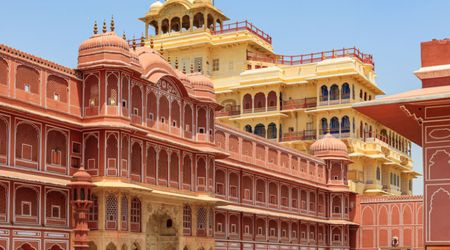
Jaipur earned the nickname "Pink City" in 1876, when Maharaja Sawai Ram Singh had the entire old city painted terracotta-pink to welcome the Prince of Wales. The color stuck, enforced by municipal law to this day. Every building within the walled city must maintain this hue, which means Ghanta Ghar doesn't stand against a neutral backdrop — it rises from a monochrome stage that amplifies its presence. The uniformity of Jaipur's streetscape is the tower's greatest theatrical advantage.
The pink isn't actually pink. Stand close to any wall in the old city and you'll see it's closer to burnt sienna, a dusty terracotta that shifts in tone depending on the time of day. At noon, the buildings flatten into a chalky sameness. At dusk, the entire city glows like a kiln, and Ghanta Ghar catches the last light on its upper registers while the bazaars below fall into shadow. That contrast — illuminated tower, darkened market — is the image most photographers chase and most arrive too late to capture.
The city's grid plan, designed by Bengali architect Vidyadhar Bhattacharya in 1727, arranged Jaipur's streets in a nine-block layout inspired by principles from the Vastu Shastra and the Shilpa Shastra. Ghanta Ghar sits near the center of this grid, which means the straight, wide avenues leading to it create sightlines that few other Indian cities can match. You can spot the tower from blocks away, framed between symmetrical rows of shops, their arched facades repeating in perspective like a lesson in vanishing points.
The city doesn't just frame the tower — it contextualizes it. Ghanta Ghar makes sense only because Jaipur makes sense. A clock tower dropped into Delhi's chaotic sprawl would disappear. Here, against that disciplined, color-coded grid, it reads as the logical conclusion of a city designed with order as its first principle.
Sandstone, Symmetry, and a Deliberate Refusal to Be European
Ghanta Ghar blends Rajput and Mughal architectural elements with a confidence that avoids pastiche. The base is broad and heavy, constructed from locally quarried sandstone that anchors the structure visually and physically to the Jaipur streetscape. Above this, arched openings and ornamental jali screens — perforated stone latticework — introduce the kind of decorative lightness that characterizes much of Rajasthani palace architecture. The effect is vertical without being imposing, detailed without being cluttered.
The tower rises in tiers, each slightly narrower than the one below, creating a telescoping profile that draws the eye upward toward the clock mechanism at the summit. Chhatris — small domed pavilions — crown the structure in a distinctly Rajput gesture. These aren't functional; they're symbolic markers of royal patronage, the architectural equivalent of a signature. You'll find the same elements on the Hawa Mahal and the City Palace, which creates a visual vocabulary that ties Ghanta Ghar to Jaipur's broader architectural identity.
The counterintuitive detail is what's absent. During this period, many Indian rulers hired European architects or borrowed European Gothic elements for their civic buildings — pointed arches, flying buttresses, clock towers that could pass for English parish churches. Ghanta Ghar doesn't. Its proportions, materials, and ornamentation are rooted in regional traditions, even though the clock itself was a Western import. That choice seems deliberate: the technology could be foreign, but the building had to be Jaipur's own.
Close inspection reveals skilled stonework in the carved brackets and pilasters that divide the tower's facades. The masons used the same techniques employed in the construction of Jaipur's older havelis, ensuring that the clock tower, despite its modern purpose, spoke a familiar architectural language to the citizens who passed beneath it daily.
The Mechanism That Outlasted the Empire It Was Built To Impress
The clock faces on Ghanta Ghar are visible from the four cardinal directions, each oriented to serve a different bazaar corridor. The original mechanism was mechanical, weight-driven, and required manual winding — a task performed by a designated caretaker whose family, according to local accounts, maintained the clock across multiple generations. The bell that gives the tower its name — ghanta means bell in Hindi — is large enough to produce a sound that carries well beyond the immediate bazaar, a low tone that still marks the hours for anyone within earshot.
Mechanical tower clocks of this vintage demand constant attention. Dust, heat, and Jaipur's dramatic temperature swings between desert days and cool nights stress every moving part. The clock has been repaired and partially modernized over the decades, but the core function remains unchanged: it tells time, publicly, from a height. There's something stubbornly analog about this in a city where every shopkeeper now carries a smartphone. The clock doesn't compete with those devices. It predates them, and it will likely outlast them.
The bell itself has become a kind of auditory landmark. Locals who've grown up in the old city describe orienting themselves by its sound rather than its sight, particularly during the monsoon months when low cloud cover and rain obscure the tower from street level. Sound travels well through Jaipur's grid — the straight, wide streets act as channels — which means Ghanta Ghar's bell reaches ears in neighborhoods that can't see its face.
The British Raj, which spurred the proliferation of public clocks across India, dissolved in 1947. The clock didn't care. It kept running under municipal jurisdiction, marking hours for a republic instead of a raj, indifferent to the political rearrangements happening at its feet. That durability isn't sentimental. It's mechanical. Good engineering doesn't require context.
Jaipur Unfolded Flat: What the Tower Shows You That the Street Conceals
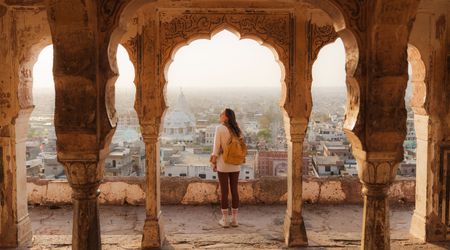
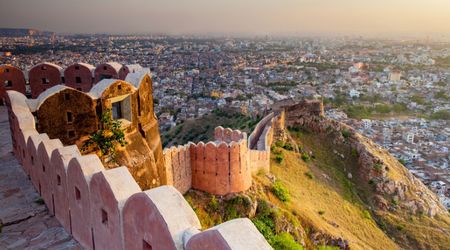
From street level, Jaipur's old city is a dense, horizontal experience — shopfronts pressing against one another, awnings overlapping, power lines crisscrossing overhead like tangled thread. Climb to the upper levels near Ghanta Ghar and the city snaps into geometric order. The grid layout that Vidyadhar Bhattacharya designed nearly three centuries ago becomes legible for the first time. The bazaar corridors run straight and true, intersecting at right angles, and the rooftops form a low, uniform surface interrupted only by temple spires and the distant silhouette of Nahargarh Fort on the Aravalli ridge.
The fort sits on the hill to the north, its crenellated walls following the contour of the ridge like a line drawn by a ruler that slipped. To the east, the Hawa Mahal's honeycomb facade is visible from elevated vantage points near the tower — a building that looks, from above, almost impossibly thin, more screen than structure. The Aravalli Hills themselves form a serrated horizon in nearly every direction, dry and scrubby, the color of a week-old bruise.
What surprises most visitors is the rooftop life they couldn't see from below. Families dry papadums and chilies on flat rooftops. Kite strings — sharp with manja, the abrasive glass coating used in kite fights — stretch between terraces. Pigeons wheel in coordinated clouds above grain markets, their movements synchronized by some avian consensus invisible to anyone at ground level. The view from elevation doesn't replace the street experience. It corrects it.
Look down instead of out and you'll see the bazaar as a living organism — foot traffic flowing through intersections, pooling around popular stalls, and draining through narrow side alleys. The tower's position at this central node means you're watching the city's circulatory system from the vantage of its heart.
Four Bazaars, One Crossroads, and a Palace Around the Corner
Ghanta Ghar stands at the confluence of Jaipur's four principal bazaars: Johari Bazaar to the south, Kishanpol Bazaar to the west, Sireh Deori Bazaar to the east, and the northern stretch leading toward the City Palace. Each market specializes. Johari Bazaar trades in jewelry and gemstones — Jaipur is one of the world's largest cutting centers for emeralds and semi-precious stones, and much of that trade still flows through ground-floor workshops on this street. Kishanpol deals in textiles, particularly the block-printed cotton and bandhani tie-dye fabrics that Rajasthan is known for.
Walk five minutes east from the tower and you reach the City Palace complex, still partially occupied by the royal family. The Jantar Mantar — Maharaja Sawai Jai Singh II's extraordinary collection of astronomical instruments, built from masonry rather than metal — sits adjacent to the palace. The largest sundial on the site, the Samrat Yantra, stands twenty-seven meters tall and can measure time to an accuracy of two seconds. Jaipur's rulers had an obsessive relationship with time long before Ghanta Ghar arrived.
The Hawa Mahal is a two-minute walk south. Its 953 small windows were designed to allow the women of the royal household to observe street processions without being seen — a building engineered around the act of looking. The irony is that it's now the most looked-at building in Jaipur, photographed millions of times annually by people standing in the very street it was designed to surveil.
This density of heritage within a few hundred meters of Ghanta Ghar isn't coincidental. The clock tower sits at the center because the city was designed with a center. Everything radiates from this point — commerce, royalty, worship, spectacle. You don't visit Ghanta Ghar and then go find the old city. You visit Ghanta Ghar and discover you've already been standing in it.
Arriving, Surviving, and Knowing When to Show Up
Jaipur's old city operates on a schedule that rewards early risers and punishes afternoon visitors. The bazaars around Ghanta Ghar open by 10 a.m., but the best light — and the thinnest crowds — arrive between 7 and 8 in the morning, when shopkeepers are still hosing down their storefronts and the chai stalls are producing their first rounds. By noon, the sun turns the pink streets into a reflective oven, and the sensible retreat to shaded interiors. Return after 4 p.m. and the bazaars revive, trading well into the evening.
Getting there is straightforward. The tower is roughly two kilometers from Jaipur Junction railway station — a quick auto-rickshaw ride that should cost between fifty and one hundred rupees, though you'll need to negotiate. Uber and Ola operate in Jaipur and eliminate the haggling. If you're coming from the Amer Fort area, about eleven kilometers north, expect a thirty-to-forty-minute drive depending on traffic.
Practical considerations worth carrying in your head:
- October through March offers the most comfortable weather, with daytime temperatures between 15 and 25 degrees Celsius — manageable for extended walking.
- The bazaars close on Sundays and during major Hindu festivals, so check locally before planning a visit around the markets.
- Carry small denomination notes; vendors near the tower rarely have change for five-hundred-rupee bills early in the day.
- Footwear matters — the streets around Ghanta Ghar are uneven stone, occasionally slick with vegetable runoff, and you'll be on your feet for hours if the markets get their hooks into you.
Water is essential. Jaipur is a desert city, and dehydration sneaks up faster than you expect when you're distracted by silverwork and spice stalls. Carry a bottle, refill it at your hotel, and drink before you feel thirsty. The nearest decent meal to Ghanta Ghar is at the rooftop restaurants along Johari Bazaar, where you can eat dal baati churma — Rajasthan's signature dish of baked wheat balls with lentil soup — while watching the bazaar traffic below.
A clock tower, in most cities, is a minor landmark — something you glance at on the way to somewhere more important. Ghanta Ghar inverts that expectation. It doesn't point you toward Jaipur's history; it plants you at the exact coordinates where that history still operates as a living system. The bazaars haven't moved. The bell still sounds. The grid still holds. Three centuries of urban planning converge at this single intersection, and the clock overhead measures nothing more dramatic than the ordinary passage of hours in a city that was designed, from its first survey line, to make order feel effortless. The most honest thing a monument can do is remain useful, and Ghanta Ghar has never stopped being exactly that.