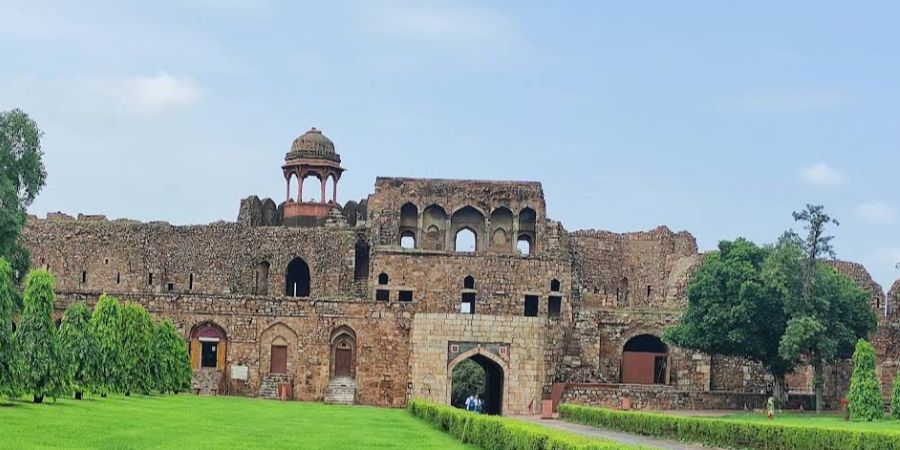


Purana Qila sits on a low mound in the middle of Delhi's Pragati Maidan area, flanked by a busy zoo on one side and a national crafts museum on the other, yet the moment you pass through its massive sandstone gateway, the city's honking, relentless sprawl feels like something that happened to someone else. This is a fort that predates the Mughal obsession with symmetry and marble inlay. Its walls are rougher, its history murkier, its stones layered with the ambitions of at least two empires and possibly a mythological one.
Archaeological excavations here have turned up painted grey ware pottery dating to around 1000 BCE, suggesting continuous habitation for three millennia. That makes Purana Qila not just old Delhi but possibly the oldest continuously occupied site in the city. What follows is a walk through the fort's tangled origins, the bitter rivalry that shaped it, the architecture that survived both neglect and partition, and the practical details you'll need to visit it without wasting half your day.
Three Thousand Years of Dirt: What Lies Beneath the Fort's Foundations
Most visitors assume Purana Qila — literally "Old Fort" — is a Mughal creation from the sixteenth century. The walls and gates are indeed Mughal-era, but the ground they stand on carries a far longer memory. Between 1954 and 1973, the Archaeological Survey of India conducted excavations inside the fort's perimeter and unearthed artifacts spanning from the Mauryan period through the Kushan, Gupta, and Rajput eras, pushing the site's occupation back well over two thousand years.
The discovery of painted grey ware pottery — the same type found at other Mahabharata-era sites across the Indo-Gangetic plain — fueled the longstanding claim that Purana Qila occupies the location of Indraprastha, the legendary capital of the Pandavas. No inscription or definitive structural evidence confirms this, and serious archaeologists remain cautious. But the stratigraphic layers don't lie: people have been living, building, and tearing down structures on this precise hillock for an extraordinarily long time.
The site likely held strategic value well before anyone thought to fortify it with sandstone. It rises gently above the surrounding floodplain of the Yamuna River, which once flowed much closer to the fort's eastern wall than it does today. That slight elevation offered both a defensive advantage and protection from seasonal flooding — enough to make it attractive to every successive power that controlled the Delhi region.
The Rajput Tomara dynasty reportedly built a settlement here in the tenth century. The Chauhans followed. Then the Delhi Sultanate swept through. Each layer was partially demolished and built over by the next occupant. By the time the second Mughal emperor arrived in the 1530s, he wasn't starting from scratch — he was inheriting a palimpsest. The fort you see today is the most recent page in a manuscript that keeps getting longer with every dig.
Two Emperors, One Fort, and a Rivalry That Carved It in Stone
Humayun, the second Mughal emperor, began constructing the fort around 1533 as the centerpiece of his new city, Dinpanah — "Refuge of the Faith." He chose the site deliberately, claiming continuity with the mythic Pandava capital. The ambition was immense: a walled citadel with gardens, mosques, and a library befitting a ruler who read more than he governed. But Humayun's administrative grip was weak, and in 1540, the Afghan warlord Sher Shah Suri defeated him at the Battle of Kannauj and seized the fort along with the empire.
Sher Shah didn't demolish Humayun's project. He completed it. The massive walls, the gates, and the principal structures you see today — the Qila-i-Kuhna Mosque, the Sher Mandal — largely date from Sher Shah's brief but vigorous five-year reign. He expanded the fortifications, added his own architectural vocabulary, and renamed the citadel Shergarh. The irony is sharp: the fort most associated with Mughal Delhi was finished by the man who kicked the Mughals out.
Humayun recaptured Delhi in 1555, just fifteen years after his exile. He moved back into the fort, restoring the name Dinpanah. Seven months later, he died after falling down the steep steps of the Sher Mandal — the very tower his rival had built. Whether he tripped because he was rushing to answer the call to prayer or because years of opium use had dulled his reflexes depends on which chronicler you trust. Either way, the fort absorbed this death as it had absorbed everything else: silently, without commentary.
The dual authorship makes Purana Qila architecturally schizophrenic in the best sense. You can read two competing visions in its stonework — Humayun's Persianate elegance and Sher Shah's blunt Afghan pragmatism — coexisting in a single compound. No plaque tells you which ruler laid which stone, but the fort doesn't need one.
Where Afghan Muscle Meets Persian Grace in Red Sandstone
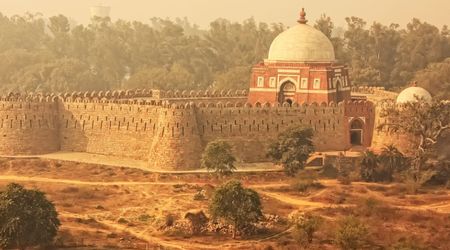
Purana Qila's walls run roughly 1.5 kilometers in circumference and rise to about eighteen meters at their highest points. They're built primarily from quartzite rubble faced with red sandstone — a combination that gives the fort a raw, martial character absent from later Mughal constructions like the Red Fort or Agra Fort, where marble and pietra dura refined the aesthetic into something approaching jewelry. Here, the stone still looks like it was cut for a fight.
The plan is roughly rectangular, oriented roughly north-south, with rounded bastions at intervals along the curtain wall. These bastions project outward to eliminate blind spots for defenders — a practical Afghan military design that Sher Shah's engineers understood instinctively. The walls slope inward slightly as they rise, a feature called a batter, which makes them harder to scale and more resistant to artillery impact.
Inside, the layout follows the conventions of a Mughal-era citadel without the obsessive axial symmetry that Shah Jahan would later impose on his projects. Buildings sit at angles that reflect functional priorities — proximity to water, orientation toward Mecca for the mosque, sightlines from the towers — rather than an overarching geometric scheme. The overall effect is less a designed garden city and more a fortified compound where architecture serves purpose first and beauty second.
The decorative elements that do appear concentrate around the gates and the mosque. Glazed tile work in blue, white, and yellow shows up in spandrels and framing arches, a technique Sher Shah's builders borrowed from the earlier Lodi and Tughlaq dynasties. The tile patterns are geometric and calligraphic, not figurative. They catch the afternoon light in a way that softens the military austerity of the surrounding walls, creating a brief, surprising contrast — as if the fort momentarily forgot it was built for war.
Three Entrances That Tell You Everything About Who Built Them
Purana Qila has three principal gates, each set into a different wall, and each carrying a distinct architectural personality. The Bara Darwaza — the "Big Gate" — faces west and serves as the main entrance for visitors today. It's the most imposing of the three, a double-storied structure flanked by massive semi-circular bastions. Two narrow staircases inside the bastions lead to the upper gallery, where guards once watched the approach road. The scale is designed to make you feel small, and it works.
The Humayun Darwaza, on the south wall, is named for the emperor who initiated the fort's construction. It's slightly less monumental than the Bara Darwaza but more refined in its decorative treatment, with carved stone brackets and remnants of the colored tile work that once covered much of its facade. The gateway's pointed arch sits within a larger rectangular frame — a characteristic Mughal device for creating visual depth on a flat surface.
The Talaqi Darwaza — the "Forbidden Gate" — occupies the north wall and remains sealed to this day. Local tradition holds that it was closed after a defeat or a superstitious event, though no reliable historical source confirms the specific reason. The name itself may derive from "talaq," meaning divorce or separation, suggesting it was permanently shut after some break or loss. Its closure gives it the strange power of a locked room: you can see the outline of the archway but not what it was meant to open onto.
Together, the three gates function as a cross-section of Indo-Islamic military architecture in the mid-sixteenth century. They combine Afghan defensive heft with Persian surface decoration, each gate balancing the two impulses slightly differently. The fact that only two of the three are open creates an accidental asymmetry that adds character — one gate invites you in, one lets you out, and one refuses to participate at all.
A Mosque Built for Prayers and a Tower That Killed an Emperor
The Qila-i-Kuhna Mosque, completed by Sher Shah Suri around 1541, stands as the most architecturally accomplished structure inside the fort. It's a single-aisle congregational mosque with five arched bays on its facade, each framed with white marble bands against the prevailing red sandstone. The central bay is taller and wider, drawing your eye to the mihrab niche that marks the direction of Mecca. Horse-shoe shaped arches, carved marble detailing, and remnants of blue and white tile create a surface density unusual for its period.
The mosque's interior is surprisingly intimate. The prayer hall's ceiling uses a mix of true arches and corbelled construction, an engineering transition point between the earlier Sultanate-era techniques and the fully developed Mughal vaulting that would follow within a few decades. Stand inside during a quiet afternoon and you'll notice how the acoustics soften footsteps and amplify whispers — a quality the builders almost certainly designed intentionally for Quranic recitation.
Directly across from the mosque sits the Sher Mandal, an octagonal two-story tower that Sher Shah built as a pleasure pavilion. Humayun later converted it into his personal library and observatory. The tower is compact — you can climb it in under a minute — but its steep, narrow stone staircase proved fatal. On January 24, 1556, Humayun heard the muezzin's call, stood quickly, caught his foot in the hem of his robe, and tumbled down. He died three days later from head injuries.
A small hammam, or bathhouse, also survives within the compound, though only its floor plan and fragments of its water channels remain legible. Together, these structures suggest a self-contained royal precinct where governance, worship, scholarship, and personal hygiene existed within a few hundred meters of each other — a compression that later Mughal forts would sprawl outward to dissolve.
The Lake That Shouldn't Exist and the Gardens That Almost Didn't
The artificial lake on Purana Qila's eastern side is a twentieth-century creation, not a Mughal-era feature. The moat that once surrounded the fort's walls was dry for centuries before civic planners in the 1960s flooded it to create a boating lake as part of the surrounding parkland. The result is visually striking — paddle boats drift past the fort's weathered walls in a scene that compresses eras recklessly — but it's worth knowing you're looking at a modern amenity dressed in historical clothing.
The lake water comes from the municipal supply, not from any natural spring or river diversion. During Delhi's drier months, the water level drops noticeably, exposing muddy banks and revealing the concrete edges that betray the lake's engineered origins. Migrating birds, particularly cormorants and painted storks, have claimed the lake as a winter stopover, giving it an ecological dimension that no one planned. Birders with long lenses are a common sight along the path from November through February.
The gardens inside and around the fort received significant restoration in the early 2000s. Lawns now fill the spaces between the mosque and the Sher Mandal, and neem and pilkhan trees provide patchy shade along the interior pathways. The plantings follow a simplified version of the char-bagh layout — four quadrants divided by water channels — though the channels themselves are dry and decorative. The effect at dawn, before tour groups arrive, is genuinely peaceful: crows bickering in the branches, a watchman's radio playing Bollywood songs at low volume, and the sandstone glowing the color of weak tea in early light.
An evening sound-and-light show operates seasonally, projecting historical narratives onto the fort's walls in Hindi and English on alternate evenings. The production quality varies. But the act of sitting on a plastic chair in the dark while a disembodied voice recounts Humayun's fall from the Sher Mandal carries a peculiar, almost theatrical gravity that the daytime visit lacks.
Getting In, Getting Around, and Getting the Timing Right
Purana Qila sits off Mathura Road, roughly equidistant from India Gate and the Pragati Maidan metro station on the Blue Line. From the metro, it's about a ten-minute walk south along a busy road with uneven sidewalks — bring shoes you trust. Auto-rickshaws from Connaught Place or Nizamuddin Railway Station will get you there for fifty to a hundred rupees, depending on your bargaining stamina and the driver's mood.
The fort opens daily from 7:00 AM to 5:00 PM. Entry costs twenty rupees for Indian nationals and two hundred rupees for foreign visitors, with an additional fee if you carry a video camera. The Archaeological Survey of India manages the site, which means signage is government-issue — factually reliable but visually uninspiring. No official audio guide exists, though several third-party apps cover the fort with varying degrees of accuracy.
Plan your visit for early morning or late afternoon. Delhi's midday heat between April and October turns the open compound into an oven, and the fort offers almost no covered shade between the mosque and the gates. Carry water — the single refreshment stall near the Bara Darwaza is not always operational. A complete circuit of the interior, including time inside the mosque and the Sher Mandal, takes about ninety minutes at a reasonable pace.
- Nearest metro: Pragati Maidan (Blue Line), approximately 800 meters northwest of the Bara Darwaza.
- Best months to visit: October through March, when temperatures drop below thirty degrees Celsius and the lake attracts winter birds.
- Combine with: The National Crafts Museum, located directly across Mathura Road, which offers an excellent counterpoint of living artisan traditions against the fort's imperial stonework.
- Photography: Permitted without restriction for still cameras; tripods occasionally draw attention from guards who may or may not ask for an extra fee.
The fort rarely feels crowded, even on weekends — a strange mercy for a monument in a city of twenty million people. Most of Delhi's tourist traffic flows toward the Red Fort and Humayun's Tomb, leaving Purana Qila to school groups, morning joggers, and the occasional history student with a notebook.
Purana Qila doesn't compete with Delhi's more famous Mughal monuments for grandeur or ornamental excess, and it shouldn't have to. Its value lies in something rarer than beauty: depth. This is a site where three thousand years of habitation compress into a single hillock, where the ruins of one dynasty literally sit on top of another, and where the man who built a library died on its stairs. Delhi reinvents itself compulsively, tearing down and building over with an energy that borders on amnesia. Purana Qila is the place where the city's memory refuses to be paved over — not because anyone protects it particularly well, but because the ground itself keeps producing evidence. The next time someone excavates here, they'll find another century no one expected.