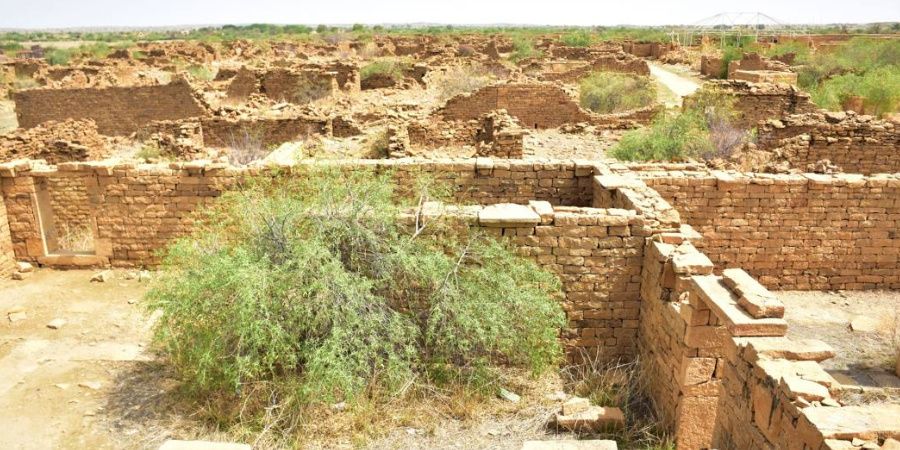


The sand covers everything slowly in the Thar Desert, but it hasn't managed to erase Kuldhara. Seventeen kilometres southwest of Jaisalmer, this village of roofless stone houses still stands in dry rows, their doorways opening onto nothing — no voices, no cookfires, no cattle. The walls are intact enough to suggest rooms where families once slept, ate, argued, loved. But nobody has lived here since approximately 1825, when the entire population of Kuldhara and eighty-three surrounding villages vanished in a single night. Not a body was left behind. Not a note. Not a forwarding address.
What remains is a story told differently depending on who tells it — a tale of tyranny, of collective defiance, and of a curse laid so precisely that nearly two centuries later, no one has successfully resettled here. The Rajasthan government declared Kuldhara a heritage site. Paranormal investigators have wandered its lanes with thermal cameras. Tourists arrive by the busload from Jaisalmer. But the village gives nothing back. It sits there, indifferent to interpretation, its silence more stubborn than the desert wind that blows through it every afternoon around three o'clock, rattling the scrub brush against sandstone walls that still bear the marks of the masons who built them.
This is the story of who built Kuldhara, why they left, and what their absence still means in a place where the ground itself seems to refuse habitation.
Six Centuries Before the Disappearance: Who Actually Founded Kuldhara
Kuldhara's founding dates to approximately 1291 CE, though the exact year depends on which oral history you trust. The Paliwal Brahmins — a community that would later abandon the village so dramatically — didn't stumble upon this spot by accident. They migrated from Pali, a town in present-day southern Rajasthan, and chose this stretch of the Thar for reasons that had nothing to do with romance and everything to do with water management. These were people who understood that survival in a desert is an engineering problem.
The village they built was precise. Stone houses arranged in a grid pattern, with shared walls that reduced material costs and provided structural support against sandstorms. The streets ran roughly north-south, which allowed prevailing winds to pass through rather than batter against broad surfaces. Kuldhara wasn't a collection of huts. It was a planned settlement, and the planning shows even in the ruins. Doorsteps are uniformly elevated — a practical measure against sand drift and flash floods during the brief monsoon.
What's often overlooked is the sheer duration of habitation. Kuldhara existed as a functioning community for over five hundred years before its abandonment. That's longer than the entire history of European settlement in North America. Five centuries of births, deaths, droughts, recoveries, trade negotiations, and seasonal migrations of livestock through the surrounding scrubland. The village wasn't fragile. It wasn't a temporary camp that couldn't withstand pressure.
This longevity matters because it reframes the disappearance. When Kuldhara emptied, it wasn't some marginal settlement failing under ordinary desert hardship. It was an established, resilient community making a deliberate choice to walk away from everything its ancestors had built — every wall, every cistern, every threshold stone worn smooth by generations of bare feet.
The Brahmin Farmers Who Could Read Monsoons Like Manuscripts
The Paliwal Brahmins defy nearly every assumption outsiders bring to the word "Brahmin." They weren't temple priests cloistered from physical labor. They were farmers and traders who happened to maintain Brahminical ritual practices alongside a sophisticated agrarian economy. Their specialty was water — specifically, rainwater harvesting in a region where annual rainfall averages roughly 170 millimeters. They built khadins, earthen dams that captured monsoon runoff and allowed the moisture to seep into the soil, creating cultivable land in an environment that looks, to an untrained eye, like it could support nothing.
Their prosperity wasn't incidental. The Paliwals turned the stretch between Jaisalmer and the border into productive agricultural land and controlled significant portions of trade along caravan routes linking the subcontinent's interior to Sindh and beyond. They dealt in opium, spices, and textiles. Their wealth was real, and it made them both respected and vulnerable.
The community was tightly organized. Eighty-four villages operated under a collective governance structure, with Kuldhara functioning as something close to a capital. Disputes were settled communally. Resources were shared during drought years. A family's honor was inseparable from the community's reputation — a cultural fact that becomes essential to understanding what happened later.
Interestingly, the Paliwals maintained detailed genealogical records and kept written accounts of rainfall patterns across decades. They were literate in an era when most rural populations were not. This literacy, combined with their wealth, gave them both social standing and political leverage — until they encountered a power that didn't care about either. The Jaisalmer state, under increasing financial pressure, began to see the Paliwals less as citizens and more as a revenue source to be squeezed.
One Night, Eighty-Four Villages, and Not a Single Witness
The most commonly cited date is 1825, though some accounts push it a few years earlier. The facts — insofar as oral history can be called factual — are stark. In a single night, the residents of Kuldhara and eighty-three neighboring Paliwal villages gathered their essentials, left their homes, and vanished into the desert. They left behind their heavier possessions, their architectural infrastructure, their fields, their khadins. They did not leave behind their people. Every man, woman, and child departed. No stragglers. No holdouts.
The logistics alone are staggering. Estimates of the total population across all eighty-four villages range from several thousand to over ten thousand people. Coordinating a mass exodus of that scale — across multiple settlements, in darkness, on foot and by cart — required planning that must have been underway for weeks, possibly months. This was not a spontaneous flight. It was an organized withdrawal, executed with military discipline by a community of Brahmin farmers.
The direction of their departure is disputed. Some sources claim they moved toward the Jodhpur region. Others suggest they scattered across Rajasthan and into what is now Gujarat. The scattering itself may have been intentional — a community deliberately disaggregating to prevent pursuit or forced return. No written record from the Jaisalmer court documents the event clearly, which itself feels significant. Either the administration didn't notice ten thousand people disappearing, or someone ensured the records stayed thin.
What you can verify is the aftermath. The villages remained empty. Nobody moved in. Kuldhara's structures began their slow conversation with erosion, and the khadins fell into disrepair. The productive land the Paliwals had engineered reverted to desert. The wealth they'd generated for Jaisalmer's treasury evaporated overnight, which suggests the departure was not only an act of survival but of calculated economic punishment.
The Words They Supposedly Left Behind in the Sand
The curse is the part of the story that sells tickets, and it deserves scrutiny precisely because it's the part most likely to have been embellished. According to local legend, the Paliwal Brahmins didn't just leave Kuldhara — they cursed it. The specific terms vary by telling. The most common version holds that the departing community declared that no one would ever be able to settle in Kuldhara again, that any attempt to inhabit the village would end in ruin.
Nearly two hundred years of vacancy lend the curse a certain empirical weight, though explanations for the persistent emptiness are more prosaic than supernatural. The land, without the Paliwals' khadins and water management, couldn't support agriculture. The buildings, constructed for a specific community's needs, had no economic value to outsiders. The area had no strategic importance after the caravan trade declined. There was, simply, no reason for anyone to move in.
But practicality has never made a good campfire story, and the curse persists. Local guides in Jaisalmer repeat it with varying degrees of conviction. Some add details — that the Paliwals performed specific rituals before leaving, that they buried objects at the village's cardinal points, that they invoked particular deities. None of these additions can be verified.
What's genuinely interesting isn't whether the curse is real. It's that the concept of a community powerful enough to render land permanently uninhabitable through collective will says something true about the Paliwals' reputation. Even in departure, they were understood as formidable. Their curse was credible because their competence was undeniable. People who could make the desert bloom could presumably make it barren again. The curse, real or fabricated, functions as the final assertion of a community that refused to be diminished.
The Tax Collector Who Wanted More Than Taxes
Salim Singh, the Diwan (prime minister) of Jaisalmer, occupies the villain's role in every version of the Kuldhara story. His offenses, depending on the source, range from crushing taxation to something far more personal. The most widely repeated account holds that Salim Singh became fixated on the daughter of the village chief of Kuldhara and demanded that she be given to him. When the community refused, he threatened to impose punitive taxes that would effectively bankrupt the Paliwal settlements.
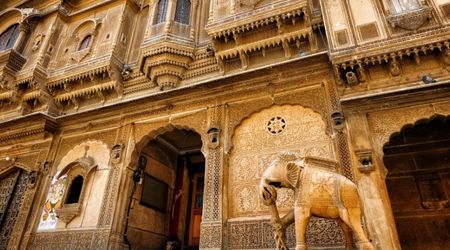
Salim Singh was a historical figure — his elaborate haveli still stands in Jaisalmer's old city, its upper stories cantilevered outward in a distinctive silhouette. He was known as an aggressive administrator who expanded state revenues through coercive means. Whether his interest in the chief's daughter is historical fact or narrative embroidery layered onto a story about economic oppression, nobody can say with certainty. The two explanations aren't mutually exclusive. A powerful man capable of crushing a community financially was likely capable of personal cruelty as well.
The Paliwals faced a specific bind. Surrender the girl, and the community's collective honor — inextricable from Brahminical identity — would be destroyed. Resist openly, and the state's military force would crush them. They chose a third option: disappear entirely, taking their labor, their knowledge, and their revenue-generating capacity with them. It was resistance through absence.
Salim Singh's haveli, incidentally, became a tourist attraction too. Visitors photograph its peacock-shaped roof brackets without knowing that the man who commissioned them may have driven an entire civilization into the desert. Jaisalmer profits from both the villain's architecture and the victims' ruins, a duality the city has never been forced to reconcile.
Sandstone Rooms With No Ceilings and No Secrets
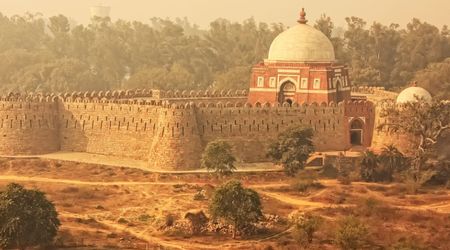
Kuldhara today looks like someone pressed pause on a demolition. The main street — and there is clearly a main street — runs through the village's center with houses arrayed on either side, their walls standing anywhere from waist height to nearly full elevation. Doorframes remain in place, though the doors themselves are long gone. Interior rooms are distinguishable: you can identify kitchens by blackened stone, storage areas by recessed wall niches, sleeping quarters by their dimensions.
The temple at the village's edge is the best-preserved structure, its carved stonework still sharp enough to cast detailed shadows in late afternoon light. A few houses retain partial roofs — stone slabs laid across timber beams, the timber having survived because the desert air is dry enough to inhibit rot. The Archaeological Survey of India has stabilized some structures and marked pathways, but the intervention is minimal. This isn't a reconstruction. It's a ruin allowed to remain a ruin.
What strikes you walking through Kuldhara isn't the decay but the order. The grid layout is unmistakable even now. The uniformity of construction materials — local yellow sandstone, the same stone that gives Jaisalmer its "Golden City" nickname — creates a monochrome effect that makes the village look carved from a single block. Drainage channels run along the streets, still visible, still functional in theory. The Paliwals built to last.
The Archaeological Survey has posted informational signs at several points, though these are weathered and sometimes illegible. A small museum near the entrance houses photographs and contextual displays, but it's modest. The village itself is the exhibit. You walk through it understanding that every room you peer into was someone's daily life, abandoned so completely that even the desert hasn't found a use for it.
Why the Paranormal Investigators Keep Coming Back Empty-Handed
Kuldhara's designation as a "ghost village" owes more to Indian television programming than to any documented supernatural activity. Multiple paranormal reality shows have filmed episodes here, invariably at night, invariably producing inconclusive footage of temperature fluctuations and ambiguous audio recordings. The Rajasthan tourism board has leaned into the ghost angle because it drives visitor numbers, especially among domestic tourists from Delhi and Mumbai who arrive expecting to be frightened.
The village's reputation for hauntings draws from several reported phenomena: unexplained sounds at night, the feeling of being watched, sudden drops in temperature, and — most commonly cited — the claim that no one can stay in Kuldhara after dark. The Rajasthan government reinforces this last point by officially closing the site at sunset, which is likely a security measure for an unstaffed archaeological site but reads, in the context of ghost stories, as confirmation.
What's genuinely unsettling about Kuldhara has nothing to do with apparitions. It's the completeness of the absence. Most abandoned places deteriorate in stages — a few families leave, then more, then services collapse, then the last holdouts go. Kuldhara skipped all of that. The abandonment was total and instantaneous, which gives the ruins a quality that feels less like decay and more like interruption. You half expect to see a meal left on a stone ledge, a garment draped over a wall.
The paranormal framing actually obscures Kuldhara's real power as a place. Ghost stories are easy. A community of thousands making a collective decision to erase itself from the map rather than submit to tyranny — that's the story that should keep you awake. The supernatural is a distraction from a human drama far stranger than any phantom.
What the Afternoon Heat Does to Your Understanding of Departure
You'll arrive at Kuldhara by road from Jaisalmer, likely in a jeep or taxi, crossing flat scrubland dotted with thorny kejri trees and the occasional herd of goats. The entrance is marked by a gate and a small ticket booth. Inside, a paved path leads to the village proper, and then the pavement ends and you're walking on packed sand between stone walls. Bring water. There is no shade worth mentioning.
The best time to visit is late afternoon, when the light turns the sandstone walls the color of dark honey and the temperature drops from unbearable to merely aggressive. Mornings are cooler but flat-lit, and the ruins photograph poorly without shadows to define their contours. Midday is punishing — the stone radiates heat, and the absence of roofs means there's no escape from direct sun. This physical discomfort, though, serves a purpose. Standing in Kuldhara at forty-three degrees Celsius, you begin to grasp what it meant to walk away from this place into open desert, at night, with children and elderly in tow.
The visit itself takes roughly an hour if you move through at a steady pace, longer if you explore the side lanes and the temple. Guides are available at the entrance, and their narration ranges from historically grounded to wildly speculative. The better ones will point out construction details — how the walls taper to shed sand, how the doors all face east to catch morning light and avoid afternoon heat. These details reward attention more than any ghost story.
There's a small stall near the entrance selling bottled water and packaged snacks. Don't expect a restaurant. Don't expect clean restrooms. The infrastructure is minimal, which is both a limitation and, inadvertently, part of the experience. Kuldhara doesn't pamper its visitors any more than the desert pampered its residents.
Getting to the Ruins and Getting the Timing Right
Kuldhara sits approximately seventeen kilometres from Jaisalmer on a paved road that branches off the route toward Sam Sand Dunes. Most visitors combine the two — Kuldhara in the late afternoon, then Sam for the sunset camel rides — which is a practical itinerary even if the pairing feels tonally incongruous. The key logistics break down as follows:
- Entry fee is modest: approximately 10-25 rupees for Indian nationals and 100 rupees for foreign visitors, though these figures are subject to revision by the state archaeology department.
- Opening hours run from roughly 8:00 AM to 6:00 PM, with the site closing firmly at sunset — no exceptions, no late extensions.
- Hired vehicles from Jaisalmer typically charge between 800 and 1,500 rupees for the round trip, depending on the vehicle type and your negotiating stamina.
- The nearest substantial food and water is in Jaisalmer. Carry your own supplies.
- Photography is permitted throughout the site with no additional fee for personal cameras.
The October-to-March window offers the most tolerable temperatures. December and January mornings can be genuinely cold — single digits Celsius — before the sun asserts itself by mid-morning. April through September is harsh, with daytime temperatures regularly exceeding forty-five degrees during peak summer. The monsoon months of July and August bring occasional rain, which transforms the scrubland briefly and dramatically but also makes unpaved sections of the site muddy.
There's no public transport directly to Kuldhara. Your options are a hired car, a motorcycle rented in Jaisalmer, or an organized tour — the last being the easiest but least flexible. If you ride a motorcycle, the road is good but watch for sand drifts across the tarmac in the final two kilometres. The village rewards slow exploration, so don't lock yourself into a group schedule that rushes you through in thirty minutes. An hour and a half gives you time to absorb what the stones are telling you.
Kuldhara doesn't fit neatly into the category of tourist attraction. It isn't a palace celebrating power. It isn't a temple celebrating faith. It's an absence celebrating refusal — the physical proof that an entire people chose erasure over submission. Most heritage sites preserve what civilizations built. Kuldhara preserves the moment a civilization decided that disappearing was more dignified than staying.
The ruins will still be standing when you visit, their sandstone walls the same color as the desert floor, their empty doorways framing nothing but heat shimmer and distance. Somewhere beyond Kuldhara's last wall, the Thar continues in every direction, and buried in its sand are the footprints of people who chose to walk into it rather than kneel — and who walked so thoroughly that even two centuries couldn't call them back.