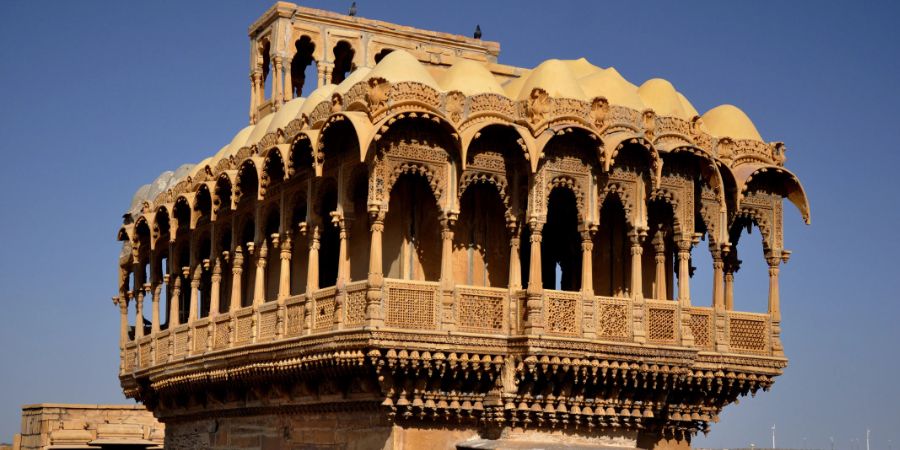


In the golden heart of Jaisalmer, Salim Singh ki Haveli stands tall—a structure of ambition, artistry, and political defiance. Often called the Ship of the Desert for its prow-shaped design, the haveli is famed for its peacock-like roof, 38 uniquely carved balconies, and a history as dramatic as its silhouette.
Unlike most havelis in the region, which were built for wealth display or noble leisure, Salim Singh ki Haveli was constructed to challenge authority. Its very existence was meant to rival the royal palace, an act that prompted royal intervention.
Historical Background Behind the Sandstone Walls
Salim Singh ki Haveli was commissioned in 1815 by Salim Singh Mahto, the prime minister (Diwan) of Jaisalmer. Salim Singh was known for his ambition, wealth, and a reputation that inspired both awe and fear at court.
He wanted his residence to surpass the royal palace in grandeur and height, originally constructing it with seven floors—two of which were later demolished on the Maharaja’s orders, as no building could rival the palace. The haveli was designed by two renowned architect brothers of the era, reflecting a period when Jaisalmer’s elite invested heavily in art, architecture, and luxury.
The mansion’s construction and Salim Singh’s assertive political stance are said to have contributed to the shifting power dynamics in Jaisalmer, eventually leading to the region’s transition to a British protectorate in the early 19th century. The haveli’s history is also intertwined with local folklore, including tales of its association with the abandoned village of Kuldhara and the fear that kept locals away for generations.
Architectural Fusion at Its Finest
Salim Singh ki Haveli blends Rajput elegance with Islamic geometry—arched doorways, latticed windows (jali), and intricate stone carvings. Features include:
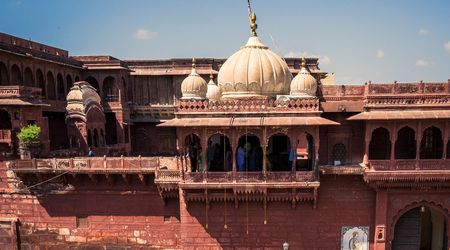
- Peacock-Shaped Roof: A rare architectural flourish, the roof features blue cupolas and curved brackets designed to mimic a peacock with spread feathers.
- 38 Distinct Balconies: No two are alike, showcasing individual artistry and forms that echo the theme of feathers.
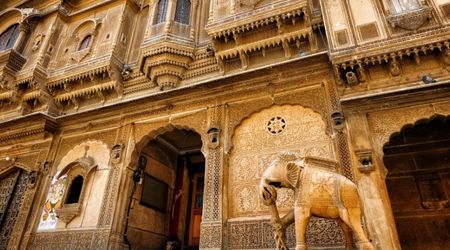
- Stone Carvings: From elephants to floral patterns, the façade and interiors are etched with detailed motifs crafted by expert stonemasons.
- Mortar-Free Construction: Stones are held together with iron rods, not cement, an impressive feat of early 19th-century engineering.
- Climate-Responsive Design: Thick stone walls, jharokhas, and ventilated screens keep the interiors naturally cool during harsh desert summers.
- Courtyards and Diwan-e-Khas: Multiple open-air courtyards and a private audience hall adorned with murals enhance the palace-like feel.
Exploring the Heart of the Haveli: Highlights for Visitors
Each corner of Salim Singh ki Haveli tells a different story. Here are the highlights that make a visit unforgettable:
Moti Mahal
Moti Mahal, which means “Pearl Palace,” is the most famous hall in Salim Singh ki Haveli. It is located on the top floor of the building and is known for its beautiful curved balconies, called bangaldar jharokhas, a common feature in Rajasthani architecture.
In the past, this hall was used for royal gatherings and special dance performances to entertain guests and nobles.
Blue Cupola Roof
The blue-domed rooftop is among the most visually striking features of the haveli. It was designed to look like a peacock with its feathers spread out.
The roof has small, light-blue domes (called cupolas) and finely carved brackets shaped like peacocks. Besides looking beautiful, the design also helps keep the space underneath cool by providing shade and good airflow.
This peacock-style roof is very rare in Jaisalmer and is a key reason why many refer to Salim Singh ki Haveli as the “Peacock Mansion.”
Grand Entrance with Stone Elephants
The entrance to the haveli is both majestic and bold, marked by two massive elephant sculptures carved from stone greeting the gateway. These elephants were symbols of strength, royalty, and protection.
Central Courtyard
In the middle of the haveli is the central courtyard, an important part of traditional Rajasthani homes. This open space was where the family came together for daily life, festivals, and social events.
When to Visit
The most comfortable time to visit Jaisalmer is from October to March. During these cooler months, the daytime temperatures are mild, making it easier to explore the narrow lanes, heritage sites, and open terraces.
The ideal time for taking photos is during the early hours after sunrise or late in the afternoon. Evening visits are also popular, as the haveli’s lighting transforms it into a visually captivating night attraction.
Timings: 8:00 AM to 6:00 PM.
Entry Fee: ₹20–₹50 for Indian nationals, ₹100 for foreign tourists. Additional charges may apply for cameras and videography equipment.
How to Reach Salim Singh ki Haveli
Here’s a complete breakdown of how you can reach this iconic landmark from various points:
By Air
The closest airport is Jaisalmer Airport (JSA), located approximately 13.3 kilometres away, connecting Jaisalmer to major Indian cities such as Jaipur, Delhi, and Ahmedabad. Upon arrival, you can easily find taxis, auto-rickshaws, or private car rentals to reach the haveli in about 10 to 15 minutes.
If you’re flying internationally, the nearest major international airport is Jodhpur Airport, around 280 kilometres away. From Jodhpur, you can continue to Jaisalmer by road (about 5–6 hours by car) or take a connecting train.
By Rail
Jaisalmer has strong railway connectivity, with its train station located within 1 kilometre of the haveli. Trains such as the Delhi Jaisalmer Express and the Howrah Jaisalmer Express operate regularly, making it convenient for travellers from across India.
By Road
Reaching Jaisalmer by road is convenient, with direct routes from major urban centres such as Jodhpur, Bikaner, Jaipur, and Delhi. State-run buses (operated by RSRTC) and private Volvo coaches offer regular services to and from Jaisalmer.
If you’re driving your own vehicle or renting a private car, the roads are in good condition, especially the NH-11 and RJ SH 61, which connect the city to other parts of Rajasthan.
From its rebellious origins to its architectural intricacies, Salim Singh ki Haveli encapsulates the spirit of a city where politics, art, and pride collided under the desert sun. To walk its corridors is to feel the pulse of a bygone era where ambition carved itself into sandstone. For lovers of history, architecture, or simply the poetic drama of the past, this haveli is a chapter that cannot be skipped.