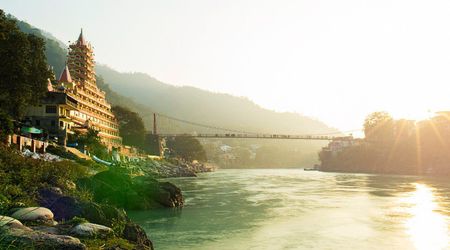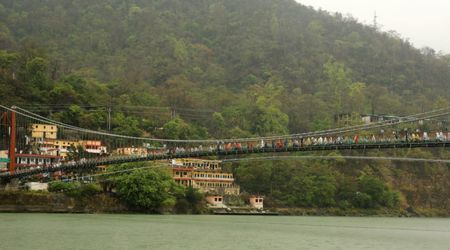
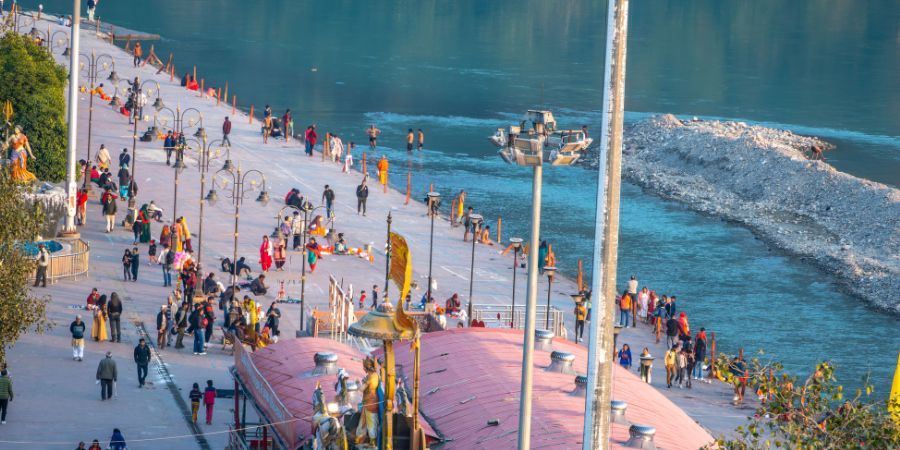
In the heart of Rishikesh, where the spiritual pulse of India beats strongest, lies Triveni Ghat — a sacred confluence where mythology flows as freely as the rivers themselves. Here, the Ganga, Yamuna, and the elusive Saraswati meet, not just in water, but in faith, history, and healing.
Rich with history, this Ghat has long been a site of devotion. Legend has it that Lord Krishna came to Triveni Ghat after being wounded by an arrow. Even now, it is here that people come to wash their sins away, seek blessings, and find solace in the smooth current of the water.
A Sacred Legacy: The History of Triveni Ghat
The name “Triveni” means “three rivers” and refers to a belief that here, the Ganges are joined by the mythical rivers Yamuna and Saraswati. Though it is invisible, the Saraswati River is said to flow underground and join the other two.
The name Triveni Ghat is described in the Hindu scriptures, such as as Mahabharata and Ramayana. According to the myth, this ghat was visited by Lord Krishna when an arrow wounded him.
For thousands of years, saints, sages, and devotees have meditated here in their quest for blessings. The recent buildings surrounding the ghat were engineered to cater to the many devotees who flock to this area daily.
Despite the changes, the spiritual essence of the place remains intact.
The Spiritual Heart of Rishikesh: Rituals & Significance
Triveni Ghat is more than just a bathing place; it is a place of great spiritual significance. Hindus think bathing here cleanses the soul and assists one in achieving moksha (liberation). Many devotees also offer Pind Daan (performing rituals for ancestors) at the ghat, believing it helps provide their departed loved ones peace.
Triveni Ghat is not just a religious place but also a cultural hub. Many classical music and dance performances take place here, celebrating the rich heritage of India. The buzzing markets around the ghat sell religious items, handicrafts, and souvenirs, making it a lively place to explore.
What to Expect at Triveni Ghat? Must-See Attractions
Apart from the spiritual experience, Triveni Ghat has more to explore. Some key highlights to seek out are:
- Geeta Mandir and Laxmi Narayan Temple: Near the ghat, temples are dedicated to Lord Krishna and Lord Vishnu. Their complex architecture and spiritual tranquility draw many believers.
- Feeding the Fishes: One of the lesser-known but interesting activities at Triveni Ghat is feeding the fish in the Ganges. Feeding the birds is also believed to be an act of virtue, and many of the devotees purchase puffed rice to feed the birds.
- Early Morning Yoga Sessions: Rishikesh is known as the world's yoga capital, and Triveni Ghat is a serene place where you can practice yoga and pranayama (breathing exercises) in the morning. Many visitors participate in yoga sessions held by local gurus along the riverbank.
Lesser-Known Facts About Triveni Ghat
Here are some lesser-known facts about Triveni Ghat:
- Mentioned in Hindu Epics: Triveni Ghat is believed to be the spot where Lord Krishna’s cremation took place after his earthly departure.
- A Magnet for Saints and Sages: Many famous saints, including Swami Vivekananda and Swami Sivananda, are said to have meditated here.
- A Filming Location: Due to its scenic beauty and spiritual significance, several Bollywood films, such as Raaj Shaandilyaa’s Vicky Vidya Ka Woh Wala Video (2024), have been shot here.
Seasons of Divinity: The Best Time to Visit
Triveni Ghat is open throughout the year, but the best time to visit depends on the kind of experience you are looking for.
From October to March, the winter and early spring months bring cool and pleasant weather, making it ideal for exploring the ghat and attending the peaceful Ganga Aarti. The mornings and evenings are especially serene, allowing visitors to soak in the spiritual atmosphere without discomfort.
During the summer months, from April to June, the temperatures rise, and the afternoons can be quite warm. However, the mornings and evenings remain pleasant, making it a good time for a quieter visit.
The monsoon season transforms the ghat into a breathtaking sight from July to September. The river swells, and its strong flow adds to the beauty of the place.
Getting There: Your Guide to Reaching Triveni Ghat
Triveni Ghat is well-connected by air, rail, and road, making it easily accessible for visitors:
By Air
The nearest airport to Triveni Ghat is Jolly Grant Airport (DED) in Dehradun, about 18 km away. From the airport, you can hire a taxi or take a bus to reach the ghat in about 30 minutes.
By Train
The nearest railway station is Rishikesh Railway Station, just 1.5 km from Triveni Ghat. It is connected to major cities like Delhi, Haridwar, and Dehradun. From the station, you can take an auto-rickshaw or a cycle rickshaw to the ghat, less than 10 minutes away.
By Road
Rishikesh is well-connected by road with major cities in North India. Government and private buses run frequently from Delhi, Haridwar, and Dehradun. If you prefer a more comfortable journey, you can hire a taxi or drive your own vehicle.
The Evening Spectacle: Witnessing the Ganga Aarti
The Ganga Aarti is one of the major attractions at Triveni Ghat, a fascinating ritual held every evening as the sun sets. The aarti is a majestic sight as large brass lamps (diyas) are lit while priests chant Vedic hymns. It is filled with the ringing of bells and blowing of the conch shell — an invocation that can be heard everywhere.
The ghat is filled with devotees and visitors, who come holding small leaf boats full of flowers and diyas, which they then release onto the river in an offering to Goddess Ganga. The reflection of the flickering flames on the water creates a magical scene that leaves a lasting impression on everyone present.
Triveni Ghat is not just where rivers meet; it’s where stories, prayers, and hearts find their way back home. Long after the lamps drift down the Ganga and the chants fade into silence, something within you shifts. It’s the kind of place you don’t just visit once — it calls you back, again and again.
Tucked away in the magical embrace of Uttarakhand’s towering mountains, where the air feels cleaner and somehow more sacred with every breath, lies the extraordinary Saptrishi Ashram. The ashram seems to hum with an energy that’s been building for centuries, where the boundary between heaven and earth feels wonderfully thin. What makes this hidden gem absolutely unmissable? This sacred place is named after the Seven Great Sagas (Sapt Rishis), who once meditated in this very spot, leavin...
Tirthan Valley, tucked in the folds of Kullu district, is like a page from a forgotten folktale that leaves an unforgettable mark on your heart. The surroundings of the valley are filled with misty hills, pine forests, quaint wooden homes, and a pristine river that defines the region. Having stayed out of the grasp of over-tourism, so when you visit, you can truly feel, introspect between th...
Perched high above Shimla, surrounded by tall deodar trees and cool mountain air, Jakhu Temple is where stories from ancient times come alive. Dedicated to Lord Hanuman, this peaceful hilltop shrine isn’t just the highest point in Shimla—it’s where faith, folklore, and breathtaking views all come together. Whether you’re climbing for the legend, the landscape, or just a quiet moment with the skies, Jakhu Temple promises an experience that stays with you. Jakhu Temple: Where Myth...
If there’s one place where you can feel divinity in the air, it’s the Ambalapuzha Sree Krishna Temple. It’s as if the gods themselves handpicked this spot, sprinkled a bit of their celestial magic, and declared it sacred. This temple, dedicated to Lord Krishna, stands tall as one of the seven greatest temples of Travancore, drawing thousands of devotees and curious visitors. When you walk inside, you'll sense an immediate connection to something beyond the ordinary. A Temple Stee...
Phool Mahal, also known as the Flower Palace, is situated within Mehrangarh Fort in Jodhpur, Rajasthan. Known for its rich decoration and historical importance, it stands out as one of the most luxurious halls in the fort. The room is famous for its gold-covered ceiling, which was made using gold brought from Ahmedabad as a war prize. It served as a private chamber for the kings of Jodhpur, used mainly for entertainment and gatherings. The Blooming Heart of Mehrangarh Fort <p...
Kamla Nehru Ridge, also known as the Northern Ridge, is one of the few old forest areas still left in Delhi. It stretches across approximately 87 hectares, nestled beside Delhi University’s North Campus. This green belt is a chunk of Delhi’s ancient spine, the Aravalli Range, which dates back billions of years. It hides tombs, towers, and pillars that tell stories of Delhi’s transformation across centuries. Stories Buried in the Ridge: What Happened Here Kamla Nehru Ridge...
In the middle of Jodhpur’s old city, surrounded by blue houses, narrow lanes, and the songs of street vendors, stands a tall sandstone tower that never stops watching over the crowds—Ghanta Ghar, the famous Clock Tower. This landmark isn’t just a clock ticking away the hours. It’s a living part of Jodhpur’s daily life, standing quietly as the city has grown and changed around it for more than a hundred years. When the clock chimes, it feels like the heart of the Blue City itself i...
Uttara Guruvayurappan Temple is a peaceful temple located in Mayur Vihar Phase 1. Unlike the towering shikharas and ringing bells of typical North Indian temples, this one draws you in with its modest wooden structure and traditional Kerala-style architecture. Every ritual, every structure, every festival is done the traditional Malayali way. If you’ve ever wanted to experience Kerala’s temple culture without going all the way south, this is where you go. Legends & Life: The...
Delhi buzzes with life, energy, and nonstop activity. And hidden in the Rohini neighbourhood lies a gem that promises calm and nature’s embrace: the Japanese Park, officially known as Swarn Jayanti Park. Spanning over 250 acres, it’s one of Delhi’s largest parks, offering a rare chance to reconnect with nature without leaving the city. The unique Japanese-inspired landscaping and spacious greenery make it a must-visit spot for locals and travellers craving peace. Historical Backg...
Located in the heart of Dharamshala’s Kotwali Bazaar, the Kangra Art Museum is a time capsule that takes its visitors on a journey through time, tracing the artistic and historical lineage of the Kangra Valley. With its diverse collection of ancient artefacts, traditional artworks, and regional crafts, it tells stories that have shaped the region’s identity. Tracing the Roots: Historical Background The Kangra Art Museum was inaugurated on 17th January 1990 and became a home to t...
Towering over the Blue City of Jodhpur, Mehrangarh Fort is more than just an ancient stronghold; it’s a bold statement of Rajput pride and precision. Built in the 15th century, this fort wasn't just designed to defend, but to impress. Every wall, gate, and palace inside speaks of skilled craftsmanship, strategic thinking, and a deep-rooted legacy. It’s where engineering met artistry, and history continues to echo through its sandstone corridors. Mehrangarh Fort: A Legacy Carved i...
The Bolgatty Palace rests on the beautiful Bolgatty Island in Kochi, Kerala, representing the grandeur of India's colonial past and architectural heritage. This historic mansion is renowned as one of the oldest surviving Dutch palaces outside the Netherlands. Built in 1744 by the Dutch traders to be the Governor's residence of the commander of Dutch Malabar, the palace stands today as a crown jewel in history. Today, it has been transformed into the Bolgatty Palace Island Resort, a luxu...
Chandni Chowk is one of India's most iconic and historic markets right in the heart of Old Delhi, where history meets vibrant energy. The soul of this area is defined by narrow streets teeming with people, the sizzling aroma of street food in the air, and countless shops overflowing with fabrics, jewellery, and spices. Walking through Chandni Chowk seems as though one is entering a time capsule. Mughal-era architecture's old-world appeal fits perfectly with the modern-day rush of pedest...
Tucked away along the historic stretch of National Highway 1, the Guru Tegh Bahadur Memorial is not your typical tourist spot; it’s a place that quietly stirs your thoughts. Unlike the bustling markets and loud monuments of Delhi, this memorial speaks in silence. It tells the story of a man who gave his life not for power or land but for the freedom of faith. Guru Tegh Bahadur, the ninth Sikh Guru, made the ultimate sacrifice to protect the rights of others, and this space captures that...
Have you ever come across a location that seemed to be sharing tales of ages past? Nestled in the serene Himachal Pradesh highlands, Ashapuri Mata Temple is a long-forgotten gem that echoes with ageless chants and is surrounded by breathtaking scenery. Even though the temple is half demolished, pilgrims and visitors seeking peace and harmony are nevertheless drawn to it by its beautiful surroundings and devotion to Maa Ashapuri, the goddess who is claimed to grant wishes. Echoes...
You know those rare places that somehow manage to slow down time the moment you step in? Majnu Ka Tilla is one of them. It’s not just a spot on Delhi’s map; it’s a living, breathing memory wrapped in prayer flags, dumpling steam, and stories passed down like lullabies. One minute, you're dodging autos and Delhi heat; the next, you’re wandering quiet lanes lined with Tibetan cafés, monks in maroon robes, and shopkeepers who smile like they already know you're going to fall in love with t...
Tucked away in the heart of Shimla, just off the bustling Ridge, lies a marketplace that feels like a page out of history—Lakkar Bazaar. With the aroma of fresh street food in the air, the clatter of wooden crafts, and the soft crunch of footsteps on cobbled paths, this charming bazaar is where the soul of old Shimla still thrives. Known for its intricate wooden handicrafts, warm local hospitality, and postcard-worthy Himalayan views, Lakkar Bazaar isn’t just a place to shop—it’s a plac...
At the far end of the Parvati Valley in Himachal Pradesh lies Tosh Village, a quiet mountain settlement surrounded by towering deodars and snow-tipped peaks. It’s a place where the air is crisp, the skies feel expansive, and the pace of life follows the rhythm of the hills. Even though the village is at an altitude as high as 2,400 metres, Tosh continues to be the last motorable village in the valley. With its laid-back charm, rustic wooden houses, and panoramic views of Tosh Gla...
In the golden heart of Jaisalmer, Salim Singh ki Haveli stands tall—a structure of ambition, artistry, and political defiance. Often called the Ship of the Desert for its prow-shaped design, the haveli is famed for its peacock-like roof, 38 uniquely carved balconies, and a history as dramatic as its silhouette. Unlike most havelis in the region, which were built for wealth display or noble leisure, Salim Singh ki Haveli was constructed to challenge authority. Its very existence was mean...
Tucked high in the Himalayas at an altitude of 4,270 metres, Hampta Pass gives its visitors an unparalleled experience through dramatically changing views. In just a span of a few days, it takes you from grassy meadows carpeted with flowers to stark, towering snowy mountains. This natural corridor connects the lush green valleys of Kullu with the dry and rocky landscapes of Lahaul and...
In the bustling heart of Delhi, surrounded by traffic and modern architecture, there stands Purana Qila, or “Old Fort.” Although it's famously linked to the Mughal period, archaeologists suggest that humans were settled here as early as 1000 BCE. This fort has seen emperors rise and fall, wars break out, and refugees take shelter, and today, people come in search of calm or maybe just a place to click the perfect sunset photo. From Myth to Mughal to Modern India Long befor...
Har Ki Pauri, or "Steps of the Lord," is a ghat in the heart of Haridwar, Uttarakhand, that houses centuries of faith within its stone steps. It is one of the most revered locations in Hinduism, located on the banks of the river Ganges. Pilgrims travel from across India and beyond to take a dip here, believing the river’s waters can cleanse sins and renew the soul. Amid the gentle sound of temple bells, the faint scent of incense, and the steady flow of the Ganga, Har Ki Pauri becomes t...
Jaipur’s celestial masterpiece, Jantar Mantar, was built in the early 18th century. This UNESCO World Heritage site is not just an observatory but a testament to India’s extraordinary astronomical prowess. Home to 19 massive instruments, including the world’s largest stone sundial, Jantar Mantar offers a fascinating glimpse into how ancient scholars decoded the cosmos. More than just a historical landmark, it’s a living marvel where the mysteries of the universe meet Rajasthan’s rich cu...
Kalkaji Temple, a sanctuary of deep spiritual energy, is located in South Delhi , where the city’s modern pulse meets ancient rhythms. It’s not just a place of worship; it’s an experience. For instance, have you ever wandered into a place and felt its energy pulling you in? Kalkaji Temple radiates that kind of energy. This temple is dedicated to an incarnation of the fierce and pr...
Ever fantasised about getting lost in a land where snow-covered mountains reach the heavens, rivers sing ancient lullabies, and forests become the earth's whispered secrets? That's Parvati Valley for you—a mystic sojourn in Himachal Pradesh where spirituality and nature go hand in hand. But what really sets Parvati Valley apart is its combination of raw Himalayan splendour and deep-seated spiritual power. From hiking and hot springs to ancient temples and yoga retreats, every move here...
The Beatles Ashram, or Chaurasi Kutia, is not just a spiritual retreat—it’s where global pop culture met ancient Indian wisdom. In 1968, The Beatles stayed here to learn Transcendental Meditation, leading to a creative explosion that gave birth to nearly 40 songs. Today, this abandoned-yet-alive ashram stands as a timeless symbol of inner peace, artistic rebirth, and East-West cultural fusion. Where Music Met Meditation: The Legacy of the Beatles Ashram The Beatles Ashram...
Nestled in the lap of a mountain on the banks of the Beas River, along the Mandi-Manali national highway, the Hanogi Mata Temple is a highly esteemed place of worship. Known locally as the Saraswati Mata temple, it honours Hanogi Mata, an incarnation of Goddess Saraswati. Some people also associate the temple with Maa Durga. This reflects the dual essence of Durga’s power and strength, and Saraswati’s grace and wisdom. The culmination of divine energy mixed with the breathtaking scenery...
The Telangana Rising Global Summit 2025, held at Bharat Future City, Hyderabad on December 8–9, witnessed the esteemed participation of Her Excellency Mahishini Colonne, Ambassador of Sri Lanka to India. Her presence added remarkable diplomatic value to the international gathering, which brought together delegates from over 40 countries. Her Excellency appreciated Telangana’s long-term development vision under Telangana Rising 2047, especially its focus on technology, women empowerment,...
The Telangana Rising Global Summit 2025, held at Bharat Future City, Hyderabad on December 8–9, witnessed the distinguished presence of His Excellency, Dr. Shankar Prasad Sharma, Ambassador of Nepal to India. His participation marked a significant moment in India–Nepal diplomatic engagement and regional cooperation. His Excellency appreciated Telangana’s vision under Telangana Rising 2047, especially its focus on tourism, sustainable development, skill empowerment, entrepreneurship, and...
Panna Meena Ka Kund is a hidden wonder that waits quietly in the shadow of Amer Fort, just outside Jaipur. While Amer Fort attracts crowds with its royal halls and battlements, this stepwell feels like a secret treasure tucked away behind yellow sandstone walls. Walk up to it in the early morning, and you’ll see how the sun paints perfect patterns across the zigzag steps. The steps look like a puzzle carved into the earth, and the still water below mirrors the sky. More than just...
Amid the grandeur of Humayun’s Tomb complex in Delhi, there lies a lesser-known but historically rich monument: Isa Khan’s Tomb. Often overshadowed by its more famous neighbour, this tomb actually predates Humayun’s and showcases the architectural prowess of the Lodhi era. Built in the mid-16th century, this tomb is among the rare surviving structures from the Sur dynasty in India. What makes it truly remarkable is its octagonal design, a rarity for its time, and its proximity to Mughal...
Old Delhi is a street food lover’s dream, where every alley, every corner, and every vendor tells a story of tradition, flavour, and irresistible aromas. The air is thick with the scent of sizzling kebabs, crispy paranthas, and sweet, syrupy delights that have been perfected over centuries. Here, food isn’t just a meal but an experience, an explosion of taste, spice, and culture packed into one unforgettable bite. Whether you're a local or a visitor, Old Delhi’s street food scene is an...
The Char Dham Yatra is a sacred Hindu pilgrimage that covers four revered sites in Uttarakhand: Yamunotri, Gangotri, Kedarnath, and Badrinath. It is believed that undertaking this journey cleanses sins and paves the way for salvation ( moksha ). The trek begins at Yamunotri, the source of the Yamuna River, and continues to Gangotri, the origin of the Ganges. Kedarnath is home to one of Lord Shiva’s twelve Jyotirlingas, while Badrinath is dedicated to Lord Vishnu. Traditionall...
Kuldhara Village is shrouded in mystery and silence. This village, located near Jaisalmer in Rajasthan, was originally inhabited by the wealthy Paliwal Brahmins. But one tragic night, the entire village vanished, leaving just vacant houses and unsolved mysteries. Some claim they fled to avoid high taxes, while others believe a cursed love story sealed their fate. Today, Kuldhara is a ghost village with shattered walls and lonely pathways that hold secrets from the past. Visitors report...
Kerala’s rich history finds its heart in Fort Kochi, a coastal gem that embodies the state’s cultural essence and remains a must-visit for every traveller. This historic town is a testament to Kerala’s lively past, with Fort Immanuel—built in 1553—marking India’s first European fort. Wandering through its streets is like stepping into a living museum, where Portuguese, Dutch, and British influences blend seamlessly, reflected in architectural marvels like St. Francis Church and the Dutc...
Nestled in the historic quarters of Fort Kochi, St. Francis Church is a silent witness to centuries of colonial rule, maritime exploration, and cultural exchanges. Built in 1503, it is the oldest European-built church in India and played a pivotal role in shaping the religious and architectural landscape of the region. A significant marker of history, the church is also known as the original burial site of Vasco da Gama, the Portuguese explorer who discovered the sea route to India. Des...