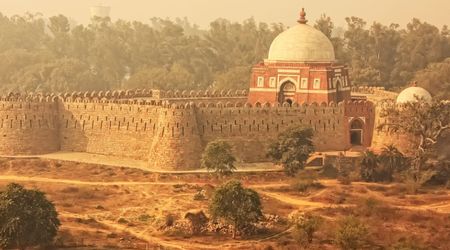


Amid the grandeur of Humayun’s Tomb complex in Delhi, there lies a lesser-known but historically rich monument: Isa Khan’s Tomb. Often overshadowed by its more famous neighbour, this tomb actually predates Humayun’s and showcases the architectural prowess of the Lodhi era.
Built in the mid-16th century, this tomb is among the rare surviving structures from the Sur dynasty in India. What makes it truly remarkable is its octagonal design, a rarity for its time, and its proximity to Mughal architectural evolution.
History Behind Isa Khan’s Final Resting Place
Isa Khan Niazi was a nobleman of Afghan descent who served under Sher Shah Suri and his successor, Islam Shah Suri. A powerful figure in the Suri court, Isa Khan was known for his military capabilities and influence in the administration.
The tomb was constructed in 1547–1548 AD, during the reign of Sher Shah Suri. Isa Khan commissioned the tomb for himself while he was still alive, a common practice among nobles who wanted to ensure they were remembered in style. He passed away around 1548, and the structure became his eternal resting place.
Between 2011 and 2015, a major conservation initiative was led by the Aga Khan Trust for Culture (AKTC) in collaboration with the Archaeological Survey of India (ASI). Part of the UNESCO World Heritage Site, the tomb is located inside the Humayun’s Tomb premises in Delhi’s Nizamuddin East area, just south of Bu Halima’s Garden.
Stone and Symmetry: Architecture of Isa Khan's Tomb
Isa Khan’s Tomb is a shining example of Lodhi-era architecture, a style that was slowly being phased out by Mughal grandeur but still holds.
Octagonal Layout
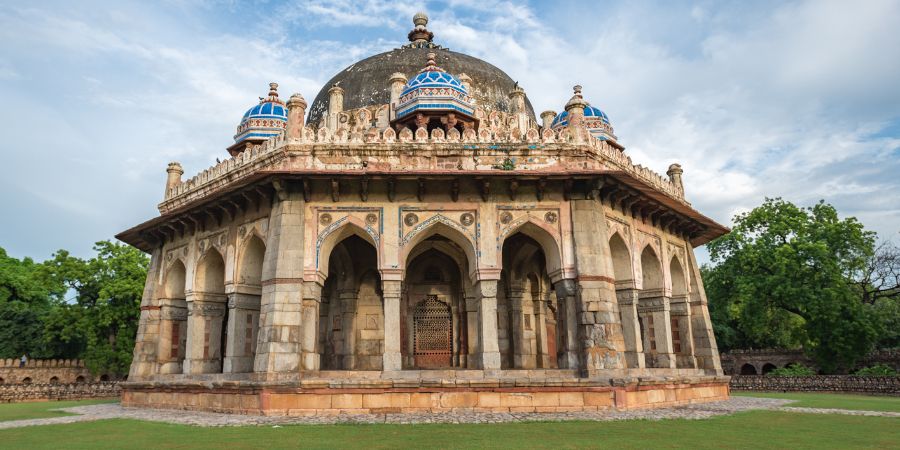
One look at the tomb, and you’ll notice its octagonal shape. It’s a classic design of the Lodhi dynasty. Built on a low plinth, the tomb is surrounded by verandahs and is crowned with a large central dome.
Each of the eight sides has three intricately carved arches topped with traditional chajjas (overhanging eaves). This gives it a balanced and symmetrical look that’s incredibly pleasing to the eye.
Materials and Finishes
The building is primarily constructed of grey quartzite, with generous use of red sandstone for detailing. Stucco plaster covers much of the masonry, while splashes of coloured tiles (blues, greens, and whites) brighten up the walls, giving it a vibe that’s more Persian than Indian.
Inside the Tomb
Step inside, and you'll find six tombs—two large and four small. Isa Khan’s cenotaph stands out, made of red sandstone and marble, with intricate Quranic inscriptions. The inner octagonal wall adds another layer of symmetry and frames the space beautifully.
The mihrab, located on the western wall, is deeply recessed and outlined with more Quranic verses. Look up, and you’ll see a decorated medallion in the dome, bursting with Persian floral motifs.
Mosque, Gateways, and Hidden Corners: What Not to Miss
Isa Khan’s Tomb might be modest in size, but it’s full of features that reward those who take the time to look closely.
The Mosque Next Door
Just west of the tomb lies Isa Khan’s Mosque, built around the same time (1547) and just as quietly elegant. The mosque has three bays, with the central one built in red sandstone and the side ones in grey stone.
It stands on a raised platform and features three mihrabs, each carved from stone. The central dome rests on a drum with sixteen sides and is accompanied on both sides by smaller chhatri-style domes upheld by slim columns.
Latticed Screens and Floral Spandrels
Inside the tomb and mosque, you’ll see jalis (latticed screens)—some geometrical, some floral. Many of these spandrels are decorated with Moorish-style tiles, echoing influences from the Islamic West.
The Enclosed Garden Complex
Unlike many other Lodhi-era tombs that are scattered and isolated, Isa Khan’s Tomb sits inside a walled garden, which was quite ahead of its time. This layout predates the famous Charbagh of Humayun’s Tomb and offers a quiet, green oasis in the middle of Delhi.
Best Time to Visit
The most favorable time to visit Isa Khan’s Tomb is from October through March when the weather is cooler and more pleasant. These months offer pleasant weather and clearer skies, ideal for both sightseeing and photography.
- Early morning (6 AM–10 AM) is best for photography, especially with soft light casting shadows across the stone jaalis.
- Late afternoon (4 PM–sunset) is another golden hour when the sandstone glows warmly under the slanting sunlight.
How to Reach Tomb of Isa Khan
Isa Khan’s Tomb is easily accessible by multiple modes of transport.
By Air
The nearest airport to Isa Khan's Tomb is Indira Gandhi International Airport (DEL), about 18 km away. From the airport, you can hire a prepaid taxi. Alternatively, you can also take the Airport Express Metro to New Delhi Station, then switch to the Pink Line at Rajiv Chowk to arrive at Hazrat Nizamuddin Metro Station.
By Rail
Hazrat Nizamuddin Railway Station is the closest major railhead to Isa Khan's Tomb, just 2.9 km away. From the station, you can reach the tomb complex by hiring a bike, a rickshaw, or an auto-rickshaw. If you're arriving at New Delhi Railway Station, the site is around 8 km away. You can use cabs, autos, or the metro.
By Road
A number of Delhi Transport Corporation (DTC) and Cluster buses operate on routes along Mathura Road and Lodhi Road, with stops conveniently located close to the tomb. Get down at the Sunder Nursery Gate or the Nizamuddin Dargah stop and walk towards the entrance. The closest metro station to Humayun’s Tomb is JLN Stadium on the Violet Line, situated about 2 km away. Another nearby station is Jor Bagh on the Yellow Line, approximately 5 km from the site.
Isa Khan’s Tomb is a stunning pre-Mughal monument that deserves far more attention than it gets. For history buffs, architecture enthusiasts, and curious wanderers, this site offers deep insights into the evolution of Islamic architecture in India, 60 years before the Taj Mahal was even imagined.