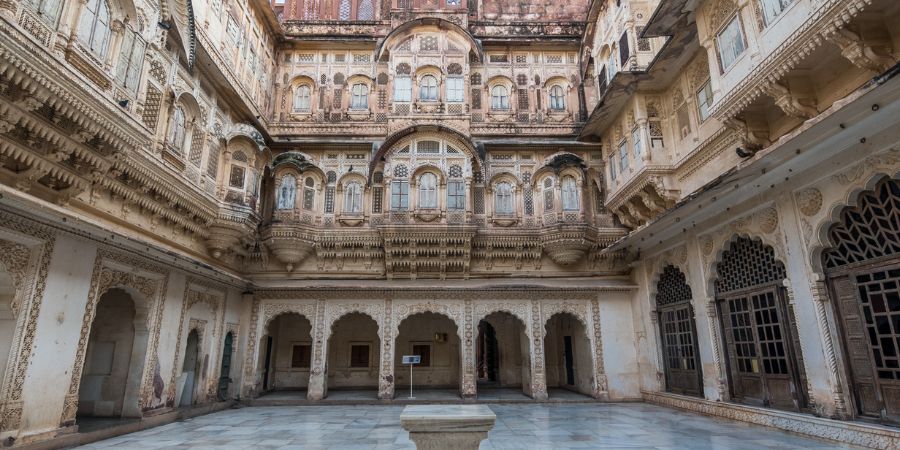


Perched high within the sandstone ramparts of Mehrangarh Fort lies Sheesh Mahal, a room that doesn’t just reflect light but an entire chapter of royal history. Built in the early 18th century as a private chamber for Maharaja Ajit Singh, this hall of mirrors isn’t about excess; it’s about intention.
Every glinting surface, every painted deity, and every shard of coloured glass tells a story of devotion, craftsmanship, and quiet power.
A Shimmering Legacy from the 18th Century
Built during the reign of Maharaja Ajit Singh (1679–1724), the Sheesh Mahal inside Jodhpur’s Mehrangarh Fort was initially designed as his private bedchamber. Tucked within one of India’s most imposing forts, this mirror-clad room wasn’t just about luxury; it blended artistic mastery with spiritual symbolism.
The walls and ceiling are covered in intricate mirror work, crafted to reflect the glow of oil lamps and create a dreamlike atmosphere. Over time, the chamber evolved into a rich tapestry of devotion and decoration.
Vivid paintings of Hindu deities, Lord Krishna, Rama, Shiva, Parvati, and Brahma, adorn the walls, revealing the deep religious ethos of the era. The palace later saw additions like coloured glass ornaments in blue, green, silver, and gold, and even a grand European chandelier, merging traditional Rajasthani aesthetics with global influences.
Every detail in Sheesh Mahal was crafted to impress and inspire. What began as a royal retreat now stands as a preserved glimpse into Marwar’s regal past, where devotion, design, and dynasty met under a ceiling of stars.
Design That Dazzles: The Architectural Brilliance of Sheesh Mahal
The Sheesh Mahal isn’t just decorated; it’s engineered to dazzle. Tucked inside Mehrangarh Fort, the chamber is wrapped in tiny mirror pieces carefully embedded into lime plaster.
Each shard was hand-cut and arranged into detailed floral and geometric designs, creating a kaleidoscope effect with the slightest flicker of light. The design cleverly blends Rajput strength with Mughal softness.
Thick fortress walls give way to a delicate interior where mirrors mimic a starlit sky. By day, natural light streams in and bounces off mirrored surfaces; by night, candlelight sets the entire space aglow, making it feel alive.
The ceiling is a masterpiece in itself, arched, domed, and completely covered in reflective work that feels almost celestial. Paintings of Hindu gods blend into the mirror work, adding spiritual depth to the visual drama.
What makes the design exceptional is not just its beauty but its function. Mirrors weren’t just for show; they expanded light, multiplied space, and elevated a single room into a sensory experience that still stuns centuries later.
What Awaits Inside Jodhpur’s Sheesh Mahal?
Step inside Sheesh Mahal, and you’re not just walking into a room; you’re entering a living fragment of royal Rajasthan. Tucked within the Mehrangarh Fort complex, this mirror-studded chamber is one of its most striking features, designed to catch every sliver of light and multiply it into something otherworldly.
The hall is compact but breathtaking. Mirrors coat nearly every surface, walls, arches, and vaulted ceilings, each shard carefully placed to create patterns that flicker and shift as light moves through the room.
By day, sunlight pours in and dances across the glass; by night, oil lamps once turned the space into a glittering sanctuary. But the beauty goes beyond the shine.
Painted images of gods like Krishna, Shiva, and Rama are nestled among the mirror work, grounding the visual spectacle in deep cultural and spiritual roots. Every detail, down to the blue and gold glass embellishments, tells a story of devotion, power, and refined taste.
Highlights You Shouldn’t Miss:
- The starry mirror ceiling that lights up like a galaxy under the right light
- Vivid mythological frescoes blended with glass inlay
- A European-style chandelier, a later addition that adds colonial contrast
- Arched corridors are perfect for quiet, immersive viewing
- Guided tours with real historical anecdotes and artisan techniques explained
Best Time to Visit
If there’s a perfect time to see Sheesh Mahal in all its shimmering glory, it’s during Jodhpur’s winter months, from October to March. The weather during this time is cool and dry, with temperatures hovering between 10°C and 24°C, making it ideal for walking through Mehrangarh Fort without battling the desert sun.
The winter sun isn’t just comfortable; it plays a key role in your experience. Skip the summers (April to June) unless you enjoy sightseeing in 40°C heat. The monsoon season (July to September) brings cooler air and greenery but also unpredictable showers that can disrupt travel plans.
- Timings: 9:30 AM to 5:00 PM
- Entry Fee: ₹25 for Indians | ₹200 for Foreigners
How to Reach Sheesh Mahal
Whether you’re flying in, rolling in by train, or cruising the desert highways, getting to this jewel inside Mehrangarh Fort is easier than you’d think.
By Air
Land at Jodhpur Airport (JDH), just 5 km from the city. It’s a small but efficient airport with direct flights from Delhi, Mumbai, Jaipur, and Udaipur. Grab a cab or an auto from the terminal, and you’ll be standing at Mehrangarh’s gates in about 15–20 minutes.
By Train
Arrive at Jodhpur Junction (JU), a major railway hub. Express trains connect it to Delhi, Jaipur, Ahmedabad, and beyond. The fort is barely 3 km away, and a short tuk-tuk ride will get you there faster than you can say “Sheesh Mahal.”
By Road
Jodhpur is well-connected via national highways. It’s roughly 5–6 hours from Jaipur or Udaipur and makes for a scenic road trip. You’ll find regular RSRTC buses and private Volvos, or you can hit the road with your own wheels.
Sheesh Mahal isn’t loud or sprawling; it’s intimate, quiet, and unforgettable. The mirrors don’t just reflect light; they echo the lives, rituals, and stories of a royal past. Every painted figure and flicker of glass is a reminder of how detail once defined power. Step inside, and you’ll feel the shift, the silence, the shimmer, the sense that this room was never just about beauty.