

Most smartphone users still haven't experienced true 5G. Not the marketing version that lights up your status bar — the actual, millimeter-wave, low-latency 5G that was promised during those splashy carrier launch events. Yet the wireless industry is already deep into planning what comes next. That disconnect tells you something important about how mobile connectivity evolves: the next generation starts cooking long before the current one finishes baking. The gap between promise and delivery in 5G has shaped how researchers and engineers are approaching 6G, and the shift in thinking is more radical than you might expect. Speed, which dominated every previous generational leap, has been quietly dethroned as the headline metric. What's replacing it will change not just how fast your phone downloads a movie, but how your phone understands the world around you. Here's what the road beyond 5G actually looks like, when it's arriving, and why this time the ambitions are genuinely different from anything we've seen before.
Every Decade Gets Its Own Letter — And Its Own Broken Promises
The pattern is almost mechanical. Roughly every ten years, a new generation of wireless technology rolls out, each one defined by a single breakthrough that the previous generation couldn't deliver. 1G gave us analog voice calls in the 1980s. 2G digitized those calls in the early 1990s and introduced SMS — a feature its creators considered an afterthought that became a global communication standard. 3G brought mobile data in the early 2000s, making the mobile web possible, though "possible" and "pleasant" were very different things on a 2004 flip phone.
4G LTE landed around 2010 and genuinely transformed what a phone could be. Streaming video, ride-hailing apps, real-time navigation — none of these worked reliably until 4G networks matured. It's the generation that turned smartphones from gadgets into infrastructure. The iPhone existed before 4G, but the app economy didn't truly explode until the network could support it.
Here's the counterintuitive part: the most transformative applications of each generation were almost never predicted when the standard was being designed. Nobody designing 3G was thinking about the App Store. Nobody building 4G imagined TikTok. The technology creates the conditions, and then developers and users figure out what to do with it — often in ways that surprise even the engineers.
5G arrived commercially in 2019, carrying the heaviest expectations of any generation. Autonomous vehicles, remote surgery, smart cities — the pitch deck was enormous. Understanding what 5G actually delivered, versus what it promised, matters because it directly informs how 6G is being designed. The industry learned something from the gap between ambition and reality, and that lesson is reshaping everything about the next leap.
The 5G Report Card Has Some Uncomfortable Grades
5G delivered meaningful improvements, but you'd be forgiven for not noticing most of them in daily use. Download speeds on mid-band 5G (the kind most people actually connect to) typically land between 100-300 Mbps — faster than 4G, certainly, but not the life-altering 10 Gbps peak that headlined the spec sheets. For streaming a show or scrolling social media, the difference between good 4G and mid-band 5G often feels marginal. Your phone says 5G. Your experience says "fine, I guess."
Where 5G has genuinely moved the needle is in network capacity. Stadiums, concert venues, and dense urban areas handle simultaneous connections far better than they did on 4G. If you've attended a packed event recently and actually managed to post a video without the upload spinning endlessly, 5G infrastructure deserves some credit. Fixed wireless access — using 5G as a home internet replacement — has also been a legitimate success story for carriers like T-Mobile, bringing broadband-level speeds to areas where wired options were limited or nonexistent.
The big misses? Autonomous vehicles didn't materialize as a 5G showcase. Remote surgery remains confined to controlled demonstrations rather than routine practice. Many of the ultra-low-latency, mission-critical applications that justified 5G's existence still aren't widespread. The millimeter-wave deployments that deliver the fastest speeds cover such tiny geographic areas that most users will never connect to one.
The surprising takeaway is that 5G's most significant contribution might be architectural rather than experiential. Network slicing, edge computing capabilities, and the move toward software-defined networks — these backend changes don't show up on your speed test, but they've laid groundwork that 6G plans to build on aggressively. The plumbing matters more than the faucet.
6G Isn't Just a Bigger Number on Your Status Bar
If you think of 6G as "5G but faster," you're missing the fundamental shift in how researchers are approaching it. Yes, theoretical peak speeds could reach 1 terabit per second — roughly 100 times faster than 5G's theoretical maximum. But the organizations driving 6G research, including Nokia Bell Labs, Samsung's Advanced Communications Research Center, and the University of Oulu's 6G Flagship program in Finland, aren't leading with speed as their primary design goal. They're designing for a different kind of network entirely.
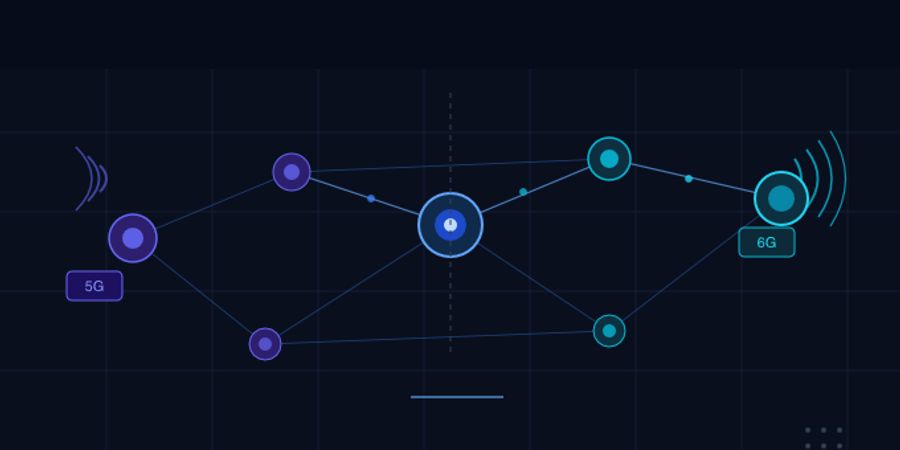
6G aims to merge communication with sensing and computation directly within the network fabric. Your phone wouldn't just send and receive data — the network itself would process, interpret, and act on information in real time. Think of it as the difference between a highway (which just moves cars from point A to point B) and a highway that also monitors weather, adjusts speed limits dynamically, reroutes traffic before congestion forms, and communicates with every vehicle simultaneously. The network becomes intelligent rather than merely fast.
One area generating serious research interest is the use of terahertz (THz) frequency bands, sitting between microwave and infrared on the electromagnetic spectrum. These frequencies could enable not just communication but also high-resolution environmental sensing — your device could potentially detect the composition of materials, measure air quality, or map indoor spaces with centimeter-level accuracy using the same radio waves it uses to connect to the network.
The genuinely unexpected angle here: 6G might make your phone less central to your digital life, not more. If the network itself handles sensing, processing, and intelligence, the compute burden shifts away from the device in your pocket. The smartphone could become thinner, simpler, and longer-lasting — a window into the network rather than the engine running everything locally.
Why Milliseconds and Machine Learning Matter More Than Megabits
Every previous generation sold itself on speed. Faster downloads, quicker uploads, bigger numbers on a benchmark. 6G research is deliberately breaking from that tradition by prioritizing two metrics that sound less exciting but carry far more practical weight: latency and native artificial intelligence.
5G promised latency as low as 1 millisecond. In practice, most users experience 10-50 milliseconds on commercial networks, which is solid but falls short of enabling the real-time applications that were hyped. 6G targets sub-millisecond latency — not as a theoretical floor but as a reliable, consistent network characteristic. At that speed, the delay between action and response becomes imperceptible to human senses. Haptic feedback in remote robotic control, real-time holographic communication, collaborative augmented reality where multiple users interact with the same virtual objects in shared physical space — these applications don't need more bandwidth. They need the network to respond faster than a human nerve signal travels.
The AI component is equally significant. Current networks use machine learning for optimization tasks like managing traffic loads or predicting maintenance needs. 6G envisions AI as a core network function, embedded at every layer. The network would learn individual user patterns, predict connectivity needs before they arise, and allocate resources dynamically — not in bulk across a cell tower, but per device, per application, per moment.
Here's what might surprise you: this approach could actually reduce total energy consumption despite the network doing more work. By predicting demand and allocating resources precisely rather than broadcasting broadly, 6G networks could avoid the enormous power waste that comes from maintaining blanket coverage at full capacity. Intelligence, it turns out, is more energy-efficient than brute force.
Mark Your Calendar — But Use a Pencil
If history holds, 6G commercial deployment should arrive around 2030. That's the target most major players have publicly acknowledged. South Korea, Japan, China, the European Union, and the United States all have active 6G research programs, and several have set 2028-2030 as their goal for initial deployments. The ITU (International Telecommunication Union) is expected to finalize the IMT-2030 framework — the technical standard that will define 6G — by the end of this decade.
But "commercial deployment" is a misleading term that the industry uses very loosely. Remember, 5G was "commercially deployed" in 2019, yet most of its promised capabilities remain unrealized in 2024. Early 6G networks will almost certainly launch in limited urban areas in a handful of countries, running alongside existing 5G infrastructure. Full, widespread 6G coverage — the kind where you don't have to check whether you're connected — likely won't arrive until the mid-2030s.
The research phase is where things stand right now. Samsung published a 6G white paper in 2020. Nokia Bell Labs has been running experimental THz transmission tests. The Next G Alliance, formed by the Alliance for Telecommunications Industry Solutions, is coordinating North American research priorities. These aren't vaporware announcements — they're the early engineering groundwork that preceded every previous generation by about a decade.
The counterintuitive reality is that the 2030 timeline might actually be too aggressive for the most ambitious 6G features. The sensing capabilities, native AI integration, and THz spectrum utilization require breakthroughs in semiconductor manufacturing, antenna design, and energy efficiency that haven't been fully achieved yet. You'll likely see 6G arrive in stages — early versions delivering incremental improvements over mature 5G, with the truly transformative capabilities following years later.
Your phone in 2030 will connect to something called 6G. Your phone in 2035 might actually use what 6G was designed to do. Planning your next device purchase around 6G readiness right now would be premature — but paying attention to how the standards develop is worth your time, especially if you build apps or services that depend on connectivity. The developers who understood what 4G would enable before it matured were the ones who built Instagram, Uber, and Spotify's mobile-first experience. The same opportunity window is opening again.
The wireless generations that reshaped our digital lives were never really about speed alone. They were about creating conditions for applications nobody had imagined yet. 6G's combination of sensing, intelligence, and imperceptible latency points toward a mobile future where the network doesn't just connect your device — it understands context, anticipates needs, and processes reality alongside you. That future is still years away from your pocket, but the decisions shaping it are being made right now. Stay curious about it. If you're a developer, start thinking about what you'd build if the network could see, think, and react. The builders who take 6G's ambitions seriously today will define how the rest of us experience it tomorrow.