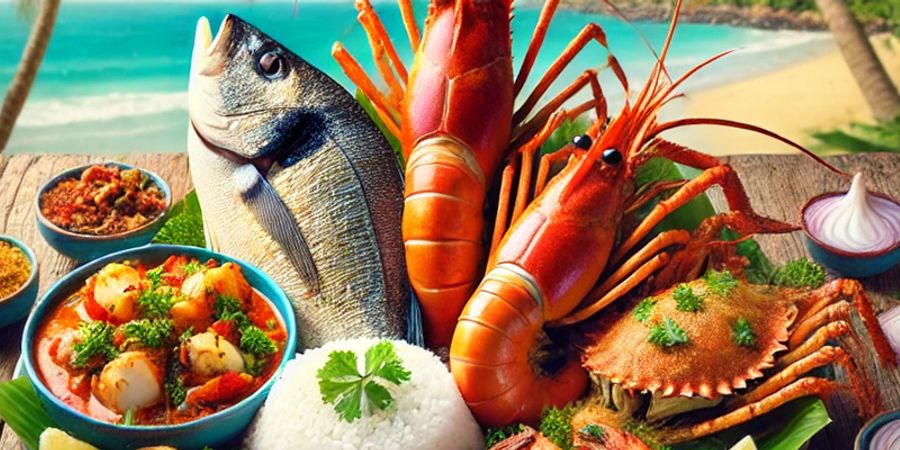


The first plate of fish curry rice I ate in Goa arrived at a shack in Benaulim with no fanfare — a steel thali, a mound of red rice, and a thin, fiery kokum-laced curry with a slab of mackerel half-submerged in it. The curry stained the rice pink. The fish fell apart at the touch of a spoon. The heat from the Kashmiri chillies crept in slowly, then stayed. That meal cost less than a cocktail at any beach club up the coast, and it taught me more about Goan cooking than a dozen restaurant menus ever could.
Goa's relationship with seafood isn't a trend or a tourism pitch — it's geography made edible. The Arabian Sea delivers the catch, and generations of Goan cooks, Hindu and Catholic alike, have developed fiercely distinct ways of preparing it. Coconut, kokum, tamarind, toddy vinegar, recheado masala — these aren't interchangeable seasonings but specific tools matched to specific fish.
What follows are five kinds of seafood that define eating in Goa, each with its own preparation, its own context, and its own reason to exist on your plate.
1. Why Surmai Commands a Price That Makes Other Fish Nervous
King fish — called surmai along the Konkan coast — occupies a position in Goan kitchens that borders on reverence. It's the fish people ask for by name. At markets in Margao and Mapusa, surmai commands a premium, and vendors know not to discount it because someone will always pay full price. The flesh is dense, white, and holds its shape through aggressive cooking, which makes it the ideal candidate for Goa's boldest preparations.
Recheado masala — a wet paste of dried red chillies, garlic, cumin, peppercorns, cloves, cinnamon, and toddy vinegar — gets stuffed into deep slashes cut across each steak. The fish then hits a hot pan slicked with coconut oil and fries until the masala forms a dark, almost caramelized crust. The vinegar keeps the paste from burning too quickly and lends the finished dish a sharp, bright acidity that cuts through the richness of the flesh. This isn't subtle cooking. It's confrontational in the best sense.
Surmai also appears pan-fried with just turmeric and salt, a preparation called rava fry when coated in semolina before hitting the oil. The semolina gives it an audible crunch, and the turmeric turns the crust golden. Most beach shacks serve this version alongside a wedge of lime and sliced onions dressed with vinegar — a pairing so natural it feels inevitable rather than designed.
What surprises many visitors is how firm surmai stays even in curry. Unlike softer fish that dissolve into the gravy, king fish maintains its structure, giving you something to bite into against the coconut-rich sauce. That textural resilience is precisely why Goan cooks reach for it when the preparation demands a fish that won't disappear. Cheaper fish have their place, but surmai earns its reputation with every bite — meaty, assertive, and completely uninterested in being delicate.
2. The Prawn That Gets Cooked in a Hundred Different Kitchens and Never Tastes the Same Twice
Tiger prawns in Goa don't need a recipe to be worth eating. Tossed in a pan with garlic, green chillies, and a squeeze of lime, they're extraordinary in under five minutes. But Goan cooks rarely stop there. The tiger prawn's firm, sweet flesh absorbs bold seasoning without losing its own character, and that quality has made it the most versatile protein on the coast. You'll find it in balchao, curry, pulao, rawa fry, and tucked inside crisp fried shells at beach bars from Anjuna to Palolem.
Prawn balchao deserves particular attention. This Goan-Portuguese pickle preparation cooks the prawns in a thick, sweet-sour-hot paste built from dried shrimp, Kashmiri chillies, sugar, and palm vinegar. The result sits somewhere between a condiment and a main course — intensely concentrated, with a lingering sweetness that sneaks up behind the heat. Traditional balchao improves after a day or two in the fridge, which makes it one of the few Goan prawn dishes that actually benefits from patience.
Prawn curry — caldinho or regular coconut-based — is the preparation most visitors encounter first. The gravy typically combines freshly ground coconut, tamarind, and a restrained spice mix, allowing the prawns to remain the focus. Served alongside a plate of steamed red rice, it's the kind of meal that seems simple until you try to replicate it at home and realize how precisely calibrated the sourness needs to be.
The counterintuitive truth about Goan prawns is that the smallest ones often deliver the most flavor. Tiny dried shrimp, ground into powder, form the backbone of countless chutneys and masalas across the state. They're the invisible seasoning — the reason a vegetable dish at a Goan table can taste unmistakably of the sea even when no whole prawn appears on the plate. Size, in this kitchen, is an unreliable measure of importance.
3. Crab Xec Xec: A Curry That Demands Your Full Attention and Both Hands
Crab xec xec (pronounced "shek shek") is not a dish you eat gracefully. It arrives in a bowl of thick, rust-colored coconut gravy, the crabs cracked just enough to let the sauce seep into the shell but not so much that the meat falls out. You pick up a claw, snap it, suck out the flesh, and mop the gravy with poi or rice. Your fingers get coated. Your shirt gets tested. The payoff is a curry with a depth of flavor that no boneless protein can match, because the shells and their juices have been simmering in that gravy from the start.
The "xec xec" refers to the dry-roasting technique applied to the coconut and spice base before it's ground into a paste. Grated coconut, coriander seeds, dried red chillies, peppercorns, and sometimes poppy seeds get toasted in a dry pan until fragrant and lightly browned. That roasting transforms the coconut from sweet and milky into something nuttier, deeper, with a faint bitterness that anchors the entire dish. Skip this step and you have a decent crab curry. Include it and you have xec xec.
Mud crabs from Goa's estuaries and backwaters are the preferred variety. They're meatier than blue swimmers and their shells contribute a richer stock to the gravy. The best versions of this dish show up not at beachfront restaurants but at small family-run places in Divar Island, Aldona, and along the Zuari river, where the crabs arrive that morning and the cook learned the recipe from a grandmother who never wrote it down.
Xec xec refuses to be rushed. The gravy needs time to thicken, the crab needs time to release its juices, and you need time to eat it — pulling, cracking, dipping. A meal built around this curry will take an hour if you do it right. That slowness isn't a flaw. It's the entire point, and any attempt to speed it up or serve it deconstructed misunderstands what makes the dish worth ordering.
4. The Fish So Polite It Lets Every Masala Speak Louder Than Itself
Pomfret has a reputation for being the refined option — the fish you order when you want something clean, mild, and elegant. That reputation isn't wrong, but it undersells what pomfret actually does in Goan cooking. Its thin, flat body and tender white flesh make it an extraordinarily efficient canvas. Marinades penetrate quickly. Frying takes minutes. And because the fish has a subtle sweetness rather than a strong marine flavor, it amplifies whatever seasoning it carries rather than competing with it.
Whole pomfret fried in recheado paste is one of Goa's most photogenic dishes for good reason. The fish lies flat on the plate, the crimson masala visible in every slash mark, the skin crisped to a shade between bronze and burnt umber. The contrast between the mild interior and the aggressively spiced exterior creates a tension that makes each bite interesting. You get sweetness, then fire, then the tang of vinegar, all layered onto a fish that never once fights back.
Pomfret caldeen offers a different experience entirely. This mild, turmeric-yellow coconut curry uses green chillies and a light hand with spice, letting the fish's own flavor come forward. The gravy is thinner than most Goan curries, almost broth-like, with a gentle sourness from kokum or tamarind. It's the preparation Goan families often make for children or elderly relatives — not because it lacks complexity, but because its complexity is quiet.
The surprising thing about pomfret is that its mildness requires more precision from the cook, not less. A heavy hand with salt or an extra minute in the pan ruins it in ways that would barely register with a sturdier fish like surmai. The best pomfret preparations in Goa reflect a cook's confidence in restraint — knowing exactly how much seasoning to add and, more importantly, when to stop. That discipline is harder to find than it should be, which is why a perfectly cooked pomfret still feels like a small event.
5. The Squid That Converts Skeptics Between the First Bite and the Second
Squid suffers from a perception problem. People who've only encountered rubbery, overcooked calamari rings at mediocre restaurants assume that's what squid is — chewy, bland, a vehicle for marinara sauce. Goa corrects that assumption swiftly. Squid cooked properly — which means either very fast or very slow, with nothing tolerable in between — has a tender, almost creamy texture and a clean oceanic sweetness that pairs beautifully with Goa's spice-forward preparations.
Squid rechad, stuffed with a recheado masala and either grilled or pan-fried, is a preparation that showcases the ingredient at its best. The tubular body of the squid holds the paste like a natural casing, and the brief cooking time keeps the flesh supple. When sliced into rounds, each piece reveals a spiral of red masala against white flesh — visually striking and intensely flavored. The tentacles, crisped separately with salt and chilli flakes, make for the kind of bar snack that makes you order another beer before you've finished the first.
Goan cafes and beach shacks serve squid in several forms worth seeking out:
- Squid sukka — tossed in a dry, roasted coconut and chilli masala that clings to every surface
- Squid vindaloo — cooked low and slow in the Goan vindaloo gravy of garlic, vinegar, and Kashmiri chillies until fork-tender
- Flash-fried calamari with a semolina crust, served with a lime-spiked aioli that owes more to Portugal than India
- Squid curry in a thin kokum-soured gravy, eaten over rice as part of a larger thali
Each of these preparations respects the same principle: squid needs decisive cooking. The difference between tender and tough is often thirty seconds, and the cooks who get it right do so through repetition, not timers. First-time visitors to Goa who order squid expecting something forgettable often find themselves reordering it the next day, now convinced. The conversion is quick and, in my experience, permanent. Squid in Goa doesn't ask for your trust — it earns it before you've had time to be skeptical.
Goa's seafood isn't a single story. It's a collection of fiercely specific ones — each fish prepared according to its own texture, each masala built for a particular purpose, each cook carrying forward techniques shaped by religion, geography, and the daily rhythms of the Arabian Sea. The five seafood experiences outlined here aren't a checklist. They're entry points into a food culture that rewards curiosity and punishes assumptions. Eat widely, eat at places that don't look like much from outside, and pay attention to the cooks who've been doing this longer than the restaurant has existed. The best meal you eat in Goa won't come from the place with the best view — it'll come from the kitchen where someone still roasts their own coconut.