

Walk onto any residential site in India and you will eventually hear the same debate. Which brand of TMT bar is the best? Contractors have their loyalties, homeowners have their half-remembered advice from a relative in the trade, and everyone has an opinion. It is a natural question. It is also, in most cases, the wrong one.
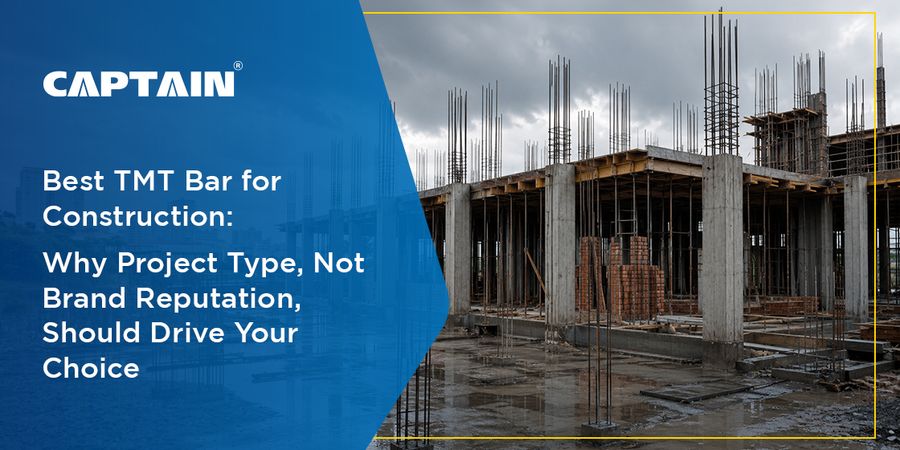
The better question, the one experienced engineers ask first, is not which brand wins but which bar suits the job in front of them. A boundary wall and a twelve-storey tower do not need the same steel. Neither does a house on the Odisha coast and one in dry inland Madhya Pradesh. The search for a single best product misunderstands how reinforcement actually works.
One structure, different demands
Reinforcement steel does several different jobs depending on where it sits and what it carries. In a single-storey home, the loads are modest and the requirements relatively straightforward. Move to a multi-storey residential building and the calculus changes. The lower columns carry far greater cumulative load, and the steel specified for them reflects that. A commercial building with wide spans and heavy floor loading, or an industrial structure supporting machinery and vibration, pushes the requirements further still.
The environment matters as much as the load. A basement or a foundation sits in constant contact with soil moisture, which raises corrosion as a first-order concern. A coastal project breathes salt air that attacks ordinary reinforcement far faster than an inland site would. A building in a seismic zone needs steel that can flex and absorb energy without snapping, a property that matters far less for a low structure in stable geology. The best TMT bar for construction in one of these settings may be quite ordinary in another.
Good engineering starts with the right questions
This is why a structural engineer, handed a project, does not begin by naming a brand. They begin by asking what the structure has to do. What loads will it carry, over what spans, for how long? What is the soil like, the water table, the seismic classification of the district? What is the building meant to still be doing in fifty years?
From those answers flow the real specifications. Yield strength, which determines how much load the bar carries before it deforms. Ductility, which governs how the steel behaves under sudden or cyclic stress. Corrosion resistance, which decides how long the reinforcement survives in a hostile environment. These are engineering attributes, not marketing ones, and they vary by grade and product line in ways a brand name alone cannot capture.
Someone choosing the best TMT steel for house construction in a coastal district should be weighing corrosion protection heavily, perhaps toward a coated or higher-grade product. The same buyer building in a dry inland town might reasonably prioritise cost and availability, because the corrosion threat that justifies a premium elsewhere is simply not present. Both are correct decisions. They are just different decisions, driven by the project rather than the label.
Performance matters more than popularity
None of this means brand is irrelevant. A manufacturer's reputation is a useful shorthand for something real: manufacturing consistency and compliance with recognised standards such as IS 1786. A well-run producer delivers steel that meets its stated grade batch after batch, and that reliability matters. The mistake is treating reputation as the whole answer rather than the starting filter.
Think of it in two stages. First, narrow the field to manufacturers whose quality and standards conformity you trust. Then, within that shortlist, choose the specific grade and product line that fits your project. The best TMT steel for house construction is not a single item on a shelf. It is whichever reinforcement, from a dependable maker, matches the loads, the environment, and the design life of the particular building.
The manufacturers who understand this tend to offer a range rather than a single hero product. Captain Steel India Ltd., for example, produces a portfolio of reinforcement solutions built around the reality that construction needs differ. Rather than pushing one grade as the answer to every question, the company positions its standard and specialised lines, including earthquake-resistant and corrosion-resistant variants, as options a builder and engineer can match to the job.
Matching reinforcement to the structure
For a homeowner or a builder, the practical shift is small but important. Stop asking which brand is best in the abstract. Start by describing your project honestly, its height, its location, its exposure, its expected life, and let those facts point toward the right specification. A short conversation with a structural engineer is worth more than hours spent comparing brand rankings online.
Choosing the best TMT bar for construction is not about finding a universal winner, because none exists. It is about matching the steel to the structure with enough care that the building performs the way it was designed to, for as long as it is meant to stand. That is a more demanding way to decide, and a far more reliable one.
About Captain Steel India Ltd.
Captain Steel India Ltd. makes TMT reinforcement bars in Eastern India, and its reach now extends into Rajasthan, Uttar Pradesh, and Madhya Pradesh. Production runs on modern practice with quality control held tight enough that the bars meet BIS specification under IS 1786 batch after batch. The range is deliberately broad. Standard grades sit alongside specialised lines, among them earthquake-resistant and corrosion-resistant reinforcement, so a builder and engineer can pick the steel a particular job actually calls for. A regional dealer network moves that steel to residential, commercial, and infrastructure sites, and the company leans on dependable supply and plain, transparent dealing to keep contractors coming back.
Frequently Asked Questions
Q1. Does every construction project need the same type of TMT bar?
No. Load, height, soil conditions, environmental exposure, and seismic risk all vary from project to project, and the right reinforcement varies with them. A single-storey inland house and a coastal high-rise call for meaningfully different steel, which is why there is no universal best product.
Q2. Why should project type influence TMT bar selection?
Because the demands on the steel change with the structure. A basement contends with moisture, a tall building with heavy cumulative loads, a coastal home with salt-driven corrosion. Matching the grade and product line to those demands is what produces a durable, safe building.
Q3. What factors determine the right reinforcement for a house?
Three things, mainly: the loads it carries, the environment it sits in, and how long it is meant to last. Those decide the specifications that count, yield strength, ductility, and corrosion resistance. Choosing the best TMT steel for house construction means matching those specifications to the site first, and only then checking that the maker delivers them consistently and to standard.
Q4. Is corrosion resistance important for inland construction?
It matters less than on the coast, but do not write it off entirely. A basement, a high water table, or a genuinely humid pocket can still corrode reinforcement well inland. Where the site is dry and the concrete cover is good, standard steel in the right grade usually does the job.
Q5. Should homeowners consult a structural engineer before choosing TMT bars?
Yes. An engineer translates a building's real requirements into the correct specification, which is far more reliable than choosing by brand reputation. Even a brief consultation can prevent both over-spending on unnecessary grades and under-specifying where performance genuinely matters.